The following briefly outlines the publications examined in this posting. The first is a book review, while the other four items are ‘shared’ essays, on generally more serious topics.
- Tapestry by Fiona McIntosh [pub. 2014];
- Essay; The Rwanda Genocide of 1994; [2026];
- Essay: Australians are hungry for new history books – but historians are pressured not to publish locally [2026];
- Essay: Agatha Christie: A world of Mystery [2026];
- Essay: A Table for Fortune, a 3,000-page book by William Vollman
Tapestry by Fiona McIntosh, published in 2014, of 457 pages: a recent gift of a publication from 12 years ago by the internationally and million-copy best-selling author of novels for adults and children, across several genres, Fiona McIntosh. Fiona roams the world for her research. Born in 1960 in the United Kingdom, she lives between South Australia from where she does her writing. and Salisbury, Wiltshire, which is her research base for UK and Europe. Her books range from adult fantasy to children’s novels, but it could be said she specialises [as indicated by this novel] in historical based adventures. She has written over 40 novels that I’m aware of, some as series, others as stand-alone novels. I’ve read previously six of the latter, viz, The Fallen Woman [2024], The Pearl Thief [2018], Nightingale [2014], Fields of Gold [2010], The Lavender Keeper [2012], and The Last Dance [2015].
While I’m a strong fan of the book and series ‘Outlander’, which spans several centuries and continents, though originally based in Scotland, and involves the transfer backwards in time [and back again] of the central character and others, I did find myself not as enthusiastic about a similar scenario which is depicted in Tapestry.
In basic summary, we learn that in 1978, Jane Maxwell in the United Kingdom, is celebrating her engagement to Will, a handsome American geophysicist, but though she should be deliriously happy, she is plagued by doubts. When tragedy leaves Will hanging between life and death, Jane’s guilt makes her determined to save him … somehow. Meanwhile, some 263 years earlier, in 1715, the Earl of Nithsdale [a direct ancestor of Will, and also named William] joins the doomed Jacobite rebellion for Scottish independence. But the cause is lost and the Earl is sentenced to be beheaded. On a desperate and dangerous quest to find some answers, Jane finds herself swept away and trapped in the past. Convinced that saving Nithsdale will also save Will – if William dies, well Will ceases to have existed – Jane embarks on a daring and audacious plot to rescue the Earl from the Tower of London [that part of the story based on a true escape from the Tower]. Past and present become entwined in a gripping race against time – and both will be changed by one woman’s determination.
While the fictional historical aspects of the novel fascinated this reader with his love of historical novels, I found the nature of the ‘back in time’ aspect and the context of Jane’s experience there, and basically infiltrating the body and persona of Will’s wife at the time, just a stretch too far!
I guess it would spoil the storyline for potential readers, if I were to reveal too much about the outcome in terms of the present/past situation, and the relationship the relationship between Jane and Will.
Be that as it may, I came across a writer from a website titled ‘Staircase Wit: Books and other impressions’ and I discovered that some of her views about Tapestry melded in quite well with my own reflections of it, so I’ve copied them below. She describes herself [she is named Constance] as a prolific book reviewer, who enjoys sharing her favourite reads [as per myself] or, sometimes, warning you about books you should avoid. I had the feeling in reading the following, that she might have been doing that in this case? Anyway, here is main part of her comments.
In Tapestry, Jane is a pragmatic Brit who met a handsome American in Cornwall five months ago and was swept off her feet. Despite being newly engaged, she has doubts about whether her fiancé, Will Maxwell, is The One, despite his good looks and devotion. When a freak accident leaves him in a coma, she feels guilty for her wavering commitment and tries to compensate by exploring various New Agey solutions, one of which catapults her from 1978 London to 1715 Scotland, married to Will’s ancestor, Lord Nithsdale.
Unfortunately, the handsome earl (who greatly resembles Will) is a Jacobite who fought unsuccessfully against the actual king and has now been captured by George I’s men and imprisoned in the Tower of London with other Scottish rebels. Of course, I am sympathetic to the brave Catholic family loyal to the Stuarts!
After Will’s injury, Jane visited a clairvoyant in London, and Robin turns out to be more than a charlatan, somehow materializing in the 18th century to provide much-needed guidance. Robin explains that if William Maxwell, Lord Nithsdale, is executed as a traitor by George I, his descendant, Will, will also die. Jane is determined to save both men, and sets off for London – on horseback, in a blizzard – with her devoted companion/maid, Cecilia. During this dangerous journey, she meets a man who stirs her senses more than Will, but she continues to London to appeal for a pardon to the king. When the king rejects her plea (you can’t blame him for disliking Jacobite traitors) that Jane must use her 20th century ingenuity to rescue her 18th century husband.
At its best, Tapestry is a sweeping historical novel, set against a backdrop of war and shifting alliances, following characters whose lives become intricately interwoven—much like the threads of a tapestry—through loyalty, courage, and sacrifice. Dual timeline novels are not for everyone, nor is time travel fiction, but both can be outstanding depending on the author and execution. Here, I liked the historical aspect better than the 1970s, as there is adventure and more interesting characters. Although it is the men who go to war, it is several women who show incredible bravery as they assist Winifred [the Earl’s wife, now ‘taken over’ by Jane], with a daring rescue plan. The imprisonment in the Tower of London of the Jacobite traitors, including the actual Earl of Nithsdale, really took place and his ingenious countess was the heroine of the day. E. Nesbit used this story in The House of Arden.
One aspect of the time travel I found unusual and offputting was that when Jane took over Winifred’s body, Winifred wasn’t entirely gone. Usually, Jane was able to access Winifred’s memories and way of speaking so she didn’t experience the situation common in time travel – not knowing the people or places around her or using anachronistic language (at one point, Jane curses extravagantly, startling those around her, but that was atypical), which makes people suspicious. When Jane has to be intimate with her 18th century husband, she withdraws mentally and lets Winifred take over. What I did not like was the way the author referred to Winifred or her body as “the host,” which made it sound like a horror novel.
Well, there you go – I didn’t actually think of the book as a horror story, but I did have similar reservations. Thankfully, Constance’s synopsis, also didn’t give away the book’s ending and final scenarios, important for anyone out there who mind decide to read it themselves.
Incidentally, there was an Australian connection to the story – while Will is lying unconscious in the English hospital, with his parents threatening to take him back to the USA for ‘proper’ treatment, Jane, to the consternation of her family, decides to travel to Ayer’s Rock [Uluru] in Australia, where she believes she will find a way to save her Will’s life. It is from there that she is transported to 1715 Scotland [not from 1970s London as noted above by Constance] and to where she is eventually returned in the 1970s after the Indigenous rangers found her some days after she’d disappeared from her climb to the top of the Rock, an exercise of course which is now forbidden at that location.
_____________________________________________
The Rwanda Genocide of 1994
This short article was posted by a friend on Facebook a few weeks ago, and it struck me as one of those events of modern history that should not be swept under the carpet, so to speak, and be forgotten about.
I’ve taken the liberty of sharing it through this forum.
Under the title and/or Facebook grouping headed Black Stories They Tried to Bury | Truth & History · The Hidden Past, we read that “The Rwanda genocide was not an inexplicable eruption of hatred. It unfolded amid organized persecution, political extremism, propaganda, and the deliberate dehumanization of an entire community. Remembering these conditions matters because atrocities do not emerge in isolation; they develop through decisions, systems, and actions that can be challenged before they lead to further suffering.”
“…every historical tragedy is made up of individual human lives.”
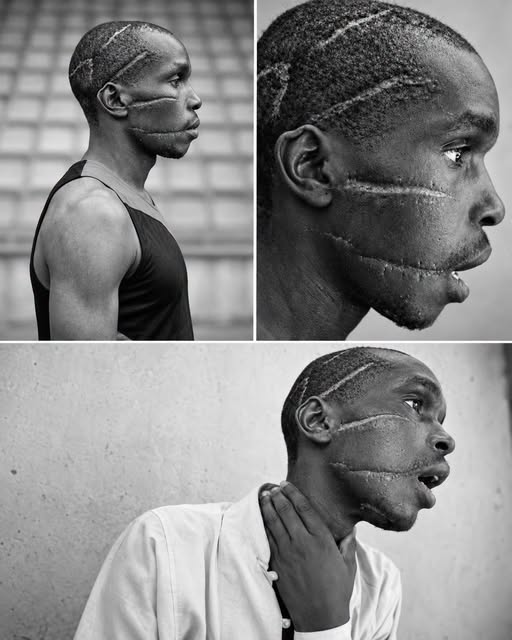
One photograph [see below] captured the human cost of the 1994 Rwanda genocide in a way that statistics alone never could. Behind the injured man’s expression was a story of persecution, survival, and the lasting consequences of organized hatred. Photojournalist James Nachtwey documented this moment inside a Red Cross hospital in Nyanza, preserving an image that continues to remind the world that every historical tragedy is made up of individual human lives.
In 1994, Rwanda descended into one of the most devastating genocides of the twentieth century. During approximately 100 days, an estimated 800,000 people were k!lled. The majority were Tutsi, while moderate Hutu and others who opposed the genocide or attempted to protect those targeted were also m*rdered.
Amid this catastrophe, Nachtwey entered a Red Cross hospital in Nyanza, where he photographed a Hutu man recovering from severe mistreatment. According to the account accompanying the photograph, the man had been detained and t*rtured by members of the Interahamwe militia after being accused of sympathizing with Tutsi people.
The photograph records more than visible injuries. It captures a human being in the aftermath of extreme cr*elty, when the immediate struggle to survive may be over but the consequences remain. His expression invites viewers to recognize the person behind the suffering rather than reduce him to a symbol of tragedy.
The man’s name is not provided in the account, but his identity as a human being should never be lost behind the historical label attached to the image. He had a life beyond that moment, with relationships, memories, and hopes that cannot be understood from a single photograph.
That is part of what makes documentary photography so important. It can preserve evidence of events that future generations might otherwise know only through written accounts and statistics. A photograph cannot explain every circumstance or tell an entire person’s story, but it can confront viewers with a reality that is difficult to ignore.
The Rwanda genocide was not an inexplicable eruption of hatred. It unfolded amid organized persecution, political extremism, propaganda, and the deliberate dehumanization of an entire community. Remembering these conditions matters because atrocities do not emerge in isolation; they develop through decisions, systems, and actions that can be challenged before they lead to further suffering.
More than three decades later, images from Rwanda remain part of the historical record. They preserve the experiences of survivors and victims while reminding the world of the consequences of allowing hatred to become a tool of power.
This photograph is not simply an image of pain. It is a reminder that survival does not erase what a person has endured, and that remembering history requires us to look beyond the numbers to the individual lives behind them.
History must be remembered honestly, not to perpetuate hatred, but to understand how persecution takes hold, recognize the humanity of those targeted, and help prevent such atrocities from happening again.
____________________________________________
Australians are hungry for new history books – but historians are pressured not to publish locally.
The essay appeared in the Conversation: Books and Ideas back in July this year, and was produced by a quartet of writers, namely, Michelle Arrow, Frank Bongiorno, Katie Holmes, Yves Rees
Even after decades of history wars, Australians still have a keen appetite for Australian history. According to recent research by UNSW, 83% of Australians believe history is relevant to society today – but only 57% feel we know much about it.
Despite a welcome rise in history education through podcasts and social media, books are still among the best vehicles for it. In fact, books are often the engine for history in other media, including radio and podcast interviews, and literary festival appearances. But you will not find many of the books written by Australian historians in your local bookshop – though local publishers say there is a healthy market for Australian history among local readers.
Elizabeth Weiss, nonfiction publisher and digital publishing director at Allen and Unwin, described a “public respect” and “public interest” in history. We spoke to her for our new research on the place of the book in Australian universities, focusing on history. The Australian Historical Association surveyed 223 members, mostly historians, researchers and students (but also publishers and agents). It is the first study of its kind.
We found that though books remain historians’ most valued form of research, many universities favour high-impact journal articles over books, and there is a bias towards international publishers over Australian ones. This makes it harder for new history knowledge to reach most Australian readers.
Pressure against affordable, accessible books
While historians – especially those still young and building their careers – feel pressure to publish internationally, many would prefer to produce affordable books that Australians might actually get to read. Yes, academics don’t always write in ways that are accessible to readers who want stories, rather than jargon. But many do.
Unfortunately, these are not the books they’re incentivised to write.
Our study found that many Australian academics felt pressured to publish with “international” – largely meaning American or British – university presses. But the resulting books can be priced well out of the range of the average reader and are rarely available at local bookshops.
There are also pressures from within the historical profession to push scholars in this direction.
One young scholar with an award-winning book published with a top Australian academic press reported on social media in 2022 that an anonymous assessor of their Australian Research Council (ARC) application described their “claim to academic excellence” as “questionable”. The problem included their “choice of publisher”. The assessor urged them “to consider more prominent international academic presses”.
In chasing international prestige, historians are often forced to forgo local audiences. This means Australian readers can miss out. So, of course, do the authors themselves, as well as universities – who desperately need to demonstrate serious value to an increasingly sceptical public.
Why history books are crucial
While people engage with historical research in many different ways, the book remains a key portal to the past. Books enable the historian to tell a complex story, explore the different sources used to find out about the past and interpret their significance. They help the public understand crucial events and periods, and how they continue to shape our present.
“Even in a changing digital world, [the book] remains the most enduring and compelling form of storytelling,” one respondent told us. Another called the book “the finest expression of the historians’ art”.
Universities, however, continue to incentivise forms of publishing that are inaccessible to most Australians. International university presses produce expensive books: some in excess of A$200. Journal articles are written for specialist, not general audiences, and often sit behind paywalls.
Publishing with the most esteemed British, North American and (to a lesser extent) European and Asian publishers helps universities improve their rankings. Australian universities seek to improve their international rankings for a range of reasons. The attractiveness of well-ranked universities to high-fee-paying international students is not the least of them.
For histories on non-Australian topics, and even for many histories with strong Australian content, an overseas publisher will often be the right choice to reach a wide international audience. But usually, historians writing on Australia want their books to be easily accessible to Australian readers – and to contribute to better understanding our country’s past.
Missed opportunities for universities
These shifts in publishing culture epitomise the rise of the “enterprise university” since the 1990s. They are regarded by university executives as positive manifestations of internationalisation. In that sense, the “cultural cringe” identified by writer and teacher Arthur Phillips in 1950, is alive, well and enjoying a second wind in Australian universities.
Today, academics are expected to publish internationally to advance their careers, even if their field is Australian history. And this pressure can produce perverse incentives.
“When I signed a contract with an Australian university press, my then Head of Department said, That’s a shame. An Australian publishing a book about Australian history with an Australian press betrays a lack of ambition,” one early career historian told us. “In truth the only reason I felt able to publish my book with an Australian press was because I’d already secured a continuing position.”
A striking finding of our survey was the concern early and mid-career historians expressed about the conditions for publishing books. While they remain deeply committed to the book, they felt that increasing workloads and precarious employment made the time required for sustained research and writing harder and harder to find.
Books are not the be-all and end-all of communicating history to the public. Indeed, most Australians learn about history in other ways. But books still have an immense power to influence how the past is understood: not least through their role in informing television documentaries, films, podcasts, museum exhibitions and school curricula.
Universities’ retreat from public culture has needlessly undermined their social licence by implying that taxpayers don’t need to be able to access the research they fund. But it is also a missed opportunity for universities to help sustain the vibrant public culture that lies at the heart of any successful democratic society.
_____________________________________________
Agatha Christie: A World of Mystery is a brilliant exploration of the life of the queen of crime, from The Conversation: Books & Ideas, 6th November, 2026, by Nadia Atia, Head of English & Reader in Postcolonial and Global Literature, Queen Mary University of London
Coinciding with the 50th anniversary of Agatha Christie’s death, the exhibition A World of Mystery at the British Library takes visitors on a fascinating journey through spaces that evoke Christie’s life and work. This landmark exhibition offers unprecedented access to a body of private papers, diaries, manuscripts and family objects, brought together for public view for the first time.
Beautifully curated by Lucy Rowland, there is an impressive array of artefacts celebrating Christie’s life and work. Visitors can see objects that conjure important moments in Christie’s life from her Devon childhood to her travels around the globe, and her enormously successful career as novelist and playwright.
The exhibition begins in the English country house, a staple of Christie’s murder mysteries. Those less familiar with Christie’s biography will learn an enormous amount. But even die-hard fans will enjoy seeing hitherto closely guarded objects and manuscripts. There are rooms filled with childhood photographs, early stories written to impress her sister and hand-drawn sketches of St Mary Mead, Christie’s iconic English village and the setting for Miss Marple’s sleuthing. These sit alongside games that visitors can play and mysteries to be solved. For instance, what are your chances of being murdered in a Christie novel? Or, can you determine the motive behind the murder described?
In the exhibition’s second space, the dispensary, visitors learn not only about Christie’s war service and her training as a pharmaceutical dispenser, but how this specialist knowledge translated into murderous poisons used in her novels. Christie’s descriptions of poison were so detailed and accurate that they occasionally helped her readers to save lives.
Visitors are then transported to one of the most iconic of Christie’s spaces: the Orient Express. I have a longstanding interest in British travellers to Iraq in the early 20th century, which brought me to investigate Christie’s time in the country. I found the resonance of Christie’s travels to the Arab world beautifully evoked both in the Orient Express section and in the room that follows, dedicated to the archaeological dig.
Christie in the Middle East
As the exhibition describes, as a young woman, Christie was first taken to Cairo for her “coming out” – an opportunity for upper-class young women to be formally introduced into society. As Christie describes in her autobiography, “if you were well off, your mother gave a dance for you. You were supposed to go for a season in London”, but “there could be nothing like that in [Christie’s] life”. The Egyptian capital’s season was an affordable alternative to a traditional, expensive London coming out. Once there, she was not much interested in the city’s historical significance as a young girl, recalling: “The wonders of antiquity were the last thing I cared to see, and I am very glad [my mother] did not take me.”
he would return to the region in 1928 on a whim, changing her original plans to travel to the Caribbean at the last minute after a chance conversation inspired her to travel to the Iraqi capital, Baghdad, on the Orient Express instead. It was on that trip that she became friendly with the eminent archaeologist, Leonard Woolley, and his wife, Katharine, a fan of Christie’s writing.
Christie returned to Iraq to visit the couple at Ur (an ancient Sumerian city-state in southern Iraq) two years later. On that trip, she got to know Woolley’s assistant, Max Mallowan. As Mallowan describes in his memoir, Katharine urged the pair to take a trip together. As they took an impromptu swim in a saltwater lake, their car became stuck in the sand.
Mallowan describes how Christie’s stoic response to this minor disaster confirmed to him that “she must be a remarkable woman”. He proposed only a few months later, and the couple were married at St. Columba’s Church in Edinburgh in September 1930.
Throughout their married life, Christie accompanied Mallowan on almost all his excavations. The couple had a house in Baghdad and made temporary homes around the region. The exhibition highlights Christie’s often overlooked role on Mallowan’s digs.
She was a skilled photographer, supervised workmen on site, and cared for their finds, even using her moisturiser to clean ancient artefacts. It is surprisingly moving to see the small typewriter – cutting-edge technology in its day – which enabled Christie to live nomadically and write anywhere. She used it to draft some of her most famous novels.
Christie’s international reputation
The exhibition’s focus on space and place is mirrored in its investment in Christie as an author of global renown and influence. It underlines the ways in which Christie’s work – so often dismissed as lightweight, middlebrow, popular fiction – continues to circulate around the world in translation and adaption.
The more problematic aspects of Christie’s writing are also present. Attention is drawn to Christie’s antisemitism and her casual racism. The offensive original name of one of Christie’s most popular novels, And Then There Were None (1939) is never mentioned, but nevertheless it’s clear that the novel evolved and its title was changed in light of changing societal attitudes.
Before entering the exhibition proper, visitors pass a wall of Christie’s novels in translation. As we enjoy unauthorised Bollywood productions of And Then There Were None, posters advertising Shanghai productions of her play The Mousetrap, or interviews with Arab crime writers who reflect on Christie’s global literary legacy, there are continual reminders of the ways in which her writing has always appealed to worldwide audiences, despite the limitations that the exhibition highlights and critiques.
The final and most modern room is the theatre. Here, the visitor is transported to the West End. A large screen plays a black and white video of Christie, incredibly humble, celebrating the tenth anniversary of The Mouse Trap at the Savoy Hotel in London in 1962.
It’s difficult to overstate Christie’s modern legacy. Her work has been loved and emulated by millions. Electronic screens in the final rooms showcase that she has now sold over two billion novels; that she was the first woman to have two West End shows running at the same time; that there have been over 7,236 translations of her work.
Even 50 years after her death, she has sold 42,779 books worldwide just this week. Impressive, informative, but most of all great fun, Agatha Christie: A World of Mystery is a must see for anyone who has enjoyed Christie’s work.
[For travellers to the UK in 2027, Agatha Christie: A World of Mystery is at the British Library, London until June 20 2027].
____________________________________________
Just as the world appears to be losing its appetite for books, William T. Vollmann pens a 3,000‑page novel [from The Conversation: Books & Ideas 23rd October, written by Christopher Coffman, Master Lecturer in Humanities, Boston University
With forecasters of doom debating the end of reading, of publishing and of literacy in general, what should we make of William T. Vollmann’s forthcoming novel, “A Table for Fortune”?
Spanning four volumes at 3,000 pages, is it madness? A determined attempt to silence print’s naysayers?
I have been writing about Vollmann’s works since I penned the introduction to “William T. Vollmann: A Critical Companion” more than 10 years ago.
The 67-year-old author has spent his career going big, in every sense, and I would not be the first to describe his approach to his art as uncompromising.
His projects grapple with weighty matters such as global poverty, the history of North America and climate change. Few of his roughly 25 books run under 500 pages. About half try to keep his readers engaged for several hundred beyond that. Many of them supplement the text with photographs, epigraphs, glossaries, family trees, sketches, timelines, variant tables of contents, alternating fonts and notes to the reader. The essay “Rising Up and Rising Down,” his philosophical and journalistic inquiry into the nature of violence, clocks in at over 3,000 pages across seven volumes.
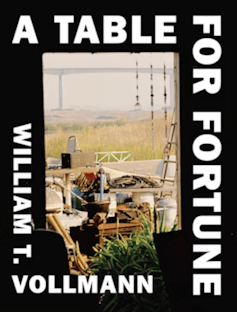
[‘A Table for Fortune’ explores what happens when the response to the horrors of 9/11 becomes an arena for perpetration of further crimes. Skyhorse Publishing].
But to those who might argue that this is the worst time to put a monster of a novel into print since the days before Johannes Gutenberg created the movable-type printing press in the 15th century, I would say that Vollmann’s approach is needed now more than ever.
The ‘poisoned harvest’ of 9/11
After reading Vollmann’s works and occasionally speaking with him in person or via post, I join others in being powerfully struck by his unrivalled intelligence, empathy and work ethic. His books are not big for the sake of being big. They reflect the deep sense of responsibility he feels toward his subjects.
In the case of “A Table for Fortune,” that subject is, as Vollmann declares in the opening volume, the cause and effects of 9/11 – “tracing the roots of that crime in one direction and its poisoned harvest in another.”
It is a novel of ideas and a novel of feelings, the former expressed in the tale of a CIA man who bears the code name DAVE, and the latter the purview of his son, Matthew. DAVE is a brilliant, deeply committed Cold War analyst whose faith in America’s mission gradually erodes after 9/11 and the ensuing war on terror. Matthew, by contrast, is less interested in geopolitics but just as invested in questions about the nature of America. His desire for purpose in life is deeply informed by a notion that the nation still harbors opportunities for freedom. At the same time, his search for that freedom leads him into such dangers as homelessness and addiction.
The book will be published at a challenging moment for Vollmann — and for reading more broadly.
In 2022 alone, he lost his daughter, was dropped by Viking, his longtime publisher, and the supporters of his archives at Ohio State, and got hit by a car while crossing a street. He has also been fighting an incurable case of colon cancer, racing against the clock to see a few final projects to completion.
Meanwhile, the nation’s educational system is constantly having to calibrate its expectations for reading down, and publishers find themselves confronting steadily worsening odds that the average reader will even pick up a book in the next year.
To the extent that there is a reading public, they’re assumed to be increasingly ill-equipped to handle the very sorts of things that motivated Viking to drop Vollmann: His books seem too long, too complex and too expensive to publish.
Deep dives can confront shallow duplicity
But I think the apparent gulf between Vollmann’s work and America’s dismal reading data could be thought of differently. What if the challenging complexity and political engagement of his tomes are exactly what’s needed?
Today, fact and fantasy intermingle freely as a consequence of political scheming and jockeying for economic advantage. Political discourse is reduced to opinions at once homogenous and balkanized, reinforced by the echo chambers of the day’s regnant algorithms. Then there are the fragmented attention spans birthed by our dearly beloved screens, which cultivate a kind of cognitive whiplash that vacillates between amnesia and yearning for more.
It’s easy to become dispirited and cynical: The field seems too big, and the game rewrites the rules too quickly for anyone to figure out how to overcome these forces.
Maybe the first step is recognition.
What happens, Vollmann’s works ask, when serving the good is revealed as its opposite? What happens when the response to the horror of 9/11 becomes an arena for perpetration of further crimes, rather than the healing of wounds already inflicted?
Even as the invasion of Afghanistan in 2001 and of Iraq in 2003 became largely condoned by the American public, displacement, suffering and impasse persist in the region, now in the form of the ongoing conflicts in the Gaza Strip and Iran. The broader post-9/11 strategy seems directed against stable governance in the Middle East generally.
Whether one works for the CIA – as do several of Vollmann’s central characters in “A Table for Fortune” – or occupies a less central node in the networks of power, it is not hard to recognize that the best intentions can be perverted, that one’s idealistic labour may unknowingly be lent to furthering the cloaked ambitions of the wicked.
Such legacies of 9/11 are the sort of uncomfortable and powerful matters to which Vollmann directs attention. And if people are to grapple with such thorny topics, they need to be delineated in detail and at length, as they are in “A Table for Fortune.”
A work like this is not only a book about powerful conspirators. It is also a book that can help keep people afloat as they navigate the tumultuous seas of the post-truth era, dodge the whirlpools of digital banality and resist the leviathans of techno-capitalism.
Literary life rafts
Vollmann is not going it alone. Far from it.
He follows the tradition of what scholars call “literary maximalism” – works that are ambitious in scale and scope, containing narratives flush with surprising intersections, proliferations and divergences.
His works build on such earlier mega-novels as Thomas Pynchon’s “Gravity’s Rainbow,” William Gaddis’ “The Recognitions” and John Barth’s “The Sot-Weed Factor,” which together confront the complexities of America’s past and present. Their topics include the limits of authenticity and how to grasp understanding in a world awash in deceit.
Vollmann also joins ambitious contemporaries such as David Foster Wallace, whose “Infinite Jest” interrogates the loss of self to entertainment and the vapid slogans of popular culture.
Behind each is arguably the grandest American novel of all, “Moby-Dick.”
I was not surprised to learn that Vollmann visited Polynesia in 2019 to walk in Herman Melville’s footsteps. Melville, after all, was wracked by difficulties that should never have been his to bear: constant problems with publishers, uncomprehending reviews, endlessly faltering finances and the loss of a teenage son to a self-inflicted gunshot wound that may not have been an accident.
In other words, Vollmann’s work is not entirely an outlier. Neither is his readership.
Indie publishing houses like Deep Vellum are celebrating thick books, and not just those from American authors. Mircea Cărtărescu’s 2015 “Solenoid,” which begins with a fictional biography set in Cold War Romania, has earned a dedicated following in translation. Michael Lentz’s “Schattenfroh,” a 1,001-page novel that follows the internal narrative of a tortured subject confronting centuries of history, likewise garnered considerable attention when its English translation dropped in 2025.
In his note to the reader, Vollmann explains that the ongoing failures most strikingly signaled by 9/11 are matters of “lessons not learned,” “expediencies of power” and “consciences disabled,” in addition to that most cunning arbiter: “chance.”
The same list of conditions is relevant to the debates about our faltering literacy. If, as seems likely, “A Table for Fortune” is one of Vollmann’s final books, it crowns a career that reminds readers that the world’s troubles must be apprehended as much more complex than a few data points and alarmist sound bites suggest.
Indeed, books like “A Table for Fortune” may be among the most essential tools for keeping our heads above water.
____________________________________________-


Leave a Reply