This past week is generally referred to as Book Week and is duly celebrated in schools, libraries, etc. This week’s edition of The Conversation: Books & Ideas recognised that with essays about four Classic Australian Children’s Books, and this contribution shares the essays for two of them. The other two Classics covered were:
- Playing Beatie Bow is a time-slip novel that makes Sydney strange: Ruth Park’s classic asks us to inhabit the past as a real place – just as 14-year-old Abigail does, when she’s transported from 1980 to 1873, in Sydney’s The Rocks.
- Shaun Tan’s essential migrant story still mesmerises, 20 years on: Shaun Tan’s groundbreaking graphic story, The Arrival, counters the dangerous fantasy of a homogeneous (white) Australia – and invites us to inhabit the other.
This contribution deals with the other two classics referred to – Storm Boy, and Seven Little Australians.
I’ve also included an essay written about Dolly Parton who passed away just recently, and in particular, her philanthropic Imagination Library which has had a proven effect in Australia, and around the world.
[1] Australian children’s classics: Storm Boy’s tough, tender ode to wild childhood will make you cry by Margot Hillel, Emeritus Professor, Children’s Literature, Australian Catholic University
Storm Boy, Colin Thiele’s much-loved classic, has never been out of print. Its iconic 1976 film version, with David Gulpilil as Fingerbone, turns 50 this year – and it has long been hailed one of Australia’s greatest books. On publication in 1963, the Times Literary Supplement argued for it to earn a place among the few “lasting children’s classics”.
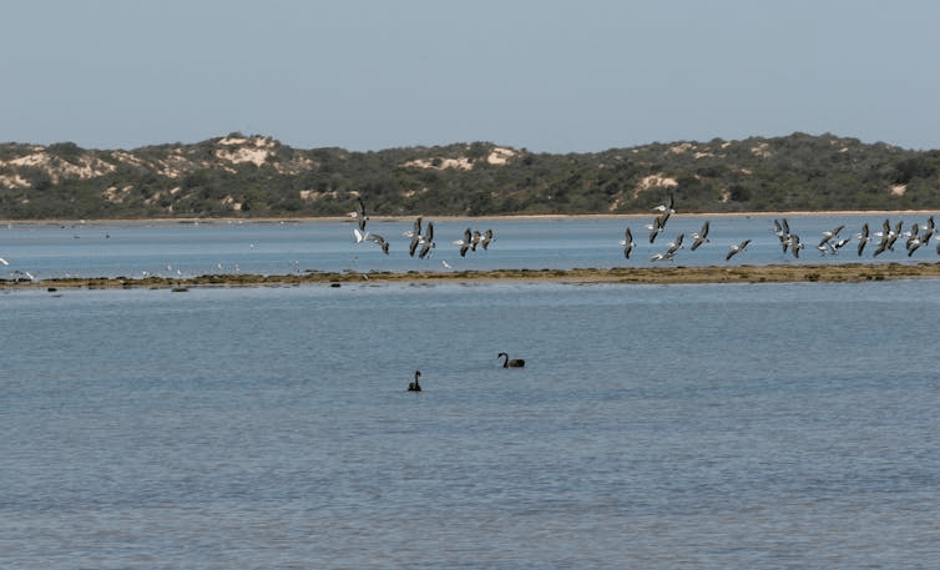
Storm Boy, whose mother is dead, lives with his father, an isolated man called Hide-Away Tom, close to nature on South Australia’s Coorong, a spectacular saline lagoon and wetland of international significance. Storm Boy befriends Ngarrindjeri man Fingerbone Bill, who becomes his mentor and guide when he rescues three pelican chicks. Storm Boy becomes close to one of the pelicans, Mr Percival – until the outside world violently intervenes.
Thiele loved the Coorong. Home to more than 200 bird species, it sits where the Murray River meets the Southern Ocean, protected from it by sand dunes and windswept beaches. Alarms have recently been raised about the threat of bird flu to the thousands of pelicans for whom the Coorong is an important breeding sanctuary.
“A wild strip it is, windswept and tussocky, with the flat shallow water of the Coorong on one side and the endless slam of the Southern Ocean on the other,” he wrote of Storm Boy’s home in the book’s opening passage. Conservation and protection of the environment would be themes in many of his more than 100 books, most of them for children.
Thiele died in 2006, aged 85. Still universally popular, Storm Boy conveys wisdom and enduring life lessons, without being in any way didactic.
The Coorong, where Storm Boy is set, is an important breeding sanctuary for thousands of pelicans. Rob Hutchison/AAP
Fragile men, wild landscape
“It’s about very fragile men in a rough and wild landscape withdrawn from society because of traumatic events in their lives,” said director John Sheedy of the beloved book in 2015, when his Sydney Theatre Company stage production, using puppets for the pelicans, showed in Melbourne. Storm Boy has often been adapted for stage and screen, including as a second film, in 2019.
Thiele created Storm Boy after his friend, artist John Bailey, described a story he wanted Thiele to write, so he could illustrate it (which he did): about a lonely boy on the Coorong, titled Storm Boy. Thiele was influenced by hearing about vandals in the area who had killed birds and destroyed their nests. The resulting book was 50 pages long. He refused a publisher’s request to expand it.
“They say that all of us have known only one child in our lives – the child we once were,” said Thiele, who described the German immigrant Barossa Valley farming community where he grew up as “an enveloping world of solitude – but never loneliness”.
Many of Thiele’s books are influenced by this background. His household was German-speaking and it was not until he went to school that he spoke English, a language in which he soon became fluent and literate. He enjoyed writing in English “from an early age”. It was a childhood he vividly described in his autobiography, With Dew on My Boots.
In tune with Country and nature
Fingerbone Bill gives Storm Boy his nickname and teaches him about Country: importantly, helping him raise the orphaned pelican chicks. Thiele’s respect for Australia’s First Nations peoples is conveyed in many of his books, including this one. Fingerbone Bill’s wisdom and affinity to the land and waterways is “an acknowledgement of Ngarrindjeri habitation of the lower Murray River, Lower Lakes and Coorong”.
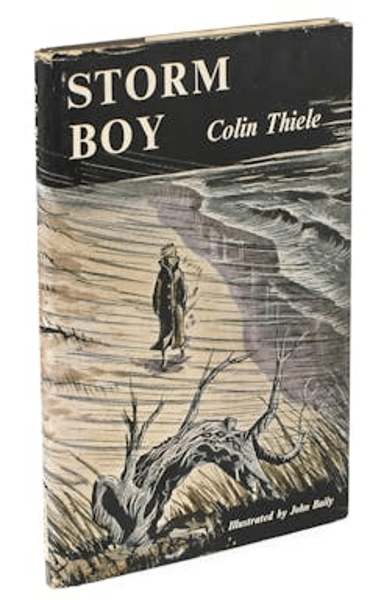
Storm Boy was originally suggested by illustrator John Bailey. Michael Trealor Antiquarian Booksellers
Actor Trevor Jamieson, who played Fingerbone in a Perth production of Storm Boy, described the 1976 film as life-changing for its depiction of the character. “Back then, it was incredible to have any Indigenous character at all,” he told the Sydney Morning Herald in 2013. “In Storm Boy, the characters are all equals. You have Fingerbone Bill, the father, the boy and the pelican … It is really beautiful.”
The book celebrates being in tune with nature. Storm Boy does not go to school; the natural world is his school, his playground and where he feels at home. He learns from his experiences – the kind of education Enlightenment philosopher Jean-Jacques Rousseau famously believed in. Storm Boy has a classic Roussuean upbringing: he has, “lived the life of a child”.
The book and film evoke a kind of nostalgia for a romantic, rural childhood where the child is free to roam and to be a part of the natural world: a world which, whether literally true or not, is seen as the proper place of childhood. In a sense, too, the life Storm Boy and his father live appeals to the Australian bush myth of independence, closeness to the land and a kind of pioneering spirit.
‘I will … NEVER kill a pelican’
As Storm Boy is motherless, the natural world also becomes his nurturer, as he himself learns to be when the adult world encroaches on his idyllic lifestyle and he finds the three pelican chicks, whose mother has been shot. This senseless act by men is a clear contrast with the “naturalness” of the child Storm Boy, who is able to understand and respect the ways of nature.
The innocence of childhood is corrupted and the outside world intrudes. The child becomes both carer and teacher. Through him, we understand the importance of conservation and respect for wildlife.
Mr Percival is a central figure – and even heroic, when he flies out to a stricken boat with a rope to secure it. Further devastation comes, however, when Mr Percival is shot. However hard he tries, Storm Boy cannot save him. He and his father bury the bird in the sand dunes.
One definition of “the very best children’s books” is that they “don’t talk down to kids”. Thiele certainly subscribed to this – and his description of Mr Percival’s death is poignant.
The bird has been trying to protect other birds from the hunters, but to no avail.
Mr Percival seemed to shudder in flight as if he’d flown into a wall of glass. Then he started to fall heavily and awkwardly to the ground. […] When Storm Boy reached him he was trying to stand up and walk, but he fell forward helplessly with one wing splayed out.
However many times I read this passage, I cannot help but be moved. Thiele himself shared reader reactions, from both adults and children. “Storm Boy has a lump in his throat and I did too.” And: “our librarian read Storm Boy to us and she started crying. She told us that every time she reads it she cries.”
One boy from Canberra wrote (with increasing emphasis): “Mr Thiele I will never, NEVER, NEVER kill a pelican.”
Storm Boy himself has become an iconic figure in Australian children’s literature – and the book is one of those wonderful stories that lives with you long after you have closed the final page.
[2] Australian children’s classics: Seven Little Australians is our own Little Women – but naughty, not earnest by Judith Ridge, PhD Candidate, Children’s Literature, University of Newcastle; University of Tasmania
There is an image from Ethel Turner’s 1894 Australian children’s classic novel, Seven Little Australians, that has stayed with me for more than 50 years. Judy Woolcot, third of the seven children, in a stained and torn pink overdress and a battered straw hat, slicing the air and bits of her dress with a grass scythe that is almost as long as she is tall.
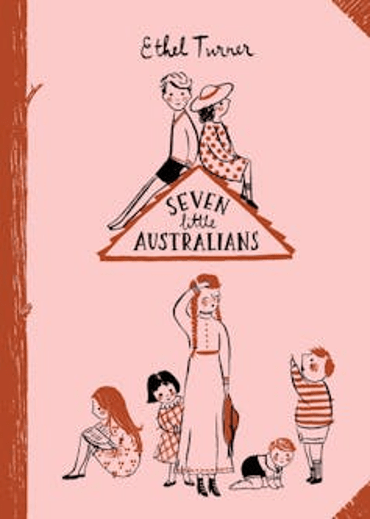
Judy, 13, is cutting the grass in an effort to please her father, who watches with growing trepidation from the side verandah of the family home. Appeasing Father is a regular activity for Judy and her siblings. In this instance, it comes after Judy has led the children in an invasion of an adult dinner party, seeking roast fowl instead of their unsatisfactory tea of bread and butter.
Judy has unconventional ideas about fathers and parenting for an 19th-century girl – and a habit of embarrassing her father, the stern “military man” Captain Woolcot. She is generally always sorry for it, with varying degrees of sincerity and self-interest.
The seven children range in age from the eldest, 16-year-old Meg, to The General, baby of the other children’s impossibly young stepmother, Esther. (“Seven of you, and I’m only twenty!” she says at one point.)
Seven Little Australians, a bestseller on publication, would sell over 2 million copies, be translated into at least 11 languages, and be adapted for the stage, film and television. It has never been out of print.
Like many Australians of my generation, I was introduced to the book when the ABC broadcast its television adaptation in 1973, with a faithful script by Eleanor Witcombe.
My mother found me a copy of the book, beginning my lifelong devotion to Judy and the rest of the Woolcots. My website and social media profiles are all variations of “Misrule”, the nickname given to the chaotic home of the Woolcot children and their long-suffering parents. I wanted to be Judy; instead, I have spent a lifetime thinking about her.
An homage – with ‘fair warning’
Turner openly modelled her novel on Little Women (1868). This is reflected even in character names: Meg is also the eldest Little Woman, and there’s an apparent homage to author Louisa May Alcott in the Woolcot family name.
Judy is often compared to Alcott’s Jo — both girls are independently minded and kicking hard against the expectations placed on them as middle-class girls in a strictly patriarchal society — but in other respects, there is little resemblance to Alcott’s novel.
In place of Christian virtue and service, the Woolcot children pursue rather more paganistic pleasures: picnics and pantomimes, fun fairs and fowl dinners. Turner gives her reader “fair warning” about the children at the start of the novel: “Not one of the seven is really good, for the very excellent reason that Australian children never are.” She puts this down to the “miasmas of naughtiness” that comes from growing up in the “sunny brilliance” of the Australian environment.
This famous line from the novel has left its mark on Australian children’s literature over the more than 100 years since its publication.
Australia’s first urban family children’s book
Seven Little Australians was not the first Australian children’s book, nor the first novel to portray Australian childhood. But it was the first to reflect an urban Australia on the cusp of nationhood, far from the bush mythos and immigrant adventure stories of earlier, family-oriented fiction.
These early books were idealised stories of “jolly life” on bush backblocks and goldfields, with intrepid men and boys (of course) fighting floods and fires, fearsome bushrangers and deadly fauna. Some were “undisguised tract[s] designed to attract immigrants from Britain to Australia”. Fear of and contempt for First Nations Australians was ubiquitous in these books, many of them written by authors who had never set foot on Australia.
Turner was a city girl. Her stories depicted urban Australian life in the years before and after Federation – and into the excitement and progress of the 20th century.
English-born, she arrived in Australian aged around ten, with her single (perhaps widowed, perhaps unmarried) mother and an assortment of sisters. A series of unsatisfactory father figures may explain Turner — and Judy’s — shrewd appraisal of Captain Woolcot’s failings. (“What’s the use of fathers in the world, I’d like to know!” Judy declares early in the novel.)
Turner was determined to make her mark in the literary scene from a young age, beginning with a literary journal she established while a schoolgirl at Sydney Girls High School. Post-school, Ethel wrote for a variety of journals, magazines and newspapers, including the Bulletin, Town and Country Journal, and the Tasmanian Mail. She earned a comfortable income from her writing and as the editor of the children’s pages of the Illustrated Sydney News.
Although her ambitions were always to be considered a serious literary writer of fiction for adult readers, it is this children’s novel, written when she was only 22, that secured Turner’s lasting place in the Australian literary canon.
There are many things to say about this remarkable, enduring novel. But despite its title, there is really only one of the Seven that captures our full attention: Judy Woolcot, born Helen (“which in no way accounts for Judy”), also known as Fizz.
Judy, whose death scene will reduce generations of Australians of all ages to tears: not because it is the sentimental death of a saintly Victorian heroine, but because of its stark depiction of the reluctance of this most alive of literary girls to go into the “gathering shadows” that attend her death.
Turner was a city girl. Her stories depicted urban Australian life in the years before and after Federation – and into the excitement and progress of the 20th century.
English-born, she arrived in Australian aged around ten, with her single (perhaps widowed, perhaps unmarried) mother and an assortment of sisters. A series of unsatisfactory father figures may explain Turner — and Judy’s — shrewd appraisal of Captain Woolcot’s failings. (“What’s the use of fathers in the world, I’d like to know!” Judy declares early in the novel.)
Turner was determined to make her mark in the literary scene from a young age, beginning with a literary journal she established while a schoolgirl at Sydney Girls High School. Post-school, Ethel wrote for a variety of journals, magazines and newspapers, including the Bulletin, Town and Country Journal, and the Tasmanian Mail. She earned a comfortable income from her writing and as the editor of the children’s pages of the Illustrated Sydney News.
Although her ambitions were always to be considered a serious literary writer of fiction for adult readers, it is this children’s novel, written when she was only 22, that secured Turner’s lasting place in the Australian literary canon.
There are many things to say about this remarkable, enduring novel. But despite its title, there is really only one of the Seven that captures our full attention: Judy Woolcot, born Helen (“which in no way accounts for Judy”), also known as Fizz.
Judy, whose death scene will reduce generations of Australians of all ages to tears: not because it is the sentimental death of a saintly Victorian heroine, but because of its stark depiction of the reluctance of this most alive of literary girls to go into the “gathering shadows” that attend her death.
The scene that was cut
One scene that appeared in early editions of Seven Little Australians disappeared from about the fifth edition, in 1896 – as did 15-year-old Pip’s swearing-adjacent “My oath!”.
The children are treated to a picnic in the country while staying on Yarrahappini, the outback New South Wales cattle property owned by Esther’s pastoralist family. It’s on this picnic that Judy will lose her young life, breaking her back saving The General from a falling ringbarked gumtree — that most striking symbol of colonial Australia.
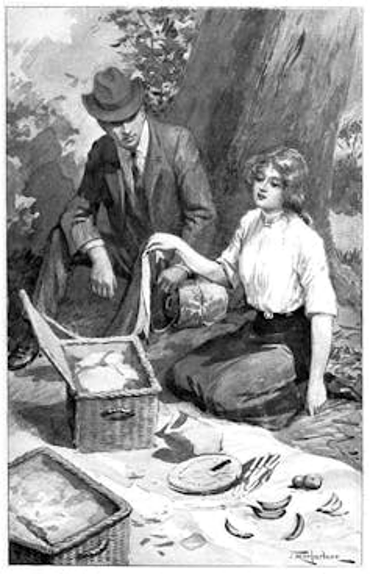
[A conversation [above] criticising colonisation, on the way to this country picnic, was cut by a London publisher]
On the way to the picnic, station manager Mr Gillet tells the children a “Koori” dreaming story about the origins of the kookaburra’s laugh. He ascribes the story’s ownership to Tettawonga, a revered Aboriginal man who worked for Esther’s family for decades. The story is remarkable in its acknowledgement of the damage done by colonisation to First Nations people:
‘Once upon a time … when this young land was still younger, and incomparably more beautiful, when Tettawonga’s ancestors were brave and strong and happy as careless children, when their worst nightmare had never shown them so evil a time as the white man would bring their race, when —’
‘Oh get on,’ uttered Pip impatiently.
It seems little wonder that the London publisher excised this story in the uncertain social and political environment leading up to Australia’s federation. Unknown until restored in the novel’s 1994 centenary edition, it has been included in every official edition since, along with Pip’s near-profanity.
No heroine like Judy
Kerry White, Australian children’s literature scholar and bibliographer, says of Judy: “I can’t think of any other heroine in our fiction quite like [her] … nobody copied Judy, not even Turner herself.”
I suspect she is probably right, though I think we can see traces of the vibrant, quick-witted, social-mores-smashing Judy in some of the more memorable fictional young women of Australian literature: Sybylla Melvyn (My Brilliant Career, 1901), Josie Alibrandi (Looking for Alibrandi, 1992), Ellie Linton (Tomorrow, When the War Began, 1993).
Many of Judy’s fans over the years have come to the same conclusion I have: Judy had to die, because there was nowhere and no one for Judy to grow up into in a modern Australia that still hadn’t found a place for unconventional women.
Because of Judy, Sybylla and Josie and Ellie could live. And in our hearts and imaginations, Judy also lives on, swinging her scythe in her shabby pink frock. Funny, naughty, clever, loving and reckless Judy. Our first real (white) Australian girl.
[3] Dolly Parton’s philanthropic Imagination Library had a proven effect in Australia, and around the world by Claire Galea, Adjunct Fellow, Western Sydney University
Dolly Parton had first-hand experience of the effects of limited literacy. Her father could not read or write. He was, she once said,
the smartest man I have ever known but I know in my heart his inability to read probably kept him from fulfilling all of his dreams.
This sentiment fuelled her passion for encouraging childhood literacy. It drove her to establish the Imagination Library, with the goal of inspiring “a love of reading and learning from a young age”.
Launched in 1995, the Imagination Library sends children enrolled in the program a free, age-appropriate, culturally inclusive book in the mail every month from birth until their fifth birthday. The program began in Sevier County, Tennessee – Parton’s home county – before spreading across the world. It has established roots in Australia, Canada, the United Kingdom, the United States and Ireland.
To date, the Imagination Library has distributed 318 million books, with 3.4 million books sent out monthly across these regions.
The Australian program was officially launched in 2013 and now operates in more than 430 locations. Currently, nearly 50,000 Australian children are receiving a free book every month.
Building foundational skills
For the past five years, I have been working firstly on a research project in Tamworth into the effects of the Imagination Library program. As Head of Research at United Way Australia, distributors of the Imagination Library in Australia, I am not involved in the delivery of the program itself. All the data I analysed was de-identified.
The Tamworth region has produced rich data on early childhood literacy. It boasts 98% enrolment of newborns in the Imagination Library program.
The research conducted in Tamworth was then extended to a global sample. Data has been collected from over 86,000 caregivers across the five countries the Imagination Library is delivered in. This study is currently the largest dataset in the world on shared book reading in the home.
One of the key findings from Tamworth was that the program encouraged caregivers to read to their children. Compared to the average Australian child, children in the Imagination Library in Tamworth were found to be read to more often, for longer, and have more books in the home. Further, these early reading routines were maintained.
The worldwide evidence showed that children enrolled in the Imagination Library were significantly more likely to display foundational early literacy skills and to develop an interest in reading compared to those not on the program. In Australia, enrolled children were found to be nine times more likely to be interested in books, 17 times more likely to join in during shared book reading, and six times more likely to demonstrate key emerging literacy skills than those who were not enrolled.
Participants in the study also reported improvements in family interactions during shared book reading. These benefits were evident across socioeconomic differences.
The effects of the program are represented by Abby and her partner, who are raising two boys in regional NSW, aged three and 10 months. They heard about the Imagination Library through a midwife at Tamworth Hospital. Both parents work full time. Although they value reading, they struggled with consistency.
The monthly book delivery removed the guesswork: no browsing, no uncertainty about developmental fit. Says Abby: “It’s simple, it’s free, and the impact goes beyond just the books. It creates connection, routine and joy.”
Lifelong reading
These results reflect studies into similar book distribution programs. Developing early literacy skills is known to correlate with reading success in later life. The most frequently reported benefit was a strong love of books and reading. Three quarters of participating children in Tamworth asked to be read to daily.
In Australia, the NAPLAN results in 2026 show that a third of Australian children are not meeting Year 3 reading benchmarks. For a skill so fundamental to success across all areas of life, this is a disconcerting reality for a country that prides itself on its education.
A report for the Australian government in 2024 found that children with little to no reading in the home were ten times more likely to grow up with poor language and cognitive development.
The simple act of getting more books into the hands of more children has a significant effect. Over the years, Dolly Parton’s Imagination Library has spread the gift of reading to households across the world, regardless of their circumstances. Her dream was to ensure all children grow up with books, instilling a lifelong love of reading.
Every 1.3 seconds, a child somewhere in the world receives a free book from Dolly, and her legacy is rekindled.
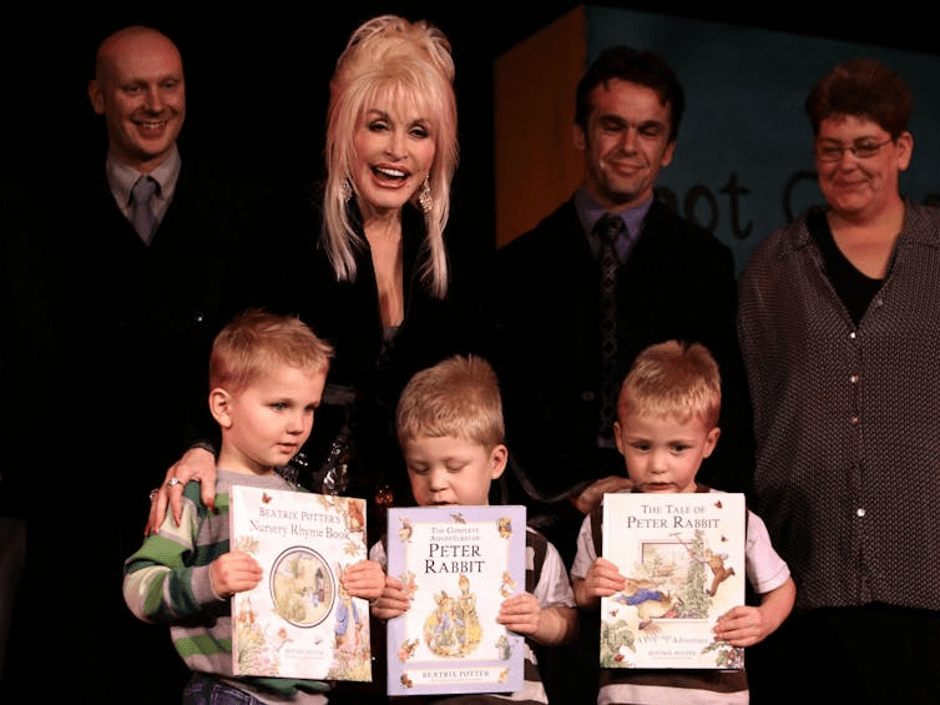
Dolly Parton at the launch of her UK Imagination Library, London, December 2007. Yui Mok/Getty Images
 Site Title
Leave a comment