SBS television in Australia is currently showing a series Chernobyl: Inside The Meltdown, following on I believe from an earlier documentary titled Chernobyl: Days that Shocked the World.
In the lead-up to the 40th anniversary of this catastrophic event, this TV series tells the full story – from reactor meltdown – to the present-day war in Ukraine, that turned a nuclear exclusion zone into a war zone.
In today’s edition of The Conversation: Books & Ideas, a Senior Lecturer in Humanities, and the Professor of English Literature from the University of Southern Queensland have joined forces to write an essay on the subject titled ‘Chernobyl at 40: the lies, the loss and why we can’t let go’. For the interest of my readers, I present a copy of that Essay below.
Chernobyl at 40: the lies, the loss and why we can’t let go
By Kate Cantrell, Senior Lecturer in Humanities, University of Southern Queensland and Jessica Gildersleeve Professor of English Literature, University of Southern Queensland
Some historical events are so catastrophic they resist comprehension. And yet they compel us to try to understand them, again and again.
Chernobyl is one of them.
On April 26, 1986, at 1:23am, Reactor No. 4 at the Chernobyl Nuclear Power Plant in Soviet Ukraine exploded, releasing a cloud of radioactive material that drifted across Europe and contaminated land inhabited by around five million people in Ukraine, Belarus and Russia.
Although it is impossible to calculate the total number of deaths attributable to the explosion and its after-effects, 31 people were killed immediately or died due to Acute Radiation Syndrome in the following months, while deaths in the years since could be as high as 10,000. Around 116,000 people were evacuated from the 30-kilometre exclusion zone in the two weeks following the accident.
As the radioactive dust settled on forests and rivers, poisoning water and food supplies, flora and fauna, it also embedded itself, indelibly, in the cultural imagination.
Forty years on, we are still working out what happened – and what it means.
An explosion that never ends
Countless books, documentaries and television dramas, as well as artworks, plays, video games and comics, grapple with the causes of the disaster and its aftermath. They seek to make visible what was invisible at the time: not just radiation and its effects on the human body, but the Soviet government’s attempts to cover up the accident.
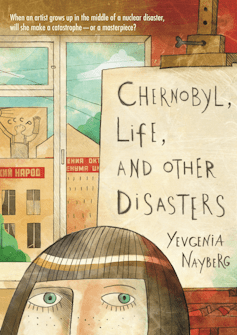
This week, Ukrainian writer and illustrator Yevgenia Nayberg published her graphic memoir, Chernobyl, Life, and Other Disasters – a künstlerroman (artist’s novel) charting her coming-of-age as an artist under Chernobyl’s long shadow. Born and raised in Kyiv, Nayberg was 11 years old and preparing for art school when she heard on the radio that “one of the nuclear reactors was damaged”, but “the situation [was] under control”.
In a recent interview, Nayberg reflected that “the most difficult part” of writing the book was “trying to forget that I know the future”.
In her memoir, she insists on the accuracy of her memories and the truth of her lived experience, set in stark contrast to the secrecy and obfuscation that marked the Soviet government’s response.
“They are just repeating the same thing over and over again,” the young Nayberg declares. “That means they’re hiding something.” Her parents and grandparents arrive at the same conclusion. “They used to pretend that they trusted the news,” she observes. “Not anymore.”
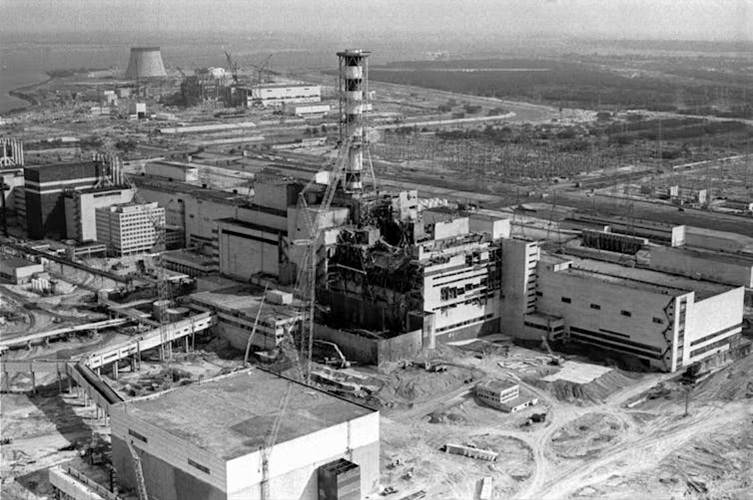
A 1986 aerial view of the Chernobyl Power Plant, with damage from the explosion in Reactor 4. Volodymyr Repik/AAP
In his 2006 essay Turning Point at Chernobyl, former president of the USSR – and the last Soviet leader – Mikhail Gorbachev argued “the nuclear meltdown at Chernobyl […] was perhaps the real cause of the collapse of the Soviet Union five years later”. “There was the era before the disaster,” Gorbachev wrote, “and there is the very different era that has followed.”
Yet it was not the meltdown itself that led to “the collapse”, but what it revealed: the extent to which the Soviet government would lie to its own people and to the world. Gorbachev said nothing to the rest of the world until a full week later, when he assured a concerned global audience “the worst is behind us”. At the same time, he denounced the “mountain of lies” purportedly being spread by Western media.
It is hardly surprising, then, that a preoccupation with truth and deception drives almost every cultural retelling of the disaster. In the collective memory, Chernobyl is not an isolated event confined to the past, but a contagion that continues to mutate and spread.
While these books differ in theme, focus, and narrative style, they all ultimately grapple with a crisis of representation: how do we express through language what defies comprehension?
Plokhy, a Harvard professor who grew up downstream from the destroyed reactor and whose thyroid was damaged by radiation exposure, concludes his haunting history of the disaster with a warning: “The world has already been overwhelmed by one Chernobyl and one exclusion zone. It cannot afford any more.”
‘This is how radioactivity looks’
The first documentary about Chernobyl was filmed three days after the explosion.
Directed by Soviet filmmaker Vladimir Shevchenko, Chernobyl: Chronicle of Difficult Weeks (1986) documents the cleanup operations undertaken by Ukrainian workers and volunteers, many of whom would later die from the high levels of radiation they were exposed to.
The 54-minute film, the product of three months of continuous shooting, opens with an aerial shot of the destroyed reactor before cutting to grainy footage of a televised speech by Gorbachev on May 14, 1986. “We have been struck by disaster,” he announces, “we have been confronted by danger: atomic energy which has become uncontrollable”.
The documentary deflects the threat to an unknown enemy, clinging to the language of war. The exclusion zone is the frontline, the liquidators are “soldiers performing a great feat” and the deserters who “abandoned their comrades” are “cowards” whose names would be made public “regardless of rank or position”. “Deserters were not executed,” the film assures, “but the people’s contempt would serve as eternal punishment.”
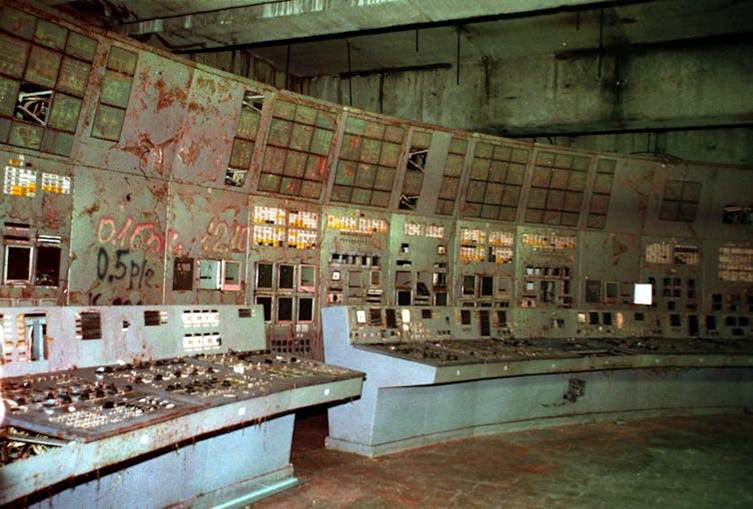
The ruined control room inside Reactor 4 at the Chernobyl Power Plant. Efrem Lukatsky/AAP
This vain attempt to reaffirm the Soviet myth of heroism – the faultless ability to overcome catastrophe – reveals the state’s attempt to absorb Chernobyl into its own mythology: to make it, in the end, a story about what the Soviet people could endure.
But what we witness, from a safe distance and with the vantage of hindsight, is something far more sinister: the radiation saturating the camera and, by extension, the hand holding it. The on-screen flashes of light, white and crackling, were initially mistaken by Shevchenko and his team for a problem with the film. “We thought this film was defective,” he explains. “But we were mistaken. This is how radioactivity looks.”
Shevchenko himself died from acute radiation sickness less than a year later. His film, suppressed by Soviet authorities and released only posthumously, is sometimes described as the most dangerous film in the world.
For a story so many were determined to silence, there is a surprising wealth of footage. As the recent documentary Chernobyl: The Lost Tapes (2022) explains, “the Soviets […] documented everything believing they would show the world a heroic victory.” In time, the truth would assert itself.
Chernobyl’s children
One year after the incident, in 1987, The Bell of Chernobyl, “an unusually frank work that plainly suggests the Soviets were wholly unprepared for the disaster”, mysteriously failed to arrive in time for its scheduled screening at the Berlin International Film Festival.
The festival’s official journal noted “there are forces in the Soviet Union – and they are not new ones – who would prefer not to have the film screened”.
These nuclear documentaries, according to film studies scholar Helen Hughes, reveal the difficult art of filming a toxic ghost – a danger that cannot be seen, heard or touched, yet whose presence can be “felt in the teeth”.
Nikolaus Geyrhalter’s Pripyat (1996), made ten years after the disaster, marked one of the first occasions when an international film crew was granted access into the 30-kilometre exclusion zone. Shot entirely in black and white, the camera lingers on stunning irradiated landscapes – frozen forests and overgrown streets – depicting a world that is the same, yet different.
At its centre, however, are the human stories of those who live and work there. Like the lab technician who, upon returning to her former flat in Pripyat, learns her possessions have been stolen by looters. And the safety officer who works at the power plant: “I keep this power plant running,” he jokes. “I am one of the guarantees that nothing will happen.”
When the film was first screened in 1996, audiences were surprised to learn Chernobyl was still operating.
In the 2000s, popular documentaries about the disaster turned to the human cost of Chernobyl, including the so-called generations of Chernobyl children whose lives were stolen from them.
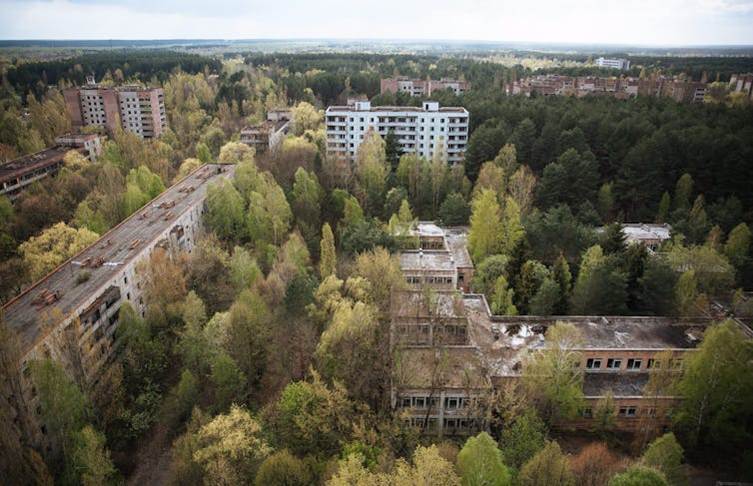
he deserted city of Pripyat, near the Chernobyl Power Plant, ten years ago – 30 years after the disaster. Roman Pilipey/AAP
Of these, none proved more confronting than Chernobyl Heart (2003), a 40-minute documentary short directed by Maryann De Leo. It follows Irish humanitarian Adi Roche and her team of aid workers as they travel through Belarus and Ukraine, visiting thyroid cancer wards, overcrowded children’s homes and maternity hospitals where, according to one doctor, only 15-20% of babies are born healthy.
In the Novinki Mental Asylum north of Minsk, we meet Julia, a girl born with her brain outside her skull. Another child, aged four, is the size of a four-month-old. Some children with cerebral palsy spend their entire lives in cots.
“I suppose I’m relieved to see she’s still alive,” Roche says of one child, “but I’m not sure that’s the best thing for her.” Gesturing at another group of children, she says, “we don’t know what’s wrong with them.”
The film, which won the 2003 Academy Award for Best Documentary Short, was criticised for its explicit depiction of children’s damaged and deformed bodies. At the time, the suffering of Chernobyl’s children was typically rendered symbolically – through a broken toy or an abandoned doll – rather than shown directly.
Often, the children themselves were not told what was wrong with them. In one quietly devastating scene, a teenage girl – born three weeks before the explosion – tells the camera she has “some problems” in her neck. As we leave her, the attending doctor reveals she has thyroid cancer. “Of course we don’t tell the children,” he says.
“It was the hardest film I’ve ever made,” De Leo later said. During filming, she was hospitalised for radiation poisoning.
The experience did not deter her. Five years later, her follow-up film, White Horse (2008), shadowed a Ukrainian man as he returned home to Pripyat for the first time in 20 years.
Secrets, lies and untold stories
The most influential retelling is undoubtedly Craig Mazin’s five-part HBO miniseries, Chernobyl (2019), which garnered 19 Emmy nominations and inspired a companion podcast.
The series stars Jared Harris as senior nuclear scientist Valery Legasov: the man tasked with containing the disaster, who took his own life on April 27, 1988 – exactly two years and one day after the explosion.
Reconstructing the timeline of events (before, during and after the explosion), the series is sharply critical of the power wielded by the Soviet government, its nuclear industry and their affiliated forces. It raises enduring questions about nuclear safety, especially emergency preparedness and response, and risk communication.
The series draws in part from Alexievich’s acclaimed book, Chernobyl Prayer, a polyphony of poetic first-person testimonies collected over a ten-year period with more than 500 eyewitnesses, including doctors, soldiers, scientists, helicopter pilots, miners, former party bureaucrats, and ordinary citizens.
As its title suggests, the book gives voice to the individuals who lived through the disaster. Compared to the series, it is a more nuanced and reflective account of the slow forms of violence that persisted long after the reactor was sealed and the cameras left.
One young father who volunteered as a liquidator recalls:
We got home. I took everything off, all the stuff I’d been wearing there, and threw the lot down the rubbish chute. I gave the cap to my little son as a present. He kept asking for it. He wore it non-stop. Two years later, he was diagnosed with a brain tumour. You can write the rest yourself. I don’t want to say any more.
Both Chernobyl Prayer and Chernobyl portray the processes that rob people of their human status – forcing them to exist beyond the threshold of human experience. The radioactive particles both inhabit them and haunt them: “Chernobyl, for those who were there, did not end in Chernobyl. They were returning not from war, but almost from another world.”
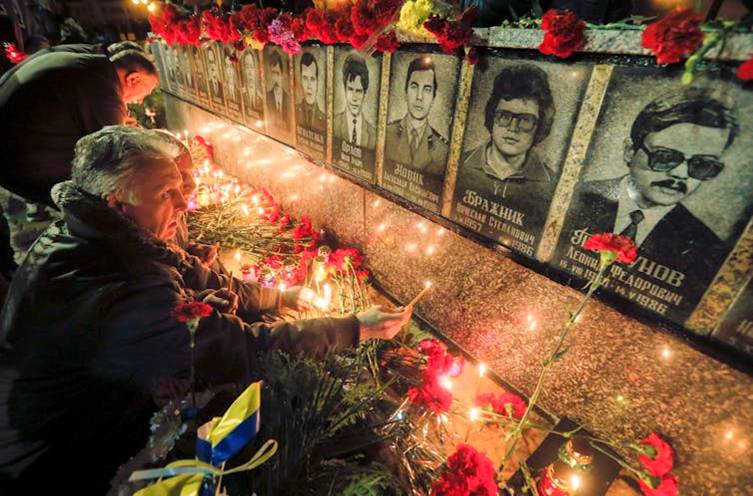
Ukrainians light candles at a memorial to the liquidators – the workers who gave their lives to contain the Chernobyl disaster. Sergey Dolzhenko/AAP
For this reason, Chernobyl is not just a story of horror. It is also, for instance, a love story: between Vasily, a firefighter exposed to a lethal dose of radiation, and his pregnant wife, Lyudmila, instructed to protect their unborn child from his “scorched” body.
In Alexievich’s book, the nurses tell her, “You mustn’t forget this isn’t your husband, it isn’t the man you love. It’s a highly contaminated radioactive object.” But Lyudmila remains by Vasily’s side – changing his sheets, wiping him down, at one point removing “pieces of lung and lumps of his liver […] coming up through his mouth.”
Alexievich writes that since Chernobyl:
Love has changed. And death, too. Everything has changed, except us.
Like Yevgenia Nayberg, Ukrainian cultural historian Maria Tumarkin was 11 when Chernobyl happened. She turns to Alexievich when it feels impossible to answer the question: “How does a society witness itself? Witness itself failing at its most fundamental duty?”
The most enduring texts about Chernobyl move beyond the disaster as event and attend to it as warning – not sensationalist, but willing to listen to what it still tells us: about power, about the “cost of lies” (as the HBO series puts it), and about the slow violence of catastrophe that does not announce itself – and does not end.
Some of what Chernobyl cost us cannot be measured. It can only be carried. This is why Chernobyl remains a story worth telling. And why it will keep being told, again and again.
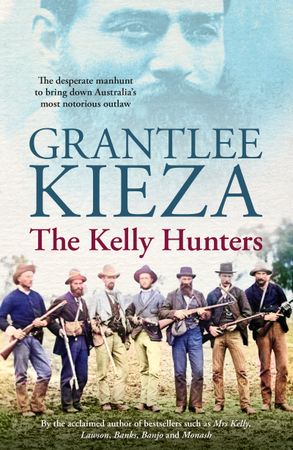
I just completed reading ‘The Kelly Hunters’ by Grantlee Kieza [published in 2022] of 327 pages. A different approach to the Ned Kelly story, we look at the other side, the story of the 20-month manhunt for Ned Kelly, and his three associates who lead the police and authorities through parts of north-east Victoria, and southern NSW., thwarting their pursuers at every turn. A chase marred by incompetence, costly and professional jealousies and conflicts amongst the police and a variety of trackers, together with the opposition and obstacles created by many in the local population providing support to the gang, and constantly sending the police on a ‘wild goose’ chase.
The general promo blurb of the story reads as follows.
When Ned Kelly and his band of young tearaways ambushed and killed three brave policemen in a remote mountain camp in 1878, they sparked the biggest and most expensive manhunt Australia had seen. The desperate search would end when Kelly and his gang, wearing suits of armour, tried to derail a train before waging their final bloody gun battle with police in the small Victorian town of Glenrowan.
In the 20 months between those shootouts and aided by a network of informers, hundreds of lawmen, soldiers, undercover agents and a team of Aboriginal trackers combed rugged mountains in freezing conditions in search of the outlaws. The police officers were brave, poorly paid and often ailing, some nearing retirement and others young with small children, but they risked death and illness in the hope of finding the men who had killed their comrades.
The hunt for the Kelly gang became a fierce battle of egos between senior police as they prepared for the final shootout with Australia’s most infamous bushrangers, a gun battle that etched Ned Kelly’s physical toughness and defiance of authority into Australian folklore. By the author of the critically acclaimed Mrs Kelly, as well as other bestsellers such as Banks, Monash and Banjo, The Kelly Hunters is a fascinating and compelling account of the other side of the legendary Kelly story.
In addition to the main story, Kieza concludes with a substantial series of Notes arising from each of the book’s 20 chapters; closing descriptions of the subsequent lives of the various characters [on both sides of the hunt]; a full listing of each of the subsequent recipients of the 8,000 Pound reward money which had being offered for information of action leading to the capture of the Kelly Gang, which sum was divided eventually amongst 66 individuals; a list of the names of all of the police who were present at Ned Kelly’s last stand at Glenrowan, include their method and time of arrival; and a concise bibliography of written material and internet sources relating to the Kelly families.
Throughout the book, there are references from time of the massacres of Indigenous people in Queensland, often by their own people employed as trackers by the local police and/or settlers – Queensland was a colony where the lives of Indigenous people were often given less value than that of the profits from sheep and cattle – one such group of black trackers led by a notorious Irish-born Sub-Inspector Stanhope O’Connor were recruited down to Victoria to assist in the manhunt for the Kelly gang, and while they were relatively unsuccessful, they were one group of pursuers that gave the greatest fear to Ned. This group, as with the Native Police in general throughout Queensland, were used as a paramilitary force by Queensland’s colonial government to provide protection to the settlers, but also to subdue, chase away or massacre their own people, under the direction of white men. Kieza suggests that the estimates of the number of Indigenous people killed on their raids over a 40-year span rany7ged from 20,000 to more than 41,000.
As noted in the blurb above, there was regular conflict and ego concerns between many of the police parties, and in particular with O’Connor and his trackers. Additionally, groups of police or individuals over much of the 20 months in question, had to endure severe climatic conditions in their attempts to track down the Kellys. One of the principal characters involved in the chase from time to time [and also in many disputes of authority etc] was Superintendent Frank Hare, the following description of whom gives some indication of the conditions under which the police and other searchers had to cope with.
From page 171: “Standish trusted Hare more than any of the other Kelly hunters. The big man was willing to endure all manner of privations in pursuit of the gang, setting off into the wilds with his men and packhorses at rhe vaguest of rumours for eight or ten days at a time. Hare was almost 50, but his bones ached like he was 100. ‘Our life was a very hard one ,’ Hare recalled, ‘sleeping in the open without tent or fire, living on potted beef, and biscuit, and sardines. Bushman think nothing of camping out for months but ask any of them in the winter months to camp out without a fire and see how long they will stand it’. [Of course the ‘no fire’ policy was aimed at preventing the Kelly gang from knowing the police were close].
Though not all thought highly of Hare.
From pages 176-177, Charles Nicolson, when he joined the pursuing forces, had a different approach to that of Hare – ‘he hardly ever sent out search parties, preferring to court spies and make deals with anyone likely to have the ear of the Kellys or their friends, especially Aaron Sherritt’ [who would be murdered as a traitor by one of the gang, a couple of days prior to the Glenrowan siege]l and from page 178 Nicholson ‘said Hare had been hunting the Kellys, with the largest body of police that ever was in the districts and with the artillery force at his command’, yet he said, ‘the whole colony was sneering at their efforts’.
The following is a brief selection of reviews of Kieza’s book, which are generally positive, with readers such as myself appreciating the book’s engaging narrative and style of reading, and while its aim to portray principally the Kelly pursuers, Kieza also provides a nuanced portrayal of the Kelly gang, and their 20 months on the run. I have to agree with each of the points made below, and for those interested, an easily read and followed historical depiction’
The Australian: Praised for its engaging writing and detailed portrayal of the Kelly gang, this review highlights Kieza’s ability to bring the characters to life;
Daily Telegraph: Described s vivid, detailed ad well-written, this review emphasises the book’s ability to capture the essence of the Kelly story;
Betterreading.com.au: Calls it a staggering accomplishment, this review suggests that the book is a must-read for history buffs and story lovers alike;
John Howard: Acknowledges Kieza’s clear and accessible writing style, which is well-crafted and extensively documented;
Weekend Australian: Praised for its clear and accessible writing, this review suggests that Kieza has added hugely to the depth of knowledge about the Kelly gang.
Grantlee Kieza OAM has held senior editorial positions at The Daily Telegraph, The Sunday Telegraph and The Courier-Mail for many years and was awarded the Medal of the Order of Australia for his writing.
The following two articles, which appeared in the online newsletter ‘The Conversation: Books & Ideas’ on the 3rd April, past, I considered worthy of sharing with interested readers. They both submit a modern perspective on two children’s stories, one an Australian classic ‘The Magic Pudding’ [written & illustrated in 1918 by Norman Lindsay], and the second, an ancient fairy-tale, ‘The Emperor’s New Clothes’ [written by Hans Christian Anderson in 1837]. I have copied them below as they appeared in the said publication.
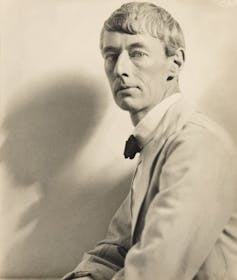
[1] How Norman Lindsay wrote The Magic Pudding to critique ‘Australian values’ – inspired by Nietzsche [essay by John Uhr, Emeritus Professor of Politics, Australian National University………………………………]The federal parliamentary seat of Lindsay, west of Sydney, was formed in 1984, honouring the great Australian illustrator and writer Norman Lindsay (1879-1969). The seat has been held since 2019 by the Liberal member, Melissa McIntosh.
When McIntosh’s colleague Angus Taylor was elected leader of the opposition in February, he immediately framed his political strategy around “Australian values”. He distanced himself from the government’s multiculturalism, called for a reduction to immigration and claimed to be in favour of “social inclusion” based on support for the “Australian way of life”.
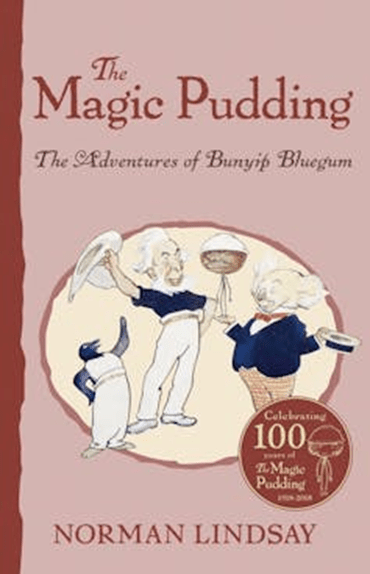
Lindsay’s classic children’s book The Magic Pudding, first published in 1918, is an interesting commentary on those “Australian values”.
His story about a bad-tempered pudding, which never diminishes no matter how much you eat it, has been widely interpreted as defending our “way of life”. For a century, critics have praised Lindsay’s beautifully illustrated text as showcasing the “Australian dream” and the national character. The book has been celebrated for its depiction of the norm of blokey larrikinism and our love of mateship, at least among males.
In fact, The Magic Pudding is a clever critique. The wily Lindsay was warning readers that Australian culture and civic morality were dangerously shallow.
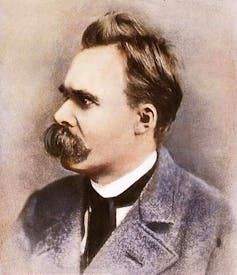
His tale was inspired by his reading of philosopher Friedrich Nietzsche. Lindsay was one of Australia’s first enthusiasts for Nietzsche, whose political philosophy was about transforming democratic culture, moving it away from what he called “slave morality” and towards a new world of the “master morality” of elite artists.
Lindsay treasured works by Nietzsche, such as Thus Spoke Zarathustra, with its message that “God is dead”. He feared that the crass philistinism of contemporary Australian democracy was tainted by “slave morality” and saw himself as a champion of “free spirits”.
The Magic Pudding was his attempt to tell that tale in a comic form.
‘Owners’ and ‘thieves’
The crafty depths of Lindsay’s critique can escape many first-time readers. But if they take a careful second look, many highly regarded “Australian values” emerge as second rate.
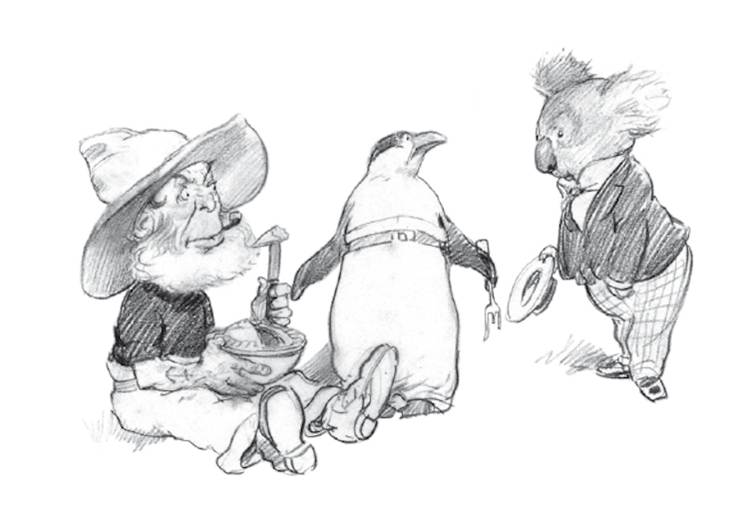
What many critics have fondly called the Australian dream is actually a grim picture of three self-declared “owners” monopolising control over a magically replenishing resource: Albert, the mean-spirited but endlessly edible pudding.
If Albert is the treasure of the story, then the koala Bunyip Bluegum is the hero. Bluegum initially appears as a young lad out to “see the world”. He might even be a potential artistic “free spirt”, having been coached by the unusual poet Egbert Rumpus Bumpus (who is also a koala).
But Bunyip Bluegum falls into company with Bill Barnacle and his sidekick, a penguin named Sam Sawnoff, the so-called “owners” of Albert. There follows a funny story about two gangs – pudding “owners” and pudding “thieves” – using their fists to fight for control of Albert.
But is it really true that, as critic Eleanor Whitcombe commented, Lindsay “created the ultimate ocker” in Albert the pudding? It might well be true that the book is “a true guide to the Australian national character” – but is Lindsay supporting or opposing this version of it?
In fact, Albert the pudding is an alien. He was “invented” out at sea by a non-Australian ship’s cook called Curry and Rice, whose sole ownership of the pudding caused Bill and Sam to become “justly enraged”.
The pair effectively drown Curry and Rice when they seize Albert, who never stops complaining about the malicious intervention of his new “owners”. The two “pudding thieves” see no legitimacy in the claims to ownership or the “the way of life” celebrated by Albert’s captors, who manage Albert as an alien slave.
Eventually, the two warring gangs end up in court, where Lindsay displays his most un-nationalistic portrait of the waywardness of Australian law and order. The mayor is ridiculous in his endless appetite for free bananas. The police officer is awkward and fearful of Albert’s rebellious distemper. The court usher is servile, treating the judge to repeated games of cards and plying him with glasses of port.
The hero Bunyip Bluegum beats the legal system with a clever lie that “Albert has been poisoned”. This so upsets the court that the “owners” are able to flee with their captive.
The tale ends with what many critics describe as an ideal conclusion: three “owners” high up in their tree, with the ever-miserable Albert secured in “a little Puddin’ paddock”.
Food and fighting
The Magic Pudding can be read as Lindsay’s black-humoured portrait of the primitive nature of a culture of “food and fighting”. The Australian way of life displayed in The Magic Pudding revolves around the life of the belly, not the life of the mind.
In a 1916 letter to publisher George Robertson, Lindsay describes Bunyip Bluegum as “the hero” of a story written against the background of “the brutal reality of war” – a story intended “to stiffen the younger generation to a more decent frame of mind”. Lindsay later wrote that his hope for “this generation” is “to see life clearly, and without the false equation of sentimentality”.
My conclusion is that Lindsay is not promoting civic pride in Australian nationality, but attempting to stimulate interest in alternative sources of national pride.
The Magic Pudding says nothing explicitly about Nietzsche, but it illustrates Lindsay’s deeply personal attempt to move beyond the ethos of military struggle at the end of the great war, in which he lost a younger brother in France at the end of 1916.
Nietzsche’s concept of the “higher man” sought to break free from the doctrine of social equality favoured by democratic movements.
What Lindsay learned from Nietzsche was that the military victory Australia earned in 1918 had merely protected a barbaric public culture.
In his book Creative Effort: An Essay in Affirmation, published not long after The Magic Pudding in 1920, Lindsay proposed that artistic “great souls” could use their talent for comedy to undermine the conventional “spirit of gravity” nurturing modern democracy, symbolised by the pre-eminence of “bellies” and lesser beasts like the “grunting pig”.
The aristocratic few, according to Lindsay, despise most ordinary citizens, who are “no more than a walking belly”. He observed sadly that “it is for the belly alone that half the energy of society is exerted”. The mind of the many fails to reach the higher levels of artistic spirit because it “is almost wholly concerned with the belly.”
The fate of Bunyip Bluegum, who is not given to fisticuffs, might be viewed in this sense as something of a cautionary tale. He is at his finest when he confronts the pudding-thieves and recites a long poem about the immorality of stealing, which moves the thieves to renounce “their evil courses”.
This is Lindsay’s most challenging test of Bunyip’s contribution to the society of pudding-owners: to try to use his poetic powers to turn the pudding thieves towards virtue.
Lindsay’s story is very much about Bunyip Bluegum rounding out the forceful skill-set of Bill and Sam – who clearly emerge as the very first pudding thieves, determined never to yield Albert to any competitor.
Gifted with poetic knowledge, Bunyip discovers that he has everything – “except food”. He uses his cleverness to help Bill and Sam, and is rewarded with a version of the high life, savoured by an endless supply of Albert’s hearty pudding.
But once he has access to Albert as a useful food slave, Bunyip loses interest in everything that might make his life more poetically noble.
Lindsay’s book warns readers that the humdrum complacency of Australian public culture needs the artistic excellence of “free spirits” as a cultural corrective to its misplaced dreaming. The Magic Pudding provides a belly full of laughs for children, but it is also a reminder of the importance of the life of the mind for adults uncomfortable with many practices of the “Australian way of life”.
Inspired by Nietzsche, Lindsay was hoping to provoke Australian readers to dream of something grander than a full belly.
[Comment: I retained a beautiful copy of this book as a gift for a future grandchild, but I fear that in 2026, it will probably hold little of interest for the members of that generation! I’d like to think I’m wrong!! – Bill]
[2] The Emperor’s New Clothes, by Hans Christian Anderson – a fairy tale for our times?
[essay by Nicola Welsh-Burke, Sessional Academic in Literary and Cultural Studies, Western Sydney University].
In mid-March, an activist group in Rutland County, Vermont, held its usual weekly rally protesting the actions of US president Donald Trump. One protester, Marsha Cassel, led the crowd, dressed as a naked Trump wearing a crown and holding a staff. Cassel was followed by another protester holding a sign proclaiming “THE EMPEROR HAS NO CLOTHES!”.
This is not the first time Trump has been compared to Hans Christian Andersen’s bumbling emperor, who marched naked through the streets while claiming to be dressed in finery – a fiction many of his subjects willingly indulged.
Who was Andersen, what aspects of his life informed this particular story and why might this be useful to know in the age of Trump?
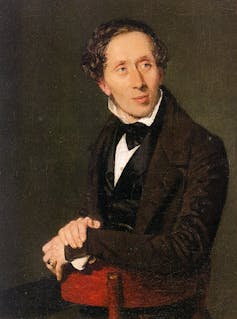
Andersen was born in Odense, Denmark, in 1805. While his grandfather supposedly claimed noble origins for the family, Andersen’s father was a cobbler and his mother an illiterate washerwoman.
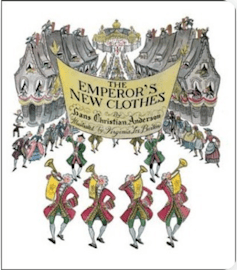
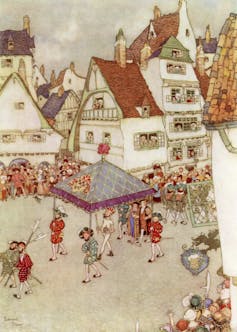
Top: book illustration.
Bottom: Illustration by Edmund Dulac from Stories from Hans Andersen, published 1938. Universal Images Group via Getty Images
After his father died, Andersen moved to Copenhagen for work, where he found a patron, theatre director Jonas Collin, who paid for his education. Andersen started writing after graduating from university, becoming well known for his fairy tales, which he began publishing in the 1830s.
The Emperor’s New Clothes is in his 1837 work, Fairy Tales Told for Children, which featured other memorable tales such as The Steadfast Tin Soldier and The Little Mermaid.
The story follows a vain and clothes-obsessed emperor who commissions clothing from two travelling conmen. These men, posing as weavers, visit his court to show off a new kind of material, which is supposedly rendered invisible to a man “unfit for the office he held”, or “extraordinarily simple in character”.
Afraid to reveal that he cannot see the material, the emperor sends in several aides to review the process, who all lie about being able to see the clothes being made.
Once the “outfit” is finished, the emperor dons it and parades naked through the town. The townsfolk compliment the garments, until a small child bursts the bubble, yelling out that the emperor has no clothes.
Unable to admit this, the emperor continues on his way. But the townsfolk now laugh.
This simple tale powerfully criticises rulers who tell untruths, performing intelligence and leadership, as well as those who uncritically allow this.
An outsider looking in
Like many fairy tales, the origins of this one stretch back centuries. Older versions date to medieval times. All feature people in power being duped by conmen who play on their vanities about their own intelligence. Literary scholar Hollis Robbins suggests Andersen’s version reflects a newly-emerging working class culture where “professional competence” was “quickly overtaking legitimacy and heritage as a source of aristocratic anxiety”.
In his book The Enchanted Screen: The Unknown History of Fairy-Tale Films, fairy tale scholar Jack Zipes claims Andersen was “embarrassed by his proletarian background” and “rarely mingled with the lower classes” once he found success as a writer.
Andersen never married and more recently, has been understood as a bisexual man. He had infatuations with both men and women, including Edvard Collin (the son of his patron Jonas) and Swedish opera singer Jenny Lind. After a fall in 1872, from which he never recovered, he died in 1875.
Andersen’s lower class background, argues Zipes, meant he was particularly well suited to biting cultural commentary about the difficult path for those escaping poverty.
In one translation of The Emperor’s New Clothes, the child who proclaims the nudity of the emperor is called “the voice of innocence” by his father. This voice spreads through the crowd, leading to the comical image of the naked emperor’s aides striving to lift the invisible train of his outfit even higher.
Regardless of one’s position in life, this story suggests you cannot escape “suffering, humiliation, and torture,” writes Zipes.
Indeed, many of Andersen’s tales feature characters (often frail, young women) who suffer immensely before dying nobly. The Emperor’s New Clothes, with its child character as the voice of reason, has an ending that, while not “happily ever after”, is as light-hearted as Andersen gets.
The power of fairy tales
The fairy tale is one of the most recognisable literary genres. We hear them from such a young age it is almost like we were born knowing them. Beginning as oral folktales, many of the tales we know today were first written down in 16th and 17th century France, Italy and Germany as social commentary and educational stories.
It is difficult to identify the “originals” of many tales, given their folkloric origins. Still, while it is almost stereotypical now to note that the “original fairy tales” (before contemporary Disney adaptations) were surprisingly dark Andersen’s are noticeably, and notably, bleak.
The Emperor’s New Clothes has been retold many times, with print, screen and musical adaptations. As Donald Trump, in the words of one pundit, continues to “construct a narrative, declare it to be true and relentlessly force the world to submit to it”, the story resonates today.
Indeed, literary academic Naomi Wood has argued that in a post 9/11 world, a “terrifying possibility” emerges in readings of the tale.
The truth of the fairy tale is not its glorification of the voice of innocence, free from corruption and untruth. Rather, it is that adults will continue to believe their own lies, even when they are clearly revealed. As a result, we allow the parade to continue, even while knowing it is farcical.
Some more reading material attended to over recent weeks, including three 2025 novels, and a Blainey classic.
Legacy by Chris Hammer [pub 2025];
The Tyranny of Distance by Geoffrey Blainey [pub 1966];
The Endless Sky by Di Morrissey [pub.2025];
Pilbara by Judy Nunn [pub. 2025]
A Gentleman in Moscow, by Amor Towles [pub. 2016].
25th February
A 2025 publication titled ‘Legacy’ by Chris Hammer, of 479 pages – this was the first of Hammer’s books I have read, with at least seven other novels having preceded this one, and if the mystery and fast-moving action of Legacy are a sample of his style, I have a bit of catching up to do!!
A novelist of detective fiction it seems and stories of crime and mystery essentially set in the Australian outback regions and/or the small town environment [the town main here has only 12 permanent residents] which are generally of a relatively isolated nature.
I was warned ‘after’ reading that Scammer often has a sequence book, and this one was apparently the 4th featuring the fictional investigative journalist Martin Scarsden – not to worry, it has come over as a stand-alone story in any case.
In basic outline – ‘Someone is targeting Martin Scarsden. They bomb his book launch and shoot up his hometown. Fleeing for his life, he learns that nowhere is safe, not even the outback. The killers are closing in, and it’s all he can do to survive. But who wants to kill him and why? Can he discover their deadly motives and turn the tables? In a dramatic finale, Martin finds his fate linked to the disgraced ex-wife of a football icon, a fugitive wanted for a decades-old murder, and two nineteenth-century explorers from a legendary expedition. According to Goodreads, this is Martin Scarsden’s most perilous, challenging and intriguing assignment yet.
Anyway, it didn’t take this reader very long to get through the 479 pages of mysterious twists, scenarios, and unanswered questions, most of which are not released as in all good mysteries until near the end, and even then, we find a further unexpected and surprising turn of events.
With the novel set in the Australian outback, and with vivid descriptions of harsh drought conditions, the damaging effects of floodwaters from rains further north, even a frightening dust storm introduced at one stage – it not difficult to agree with the perception of one reviewer that ’I’m yet to find another author who paints the Australian landscape for the reader in such vivid, glorious detail. Hammer has a way with words that other authors can only dream of’ [Ann Cleeves from damppebbles.com].
Rod McLary, reviewing the book for the Queensland Reviewers Collective last year, has some interest reflections of the storyline, and I share his views here.
Chris Hammer is one of Australia’s finest – and one the most successful – crime writers. The setting for most of his novels is the Australian outback – a setting as harsh and unforgiving as the crimes which lie at the heart of his novels placing them securely within the sub-genre ‘outback noir’.
It is a feature of Chris Hammer’s novels that the outback and its terrain are so well described by him that their presence is a palpable one. The following is just one example: There is nothing green, not yet, but I can sense the promise. The air still smells of dust, but a new note has joined the outback fragrance. The reader is immediately transported 1000km to outback New South Wales to breathe the outback air. – The chief protagonist in Legacy is Martin Scarsden an investigative journalist and author who is now about to launch his latest book – a true-crime exposé entitled Melbourne Mobster: The Vivid Life and Violent Death of Enzo Marelli. When he is about to be introduced at the book launch in his hometown Port Silver, Scarsden and all the guests are ordered to immediately evacuate the building because of a bomb threat. Within minutes of the building emptying, there is an explosion and then a second one with ‘flames roaring and smoke pouring skywards’ And then two shots aimed at Martin. Clearly, he has offended a powerful person – perhaps the Mafia with whom Enzo Marelli had strong links.
What follows is a complex and entwined game of cat-and-mouse as Scarsden – with the support of his friend and ASIO officer Jack Goffing – attempts to remain at least one step ahead of his pursuers. Running alongside the primary narrative is a second one involving Ekaterina Boland – or Ecco – who has been engaged by a local grazier Clayborne Carmichael to ghostwrite his biography [biography because his name will not appear as author]. Carmichael and his adult children Vincent and Chloe figure significantly in the narrative as do Merriman Stanton and his son Roman. There is a longstanding feud between the Carmichaels and the Stantons over water rights which persists into this narrative as well as influencing the narrative.
Add to the mix sub-plots involving two members of the ill-fated Ludwig Leichhardt expedition, the possibility of a hidden goldmine, the fate of Carmichael’s daughter who has been missing for twenty years, and the role of the local hotelkeeper in these events, and you have an intriguing and captivating crime novel which is as good as any Chris Hammer has written to date.
The characters are engaging and three-dimensional and the backstories of the new characters are gradually revealed to the reader adding an element of personal interest to the core narrative of ‘who wants Martin Scarsden killed?’ To leaven the tension and Machiavellian intrigue is the emergence of a slow-burning romance between two of the characters which comes to fruition only when the dust is settled and the mysteries are solved.
As Ann Cleeves, mentioned above notes – Ironically, water is exactly what creates a lot of tension and bad feeling between the characters. The desperately dry, sun-baked outback. The graziers whose livelihood depends on the precious incoming flood to restore and feed their stock for the coming months. And the lengths those graziers will go to ensure they, and their land, get what they need’.
That environmental setting and the mix of historical relationships and the mysteries surrounding those relationships between the various characters, and ‘a number of well-penned twists and turns’, a make for a great piece of fast-moving detective reading.
6th March 2026
A book I had intended to read many years ago, but only just came across a copy earlier this year – ‘The Tyranny of Distance’ by Geoffrey Blainey, published back in 1966, of 365 pages, a Sun Book paperback.
First published in 1966, the book examines how Australia‘s geographical remoteness, particularly from Great Britain, has been central to shaping the country’s history and identity and will continue to shape its future. The long distance between Australia and the centre of the British Empire, along with the United States, made Australians unsure of their future economic prosperity. Blainey writes about how the tyranny had been mostly surmounted and may have even worked in Australia’s favour in some ways.
In one of the book’s early chapters, Blainey challenges the notion that Australia was colonised by the British in the 18th century solely to serve as a place of exile for convicts. Blainey’s assertion that broader strategic and commercial factors also influenced Britain’s decision to establish a penal settlement in New South Wales led to significant debate among Australian historians. The expression “the tyranny of distance” from the book’s title has become common parlance in Australia. Although Blainey is widely credited with coining the term in his 1966 work, the term appeared five years previously in the geographic research of William Bunge, who uses the term in quotation marks, indicating that the phrase may have had earlier usage.
Reflecting on the 50th anniversary of the book’s publication, historian Graeme Davison stated: “The Tyranny of Distance changed our map of the Australian past. It was a bestseller and a mind-changer… Few books on Australia have been as popular and influential.”. More recently, during the COVID-19 pandemic, a news article in the conservative magazine Quadrant cited the book in relation to how Australia’s relative isolation from China’s viral epicentre may have been favourable in containing the virus within Australia.
Rather than attempt to ‘reinvent the wheel’ so to speak, I’m quoting below from some of the various commentaries providing specific views of both Blainey and his book, which have been generally been sourced from Wikipedia and associated articles. I have read many books published over the decades attempting to interpret the history of Australia – I found this of particular interest because it approached the topic from an angle not generally covered in any particular detail by other authors who were perhaps attempting to provide a more broad-based view of the country’s development. As the book title suggests, Blainey approaches from a precise area of influence.
Geoffrey Blainey’s The Tyranny of Distance is among the most important books ever written about Australia. Through the lens of distance—distance to and distances within Australia—it explains much about our origins, our economy and society, as well as our triumphs and failures.Blainey is a brilliant historian and writer of rare talent who rewards the reader with insightful analysis and conclusions which overturn the conventional wisdom.
Sending ships half-way around the world was hardly the cheapest way to dispose of England’s convict burden. Blainey offers the view that the final push to settle New South Wales came as the Royal Navy saw in nearby Norfolk Island the means to diversity its source of pine (for masts) and flax (for sailcloth and cables).
Blainey resurrects the maritime heritage of Australia, which began as a series of ports for supply and safe haven but became an agrarian and urban nation forgetful of the ocean’s role as a conduit for its people, its food, its export markets, and news of the world. The great industry of the early years was whaling, which earned significant foreign exchange, spurred coastal settlements, and was ‘a free man’s calling in a country where most occupations had the taint of the broad arrow’. For one hundred and fifty years, the strong and reliable winds which could take ships out of the UK around the Cape of Good Hope to Australia and then home via Cape Horn shaped our enmeshment with the British Isles; as our largest market, as a source of forced or assisted migrants, and of political and social ideas. Fares from the UK to North America were always a much cheaper option for families, so single working men dominated migration to Australia, and thus was mateship born and eulogised.
Blainey is perceptive and lyrical when evoking and ennobling the life of the common worker, be it sailor, bullocky, farmer or even the convict road-builder displaying his ‘skill with pick and shovel and wheelbarrow’. He is grounded in the challenges of earning a crust on the frontier in an age where failure could mean starvation and death. His economic history is not grand aggregates but rather the sums done by the farmer, the merchant and the trader to ensure they could make a profit and survive. For a very long time the overwhelming consideration was the enormous cost of transporting product and input goods.
Similarly, he provides context for the decisions of early political leaders, shaped as they were by distance. Thus the divergence of railway gauges between states simply was of no importance when the ‘purpose of the railways was not to link the ports but to link each inland area with the nearest port’. On the other hand, the populist trend of colonial governments in the nineteenth century to ‘half-raise the drawbridge across the moat’, pocketing the revenues from land sales previously applied to subsidised immigration, meant nearly a century of slow population growth, societal stagnation, and the dominance of organised labour in political life. Grand development schemes failed for want of sufficient markets and/or local population, while colonial treasuries were burdened with debts that could barely be supported in the depressions of the 1890s and 1930s.
And now a couple of quick-read novels set in rural areas of outback Australia, by two of the country’s most popular female authors.
10th March, 2026
Another easily read over a couple of nights – ‘The Endless Sky’ by Di Morrissey , published in 2025, of 373 pages. Set mainly in the rugged red, rocky outback region of western Queensland, a wonderful depiction of the environment of that area, together with yet another light mystery novel from this prolific Australian author. This is her 31st novel, of which I’m just missing of her earlier stories I’ve not yet caught up with – her 2nd, 4th and 11th novels to be precise! Most of her novels have been inspired by a specific landscape, be that generally, but occasionally overseas. One particular aspect of her novels is so often driven by personal passions which she incorporates into her stories, this one being no exception. She’s described as a tireless and passionate advocate and activist for many causes, speaking out on issues of national and international importance
In ‘The Endless Sky’, the story is based around the search for archaeological evidence of Australia’s early history, in the remote regions of western Queensland, and the problems faced and encountered by such researchers through the development of such corporations, or the international theft of artifacts and their sale to wealthy collectors that museums etc are unable to financially compete against.
A broad general summary reveals that Top-rating TV presenter Nicole and her savvy producer and friend Stacie suddenly find themselves under the rule of a new boss … he’s arrogant, patronising and out to prove he’s in charge. Their challenge? To create a hit show revealing the hidden heart of outback Australia – a place few from the towns and cities have visited and even fewer people understand. What begins as a career-defining adventure quickly spirals into something far more dangerous and unexpected. In a land of craggy rocks and vast plains, whispered stories and a history as old as the dinosaurs, Nicole and Stacie uncover secrets – how other lives are lived, fossil treasures deep in the red earth, a possible murder and a blossoming love story. Beneath the endless sky this land reveals its magic – and its menace – as the two friends find more than they could ever have imagined.
From the Queensland Reviewers Collective, a little professional review by Wendy Lipke
Most people when setting out on a writing career are told to write about what they know and this is certainly true for Di Morrissey AM especially in her latest book, The Endless Sky.
Having had her own morning TV show and appeared in several episodes of the CBS TV series Hawaii Five-O, she is well placed to share with readers what is involved in preparing for and producing a TV show, which is what this book is about.
Di Morrissey is an environmentalist and activist, and all her novels are inspired by landscape with environmental, political and cultural issues woven into mass market popular fiction. Morrissey published her first book, Heart of the Dreaming, in 1991 and has produced one book a year since then except for a couple of occasions.
The Endless Sky, I found to be a little different in its format from most other books I have read recently. The Acknowledgement section is at the front of this novel following a dedication to a friend lost recently to cancer. The storyline is evident right from the start where in other books the reader is introduced to various characters who at first appear to have no connection, although the reader knows that they will all come together in the end.
TV presenter Nicole and producer friend, Stacie, set out to find inspiration for a new TV series. On their way they find the other key characters to this story. Both women are city people and as they head to the heart of Australia, they discover much information which could be used in their show. They just have to find a theme to link what they have found.
Away from the city they discover archaeological digs, laboratories, fabulous caves and the endless sky. However, they also find mysteries. What happened to the man who drove off into the night, and his car was later found smashed into a tree? They hear of a threat to this pristine part of Australia from big overseas corporations and there is also fossil theft.
Do these things all fit together? Can the information they have discovered be part of a TV program viewers would want to watch? Will they have the freedom to create this as they wish, or will personalities and vested interests derail any new programs?
This 388-page hard-covered novel contains much information that may be new to readers, like a textbook, but it is also a story of human feelings, relationships, both good and bad, environmental issues and the lengths some people will go to for riches. The outback, and the wonders it contains, are described in detail. When the women arrive in Brisbane, chasing new information, key landmarks in this city are also highlighted.
The dust jacket on the book depicts the endless sky above the deep orange of the landscape. Words on the back of the dust cover beautifully sum up the contents of this book. Beneath the endless sky this land reveals the magic – and its menace – as the two friends find more than they could ever have imagined.
In May 2017 Morrissey was inducted into the Australian Book Industry Awards (ABIA) Hall of Fame and given the Lloyd O’Neil Award for service to the Australian book industry. She was also made a Member of the Order of Australia (AM) in the 2019 Queen’s Birthday Honours in recognition of her “significant service to literature as a novelist, and to conservation and the environment”.
This is an engaging storyline as well as a book with interesting information about towns and people away from the big cities. The inner workings of any big organisation also have their egos and jealousies. These are painted realistically within this story.
17 March 2026
Finished reading ‘Pilbara’ by Judy Nunn, published in 2025, of 484 pages. I read this one over a couple of days after deciding to have a break from something more serious [see my next review following]. Set initially in Yorkshire, UK, and then moving on to the late 1800s frontier country of the Pilbara, in Western Australia, this was a wonderful read by this prolific author, and I found myself again neglecting other tasks, rather than put the book down.
As always, I enjoyed the historical [if not fictional] nature of this story, and in particular the sharp contrasts illustrated with regard to society norms and expectations of legality and moral relationships between the two main locations . As the lead character in the book noted ‘Once again, justice has been served in Pilbara fashion, Charles thought. He still didn’t altogether approve, but there were times when he had to admit it really did work out for the best. And who can argue with that’ [page 449].
A brief synopsis, as generally used when promoting the book!
‘The Pilbara, late 1800s: Frontier country, the wild west of Australia – a lawless, violent place where treachery is a way of life.
Widower Charles Burton arrives in this forbidding corner of the world with his three young children. They’ve travelled half the globe, from the lush, rolling hills and dales of Yorkshire, on a mission to save their family’s sheep and cattle property. Rebuilding the fortunes of Burton Station will ask everything of Charles and his children, particularly his daughter, Victoria, who will at times threaten to bring about their downfall.
Here in the oldest landscape on earth, survival has always proved a battle. And when greed takes over, the battle only intensifies. Aboriginal people are robbed of their lands and their very way of life as every new arrival fights for the riches on offer – the grazing territory, the pearls and the gold. Amid all this brutality, the Burtons and their allies must fight to conquer the savagery that surrounds them.
From Yorkshire to Cossack in Western Australia, and London to Tahiti in French Polynesia, Pilbara is the tale of a family on a mission to restore the honour of its name’.
For many older Australian readers the name, Judy Nunn, will bring back memories of TV shows such as The Box, Sons and Daughters and Home and Away. Since those days Judy Nunn has become a prolific writer of historically based novels which foreground strong women. She was awarded the Order of Australia in 2015 in recognition of her achievements. In this, her latest novel, Pilbara, she takes her readers back to the 1800s and the early opening up of Australia to adventurers from across the globe.
Reviewing for the Queensland Reviewers Collective, Wendy Lipke, in presenting a more expansive description of the book, wrote:
The story begins with the arrival of Charles Burton and his three small children to the Port of Albany on the underside of the Australian map. The year is 1888 where Charles is to meet his uncle before travelling to the property in the Pilbara. However, the uncle is not there when they arrive, and they soon learn that they will have to travel to their destination on their own.
The story that follows is divided into three parts. The first setting is Yorkshire, England and the year is 1874. William Edward Burton is the 34th Squire of Pendleton in West Yorkshire. He lives with his young daughter Charlotte and as a responsible man, conscious of his position in life and intensely proud in his heritage, he has passed all these characteristics on to his young daughter.
His younger brother had gone to Australia to find his own future and ended up in the Pilbara which at the time was considered the real frontier in Australia or the ‘Godforsaken Wilderness’ (21). At the time this was a lawless, violent place where treachery was a way of life. It was a place where new arrivals fought for the riches on offer,
whether they be land, pearls or gold. Parts two and three of the book are set in the Pilbara with a return to Yorkshire at the latter part of the book. The Epilogue is set in Yorkshire 1903.
The characterisation is strong for all main players with a touch of mystery surrounding most of them, whether it be concerning the name they currently go by or parts of their personal history. The storyline is foremost, but the landscape also plays a large part in the story. The author has presented her information through descriptive text, dialogue and letters going back and forth between the two locations. These are presented in italics.
This 496-page epic is a tale of hardship, danger, strong family connections and keeping up appearances. Embracing the hardship of such an untamed land and the dangers for its inhabitants, the story is predominantly about humanity, a strong family bond, loyalty and doing what is believed to be right. Yet in parts it can be very raw. Honour and justice are two major themes throughout, whether in the Pilbara or back in Yorkshire.
Many events occurred in the Pilbara which took time to heal, but the area also allowed that to happen. The role of women and how the different genders were perceived and treated at that time in history, is evident throughout this novel’.
A wonderful opportunity to learn a little early Australian history in the remote outback regions, and enjoy a wonderful novel along the way. And note the characters of Charlotte and Charles – are they two, or one of the same – revealed to the reader, but not to most of those that they live and work with through the course of their time in the Pilbara, and the sea voyages there and back.
29th March, 2026
This book, recommended by my brother – ‘A Gentleman in Moscow’ by Amor Towles, published in 2016, of 462 pages – a rather fascinating look at life in and around Moscow over a number of decades following the Russian revolution, though basically written as a fictional novel.
The best way to describe the book in broad terms – ‘A Gentleman in Moscow’ concerns the story of Count Alexander Rostov. When, in 1922, he is deemed an unrepentant aristocrat by a Bolshevik tribunal, the count is sentenced to house arrest in the Metropol, a grand hotel across the street from the Kremlin. Rostov, an indomitable man of erudition and wit, has never worked a day in his life, and must now live in an attic room while some of the most tumultuous decades in Russian history are unfolding outside the hotel’s doors. Unexpectedly, his reduced circumstances provide him a doorway into a much larger world of emotional discovery.
This is not written as a history, although many facets of Russian developments during the decades during which Rostov is incarcerated in his ‘hotel accommodation’ are revealed throughout his story. Bill Gates wrote that ‘it is an amazing story because it manages to be a little bit of everything. There’s fantastical romance, politics, espionage, parenthood, and poetry. The book is technically historical fiction, but you’d be just as accurate calling it a thriller or a love story’.
In fact, some other comments by Gates’s commentary, wrote in 2019, give an excellent broad depiction of the scenario under which Rostov lived, which might encourage the doubtful reader. For eg, he noted that
“A Gentleman in Moscow is a fun, clever, and surprisingly upbeat look at Russian history through the eyes of one man. At the beginning of the book, Count Alexander Ilyich Rostov is sentenced to spend his life under house arrest in Moscow’s Metropol Hotel. It’s 1922, and the Bolsheviks have just taken power of the newly formed Soviet Union. The book follows the Count for the next thirty years as he makes the most of his life despite its limitations.
Although the book is fictional, the Metropol is a real hotel….. It’s the kind of place where you can’t help but picture what it was like at different points in time. The hotel is located across the street from the Kremlin and managed to survive the Bolshevik revolution and the rise and fall of the Soviet Union. That’s a lot of history for one building. Many scenes in the book never happened in real life (as far as I know), but they’re easy to imagine given the Metropol’s history. In one memorable chapter, Bolshevik officials decide that the hotel’s wine cellar is “counter to the ideals of the Revolution.” The hotel staff is forced to remove labels from more than 100,000 bottles, and the restaurant must sell all wine for the same price. The Count—who sees himself as a wine expert—is horrified.
Count Rostov is an observer frozen in time, watching these changes come and go. He felt to me like he was from a different era from the other characters in the book. Throughout all the political turmoil, he manages to survive because, well, he’s good at everything. He’s read seemingly every book and can identify any piece of music. When he’s forced to become a waiter at the hotel restaurant, he does it with this panache that is incredible. He knows his liquor better than anyone, and he’s not shy about sharing his opinions. The Count should be an insufferable character, but the whole thing works because he’s so charming. Towles has a talent for quirky details. Early-ish in the book, he says the Count “reviewed the menu in reverse order as was his habit, having learned from experience that giving consideration to appetizers before entrees can only lead to regret.” A description like that tells you so much about a character.
I’ve read a bunch of books about Lenin and Stalin. A Gentleman in Moscow gave me a new perspective on the era, even though it’s fictional. Towles keeps the focus on the Count, so most major historical events (like World War II) get little more than a passing mention. But I loved seeing how these events still shifted the world of the Metropol in ways big and small. It gives you a sense of how political turmoil affects everyone, not just those directly involved with it”.
While not a ‘quick read’ like the three novels mentioned previously, it was a book that retained my interest throughout, such interest of course accentuated by the ‘historical’ aspects revealed from time to time. While Rostov’s ‘residence’ in the hotel comes over as relatively comfortable and even ‘safe’, it is obvious that is not generally the case in the ‘outer’ regions of Moscow or the wider Russia in those times.
In a http://www.literaturelust.com post, reviewer Melissa Gouty noted in 2023 some reservations – Why would I want to read about a solitary man wandering around a hotel in Moscow?” I thought to myself. “The last thing I want to read about is a privileged guy living in a luxury hotel in a country I’m furious at right now.”
But, after reading the book = well, she wrote – But the book is about so much more than a rich man. It’s about being kind, compassionate, and curious in the worst of circumstances. It’s about building relationships, making families, and thriving instead of just surviving. A joy to read, A Gentleman in Moscow is filled with observations of humanity and profound life philosophies.
So there you have it – thank-you Robert for the recommendation!
The following article was printed in The Conversation: Books and Ideas on the 6th March this year, and reviews five recent publications by women from Afghanistan.
The Taliban wages war on women, but their voices roar on the page. Here are 5 essential books by Afghan women writersby Ayesha Jehangir, Lecturer, Journalism and Communication, UNSW Sydney
There is something profoundly defiant, almost incendiary, about Afghan women writers. When the Taliban regained control of Kabul in August 2021, images of women protesting in the streets and girls being barred from classrooms circulated around the world.
Amid this institutionalised erasure, writing becomes an act of resistance. Recent Afghan women’s literature challenges this erasure. It is a way of reclaiming agency.
Afghanistan frequently reaches Australian readers through the hard grammar of war reporting and the procedural language of policy debate. Literature offers a different vantage point. Here are five essential books by contemporary Afghan women writers.
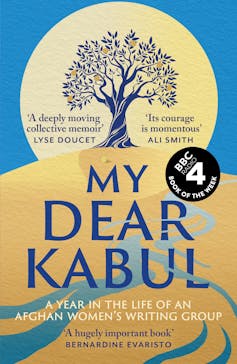
My Dear Kabul: A Year in the Life of an Afghan Women’s Writing Group
My Dear Kabul (2024) is not a traditional memoir told in a single voice, but a cartography of lived experience. It contains the voices of 21 Afghan women writers who ran a clandestine digital writing group as the Taliban consolidated power.
Drawn from WhatsApp exchanges that have been downloaded, translated and compiled into a collective diary, the book is a visceral account of life as a political system collapses.
Contributors vary in locale and literary temperament. Their entries oscillate between reportage, testimonies, narrative reflection and fragmented poetic utterance. The women in My Dear Kabul are mostly in their 20s and 30s, although there is one in her 60s. This plurality challenges monolithic representations of Afghan women.
We experience personal fear through the story of Sadaf, a teacher who describes the abrupt end to her classroom when the head teacher interrupts an exam to dismiss her Year 8 students because the Taliban are entering the city.
Fakhta, a law student from Daikundi province, had to flee the city along with other students in a university hostel. Her writing combines minute personal details with the existential uncertainty of the moment. “Towards an unknown fate,” she writes, “we all kept moving.”
A second book, Rising After the Fall (2023), edited by Lucy Hannah and Zarghuna Kargar, with illustrations by Sara Rahmani, has adapted the collective concept of My Dear Kabul for younger readers. Rising After the Fall has voices of different ages.
The book distils fragments of lived experience through glimpses of domestic resistance, displaced schooling and truncated freedoms. The edition situates Afghan girls not as passive recipients but as active narrators of their worlds. I find myself returning to it as an ideal birthday gift for young readers, a gesture of imaginative solidarity.
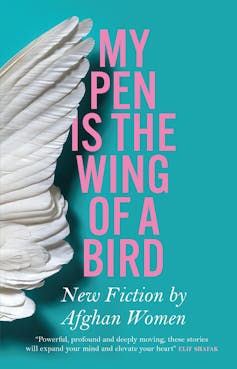
My Pen Is the Wing of a Bird: New Fiction by Afghan Women
Edited by Lyse Doucet and Lucy Hannah, My Pen is the Wing of a Bird (2022) gathers short fiction by 18 Afghan women living inside the country. The stories have been written in Afghanistan’s two principal languages, Pashto and Dari, and translated into English by Afghans, several of them writers themselves.
These narratives, some of which are set in the claustrophobic domestic sphere and others in speculative or transitional landscapes, interrogate the conditions of life under patriarchal authoritarianism.
In Sharifa Pasun’s “The Late Shift”, for example, the reader encounters Sanga, a young mother and a journalist in 1980s Afghanistan, who navigates the overlapping demands of professional life, family responsibilities and existential threat.
Sanga works evening shifts, broadcasting the day’s news under the constant threat of rocket fire. By day, she attends Kabul University, then returns home to her two-year-old child, Ghamai.
Pasun uses the figure of a working mother to depict the labour of care against a backdrop of violence. As she writes:
the roads were busy with ambulances. The rockets couldn’t be heard anymore. Sanga knew that the opposition had run out of rockets. They must be tired like her, she thought.
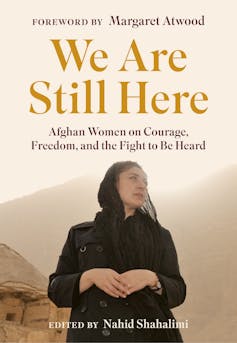
We Are Still Here: Afghan Women on Courage, Freedom, and the Fight to Be Heard
Edited by Nahid Shahalimi, We Are Still Here (2022) compiles essays, testimonies and reflections by 13 Afghan women journalists, activists, educators, scientists, coders, musicians and artists. It covers the period before and after the Taliban’s takeover.
Individual lives are situated within global militarisation, evacuation, refugee displacement and the international humanitarian regime, without personal voices being reduced to geopolitical abstractions. Contributors refuse both silence and pity.
The book foregrounds women’s agency in shaping narratives of resistance, belonging and intellectual continuity.
The story of Razia Barakzai, a former official who worked in Afghanistan’s presidential office, stands out. Barakzai describes how she and other young women organised demonstrations in Kabul, even as the risks became immediate and personal. They carried placards in Dari, Pashto and English, declaring that Afghan women still existed and demanded their rights.
Her reflections capture the moral clarity driving these protests. Her story illustrates how Afghan women’s resistance often emerges through collective courage — transforming fear into solidarity and refusing both erasure and pity.
“To be silent,” she writes, “would mean we were accepting and surrendering to the Taliban’s power.”
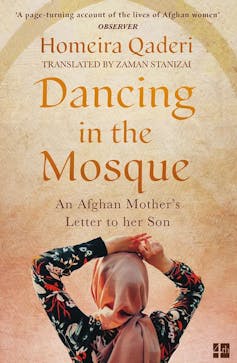
Dancing in the Mosque: An Afghan Mother’s Letter to Her Son
Although Homeira Qaderi’s memoir Dancing in the Mosque (2021) predates the fall of Kabul, it gained renewed urgency in the post-2021 landscape. It is written as a letter to Qaderi’s son, whom she was forced to relinquish after divorcing her abusive husband. Afghan custody laws and social norms overwhelmingly favour fathers after divorce.
The book’s title comes from a formative childhood memory. As a young girl, Qaderi accompanies her grandmother to a mosque where women gather to pray and mourn. At one point, carried away by a moment of joy, she begins to spin and dance. The reaction is immediate. The women around her reprimand her sharply, reminding her such movement is “inappropriate in a sacred space”.
The moment becomes emblematic. The mosque, which should be a place of spiritual refuge, becomes a site where a girl first learns the boundaries placed on her body and voice. Yet the image of the girl dancing also signals a stubborn impulse toward freedom that persists even within those confines.
The book moves associatively, drifting between childhood memories, reflections on motherhood, moments from Qaderi’s marriage, and the act of writing to her absent son. The narrative often circles back on itself, lingering on small sensory details: a room, a conversation, a fleeting moment of joy or grief.
The fragmented structure mirrors the turbulence that shapes Qaderi’s life: the dislocations of war, the contradictions of love and loss, and the unresolved ache of separation from her child. The memoir is an intimate act of remembering, where memories surface unevenly, guided by feeling rather than the orderly progression of events.
The looping, pausing and returning evokes the turbulence Afghan women have navigated. In a context where women’s education itself has been criminalised, Qaderi’s text stands as an enduring testament to the interior life as a site of resistance.
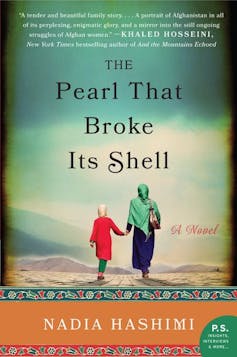
The Pearl that Broke Its Shell
“I knew nothing about pearls and shells either,” Nadia Hashimi writes in The Pearl that Broke Its Shell (2014), “except that one had to free itself from the other.”
The novel explores the quiet ingenuity with which Afghan women navigate restrictive gender norms. At its centre is Rahima, a young girl in Kabul who becomes a bacha posh (a girl temporarily raised in boys’ clothes so she can move freely in public and support her family).
The transformation allows Rahima to experience freedoms otherwise denied to her, such as attending school, running errands, even riding a bicycle through the city streets. Yet this fragile autonomy is always temporary. As Rahima reflects, “To be a bacha posh is to borrow a boy’s freedom until you are old enough to give it back.”
Across the 69 chapters of her novel, Hashimi interweaves Rahima’s story with that of her great-great-grandmother Shekiba – “born at the turn of the twentieth century, in an Afghanistan eyed lasciviously by Russia and Britain” – who also survived by inhabiting roles typically reserved for men.
Through these parallel narratives, The Pearl that Broke Its Shell reveals how Afghan women have long devised creative strategies for survival within patriarchal systems. The result is a moving portrait of resilience, one that suggests that beneath the constraints placed on them, Afghan women have courage and aspirations that persist across generations.
I’ve continued reading since the Christmas/New Year period, and as always like to share something about that material which this time includes some older publications. Only a short selection of readings this time, however some substantial commentary has been provided for the third listed book below.
Last One Out by Jane Harper, pub. 2025;
The Rainbow and the Rose, by Nevil Shute, pub. 1958;
The Agony and the Ecstasy: the biographical novel of Michelangelo, by Irving Stone, pub. 1961;
Atonement by Ian McEwan, pub. 2001.
13th January
The latest novel by Australian author Jane Harper called ‘Last One Out’, published in 2025, of 373 pages, a slow-moving novel which built up to its leading crescendo of awareness in the closing pages. A true mystery I guess, where the reader may well assume that the killer[s] are someone still in the town, but not revealed until the appropriate time. In some ways, as I read, I found myself silently saying ‘get on with the story’, yet still a difficult book to put down!!
“Last One Out” is a gripping mystery novel by Jane Harper that explores the disappearance of a young man and the haunting impact it has on his family and a small rural community.
The story revolves around Ro Crowley, who is waiting for her son Sam to return home on the night of his 21st birthday. However, Sam never arrives, and his disappearance sends shockwaves through the community of Carralon Ridge, and eventually Ro leaves her husband Cliff as they both struggle in different ways to overcome their loss.
Five years later, Ro returns to the now desolate town for Sam’s annual memorial, only to find it transformed by the encroaching coal mine that has driven most residents away. As she revisits the abandoned houses where Sam’s footprints were found, Ro seeks answers about her son’s fate, uncovering secrets that the remaining townsfolk may hold. The skeletal community is now an echo of itself, having fractured under the pressure of the coal mine operating on its outskirts. But Ro still wants answers. Only a few people remain. If the truth is to be found in that town, does it lie among them? She has not given up hope that Sam is still alive and is desperate to make sense of his final hours
From Australian Book Review of December, 2025, the reviewer, Barbara Pezzotti describes the affect of the mine on the town thus – ‘In Harper’s descriptive language, the presence of the mine is not only visible through the destruction of the landscape; it is also constantly felt and heard by the inhabitants of Carrolan Ridge. The rumbling and rattling of the machinery [24 hours a day] scarring the ground and destroying nature is constant, day and night. Replacing birdsong, it is the background to walking, eating, sleeping and talking….Heavy vehicles lumber their way up and down past people’s front doors. A grey layer of coal dust covers every flat surface, the taste of the water and the smell of sulphur in the air, a constant reminder of the mine’s devilish presence’
She also describes [in line with my opening paragraph above] where ‘In this slow-burn, stand-alone mystery, police investigation is non-existent and the burden of the enquiry rests only on Ro’s shoulders. Through flashbacks, the narrative gives an account of Ro’s five-year-long investigation. A new, unexpected clue materialises only towards the end of the novel, bringing finality’.
Chris Gordon, writing for Readings [Sept 2025] summarises the book as follows
“Jane Harper’s latest novel is a heartbreaker. There is no ruggedly handsome detective trying to make sense of his own frailties while solving a murder. Last One Out does something different to Harper’s previous works. The story concentrates on a family with a son, Sam, who disappeared five years prior to the book’s beginning. The novel’s focus remains on the mother, Ro, a doctor who fled her marriage and the community after the initial trauma. Yet she returns each year to the failing town to acknowledge her loss and to connect with the friends and family who remain. And here lies the other tragic component of the novel: the entire story is set in Carralon Ridge – an isolated rural town that has run out of steam and has been purchased for mining. The residents who haven’t left are bitter – defeated, even – and certainly nostalgic for times that now do not exist. The men seem to cower from change, while the women support everyone, clean, and hide their pain. Harper does an excellent job of working into the narrative the relentless nature of the dust, the noise of the mining, and the heat. This is not a town for tourists. This is a town that screams resentment and frustration. And this time, Ro’s annual visit uncovers the past – and her son’s murderer.
Harper has written a wonderful literary exposé of a disappearing town. The metaphors she uses are damning of the environmental damage caused by mining. She perfectly captures the limbo in which the dispirited locals are trapped, along with the social fractures and fear the uncertainty causes. This is a universal story of decline. Readers of Harper’s previous crime novels – and this is another – will delight in her steady pace and astute character observations. I found this novel painfully affecting: our rural past is swept up in the dust with more than one victim.
Reverting back to Pezzotti’s analysis – ‘Last One Out lacks the rhythm and suspense of Harper’s earlier work [all of which I have read]. The sociological and psychological study of a disappearing community is compelling, but it distracts from the crime plot…………..This is not an uplifting story of resistance and empowerment, nor is it a sharp condemnation of the evils of neo-liberalism and globalisation. The moral of the story is simply to accept the inevitable consequences of corporate greed and focus on personal regeneration , even at the expense of community’.
In an article I included in this Column a few months ago, Harper’s novel was criticised to the extent, that as with her past books, the Aboriginal population did not feature . The original Australians don’t appear to have a place in this town or in her novels, so far!
25th January
A novel written many years ago, which I’ve just caught up with was ‘The Rainbow and the Rose’, by Nevil Shute, published in 1958, of 306 pages. When seasoned pilot Johnny Pascoe tries to rescue a sick girl from the Tasmanian outback, his plane crashes and leaves him stranded and dangerously injured. Ronnie Clarke, who was trained by Pascoe, attempts to fly a doctor in to help, but rough weather makes his mission more difficult than he imagined. As he waits overnight at Pascoe’s house for a chance to try again the next day, Clarke revisits the past of this unusual man [which he does through dreams he has while asleep]—and reveals the shocking and tragic secrets that have influenced his life.
The title is taken from a sonnet “The Treasure” by Rupert Brooke, which is quoted in full as a preface:
Wikipedia summary of the novel [readers’ spoiler]
The story concerns the life of Canadian Johnnie Pascoe, a retired commercial and military pilot, who has crashed while attempting a medevac flight in difficult weather conditions into a small airstrip a mountainous region of Tasmania. Unconscious and suffering from a dangerous head injury, he lies in the house of the child he had been sent to help, which is inaccessible by road and in contact with the outside world only by radio. Hearing of his plight, Ronnie Clarke — an airline pilot and student of Pascoe decades earlier — offers to try and land a young doctor. After two failed flights in one of Pascoe’s own Taylorcraft Auster aircraft from the small flight school Pascoe set up after retirement, Clarke rests overnight at Pascoe’s house, meets Pascoe’s two daughters, and narrates the life of his former mentor through three dream episodes.
In the first episode, Pascoe is a young fighter pilot in the Royal Flying Corps during The Great War and marries an up-and-coming actress. At war’s end they separate when she accepts a role in Hollywood, moves in with another man, and files for divorce from there with sole custody of their daughter.
A few years later, in the 1920s, Pascoe is chief pilot at the small flying school where Clarke learned to fly, and becomes romantically involved with a student pilot, Brenda Marshall, whose husband is in a mental asylum after sexually assaulting children. Things go awry after the birth of Pascoe’s and Marshall’s baby daughter, and when Marshall learns that her husband has refused to grant a divorce, she commits suicide by deliberately crashing her de Havilland Moth. Pascoe leaves the country, with the baby in the care of Marshall’s mother, and shortly afterwards he learns that the baby has died
In the final dream episode, after having served with Ferry Command during the Second World War beside Clarke, Pascoe is a senior pilot with fictitious AusCan Airlines in the 1950s, flying routes between Canada and Australia, and approaching mandatory retirement at age 60. Peggy Dawson, a flight attendant and former nurse in her late 20s, asks to join his cabin crew and impresses him during the interview. They begin to spend more time together during layovers, and he develops feelings for her that he notes are non-sexual. With retirement approaching, Pascoe wants to find a way to keep Dawson in his life, so he proposes marriage, even though he does not believe that his feelings are romantic. Dawson reveals that she rightfully should be named Brenda Maragaret Pascoe. She is Pascoe’s daughter with Brenda Marshall, who Pascoe believed to have died in infancy; she had left nursing and joined AusCan airlines to observe her father and possibly to make contact with him. The framing story closes with Ronnie Clarke making a successful attempt to land the doctor and Pascoe’s daughter Nurse Dawson in clear weather the next morning, only to learn that Pascoe had died during the night. Dawson remains to arrange for an informal burial, then plans to hike 40 miles (64 km) back through to bush with the rescue party to deal with her father’s estate. There is a strong suggestion that Dawson and the young doctor have developed feelings for each other.
Clarke returns to Melbourne, 36 hours after he left, and notes that his life is full of blessings with his spouse and children, while Pascoe, who was (in his opinion) the better man, had so little joy in life.
Like Conrad, Shute often uses a narrator to tell the story; in The Rainbow and the Rose, the narrator periodically shifts from Clarke to Pascoe.
16 February
The Agony and the Ecstasy: the biographical novel of MICHELANGELO by Irving Stone, published in 1958, of 664 pages. I can’t admit to reading this mammoth book in the hurry – in fact recall when it actually came into my possession, many years ago, or whether it was a purchase or s gift. My copy was personally signed by the author. In any case, I began to read it many years ago, put it aside, probably for a couple of decades, only getting back to it early this year, and determined to see it through!
I found it not just a biography of a great artist [in novel form] but also a fascinating depiction of the historical events of the period of his life and of the political and religious strife of Italy and surrounding areas of the then Europe. Reading in particular about the Popes of those times – well hardly comparative to the perceived moral and religious authority of the modern-day Pope. That’s a story on it’s own!!
Just one of many examples: [page 636] “Cardinal Giovanni Pietro Caraffa became Pope Paul IV. No-one quite knew how he had been elected. He was a thoroughly disagreeable man, violent of nature, intolerant of all about him. Pope Paul IV, knowing how completely he was hated, said: ‘I do not know why they elected me Pope, so I am bound to conclude that it is not the cardinals but God who makes the Popes’.
Published in 1961, this is a captivating novel that chronicles the life of Michelangelo Buonarroti, exploring his artistic genius and personal struggles during the Renaissance and exploring the historical context of the time. The book is not only a tribute to Michelangelo’s genius, and at times, hi complex character, and the often tumultuous relationships he had with artists such as Leonardo de Vinci, but also a reflection on the broader tensions faced by artists in pursuit of their vision
The narrative begins with a young Michelangelo, grappling with feelings of loneliness and a desire for love following the death of his mother. His journey into artistry sees him facing both physical and emotional struggles, driven by an insatiable pursuit of perfection and the agony of creating masterpieces only to witness their destruction, and regularly facing the demands and changes of those demands by different Popes and other authorities of the time. Announcing that it was his ambition to wipe out all heresy in Italy, he unleashed on the Roman people the horrors of the Spanish inquisition”.
However, this book is about Michelangelo, although in reading through it, one quickly learns of the powerful influence that the various Popes of his time had on his work, his lifestyle, his relationships, and even at times, his life and freedom itself.
The novel emphasizes several key themes, including:
Irving Stone conducted extensive research for the novel including translating Michelangelo’s letters and studying his techniques. This meticulous approach allowed Stone to blend historical facts with fictional narrative, while the novel has been divided into precise sections that detail distinct periods of Michelangelo’s life, making the story both informative and engaging. Stone trawled through every document, including Michelangelo’s bills and legal documents, and even worked sat one time in an Italian quarry.
Writing in a publication from Sep 27-October3, 1997, called ‘The Vulture’ [an article which described itself as ‘Picks over the bones of contemporary culture], it was noted that ‘This version of the artist’s long, difficult life takes no risks. What we get is an intricate skeleton of events and a carefully textured skin of meticulous local colour. It is a fascinating canvas so long as you don’t expect much psychological flesh’. Well, if merely a skeleton, the 647 pages I read certainly contained plenty of skin and flesh!!
Having noted also with special interest the years and efforts and trials Michelangelo put into creating many if not all of his ‘masterpieces’, I found myself adding to my ‘bucket list of things I’ll never achieve’ a genuine desire to see in person those existing masterpieces such as the Sistine Chapel Ceiling, The Last Judgement, the statue David, The Garden of Eden, the Pieta, Moses, St. Peters, and so on [see following].
Getting back to the novel –
Key characters include Lodovico, Michelangelo’s father, whose harsh expectations and lack of affection contribute significantly to Michelangelo’s personal challenges. Lorenzo de’ Medici, a significant patron, embodies the Renaissance ideals that inspire Michelangelo, while Contessina de’ Medici and Clarissa Saffi represent the romantic entanglements that are ultimately thwarted by social constraints and Michelangelo’s artistic obsessions. Vittoria Colonna, a devoted reformist, captures his admiration later in life, though their relationship remains platonic. Lastly, Tommaso de Cavalieri serves as a devoted companion in his later years, showcasing the importance of friendship amidst Michelangelo’s solitary existence. This rich tapestry of relationships illuminates the artist’s life, highlighting the balance of agony and ecstasy inherent in his quest for artistic immortality.
As one reviewer noted – the novel explores his quest to become the living representation of Renaissance humanism, a journey filled with personal and professional hurdles. Michelangelo must navigate familial opposition, religious constraints, political manoeuvrings, and the competitive nature of artistic patronage to fulfill his vision.
From a Wikipedia summary we note that:
Beginnings and Early Challenges
Despite his father’s disapproval, young Michelangelo earns an apprenticeship under the painter Ghirlandaio, and later, the sculptor Bertoldo, who works under the sponsorship of Lorenzo de’ Medici, a prominent Florentine patron. Michelangelo quickly gains Lorenzo’s admiration and forms connections with his children, including future popes Giulio and Giovanni, and Contessina, his first love. He faces hostility from envious peers, including an infamous encounter with Torrigiani that leaves him physically marked, but through illicit study of anatomy, he hones the skills crucial to his craft. As Savonarola rises to power, threatening the Medici family and the cultural landscape of Florence, Michelangelo finds himself at a crossroads.
Rome: A Turning Point
Seeking refuge in Bologna during Savonarola’s reign, Michelangelo encounters Clarissa Saffi and creates “Bambino,” drawing the attention of Leo Baglioni. His first visit to Rome introduces him to influential figures such as banker Jacopo Galli, who commissions his work, and architects Giuliano Sangallo and Bramante, the latter becoming a rival. Here, Michelangelo sculpts the renowned Pieta, learns the intricacies of patronage, and becomes involved in the ambitious project of St. Peter’s Basilica, which will dominate his later years.
Return to Florence
Back in Florence, Michelangelo creates his monumental statue, “the Giant,” or David, which comes to symbolize the city itself. He crosses paths with Leonardo da Vinci, his chief rival, and Raphael, forming a triumvirate of Italian Renaissance art. Michelangelo’s rivalry with Leonardo intensifies as they compete to paint frescoes for Florence’s rulers. Pope Julius takes note of Michelangelo’s prowess and summons him to Rome, compelling him to work in bronze and undertake the monumental task of painting the Sistine Chapel ceiling. Julius’s vision of a new St. Peter’s aligns with Michelangelo’s burgeoning architectural ambitions.
Under Papal Influence
Following Julius, the Medici popes Giovanni and Giulio add new dimensions to Michelangelo’s challenges. Giovanni demands that Michelangelo procure marble from the remote Pietrasanta, inadvertently turning him into an engineer, while Giulio’s forces require him to fortify Florence, utilizing his engineering acumen. Pope Paul III commissions Michelangelo for the Last Judgment and appoints him architect of St. Peter’s amidst ongoing disputes. Michelangelo’s culminating achievement is the dome of St. Peter’s, a fitting testament to his artistic and architectural legacy. Alongside his professional triumphs, he finds personal solace in the company of Tommaso de Cavalieri, who would carry on his work on St. Peter’s, and Vittoria Colonna, his intellectual companion and muse.
Looking at perhaps the most famous of his works, with copies of these to follow:
David, completed by Michelangelo in 1504, is one of the most renowned works of the Renaissance. The masterwork definitively established his prominence as a sculptor of extraordinary technical skill and strength of symbolic imagination – created from 1501 to 1504.
The Sistine Chapel: – from the creation to Noah in 175 individual paintings covering 12,000 square feet
The creation of Adam (bottom), the creation of Eve from Adam’s rib (centre) and the temptation and expulsion of Adam and Eve from the Garden of Eden (top)
The Pieta: this is Michelangelo’s masterpiece that depicts the Virgin Mary cradling the lifeless body of Jesus after his crucifixion.
David by Michelangelo Florence Galleria dell’Accademia
[David]
The Last Judgement [1536-41]in the Sistine Chapel, Vatican City.
–
The Sistine Chapel ceiling, in the Vatican Palace [1508-1512], Vatican Palace, Vatican City
The Creation
Above -Madonna and Child [1524-34], Medici Chapel, Florence; and below, The Last Judgement [1536-41]in the Sistine Chapel, Vatican City.
In conclusion, the night before Michelangelo died [in Irving Stone’s fictional biographical terms]
[page 647] “That night, as he lay sleepless in bed, he thought, ‘Life has been good. God did not create me to abandon me. I have loved marble, yes, and paint too. I have loved architecture, and poetry too. I have loved my family and my friends. I have loved God, the forms of the earth and the heavens, and people too. I have loved life to the full, and now I love death as its natural termination. Il Magnifico would be happy: for me, the forces of destruction never overcame creativity.”
19th February
Another book from earlier years – Atonement by Ian McEwan, published in 2001, of 372 pages. This book was shortlisted for the 2001 Booker Prize, and after reading, I was not surprised with that nomination. Widely regarded as one of McEwan’s best works, ‘Time’ magazine named Atonement in its list of the 100 greatest English-language novels since 1923.
It is set in three time periods, 1935 England, second World War England and France, and present-day England, and covers an upper-class girl’s half-innocent mistake that ruins lives, her adulthood in the shadow of that mistake, and a reflection on the nature of writing.
On the hottest day of the summer of 1935, thirteen-year-old Briony Tallis sees from a distance, her sister Cecilia strip off into her underwear, and plunge into the fountain in the garden of their country house to retrieve a vase that has been thrown in by the son of the estate’s cleaner, who has virtually been a part of the family since childhood. . Watching her too is that family friend, Robbie Turner who, like Cecilia, has recently come down from Cambridge. By the end of that day, the lives of all three will have been changed for ever. Robbie and Cecilia will have crossed a boundary they had not even imagined at its start, and will young become innocent victims of a young girl’s imagination and writing ambitions as Briony commits a crime for which she will spend the rest of her life trying to atone, while the other two, and the extended family suffer and have their lives changed in various ways.
As noted on the ‘Bookaholic Academy’ a few years ago – ‘Some books are just stories, and then there are those that feel like they’ve crawled under your skin and left a mark. Ian McEwan’s Atonement falls into the latter category. It’s not just a novel – it’s a gut punch wrapped in beautiful prose, a story about guilt, love, and the slippery nature of truth. If you’ve ever wondered how one mistake can ripple through lives like a stone thrown into water, this book gives you the answer in heartbreaking detail’.
That and the vivid heart-rending depictions of the allies and civilians as they flee from the Germans towards Dunkirk [the second period of the book], and the horrific [to a bystander as a reader] experiences of both Briony and her sister as nurses in the English hospitals attending to the wounded arriving from across the Channel from France [third time period] emphasise so strongly that second category mentioned above.
I’ve copied below the full synopsis of the book, as published by Wikipedia, which is basically a spoiler for those who may be intending to read the book. As a ‘non-spoiler’, a brief plot overview could be:-
‘At it’s core, Atonement is about Briony Tallis, a 13-year-old girl, with an overactive imagination. One hot summer day in 1935, she witnesses something she doesn’t fully understand. But instead of keeping her confusion to herself, she makes an accusation – one that changes the lives of her sister Cecilia and Cecilia’s lover, Robbie, forever. From there, McEwan drags us through the brutality of World War II, the fragility of love in a world torn apart, and the crushing weight of regret. The structure is layered, moving from a childhood mistake to its devastating consequences, and finally to the lasting scars left behind’.
At this point, if you don’t want to read the spoiler, stop reading here!
From a Wikipedia contribution about ‘Atonement’
Part one
Briony Tallis, a 13-year-old English girl with a talent for writing, lives at her family’s country estate with her parents Jack and Emily Tallis, who are members of the landed gentry. Her older sister Cecilia has recently graduated from the University of Cambridge with Robbie Turner, the Tallis family housekeeper’s son and Cecilia’s childhood friend, whose university education was funded by Jack Tallis.
In the summer of 1935, Briony’s maternal cousins, 15-year-old Lola and 9-year-old twins Jackson and Pierrot, visit the family amidst their parents’ divorce. Cecilia’s older brother Leon returns from London, accompanied by his friend from Oxford, the well-off manufacturer Paul Marshall. Cecilia and Robbie bicker over a vase, which breaks and falls into a fountain. Cecilia strips to her underwear and dives in to retrieve the pieces, surprising Robbie. Briony, watching from a window, is confused and intrigued by Cecilia and Robbie’s actions. She is inspired to begin writing psychological realism, and the reader is informed that this will eventually become a hallmark of her fiction.
In the wake of the incident by the pond, Robbie realizes he is attracted to Cecilia, and writes several drafts of a love letter to her. He gives the letter to Briony to deliver to Cecilia; however, he inadvertently gives her a version he had meant to discard, which contains lewd references (“In my dreams I kiss your cunt“). By the time Robbie realizes his mistake, Briony has already returned to the house with his letter.
Despite Robbie’s instructions to the contrary, Briony opens the letter and reads it. She is shocked by its vulgar language, and becomes convinced that Robbie intends to harm Cecilia. An injured Lola goes to Briony for comfort, claiming that her younger brothers attacked her, although it is implied to have instead been Paul Marshall, who has a long scratch on his face. Briony relays the contents of the letter to Lola, who labels Robbie a “maniac,” re-affirming Briony’s feelings. Robbie arrives at the main house for a family dinner party, and is confronted by Cecilia. He confesses his feelings to her, and she responds in kind. Later the same evening, Briony walks in on Robbie and Cecilia having sex in the library. The immature Briony believes she interrupted a vicious assault on Cecilia, and stands stunned while Robbie and Cecilia quickly exit.
At the dinner, which is generally tense, it is discovered the twins have run away. The party breaks into teams to search for them. When Cecilia goes with Leon, Robbie and Briony each set off on their own. In the darkness, while everyone is searching for the twins, Briony discovers her cousin Lola being raped by an assailant neither girl can clearly see. The attacker flees. Briony, convinced that it must have been Robbie, gets Lola to agree that she likely heard Robbie’s voice. The girls return home, and Briony identifies Robbie to the police as the rapist, claiming she saw his face in the dark. Lola is sedated by the local doctor, Cecilia screams at Briony and locks herself in her room, and Paul Marshall shares cigarettes with the policemen.
Robbie does not return, and the family and police officers stay awake waiting for him. As dawn breaks, Robbie appears in the driveway with Jackson and Pierrot, having found and rescued them. He is arrested on the spot and taken away, with only Cecilia and his mother believing his protestations of innocence. Briony is satisfied by this conclusion to her mythologized version of the events, with her as the hero and Robbie as the villain.
Part two
By the time the Second World War has started, Robbie has spent several years in prison. He and Cecilia have passed several years exchanging letters, maintaining their love for each other. Robbie is released from prison on the condition he enlist in the army. Meanwhile, Cecilia has completed training as a nurse, and cut off all contact with her family for the parts they played in locking Robbie up. Shortly before Robbie is deployed to France, they meet once for half an hour, during Cecilia’s lunch break. Their reunion starts awkwardly, but they share a kiss before leaving each other.
In France, the war is going badly, and the army is retreating to Dunkirk. As the injured Robbie makes his way there, he thinks about his love for Cecilia and his hatred for Briony. However, he eventually concludes that Briony was too young to be blamed fully, and writes Cecilia a letter encouraging her to reconnect with her family. His condition deteriorates over the course of the section; he weakens and becomes delirious. Robbie falls asleep in Dunkirk, one day before the evacuation begins.
Part three
A remorseful Briony, now eighteen years old, has refused her place at Cambridge and instead is a trainee nurse in London. She has realised the full extent of her mistake and decides it was Paul Marshall, Leon’s friend, whom she saw with Lola.
Briony still writes fiction, and receives a letter from Cyril Connolly at the hospital where she works. Cyril is rejecting Briony’s submitted draft of her latest work to his magazine, Horizon, but providing kindly and constructive feedback. The work is in fact the first draft of the first section of this novel.
Briony travels to attend the wedding of Paul Marshall and her cousin Lola, with the knowledge that Lola is marrying her rapist. Briony considers speaking up during the wedding, but does not. Afterwards, she visits Cecilia, who is cold but invites Briony in nonetheless. While Briony is apologizing to Cecilia, Robbie unexpectedly appears from the bedroom. He has been living with Cecilia while he is on leave from the army. Robbie expresses his fury at Briony, but with Cecilia’s soothing remains civil.
Cecilia and Robbie both refuse to forgive Briony, who nonetheless tells them she will try to put things right. She promises to begin the legal procedures needed to exonerate Robbie, even though Paul Marshall will never be held responsible for his crime because of his marriage to Lola. As Briony leaves Cecilia’s, she is optimistic about her role in Robbie’s exoneration, thinking that it will be “a new draft, an atonement” and that she is ready to begin.
Postscript
The final section, titled “London 1999”, is narrated by Briony herself in the form of a diary entry. Now 77, she is a successful novelist who has recently been diagnosed with vascular dementia, so she is facing rapid mental decline.
It is confirmed that Briony is the author of the preceding three sections of the novel. She attends a party in her honor at the Tallis family home, where the extended Tallis children perform The Trials of Arabella, the play that 13-year-old Briony had written and unsuccessfully attempted to stage with her cousins in the summer of 1935. Leon and Pierrot are in attendance, Jackson is fifteen years deceased, and Lola is alive but does not attend. Finally, Briony reveals to the reader that Robbie Turner died of septicaemia on the beaches of Dunkirk, that Cecilia was killed several months later when a bomb destroyed Balham Underground station during the Blitz, and that Briony’s story of seeing them together in 1940 was a fabrication. Briony did attend Lola’s wedding to Paul Marshall, but confesses she was too “cowardly” to visit the recently bereaved Cecilia to make amends. The novel, which she says is factually true apart from Robbie and Cecilia being reunited, is her lifelong attempt at “atonement” for what she did to them.
Briony justifies her invented happy ending by saying she does not see what purpose it would serve to give readers a “pitiless” story. She writes, “I like to think that it isn’t weakness or evasion, but a final act of kindness, a stand against oblivion and despair, to let my lovers live and to unite them at the end.”
I usually like to provide a summary of these awards each year, and decided 2026 should not be an exception.
There were 33 nominees for the four ‘Australian of the Year’ Awards for 2026 from the various Australian States and Territories – those award categories were:
Australian of the Year;
Senior Australian of the Year;
Young Australian of the Year; and,
Local Hero/
The Australian of the Year is a national award conferred on an Australian citizen by the National Australia Day Council, a not-for-profit Australian Government-owned social enterprise. Similar awards are also conferred at the state and territory level and the respective winners of those Awards represent the nominees at the national level. The award offers an insight into Australian identity, reflecting the nation’s evolving relationship with world, the role of sport in Australian culture, the impact of multiculturalism, and the special status of Indigenous Australians. It has also provoked spirited debate about the fields of endeavour that are most worthy of public recognition. The award program promotes active citizenship and seeks to elevate certain people as role models. The three companion awards recognise both Young and Senior Australians, as well as the efforts of those who work at a grass roots level through the ‘Australia’s Local Hero’ award.
In the following article, we will:
Summarise each of the respective nominations in each of the four award categories; and;
Reveal the four winners of the National awards.
Nominations in each category were as follows
Australian of the year
The eight nominations for the Australian of the Year Award this year with brief biographies [full bios can be found on the National Australia Day website] are as follows, the winner to be chosen from each of the respective state and territory nominations
ACT: Professor Rose McGready has spent three decades providing health services to displaced people in the border region between Thailand and Myanmar, with her commitment, compassion and clinical expertise providing life-saving aid to some of the world’s most vulnerable communities.
NSW: Dr Alison Thompson has deployed thousands of volunteers to the world’s worst disaster zones, and in doing so, building resilience in local communities through sustainable, locally driven disaster prevention and recovery.
NT: Dr Felix Ho tirelessly serves remote communities in the Northern Territory as a medical practitioner. Through the St. John Youth Program, he brings people together across geography and generations to equip Australia’s youth to save lives through first aid in an emergency.
Qld: Dr Rolf Gomes has had a far-reaching impact on rural health and medicine, through amongst other efforts, his launching of the first Heart of Australia mobile ‘Heart trucks’ to visit remote communities.
SA: Katherine Bennell-Pegg is creating history as the first Australian to qualify as an astronaut under Australia’s space program, having trained as part of a class of six by the European Astronaut Centre in Germany, chosen from a field of over 22,500 applicants. She is considered a trailblazer in Australia’s emerging space industry.
Tas: Dr Jorian [Jo] Kippax was part of a specialist team of rescuers involved in freeing a whitewater rafter trapped in the Franklin River rapids in 2024. That rescue was just one chapter in Jo’s long career in emergency medicine, disaster response and search and rescue.
Vic: Carrie Bickmore is a radio and television presenter who has changed the way that brain cancer research is funded in Australia, and in 2021, she established the Brain Cancer Centre to bring together the brightest minds in research to find a cure.
WA: Dr. Daniela Vecchio is the head of mental health and addiction services at the Fiona Stanley Hospital, and is a pioneer in establishing in 2022 the first publicly funded gaming disorder clinic in Australia
Senior Australian of the Year
Tas: Julie Dunbabib: a pioneer in school nutrition, who is changing the way education departments and schools prepare and deliver school lunches to children.
NSW: Professor Henry Brodaty: he is transforming the diagnosis, care and prevention of dementia – improving countless lives, both in Australia and around the world.
SA: James Currie: his filmography reads like a list of South Australia’s most successful films over the past 50 years. His work as a sound designer, recordist and mixer includes titles such as Breaker Morant, The Lighthorsemen, Bad Boy Bubby, The Tracker, Wolf Creek, Ten Canoes, Red Dog and, most recently, the AACTA award-winning documentary My Name is Gulpilil.
And: Malcolm Benoy: he has made a significant contribution to climate change research in his role as a volunteer citizen scientist, helping to preserve valuable records and data relating to South Australia’s meteorologicalhistory.
NT: Jenny Duggan OAM: For decades, Jenny has shown extraordinary grassroots leadership as Katherine’s ‘rubbish warrior’, quietly transforming the landscape and community spirit of her town.
Each morning Jenny walks the banks of the Katherine River to remove litter. In collecting hundreds of kilograms of rubbish, she’s put the spotlight on environmental safety.
QLD: Cheryl Harris: Cheryl Harris has been instrumental in driving volunteer engagement and championing the important work that volunteers perform on the Sunshine Coast.
ACT: Heather Reid AM: has made it possible for thousands of women to play football, both in the Australian Capital Territory and around Australia. Heather was instrumental in establishing the Australian National University Women’s Soccer Club in 1978 and the Australian Capital Territory Women’s Soccer Association a year later.
Vic: Bryan Lippman, AM: As a young social worker, Bryan witnessed first-hand the appalling conditions in which many elderly homeless people were forced to live. Realising that existing aged care homes were not the answer, he founded Wintringham to provide a safe space where the elderly poor and homeless could live with dignity and respect. Today, Wintringham supports 3,000 people with accommodation and home care services.
WA: Professor Kingsley Dixon, AO: from The University of Western Australia is an internationally recognised botanist whose devotion to science has transformed Australian native plant conservation.
As Foundation Director of Science at Perth’s Kings Park and Botanic Garden, Kingsley shaped a small research unit into one of the world’s top five botanic garden-based science centres. One of Kingsley’s most notable achievements is the 1992 discovery of smoke as a cause for Australian plants to germinate after bushfires.
Young Australian of the Year
Tas: Alyssia Kennedy: realising how important life skills can be, Alyssia founded the Life After School program, an educational package to help bridge the gap between school education and life knowledge. She now works with schools and youth groups to deliver the program and give young people the tools they need to transition to adulthood.
NSWE: Ned Brockmann: ultra marathon runner for the homeless: a then 23-year-old electrician from Forbes, had a goal – to run across Australia and inspire people to do more for themselves and the homeless. Nedd’s concern for homelessness was sparked by his journey into TAFE every week where he saw too many people sleeping rough on Sydney’s Eddy Avenue. He wanted to do something to highlight homelessness, its complexities and prove that it’s solvable.
SA: Chloe Wyatt-Jasper: Chloe Wyatt-Jasper has applied her lived experience of trauma and mental health challenges to help other people facing similar issues. Chloe experienced a domestic violence family tragedy at a very young age and has lived with profound mental health conditions as a result. In speaking out about these challenges, Chloe hopes to help other people overcome the stigma often associated with mental health.
NT: Jaiden Dickensen: as a proud Warumungu man Jaiden Dickenson is a beacon of hope and resilience for young people in the Tennant Creek, Ali Curung and Elliott communities. In his role as a Tennant Creek Mob Youth Diversion Officer, Jaiden helps young people address the trauma at the root of crime and social disorder by taking responsibility for their behaviour, overcoming their personal challenges and moving towards rehabilitation.
Qld: Jarib Branfield-Bradshaw: youth worker and mentor: As a proud Kooma man and youth worker, has made a huge difference to the town of Cunnamulla by opening a youth neighbourhood centre. As a local himself, Jarib knows what it’s like to live in a quiet town where there’s not a lot for young people to do outside the home.
ACT: Sita Sargeant: historian and guide: Sita is forging a distinctive approach to storytelling and historical research, highlighting little-known women’s stories and their impact on towns and cities across Australia. She is the founder of She Shapes History, a historical tourism company and social enterprise dedicated to uncovering the often-overlooked stories of women who have shaped Australia in ways that receive little or no recognition. Through walking tours, digital content, and partnerships with cultural institutions and historic sites, Sita reveals how women’s contributions have long been ignored by mainstream history
Vic: Abraham Kual: Abraham Kuol is a respected youth leader who uses his knowledge of the police and justice system in Victoria to help young people in his community. Day to day, Abraham devotes his time to mentoring and guiding young people, running sports programs and building community ties – all while studying for a PhD in Criminology at Deakin University where his research is having a real-world impact.
WA: Dr Haseeb Riaz and Gareth Shanthikumar: positive masculinity educators: Haseeb and Gareth felt that negative stereotypes of masculinity were harming young men, so they established MAN UP to help young men strengthen their mental health, communicate openly and build pathways to healthier lives. Through workshops on male culture, respectful relationships and emotional coping, they provide boys with safe, relatable spaces to explore identity, relationships and emotional literacy.
Local Hero Award
NSW: Theresa Mitchell: Theresa cares for people who are homeless or in crisis, providing a compassionate lifeline for people who’ve fallen through the gaps. Opening its doors in 2009, Agape Outreach Inc began when Theresa found she couldn’t walk past homeless people on the street anymore. So, she handed out meals she cooked in her own kitchen, and it went on from there.
SA: Ayesha Safdar: community leader. Ayesha has dedicated herself to helping newly-arrived migrant and refugee women find their place in Australian society. In 2010, Ayesha founded the Adelaide Pakistani Women’s Association (APWA) to create a safe, inclusive space for Pakistani women adjusting to life in Australia. Today, the association works with women from all backgrounds, helping them to navigate their way through a new culture and acquire language skills, education and employment. Ayesha is empowering women to build their confidence and develop the skills they need to create a new life in Australia
NT: Ron Green, BM ESM: Emergency services and St. John Ambulance volunteer: Local legend Ron has volunteered hundreds of hours keeping his community safe in times of crisis. Since 2005, he’s grown and strengthened the success of the Katherine Volunteer Unit of the Northern Territory Emergency Service. Ron also fights bushfires and attends vehicle crashes as a volunteer for the Northern Territory Fire and Rescue Service. On top of this, he leads the Katherine Youth Division of St John Ambulance, where he inspires and trains future generations of emergency first responders.
QLD: Ian Gay: he has dedicated more than 20 years to helping people with disabilities enjoy the surf in a fun, safe way. As a volunteer with the Disabled Surfers Association Gold Coast (DSAGC), Ian has held many roles and was branch vice president until 2015 and then branch president from 2015 to present.
ACT: Ben Alexander: Ben is well known in Canberra for his rugby career with the Brumbies and Wallabies. Since retiring, he has turned his focus to mental health, co-founding Running for Resilience (R4R) with Matt Breen to help make Canberra suicide-free by 2033. R4R helps people overcome personal struggles by exercising and connecting with others. Every week, hundreds join free runs and walks across Canberra to boost their physical and mental health.
Vic: Linda Widupp: Linda is bringing hope to Australian farmers in their time of need, organising deliveries of invaluable feed in response to drought and natural disasters. Linda founded Aussie Hay Runners in 2019, starting out with just four trucks delivering hay to help farmers feed their livestock. The voluntary organisation now has more than 70 trucks it can call on, clocking up millions of kilometres and delivering over 90,000 bales of fodder to farmers needing a helping hand
WA: Frank Mitchell: Indigenous construction leader: he is a proud Whadjuk-Yued Noongar man, co-director of Wilco Electrical and co-founder/director, of Kardan, Baldja and Bilyaa in the trades and construction industry. Frank’s commitment to change was shaped by early lived experiences of suicide and the loss of best friends. As a young single father, being offered an electrical apprenticeship felt like a profound opportunity. When he became a business owner in 2015, he pledged to create the same opportunities for Mob.
Tas: Emily Briffa: Emily’s social enterprise, Hamlet, has helped many disadvantaged and marginalised people in Hobart overcome employment barriers and transform their lives. Hamlet is a community café that provides individualised training, work readiness and wrap-around support to Tasmanians with disability, neurodivergence, and mental health concerns who are experiencing barriers to employment
And the four Australian of the Year Award winners as announced by the Prime Minister of Australia in Canberra tonight were:
“I can tell you that, having got out and about across Australia over the last year, that there are so many young people dreaming of the stars,” she said. “Curiosity and potential have no postcode and no gender, but talent is everywhere, and aspiration can be, if we foster that confidence.”
I studied the Russian novel ‘Crime and Punishment’ back in 1964 as part of an English Literature course that year, so was interested to find the following article published as the Friday Essay in the on-line edition of ‘The Conversation’ earlier this month. Written by Kevin John Brophy, the Emeritus Professor of Creative writing at the University of Melbourne, on December 5th, he also was returning to the novel after 60 years, and claimed to be still ‘awed’ by it.
I share his reflections of ‘Crime and Punishment’ by Fyodor Dostoevsky below. Whether I ever make the time to reread the novel remains to be seen, perhaps Brophy’s return to it may suffice!
The old woman who once sliced our front garden hose with a knife has just walked past our home without pausing. Not long after the hose incident I confronted her with what she had done and she denied ever walking along our street, let alone cutting anyone’s hose, or even carrying a knife.
In fact she emptied her bag for me and there was no knife in it. I had been searching on the web about strange behaviour among the elderly and one source noted that it is not uncommon for aged women to carry a knife in their bag. I am not sure what this means, but each time I see the old woman (and I see her often on our street), I feel reassured when she manages to pass by our front garden without a glance in the direction of the hose – though the lingering question of the motive for her crime remains.
I am rereading Fyodor Dostoevsky’s Crime and Punishment 60 years after first being enthralled by it, with the idea of testing myself against an experience I’ve long been convinced upended me as a teenage reader, then shaped me as a university student of the 1970s who channelled his version of Dostoevsky’s protagonist, Raskolnikov – a name that means something like “heretic”, or one who cuts themselves away from their community.
Rereading is a risk, of course, for the book might fail to stand up to my memory of it as powerful, original, frightening, scandalous and utterly compelling. It might no longer surprise me and I might have to shrink it back to a diminished place among books that are not, after all, lastingly great in my reading life.
Early on, a first surprise for me is that Raskolnikov was handsome. In my memory his figure is physically as repulsive as his psyche. But no, on the first page of the novel Dostoevsky is at pains to tell the reader that his student was attractive. Later, Raskolnikov’s sister, Dunya, who looks just like him, is repeatedly the subject of men’s desires on account of her beauty.
My second surprise in these early pages is the drunkard, Marmeladov, saying he’s drinking up his eldest daughter’s income from “the yellow card”, that is, from her work as a prostitute. Did I even know what the man was talking about when I was 14?
I was a Catholic boy from a family of nine children and being the first son, I was the one who would go into a monastery at 18 and last there for two years of study, silence and prayer. How was it that I had even come across such a novel on the faintly rural fringe of early-1960s Melbourne in the outer suburb of Watsonia, where soldiers of the second world war had been given blocks of land at bargain prices?
I had been a comics reader as much as a book consumer through my childhood and early teens, and Classic Comics had introduced me to a world of “classic” stories, including Dostoevsky’s. Classic comics made the stories look dramatic and serious. I wanted intensely to go further into that realm.
Like any young reader discovering the world’s rich history of storytelling I wanted to read what was beyond my understanding and capacity. The thick weightiness of Crime and Punishment (first published in 1866), a handsome paperback, its ultra-thin pages, the adult gravity of such small print and the dully serious, high-art cover, all of this made me feel I had arrived at something worth curling up with for days on end. The novel took a grip on me even through the fog of a devout Catholicism and the security of a tightly-guarded family circle.
Soon after we meet him, Raskolnikov receives a long letter from his mother promising money in a few days’ time, while going on to narrate a brief and apparently fortuitous courting of his sister by a vain and forceful businessman more than twice her age. And yet, his mother writes, this suitor appears to be kind and, as he says himself, without prejudice. She ends her letter remembering Raskolnikov as a child babbling prayers on her lap. “I fear in my heart”, she writes, “that you may have been affected by this latest fashion of unbelief.”
Not softened by his mother’s love, her generosity, or even by her fears, Raskolnikov goes out into the streets of St Petersburg with a face “distorted” by a “nasty, lugubrious, jaundiced smile snaking across his lips” as he vows never to allow his sister’s marriage to take place.
Throughout the first vodka-soaked chapters, not only does a man confess to living off his daughter’s prostitution, but a drunken teenage girl on the street, only partly dressed and most likely already abused, is openly followed by a man who wants her for his pleasures, and Raskolnikov recalls, or dreams (it is unclear) the beating of a horse to death, after remembering that he used to play in a certain cemetery where his brother, who died at six months, was buried.
In each episode, Raskolnikov seems to be both an element of Petersburg’s abject street life and a lone figure of sobriety, decency and compassion. He protects the young girl on the street until she is safe. He suffers for the horse. But we are also witness to the fact that he has already condemned his own soul for indulging in the desire to kill an old woman.
Reading anew the passage describing the beating of a horse outside a drinking house, (in my Penguin edition, translated by David McDuff), I remember that as a child I had seen a man do just this to a horse. Is it a true memory though? When I was a child I used to accept rides on a milkman’s cart in the mornings on my way to the local church to serve as an altar-boy at early mass, so it was not unusual to see horses in mid-1950s Melbourne.
Or perhaps while reading this passage I was reliving my first encounter with it as if it was a scene I had witnessed myself. I can’t be certain. The scene in the novel, horrific and gothic, is barely realist though utterly real. In my memory I have an image of my father driving me past a patch of grass outside flats along Murray Road in Coburg where we passed a man flogging a horse. My memory is that this was the first time I fully realised humans had absolute and merciless power over animals.
The beating to death of the horse works as the first murder in the novel, a climax to the phantasmagoria of cruelty, immorality, decadence and drunkenness we have been witness to in the early pages. The beating of the horse, so unsettling to Raskolnikov, is an uncanny rehearsal of the wanton brutality he’s contemplating committing himself. The novel swings between chaos encountered on the streets and an inner world of tormented thoughts with such pressing vertigo that one becomes a mirror of the other.
That the murder of the old woman happens so early in the book startled me then and still does. I remember wanting to know from the inside the mind of a character capable of such a crime. There was something of the voyeur to my desire, but something too of a hint that through this reading experience I was in connection with a real and dangerous part of myself.
And now, so much later, from this end of life, I perceive Raskolnikov not so much as a possible me, but as a victim of his thinking, reading, youthful extravagance, boundless ambition and of course his fashionable unbelief. The novel was possibly a dangerous one for me to be reading as a naïve 14-year-old.
It was nearly another ten years beyond my first reading Crime and Punishment when a late 20th century version of fashionable unbelief took me from the Catholic Church towards what I experienced as freedom from belief in God.
Through my twenties I lived at least partly as a version of Raskolnikov: a student, chronically poor, renting rooms in share houses, intense to a fault, absorbed in a feverish imagination, dressed in worn-out clothes. And like Raskolnikov, I chose to live this way. In the 1970s there were whole suburbs of students living like this around inner-city universities. But the murderer in Raskolnikov was seemingly forgotten by me at this time, perhaps in denial, but just as it is ignored through long passages of the novel.
Re-reading now the scene of the murder of the old woman, I am shocked that I had forgotten it was a double murder, and that the second murder was so cold-bloodedly executed on the old woman’s younger sister, the one whose life might have been, in Raskolnikov’s earlier thoughts, saved and transformed by the death of her miserly, oppressive, older sister.
At the moment of the double murder all sympathy for Raskolnikov should disappear. In fact, perhaps at this point of the novel some readers would simply abandon the book unwilling to go the journey with such a character for another 500 pages. In 1866, when it appeared in monthly instalments in The Russian Messenger, then an influential, progressive literary journal, the book caused a sensation. Some readers were so affected they felt ill. Many put the novel aside, though most, like me a century later, were unable to put it down.
The attraction of the book might have something to do with it being almost a crime, one feels, to keep reading after the murder scene. Other later works of fiction such as Nabakov’s Lolita, Robert Block’s Psycho, Louis-Ferdinand Celine’s Journey to the End of the Night, or Anais Nin’s diaries also powerfully attract as much as they repel and distress.
In hindsight, this was my introduction to intimations of a dark side to literature, leading me to writers such as Franz Kafka, Thomas Hardy, Joseph Conrad, Sigmund Freud, T.S. Eliot, Thomas Mann, Virginia Woolf and the agonied loneliness of so many characters in modernist novel after novel, on to the suicidal ruminations of Thomas Bernhard’s fiction, and even the tortured and hilariously desperate isolation of Gerald Murnane’s young men in his early works. Raskolnikov showed the way ahead to a century and more of misfits and misanthropes.
In a new biography of composer and writer Erik Satie, Ian Penman makes a plea for re-balancing the story of modernity:
Why this general tendency to fetishise ‘darkness’? Why is so much reflection about modernity tangled up with melancholy? Why do we overstress the abject, the obscene, the transgressive? […] I mean, don’t we all want to be happy? Why fight against it?
His plea for relief makes good sense, especially perhaps for music, but the crises in the hearts of characters from Mary Shelley’s monster onwards, through Charles Dickens’ villains, to the grotesque creations of Wilkie Collins and later Camus’ murderous Meursault, are too urgently conjured for this reader to turn entirely from them.
So I do keep reading this time and not out of any sense of duty to literature or my former self, but because the novel does, once again, grip. It compels me forward by the force of scene after scene that screws Raskolnikov closer and closer to whatever might be the punishment promised in the title.
And if his conscience does bring him to punishment, how are we to know what is just? And how might his heart or his thinking bring him to embrace his punishment? What would it mean for my feelings about him if he gets away with it or does not feel something like remorse and revulsion over what he has done?
And was it, after all, a motiveless crime? Was it an act of unfeeling pride so misguided and mangled that one has to feel equal horror and sympathy for a killer who can sometimes act so selflessly? Is Raskolnikov finally as capable of love as he is of murder?
Current events snag on the novel as I read it this time. Its questions swirl around the criminal trial and sentencing of Erin Patterson, found guilty of murdering three members of her extended family with a carefully prepared meal of death cap mushrooms (a conviction she is now appealing). An almost unimaginable crime. Everyone with an interest in the case must imagine for themselves what might have been going on inside her as the murder was planned. A growing number of videos and podcasts explore what might have been Patterson’s motivations. At her public sentencing, Justice Beale at last addressed her directly on the reasons for her crimes with: “Only you know why you committed them.”
And as with Raskolnikov, Patterson is smart, but she was clumsy too. When Raskolnikov defends himself against accusations of being a lecher, accusations manufactured by his sister’s suitor, Luzhin, he remarks about him (but equally about himself), “He’s a clever man, but in order to act cleverly, cleverness alone is not enough.”
I don’t sympathise with Raskolnikov, but I don’t turn from him as a monster either. He can be compassionate without being saintly, generous to his last kopeck, honest to his own detriment, and instinctively respectful of those who suffer – and yet there he was with the axe in that room.
At almost breakneck speed Dostoevsky lets the murderer loose on the streets, where he encounters more prostitutes, gives away money, mock-confesses to committing the axe-murder at a night club, watches a suicidal woman jump into the city’s main canal only to be rescued against her will, possibly saving him from the same experience.
Then, as he is on his way to the police station to make an actual confession, he rescues the drunken Marmeladov from under the panicked horses of a barouche and delivers him, dying, to his destitute family, summoning a doctor and leaving the new widow with all the money (his mother’s gift) he has in his possession.
In almost every respect he seems an innocent in a world of depravity. Of course Dostoevsky is playing with his readers, daring us to sympathise with this young man, to witness his compassion, and to put aside for pages at a time the knowledge of the double murder he has committed. This is such a risky skating across thin ice that one does not want to stop following until the far bank is reached. I have no idea what my young self was making of all this beyond deciding to read on through it trusting the storyteller and trusting that the story would be a large and lasting one because it is, well, Russian, a masterpiece, and a “classic”.
I am shocked all over again by the fact that Raskolnikov himself does not seem to remember that he killed not just “one old woman”, but two women. He is repeatedly far too ready to minimise his crime.
When the young, accommodating docotor Zosimov begins talking at length out of vanity and pride, as most characters in the novel do when they launch into speeches, he tells Raskolnikov’s mother and sister, that Raskolnikov might be displaying a certain idée fixe, suggesting a case of “monomania” – a condition so interesting that he, Zosimov, is conducting a special study of it.
Monomania? I don’t remember this word quite popping out at me that first time the way it does now. It is strangely medical, strangely decisive. After some reading on it I discover that this was a relatively recently invented psychiatric diagnosis introduced to medicine in the first two decades of the 19th century partly through a Dr Etienne-Jean Georget who first defined Monomania as an idée fixe – a single pathological preoccupation in an otherwise sound mind.
After Georget’s published speculations on whether criminals could be defended on the basis that a monomania might diminish their culpability, French lawyers took up this line of defence so enthusiastically that the diagnosis had become discredited by the 1850s. You might say that monomania became a legal idée fixe.
For Dostoevsky’s readers it might have been a medical-sounding word, but one that also rang of sham psychiatry. In this scene the diagnosis washes through mother and daughter and Zosimov leaves in a hurry. But reference to the diagnosis keeps recurring, and oddly it will finally be tangled with Raskolnikov’s fate.
In a remarkably tense scene in the central police station, Detective Porfiry Petrovich exposes Raskolnikov’s authorship of a philosophical article that argued for the superiority of certain rare individuals above the norms of common humanity. These individuals can and apparently, must, commit crimes in order to do the work that will benefit humanity.
Raskolnikov tries to say his article is no more than a mild acceptance of what history has demonstrated, until, from the corner of the room, Amyotov, to whom Raskolnikov had made his mock confession, says, “Perhaps it was some budding Napoleon who did in old Alyona Ivanovna with an axe last week.”
Reading this now, it is difficult not to think of the sovereign citizens movement, far right conspiracy theorists, white supremacists, cults of the Christian kind and others who consider themselves to be outside norms and law – an often smart and always disturbing minority presciently described in Dostoevsky’s novel. Raskolnikov is an outrageous outsider, and like many of the far right conspiracists now, initially his complaints and suspicions about the hypocrisies of the powerful are acute and accurate until the line of argument takes him to its farthest reaches, to murder.
Sometimes an image seems to have been thrown into a novel just to see what will happen. Like a stone into a pond, a fishing line into surf, a boot into a crowd, a hat into the air. The troubling and provocative figure of Svidrigailov appears, a wealthy widower infatuated with Raskolnikov’s sister, possibly guilty of murdering his wife, and almost certainly guilty of raping a disabled girl – a twisted mirror image of Raskolnikov if Raskolnikov ever fully embraced the nihilism and exceptionalism he wrote of in his journal article. It is Svidrigailov who suggests eternity might be a small room no larger than a country bathhouse with soot on the walls and spiders in every corner. In fact, he says, this is the way he would have it if he had been given the job of designing things.
Do I remember first encountering this image of eternity? I think I do, and it connects for me with room 101 in George Orwell’s 1984, only here it is not the ultimate in torture, it is all there is that can be hoped for. The lasting effect of this image of eternity might have had something to do with the standard Catholic versions feeling, to me, either bland or illogical or too medieval.
Svidrigailov’s empty, cobwebbed room said more about the frightening nature of the idea of eternity than anything I had come across.
Sonya, Marmeladov’s prostitute-daughter, takes an increasingly central role as the book nears its end. She might herself be a lost soul, or a figure of Christ himself, perhaps a type of Mary Magdalene, a figure of blind faith, or of stubbornness beyond sense, and loyalty beyond reason.
Progressive critics at the time of publication condemned the novel for attaching Sonya to conservative (that is, peasant) Christian beliefs. But, as with much literature, the story is open to many ways in, so that reading it in 2025, Sonya for me is a figure simply of love, and of the simplest most willing love offered to one person from another. She doesn’t ever ask Raskolnikov to pray to her God, but only to accept love. If monotheism could be a form of monomania, she is not disfigured by it, despite her faith.
When Raskolnikov comes to confess his crimes, it is to her, and it is the killing of her friend, Alyona’s younger sister, Lizaveta, that he must most shamefully explain: that she was killed for simply being there. “How, how could you, a man like you […] do a thing like this?” Sonya has to ask.
Raskolnikov takes himself through the reasons: he killed because the money to be stolen would see him through a university degree in style. But no, he did not even rob the woman properly and the little he did take he buried away. He says he killed her to know if he could kill “without a thought”; or he killed the old woman because she was after all “a louse – a loathsome, useless, harmful louse”.
Sonya makes the only reply possible: “But that louse was a human being!”
Her statement echoes all the way to Kafka’s Red Peter, the killers Dick Hickock and Perry Smith from Truman Capote’s In Cold Blood, Patrick White’s Mr Voss and Lionel Shriver’s Kevin. Even if there was no conscious connection with Crime and Punishment for Kafka as he wrote The Metamorphosis, I cannot but think that Kafka’s story is a long meditation in response to Sonya’s cry.
To Sonya the only way out for Raskolnikov is to confess and accept the suffering that comes with shame. But the novel spins on possibilities to the very end as a scapegoat emerges who might stand in for the murderer, thus creating a last opportunity to avoid both punishment and even conscience.
On the final pages of the novel this time, I had tears in my eyes. I was exhausted, wrung out, needing Raskolnikov to be punished, but still hopeful for the young man he sometimes was, and I had for a time thought I was.
Perhaps the novel, in the end, inspires the reader to match Sonya’s love for a man who in all reasonableness does not deserve love or for that matter faith or respect. Having uncovered that flip side of pride, which is shame, in justice we should leave him in that state. But I felt tender towards him.
I suspect that as a 14-year-old I felt this tenderness too, and perhaps in response to Sonya’s love for him. This feeling though has never diminished my horror at his act, a horror mingled with a strange sense of relief that the act took place in a book of fiction so that I could bear it.
Some others have asked me how I could have ever wanted to emulate a murderer or side with a man who thought he was a superior exception to all moral values. I ask myself this question too and the only answer I can reach for is that reading the novel is something of a chaotic experience and that to be open to this figure of Raskolnikov is to find something dark within oneself that’s not easy to shrug off or deny.
In literature a subterranean world of wild emotions and thoughts normally repressed, controlled and civilised can be given explicit and shocking presence – and this might be one aspect of the book that helped make me, for life, a reader.
The novel this time has done a different kind of work on a different me, but again it has been a powerfully affecting work. I remain grateful to it and in awe of it.
Sometimes these days I stop to talk with the hose-cutting old woman as she passes along our street. I have learned her name and some of her history, including her grief for a son suddenly lost. I’m not sure that she always remembers who I am, but in speaking to her she comes alive for me in new ways. She is not dangerous, she is not insane or useless, and definitely not harmful. No need for us to talk any more about the knife. She is someone I am coming to know a little and I hope our encounters on the street help her to feel the safety of recognition.
The Coachbuilder’s Column: Volume 15: Issue 15: 10th October, 2025: A further selection of recent reads!!
A shorter, but varied selection of recently read books on this occasion,
East Of Eden by John Steinbeck [1952];
The Turing Protocol’ by Nick Croydon [2015];
Lolita by Vladimir Nabokov [1955];
A Beautiful Family’ by Jennifer Trevelyan [2025];
The Shortest History of Music by Andrew Ford [2024]
This was a wonderful story, which was at one time described by The New York Times Book Review as ‘A fantasia of history and myth, a strange and original work of art’. My edition is preceded by an interesting 23 page introduction and further references by David Wyatt. Many of you may have one of his other great novels – ‘The Grapes of Wrath’ published in 1939.
Essentially, ‘East of Eden’ is a ‘family saga’, the book which has been described as Steinbeck’s most ambitious novel, this sprawling and often brutal novel brings to life the intricate details of two families, the Trasks and the Hamiltons, and their interwoven stories. The Hamilton family in the novel is said to be based on the real-life family of Samuel Hamilton, Steinbeck’s maternal grandfather.
In short, ‘Goodreads’ describes the story as revolving around Adam Trask who came to California from the East to farm and raise his family on the new rich land. But the birth of his twins, Cal and Aaron, brings his wife to the brink of madness, and Adam is left alone to raise his boys to manhood. One boy thrives nurtured by the love of all those around him; the other grows up in loneliness enveloped by a mysterious darkness. First published in 1952, East of Eden is the work in which Steinbeck created his most mesmerizing characters and explored his most enduring themes: the mystery of identity, the inexplicability of love, and the murderous consequences of love’s absence. A masterpiece of Steinbeck’s later years, East of Eden is a powerful and vastly ambitious novel that is at once a family saga and a modern retelling of the Book of Genesis.
More broadly, the book explores themes of depravity, beneficence, love, the struggle for acceptance and greatness, the capacity for self-destruction, and of guilt and freedom. It ties these themes together with references to and many parallels with the biblical Book of Genesis with much of the storyline revolving around a fractious relationship between the two Trask brothers. Steinbeck’s inspiration for the novel comes from the fourth chapter of Genesis, verses 1 – 16, which recounts the story of Cain and Abel. Steinbeck took the title, East of Eden, from Genesis, Chapter 4, verse 16: “And Cain went out from the presence of the Lord, and dwelt in the Land of Nod, on the east of Eden” (King James Version).
Mind you, as indicated by the above comments, there are many unpleasant lifestyles depicted in the story, which can be a bit off-putting at times, but I was able to never allow that to tarnish my overall enjoyment of the book, which was difficult to put down much of the time.
In the beginning of East of Eden, before introducing his characters, Steinbeck carefully establishes the setting with a description of the Salinas Valley in Central California. The story is primarily set in the Salinas Valley, California, between the beginning of the twentieth century and the end of World War I. The first fourteen chapters, set in Connecticut and Massachusetts, go as far back as the American Civil War and serve as backstory for Adam Trask, his brother Charles, their father Cyrus, and Cathy Ames.
Steinbeck wrote to a friend after completing his manuscript, “I finished my book a week ago…Much the longest and surely the most difficult work I have ever done… I have put all the things I have wanted to write all my life. This is ‘the book.’ If it is not good I have fooled myself all the time. I don’t mean I will stop but this is a definite milestone and I feel released. Having done this I can do anything I want. Always I had this book waiting to be written.”
John Steinbeck was born in Salinas, California, in 1902. He grew up in a fertile agricultural valley about twenty-five miles from the Pacific Coast – and both valley and coast would serve as settings for some of his best fiction. He died in 1968, having won a Nobel Prize for Literature in 1962.
A synopsis of the novel – taken from a Wikipedia article which I felt provides a fair summary of the novel. If you haven’t read the book, but intend to yet but don’t want to have too much revealed about the storyline, perhaps overlook this part…………………
Adam Trask – newly wed with newly inherited wealth from his late father – arrives in California and settles with his pregnant wife Cathy Ames in the Salinas Valley. Without Adam’s knowledge, Cathy had tried to abort the pregnancy with a knitting needle. In their new home, she warns Adam that she had not wanted to move to California and plans to leave as soon as she can. Adam dismisses her, saying “Nonsense!”
Cathy gives birth to twin boys, shoots Adam in the shoulder after convincing him to unlock the bedroom door, and flees. Adam survives and falls into a deep depression. His Chinese-American servant, Lee, and his neighbor, the inventive Irish immigrant Samuel Hamilton, rouse Adam out of it enough for him to name his sons Aaron and Caleb, after biblical characters.
Lee becomes a good friend and adopted family member and has long philosophical talks with Adam and Samuel, particularly about the story of Cain and Abel. Maintaining that it has been imperfectly translated in English-language bibles, Lee tells how his relatives in San Francisco, a group of Chinese scholars, spent two years studying Hebrew so that they might discover the moral of the Cain and Abel story. Their discovery that the Hebrew word timshel means “thou mayest”, which becomes an important symbol in the novel of a person’s power to choose their paths, meaning that human beings are neither compelled to pursue sainthood nor doomed to sin.
Meanwhile, Cathy becomes a prostitute at the most respectable brothel in the city of Salinas. She renames herself “Kate Albey”, ingratiates herself with the madam, murders her, and inherits the business. She makes her new brothel infamous as a den of sexual sadism and a source of blackmail on the rich and powerful of Salinas Valley.
Adam’s sons, Caleb (“Cal”) and Aaron (“Aron”) – echoing Cain and Abel – grow up oblivious of their mother’s situation. They are opposites: Aron is virtuous and dutiful, Cal wild and rebellious. At an early age, Aron meets a girl, Abra Bacon, from a well-to-do family, and the two fall in love. Although there are rumors around town that Cal and Aron’s mother is not dead but is actually still in Salinas, the boys do not yet know that she is Kate.
Inspired by Samuel’s inventiveness, Adam starts an ill-fated business venture and loses almost all of the family fortune. The boys, particularly Aron, are horrified that their father is now the town’s laughingstock and are mocked by their peers for his failure.
As the boys reach the end of their school days, Cal decides to pursue a career in farming, and Aron goes to college to become an Episcopal priest. Cal, restless and tortured by guilt about his very human failings, shuns everyone around him and takes to wandering around town late at night. During one of these ramblings, he discovers that his mother is alive and the madam of a brothel. He goes to see her, and she spitefully tells him they are just alike. Cal replies that she is simply afraid and leaves.
Cal goes into business with Samuel’s son Will, who is now a successful automobile dealer. Cal’s plan is to earn his father’s approval and his money back by capitalizing on World War I and selling beans grown in the Salinas Valley to nations in Europe for a considerable profit. He succeeds beyond his wildest expectations and wraps up a gift of $15,000 in cash which he plans to give to Adam at Thanksgiving.
Aron returns from Stanford University for the holiday. There is tension in the air because Aron has not yet told their father that he intends to drop out of college. Rather than let Aron steal the moment, Cal gives Adam the money at dinner, expecting his father to be proud of him. Adam refuses to accept it, however, and tells Cal to give it back to the poor farmers he exploited.
In a fit of rage and jealousy, Cal takes Aron to see their mother, knowing it will be a shock to him. Sure enough, Aron immediately sees Kate for who she is and recoils from her in disgust. Wracked with self-hatred, Kate signs her estate over to Aron and commits suicide.
Aron, his idealistic worldview shattered, enlists in the Army to fight in World War I. He is killed in action in the last year of the war, and Adam suffers a stroke upon hearing the news from Lee. Cal, who began a relationship with Aron’s girlfriend Abra after Aron went to war, tries to convince her to run away with him. She instead persuades him to return home.
Lee pleads with the bedridden and dying Adam to forgive his only remaining son. Adam responds by non-verbally indicating that he forgives Cal and then says “timshel,” giving Cal the choice to break the cycle and conquer sin.
9th September
Something rather different – ‘The Turing Protocol’ by Nick Croydon, published in 2025, of 314 pages – probably not a book I would have chosen, were it not a gift – however, interesting enough from the point of view of the coverage of major world events from prior to World War Two up until the current Ukraine crisis. Where the book lost me a bit – well, I guess it was built into the theme of the story – that of an individual having the power to change history, simply a bit too fanciful for my taste – a good and apt description to describe my reaction was ‘its gripping narrative and intriguing premise, with readers and authors alike highlighting its blend of historical fiction and speculative elements’. I think it was the ‘speculative elements’ that got this reader offside a little. This is Croydon’s debut novel.
In short, in the midst of World War II, Enigma codebreaker Alan Turing has created a machine named Nautilus that can send a message back into the recent past. After Turing uses it to help the Allied forces succeed on D-Day, he sees the power (and potential danger) of what he has created. He knows he can only entrust it to one person: Joan, the mother of his secret child. Over the next seventy years, the Nautilus is passed down through the Turing family, who all must decide for themselves when to use this powerful invention. Will it save the world – or destroy it?
Three words to describe the book – a ‘romp’ [yes, short, fast-reading chapters, sometimes just a couple of pages]. ‘thought-provoking’ [though too unrealistic to my mind, but then with modern technology who knows what’s ahead of us?], and ‘entertaining’ [well, I couldn’t put it down until I reached the end, which would suggest one wanted to see where it was going to lead us to?]. Other authors have described it as a “smart, gripping thriller with an amazing big idea behind it,” and a “fascinating alternative history with an intriguing ‘what if’ at its core”. All very good, I just wasn’t keen on the ‘what-ifs’ in the alternative scenarios raised!
A useful summary – “The Turing Protocol” is recognized for its engaging storytelling and thought-provoking themes, making it a compelling read for fans of historical fiction and speculative narratives. The combination of Turing’s legacy and the ethical questions surrounding time travel adds depth to the narrative, appealing to a wide range of readers. A scenario where the past can be changed to save the future!
The man upon which much of the storyline was based was Alan Turing [1912-1954], who was a British mathematician and logician who made major contributions to mathematics, cryptanalysis, logic, philosophy, and mathematical biology and also to the new areas later named computer science, cognitive science, artificial intelligence, and artificial life.
28th September
I’ve just read ‘Lolita’ by Vladimir Nabokov, published in 1955, this book a Penguin edition of 361 pages. I bought this edition on the spur of the moment whilst visiting Dymock’s book store recently. Interesting book – I’m not sure what I was expecting in view of all the publicity on it’s initial publication, and subsequently!
But as noted in the ‘Forward’ by John Ray Jnr – “True, not a single obscene term is to be found in the whole work; indeed the robust philistine who is conditioned by modern conventions into accepting without qualms a lavish array of four-letter words in a banal novel, will be quite shocked by their absence here.” I was actually quite pleased by that missing element, but at the same time, disturbed by much of what I read.
My personal feeling, as I read through the book, that despite those ‘modern conventions’ a novel of this kind would be hard-pressed today to get published [by a reputable publisher anyway] – mainly because of the modern attitude to ‘sexual crimes’ against the under-aged, and the manner in which such crimes are pursued by both the law, and the public in general, as they quite rightly should be. Yet in 1959, Nabolov got away with it – as Ray goes on to say, looking to the time beyond 1959 and today, that ‘Lolita should make all of us – parents, social workers, educators – apply ourselves with still greater vigilance and vision in the task of bringing up a better generation in a safer world’.
On a broader scale, for those interested, I found a very succinct [but also a plot giveaway] from an organisation called ‘sparknotes.com’. But if you don’t want to spoil the storyline before reading, that summary appears at the end of this ‘review’.
Meanwhile, a less revealing synopsis, and comments, follow.
As noted in Wikipedia – ‘Lolita is a novel by Vladimir Nabokov. The book was written in English. It was published in Paris in 1955. It was translated into Russian by Nabokov. The story is about the sexual relationship that develops in the United States between a middle-aged British professor and a 12-year-old girl after he becomes her stepfather. It was a very controversial book. The novel was made into a movie by Stanley Kubrick in 1962, and remade in 1997’. I may have seen the movie, but honestly can’t recall doing so.
In any case, it’s being described as the most famous and controversial novel from one of the [so-called, by some] greatest writers of the twentieth century. It tells the story of Humbert Humbert’s obsessive, devouring, and doomed passion for the nymphet Dolores Haze [“The conjunction of a sense of humour with a sense of horror [results in] satire of a very special kind.” [claimed The New Yorker].
Britannica writes: “Lolita, is a novel by Vladimir Nabokov, published in 1955 in France. Upon its American publication in 1958, Lolita created a cultural and literary sensation. The novel is presented as the posthumously published memoirs of its antihero, Humbert Humbert. A European intellectual and pedophile, Humbert lusts obsessively after 12-year-old nymphet Lolita (real name, Dolores Haze), who becomes his willing inamorata. The work examines love in the light of lechery
Awe and exhilaration—along with heartbreak and mordant wit—abound in Lolita, which tells the story of the aging Humbert Humbert’s obsession for the nymphet Dolores Haze. Lolita is also the story of a hypercivilized European colliding with the cheerful barbarism of postwar America. Most of all, it is a meditation on love—love as outrage and hallucination, madness and transformation.
Now, from sparknotes.com.
In the novel’s foreword, the fictional John Ray, Jr., Ph.D., explains the strange story that will follow. According to Ray, he received the manuscript, entitled Lolita, or the Confession of a White Widowed Male, from the author’s lawyer. The author himself, known by the pseudonym of Humbert Humbert (or H. H.), died in jail of coronary thrombosis while awaiting a trial. Ray asserts that while the author’s actions are despicable, his writing remains beautiful and persuasive. He also indicates that the novel will become a favorite in psychiatric circles as well as encourage parents to raise better children in a better world.
In the manuscript, Humbert relates his peaceful upbringing on the Riviera, where he encounters his first love, the twelve-year-old Annabel Leigh. Annabel and the thirteen-year-old Humbert never consummate their love, and Annabel’s death from typhus four months later haunts Humbert. Although Humbert goes on to a career as a teacher of English literature, he spends time in a mental institution and works a succession of odd jobs. Despite his marriage to an adult woman, which eventually fails, Humbert remains obsessed with sexually desirable and sexually aware young girls. These nymphets, as he calls them, remind him of Annabel, though he fails to find another like her. Eventually, Humbert comes to the United States and takes a room in the house of widow Charlotte Haze in a sleepy, suburban New England town. He becomes instantly infatuated with her twelve-year-old daughter Dolores, also known as Lolita. Humbert follows Lolita’s moves constantly, occasionally flirts with her, and confides his pedophiliac longings to a journal. Meanwhile, Charlotte Haze, whom Humbert loathes, has fallen in love with him. When Charlotte sends Lolita off to summer camp, Humbert marries Charlotte in order to stay near his true love. Humbert wants to be alone with Lolita and even toys with the idea of killing Charlotte, but he can’t go through with it. However, Charlotte finds his diary and, after learning that he hates her but loves her daughter, confronts him. Humbert denies everything, but Charlotte tells him she is leaving him and storms out of the house. At that moment, a car hits her and she dies instantly.
Humbert goes to the summer camp and picks up Lolita. Only when they arrive at a motel does he tell her that Charlotte has died. In his account of events, Humbert claims that Lolita seduces him, rather than the other way around. The two drive across the country for nearly a year, during which time Humbert becomes increasingly obsessed with Lolita and she learns to manipulate him. When she engages in tantrums or refuses his advances, Humbert threatens to put her in an orphanage. At the same time, a strange man seems to take an interest in Humbert and Lolita and appears to be following them in their travels.
Humbert eventually gets a job at Beardsley College somewhere in the Northeast, and Lolita enrolls in school. Her wish to socialize with boys her own age causes a strain in their relationship, and Humbert becomes more restrictive in his rules. Nonetheless, he allows her to appear in a school play. Lolita begins to behave secretively around Humbert, and he accuses her of being unfaithful and takes her away on another road trip. On the road, Humbert suspects that they are being followed. Lolita doesn’t notice anything, and Humbert accuses her of conspiring with their stalker.
Lolita becomes ill, and Humbert must take her to the hospital. However, when Humbert returns to get her, the nurses tell him that her uncle has already picked her up. Humbert flies into a rage, but then he calms himself and leaves the hospital, heartbroken and angry.
For the next two years, Humbert searches for Lolita, unearthing clues about her kidnapper in order to exact his revenge. He halfheartedly takes up with a woman named Rita, but then he receives a note from Lolita, now married and pregnant, asking for money. Assuming that Lolita has married the man who had followed them on their travels, Humbert becomes determined to kill him. He finds Lolita, poor and pregnant at seventeen. Humbert realizes that Lolita’s husband is not the man who kidnapped her from the hospital. When pressed, Lolita admits that Clare Quilty, a playwright whose presence has been felt from the beginning of the book, had taken her from the hospital. Lolita loved Quilty, but he kicked her out when she refused to participate in a child pornography orgy. Still devoted to Lolita, Humbert begs her to return to him. Lolita gently refuses. Humbert gives her 4,000 dollars and then departs. He tracks down Quilty at his house and shoots him multiple times, killing him. Humbert is arrested and put in jail, where he continues to write his memoir, stipulating that it can only be published upon Lolita’s death. After Lolita dies in childbirth, Humbert dies of heart failure, and the manuscript is sent to John Ray, Jr., Ph.D.
1 October, 2025
Back to 2025 we find ‘A Beautiful Family’ by Jennifer Trevelyan, published in 2025, of 328 pages – one of those light novels I like to turn to now and then as some quick relief from more serious reading.
Easily read, an entertaining enough story, although I was a little disappointed at the way the author finished the story – as though it was assumed the reader would be fully aware of the likely outcome of the various scenarios which arise during the course of the novel. I guess that writing style of a novel appeals to some readers, but I probably would have preferred a ‘tidier’ ending, which I felt a little cheated out of!!
Nevertheless, an entertaining little storyline, and related from the point of view of a 10-year-old girl, and while throughout novel one has a fair indication of how situations are or are going to eventuate, these are generally only hinted out in the absence of any clear actual revelation.
As noted by The Newtown Review of Books “With sun, swimming, picnics, friends and adventures, A Beautiful Family could be a simple story of a happy family holiday, but Jennifer Trevelyan exploits the adult reader’s awareness of the dangers that Alix, as a naïve ten year old, unknowingly faces; and she allows the underlying tension to build throughout the book until the dramatic and frightening end. We listen to Alix and follow her actions, fearing at times for her safety, but, as in every good mystery, Trevelyan manages to surprise us” in what is apparently her debut novel.
Amazon’s brief summary tells us –
‘In the past we had always spent our summer holidays in remote places. That had always been my mother’s preference. This year was different…………………………………………………………………………………… … As the summer holiday stretches ahead, with her older sister more interested in boys, her mother disappearing on long walks and her father, beer in hand, watching the cricket, the youngest in the family often finds herself alone. At the beach, she meets Kahu, a boy who tells her a tragic story about a little girl who disappeared a couple of years ago, presumed drowned. Suddenly, the summer has purpose-they will find the missing girl and become local heroes. Between dips in the ocean, afternoon barbecues and lazy sunbaking, their detective work brings to the surface shocking discoveries and dark secrets, even about her own beautiful family … Jennifer Trevelyan magnificently captures the confusion and frustration of childhood, the fraught but unshakeable bond between sisters, and the dangers that lurk in the white lies we tell-especially about the people we love most.
Liane Moriarty [author of ‘Here One Moment’ ] said ‘I absolutely loved this page-turning family mystery and didn’t want it to end’. Probably that’s why I got through it in a few short hours over a couple of days, but as already admitted, didn’t find it ended in the way I would have preferred!!
10th October 2025
This afternoon, I finished reading ‘The Shortest History of Music by Andrew Ford, published in 2024, of 233 pages. A very entertaining little book – apart from most of the second chapter which dealt principally with the technical side of music, notes, structure etc – as a non-musician, most of that I was lost to!!!
As Ford explains, this is not so much a chronological history [although such an approach comes through] but a focus on a series, five in all of specific themes in the history of music, and these are approached in terms of how those themes have played out through the ages. ,
Those themes are as follows:
The tradition of music, from pre-history to the present; BCE to present;
Music and notation: blueprints for Building in Sound from 1400 BCE to the present [this section I had the most difficulty with];
Music for sale: Paying the Piper from 1000 BCE to the present;
Music and Modernism: Reinventing the Art from 1150 to the present; and,
Recording music, from 1500 to the present.
Throughout the book, many well known musicians [and singers] are brought into the story, from the great classical composers, to the music of Blues, Jazz. Folk, Rock and so on, and it was interesting to read about the origins of much of the music of various that I had played for many years on my community radio station – had this reader thinking he’d like to return to that medium!!
The book has been described in one way as a ‘thematic’ exploration of music’s evolution, by examining its cultural significance and the human impulse to create music in various ways and for a multitude of reasons over thousands of years.
In promoting the book, Amazon and others, describe it as a lively, authoritative tour through several thousand years of music. Packed with colourful characters and surprising details, it sets out to understand what exactly music is – and why humans are irresistibly drawn to making it. How has music interacted with other social forces, such as religion and the economy? How have technological changes shaped the kinds of music humans make? From lullabies to concert halls, songlines to streaming services, what has music meant to humans at different times and in different places?
My lack of comprehension of some aspects, as already noted, could perhaps be explained by the following explanatory comment at the beginning of a review of the book by Ash Brom, as appeared in the Arts Hub on the 31 July 2024 where in one observation he wrote that “Giving this book either one star or five stars is kind of meaningless. The reason for this is because the book is so thick with musical references, knowledge and vocabulary that, in order to keep up with it, the reader needs to know so many musical references, knowledge and vocabulary that they probably don’t need to be reading the book in the first place. There’s so much assumed knowledge that it feels like Ford is a lecturer in a university, and the audience is a room of seasoned academics “Giving this book either one star or five stars is kind of meaningless. Your brain needs time to sit and work out what that means, but the narrative bolts ahead, assuming that all is understood”.
So having said that, I feel I did pretty to have the majority of the contents!!
Brom went on to say that “David Attenborough’s introduction to natural history, Life on Earth, assumed the reader knew little of the topic matter; Stephen Hawking’s introduction to theoretical cosmology, A Brief History of Time, assumed the reader knew next to nothing; Ford’s book assumes the reader has a degree in classical music history with a major in ethnomusicology, an encyclopaedic knowledge of jazz and fluency in music scales. This is why it is hard to give the book a star rating. It just is what it is – that being an academic text written for people who are already in the club” He also noted that ‘The works of young, living composers are all too often neglected.’ From the probable hundreds of names in Ford’s book, I’d say that less than 5% are still alive.”
That is true, but this after-all was promoted as a ‘short history’ and I guess there was a limit to covering ‘everything and everyone’ – yes, I did note the absence of contemporary and currently ‘alive’ performers, but to be honest, I wasn’t really anticipating or seeking an advancement into the 21st century, much of which I don’t actually see as ‘history’!! Others may disagree.
On the question of shortness of subject matter – in the August 2024 edition of the Australian Book Review, Malcolm Gillies notes that ‘This highly readable ‘shortest’ history contrasts with the ‘longest’ currently available, single-authored history of music Richard Tasruskin’s 4,272-page ‘The Oxford History of Western Music’, [2005], which restricts itself mostly to the notated tradition of ‘classical’ music. By contrast, Ford celebrates the music ‘happening all around us all the time’, whether notated, instrumental, or oral, spontaneous or rehearsed, in infancy or old age, and recorded or just ;vibrating in the memory’”
Returning to Ash Brom, his review was not all negative, as he began the main body of his review with the following paragraph.
“Despite the points above, which I think are vital to mention, Ford’s book is an extremely well-written introduction to, basically, humans’ relationship with organised noise from the earliest hominids to circa the 1970s. It covers at length the impacts of first, notation, and second, recording, on our relationship with music. Some of this is genuinely fascinating, especially in a society like ours where microphones and music as tradable, portable commodities are commonplace and ubiquitous – Ford shows us the world before them and after them, and it’s a very different place.”
So, in summary, if you like music [and I would guess that most people like ‘some form of music’, give this book a go – Ford introduces us, if only briefly at times, to characters who have featured in a broad genre of music styles at least up until around the 1970’s. One little point of interest with respect to ‘Blues’ music and it’s relationship in development with Jazz – apparently there remains much conjecture as to where and how ‘Blues’ music originated; that I think would be a fascinating topic on its own!!
As for the author, Andrew Ford has been described as a ‘musical polymath’. On his website he identifies as a ‘composer, writer and broadcaster’., but I think much of the Australian public [well, those that are aware for eg, of the ABC’s Radio National network, would know him best as a broadcaster, given his three decades at the helm of the ABC’s Music Show.
The following article appeared on the 13th September, just past, in the on-line Newsletter ‘The Conversation: Books and Ideas”
Titled ‘The legend of Troy’, and written & explained by Marguerite Johnson, Honorary Professor of Classics and Ancient History, School of Historical and Philosophical Inquiry, The University of Queensland
The Trojan War is a legend that sprang from a distant memory of a real Greek incursion into the Bronze Age city of Troy (in modern day Türkiye). This may have taken the form of annual piracy raids and/or encounters based on control of the Aegean Sea.
These real-life encounters between Greeks and Trojans, led to the destruction of Troy circa 1150 BCE (likely though warfare and fire). Over hundreds of years, they were transformed into oral tales.
Collectively known as the Trojan War Cycle, these tales were later committed to writing. They were retold and readapted over centuries in Greek and Roman antiquity, with writers and artists changing and adding to the basic plotline to suit their own purposes. Adaptations of the hundreds of stories that make up this cycle continue today, particularly in theatre.
The immediate cause of the legendary war, as storytellers have told it, was the abduction of King Menelaus’s wife Helen, Queen of Sparta, by the Trojan prince, Paris. (In the shame-based culture of Bronze Age Greek society, this act was deeply humiliating for a man, especially a king).
In response to the kidnapping, Menelaus’s brother, Agamemnon, King of Mycenae (a city in the Peloponnese), led a military campaign against Troy. The city of around 10,000 people was surrounded and held under siege for ten years.
The war ended with the ingenious deception of the Trojan Horse. This huge wooden beast was offered to the Trojans as a so-called gift from the Greeks, but secretly contained Greek soldiers. Once inside the city, they crept out, threw open the gates to their fellow Greeks and so began the city’s final days.
Is any of it true?
Most of us may find it strangely romantic to believe in a heroic quest for a stolen queen rather than accept that the city of Troy ultimately fell as a result of strategic and economic assaults at the hands of the Mycenaean Greeks.
Indeed, the actual city of Troy has been located, complete with two archaeological sublayers. Experts have found evidence that attests to the city’s destruction by siege. Similarly, the site of Bronze Age Mycenae, a palatial structure, as old as the particular sublayers of Troy, has been identified at the place of origin for the Greek expeditions.
But such physical sites cannot prove the historical existence of Helen, Achilles and the other superstars of the storytellers.
Such heroes and heroines most likely came into being as the stories developed, although some characters may have been partially based on historic leaders, their wives and families.
The Iliad’s account
The Iliad (c. eighth century BCE) is the earliest example of how the shadowy, inglorious invasion of a prosperous city was transformed into a monumental national epic. Other stories tell aspects of the myth, for example Euripides’ tragedy, The Trojan Women (415 BCE).
Attributed to the poet Homer, the Iliad chronicles some weeks in the last year of the war. Composed in dactylic hexameter and divided into 24 “books” (chapters, if you will) that culminate in 15,693 lines of poetry, it is the definitive masterpiece of war literature.
Moving from the Greek encampment along the shores of northwest Asia Minor (modern-day Türkiye) to the fortified citadel of Troy (the modern-day city of Hisarlik) at the mouth of the Dardarnelles, the Iliad evokes the lives of both Greek and Trojan warriors as well as those of civilians.
As a war narrative, its battle scenes are visceral and drenched in blood, evoking both courage and cowardice, and certainly not for the squeamish. Yet it also captures the devastation war brings to children, wives, mothers, men too old to fight and hostages, along with soldiers.
The poem opens with an internal feud among the Greeks themselves, centring on the animosity between Agamemnon, and Achilles, leader of the Myrmidons (from modern-day Thessaly), who is also fighting for the Greeks.
At the heart of this bitter dispute are two hostages. Chryseis, daughter of the Trojan priest of Apollo, Chryses, has been taken by Agamemnon as a sex slave following a raid. Briseis was awarded to Achilles during a similar incursion.
The god Apollo sends a plague upon the Greeks as a result of Agamemnon’s refusal to return Chryseis to her father. Achilles – enraged and acting above his station – publicly confronts Agamemnon, demanding he return the young woman. Humiliated, Agamemnon eventually agrees but, in order to regain his preeminent status, takes Briseis from Achilles.
This scene evokes what modern people might recognise as combat fatigue. There is tension around decision-making, confused thinking, mistrust and anger. This personal feud depicts both men, not only as larger than life warriors, but also as complex human beings enduring almost unendurable conditions.
While such a situation may seem irrelevant in an epic that tells such a monumental tale, explicating the horrors of war on such a grand and devastating scale, the reality is quite the opposite.
Firstly, it is a reminder that war can be banal. Indeed, the “mini war” over two sex slaves seized during raiding parties reenacts the overarching “super war” at Troy, reinforcing the vanity of the human condition as well as the recklessness and even malignancy propelling some conflicts.
Interestingly, the story of the Trojan Horse, the death of Achilles, and the many other instalments that constitute the Trojan War Cycle, do not interest the poet who compiled the Iliad. These are tales told elsewhere, in the fragments that remain of other epics, in the songs of lyric poets and in some of the extant tragedies of playwrights, right up to the literature and art of Late Antiquity.
Rather, Homer is interested in the stories of the humans trapped in the crossfire. For example, in Book Six of the Iliad, Hector, a Trojan prince and Troy’s greatest warrior, farewells his wife, Andromache, and his infant son, Astyanax, as he prepares to return to the battlefield. Andromache, who senses her husband is soon to die, says:
[…] for me it would be far better to sink into the earth when I have lost you, for there is no other consolation for me after you have gone to your destiny – only grief […]
The Trojan Women
Andromache’s story and those of other women after the fall of Troy are of particular interest to Greek tragic playwrights of the fifth century BCE. The most powerful of the extant plays on this theme is Euripides’ The Trojan Women. The play consists of the voices of the four women who mourn the death of Hector at the hands of Achilles in the last book of the Iliad: Cassandra, the Trojan princess; Hecuba, the Queen of Troy; Andromache; and, finally, Helen herself.
To emphasise the suffering in war, the Chorus (the traditional collective narrators in Greek plays) is comprised of captive Trojan women, representing the nameless and forgotten human collateral.
This tragedy has been retold and re-imagined since its original production, including a heralded Australian adaptation by Barrie Kosky and Tom Wright in 2008.
Euripides details the fate of Cassandra, the princess also taken as a sex slave by Agamemnon; Hecuba, the wife of Priam, the last king of Troy, who is enslaved to Odysseus, King of Ithaca, and Andromache, indentured to Neoptolomus, son of Achilles. As for Helen, she is vilified as having caused the Trojan War, although in this play she, too, is a victim of war as she must beg her husband for her life.
The horror and inhumanity expressed in The Trojan Women culminates in the Greek execution of Astyanax, the baby son of Andromache and Hector. The tiny body is prepared for burial by his grandmother, Hecuba, while Andromache wails and Troy burns.
The endless interpretations of the siege of Troy in both literature and art can show courage and the triumph of the human spirit in the face of the worst of adversities. Yet others show that heroism is debatable and mutable, victory comes with loss of humanity, and women and children are always the victims.