Tag: books

  • The Coachbuilder’s Column: Volume 16: Issue 5:  More book reviews of interest.

    Some more reading material attended to over recent weeks, including three 2025 novels, and a Blainey classic.

    • Legacy by Chris Hammer [pub 2025];
    • The Tyranny of Distance by Geoffrey Blainey [pub 1966];
    • The Endless Sky by Di Morrissey [pub.2025];
    • Pilbara by Judy Nunn [pub. 2025]
    • A Gentleman in Moscow, by Amor Towles [pub. 2016].

    25th February

    A 2025 publication titled ‘Legacy’ by Chris Hammer, of 479 pages – this was the first of Hammer’s books I have read, with at least seven other novels having preceded this one, and if the mystery and fast-moving action of Legacy are a sample of his style, I have a bit of catching up to do!!

    A novelist of detective fiction it seems and stories of crime and mystery essentially set in the Australian outback regions and/or the small town environment [the town main here has only 12 permanent residents] which are generally of a relatively isolated nature.

    I was warned ‘after’ reading that Scammer often has a sequence book, and this one was apparently the 4th featuring the fictional investigative journalist Martin Scarsden – not to worry, it has come over as a stand-alone story in any case.

    In basic outline –  ‘Someone is targeting Martin Scarsden. They bomb his book launch and shoot up his hometown. Fleeing for his life, he learns that nowhere is safe, not even the outback. The killers are closing in, and it’s all he can do to survive. But who wants to kill him and why? Can he discover their deadly motives and turn the tables?   In a dramatic finale, Martin finds his fate linked to the disgraced ex-wife of a football icon, a fugitive wanted for a decades-old murder, and two nineteenth-century explorers from a legendary expedition.
    According to Goodreads, this is Martin Scarsden’s most perilous, challenging and intriguing assignment yet.

    Anyway, it didn’t take this reader very long to get through the 479 pages of mysterious twists, scenarios, and unanswered questions, most of which are not released as in all good mysteries until near the end, and even then, we find a further unexpected and surprising turn of events.

    With the novel set in the Australian outback, and with vivid descriptions of harsh drought conditions, the damaging effects of floodwaters from rains further north, even a frightening dust storm introduced at one stage –  it not difficult to agree with the perception of one reviewer that ’I’m yet to find another author who paints the Australian landscape for the reader in such vivid, glorious detail. Hammer has a way with words that other authors can only dream of’ [Ann Cleeves from damppebbles.com].

    Rod McLary, reviewing the book for the Queensland Reviewers Collective last year, has some interest reflections of the storyline, and I share his views here.

    Chris Hammer is one of Australia’s finest – and one the most successful – crime writers.  The setting for most of his novels is the Australian outback – a setting as harsh and unforgiving as the crimes which lie at the heart of his novels placing them securely within the sub-genre ‘outback noir’.

    It is a feature of Chris Hammer’s novels that the outback and its terrain are so well described by him that their presence is a palpable one.  The following is just one example: There is nothing green, not yet, but I can sense the promise.  The air still smells of dust, but a new note has joined the outback fragrance.  The reader is immediately transported 1000km to outback New South Wales to breathe the outback air.  –  The chief protagonist in Legacy is Martin Scarsden an investigative  journalist and author who is now about to launch his latest book – a true-crime exposé entitled Melbourne Mobster: The Vivid Life and Violent Death of Enzo Marelli.  When he is about to be introduced at the book launch in his hometown Port Silver, Scarsden and all the guests are ordered to immediately evacuate the building because of a bomb threat.  Within minutes of the building emptying, there is an explosion and then a second one with ‘flames roaring and smoke pouring skywards’ And then two shots aimed at Martin.  Clearly, he has offended a powerful person – perhaps the Mafia with whom Enzo Marelli had strong links.

    What follows is a complex and entwined game of cat-and-mouse as Scarsden – with the support of his friend and ASIO officer Jack Goffing – attempts to remain at least one step ahead of his pursuers.  Running alongside the primary narrative is a second one involving Ekaterina Boland – or Ecco – who has been engaged by a local grazier Clayborne Carmichael to ghostwrite his biography [biography because his name will not appear as author].  Carmichael and his adult children Vincent and Chloe figure significantly in the narrative as do Merriman Stanton and his son Roman.  There is a longstanding feud between the Carmichaels and the Stantons over water rights which persists into this narrative as well as influencing the narrative.

    Add to the mix sub-plots involving two members of the ill-fated Ludwig Leichhardt expedition, the possibility of a hidden goldmine, the fate of Carmichael’s daughter who has been missing for twenty years, and the role of the local hotelkeeper in these events, and you have an intriguing and captivating crime novel which is as good as any Chris Hammer has written to date.

    The characters are engaging and three-dimensional and the backstories of the new characters are gradually revealed to the reader adding an element of personal interest to the core narrative of ‘who wants Martin Scarsden killed?’  To leaven the tension and Machiavellian intrigue is the emergence of a slow-burning romance between two of the characters which comes to fruition only when the dust is settled and the mysteries are solved.

    As Ann Cleeves, mentioned above notes – Ironically, water is exactly what creates a lot of tension and bad feeling between the characters. The desperately dry, sun-baked outback. The graziers whose livelihood depends on the precious incoming flood to restore and feed their stock for the coming months. And the lengths those graziers will go to ensure they, and their land, get what they need’.

    That environmental setting and the mix of historical relationships and the mysteries surrounding those relationships between the various characters, and ‘a number of well-penned twists and turns’, a make for a great piece of fast-moving detective reading.

    6th March 2026

    A book I had intended to read many years ago, but only just came across a copy earlier this year  –   ‘The Tyranny of Distance’ by Geoffrey Blainey, published back in 1966, of 365 pages, a Sun Book paperback.

    First published in 1966, the book examines how Australia‘s geographical remoteness, particularly from Great Britain, has been central to shaping the country’s history and identity and will continue to shape its future. The long distance between Australia and the centre of the British Empire, along with the United States, made Australians unsure of their future economic prosperity.  Blainey writes about how the tyranny had been mostly surmounted and may have even worked in Australia’s favour in some ways.

    In one of the book’s early chapters, Blainey challenges the notion that Australia was colonised by the British in the 18th century solely to serve as a place of exile for convicts. Blainey’s assertion that broader strategic and commercial factors also influenced Britain’s decision to establish a penal settlement in New South Wales led to significant debate among Australian historians.   The expression “the tyranny of distance” from the book’s title has become common parlance in Australia. Although Blainey is widely credited with coining the term in his 1966 work, the term appeared five years previously in the geographic research of William Bunge, who uses the term in quotation marks, indicating that the phrase may have had earlier usage.

    Reflecting on the 50th anniversary of the book’s publication, historian Graeme Davison stated: “The Tyranny of Distance changed our map of the Australian past. It was a bestseller and a mind-changer… Few books on Australia have been as popular and influential.”.    More recently, during the COVID-19 pandemic, a news article in the conservative magazine Quadrant cited the book in relation to how Australia’s relative isolation from China’s viral epicentre may have been favourable in containing the virus within Australia.

    Rather than attempt to ‘reinvent the wheel’ so to speak, I’m quoting below from  some of the various commentaries providing specific views  of both Blainey and his book, which have been generally  been sourced from Wikipedia and associated articles. I have read many books published over the decades attempting to interpret the history of Australia –  I found this of particular interest because it approached the topic from an angle not generally covered in any particular detail by other authors who were perhaps attempting to provide a more broad-based view of the country’s development. As the book title suggests, Blainey approaches from a precise area of influence.

    Tyranny of Distance is no polemic [the word you might use to refer specifically to an aggressive attack on someone’s ideas or principles] but it is an antidote to the view of early Australia as no more than a gulag or killing ground, and its settlers as either victims or brutal oppressors.

    This commentary which follows were made by Scott Hargreaves and were originally published in the IPA’s 100 Great Books of Liberty (2011).

    Geoffrey Blainey’s The Tyranny of Distance is among the most important books ever written about Australia. Through the lens of distance—distance to and distances within Australia—it explains much about our origins, our economy and society, as well as our triumphs and failures.  Blainey is a brilliant historian and writer of rare talent who rewards the reader with insightful analysis and conclusions which overturn the conventional wisdom.

    Sending ships half-way around the world was hardly the cheapest way to dispose of England’s convict burden. Blainey offers the view that the final push to settle New South Wales came as the Royal Navy saw in nearby Norfolk Island the means to diversity its source of pine (for masts) and flax (for sailcloth and cables).

    Blainey resurrects the maritime heritage of Australia, which began as a series of ports for supply and safe haven but became an agrarian and urban nation forgetful of the ocean’s role as a conduit for its people, its food, its export markets, and news of the world. The great industry of the early years was whaling, which earned significant foreign exchange, spurred coastal settlements, and was ‘a free man’s calling in a country where most occupations had the taint of the broad arrow’. For one hundred and fifty years, the strong and reliable winds which could take ships out of the UK around the Cape of Good Hope to Australia and then home via Cape Horn shaped our enmeshment with the British Isles; as our largest market, as a source of forced or assisted migrants, and of political and social ideas. Fares from the UK to North America were always a much cheaper option for families, so single working men dominated migration to Australia, and thus was mateship born and eulogised.

    Blainey is perceptive and lyrical when evoking and ennobling the life of the common worker, be it sailor, bullocky, farmer or even the convict road-builder displaying his ‘skill with pick and shovel and wheelbarrow’. He is grounded in the challenges of earning a crust on the frontier in an age where failure could mean starvation and death. His economic history is not grand aggregates but rather the sums done by the farmer, the merchant and the trader to ensure they could make a profit and survive. For a very long time the overwhelming consideration was the enormous cost of transporting product and input goods.

    Similarly, he provides context for the decisions of early political leaders, shaped as they were by distance. Thus the divergence of railway gauges between states simply was of no importance when the ‘purpose of the railways was not to link the ports but to link each inland area with the nearest port’. On the other hand, the populist trend of colonial governments in the nineteenth century to ‘half-raise the drawbridge across the moat’, pocketing the revenues from land sales previously applied to subsidised immigration, meant nearly a century of slow population growth, societal stagnation, and the dominance of organised labour in political life. Grand development schemes failed for want of sufficient markets and/or local population, while colonial treasuries were burdened with debts that could barely be supported in the depressions of the 1890s and 1930s.

    And now a couple of quick-read novels set in rural areas of outback Australia, by two of the country’s most popular female authors.

    10th March, 2026

    Another easily read over a couple of nights – ‘The Endless Sky’ by Di Morrissey , published in 2025, of 373 pages.  Set mainly in the rugged red, rocky outback region of western Queensland, a wonderful depiction of the environment of that area, together with yet another  light mystery novel from this prolific Australian author.  This is her 31st novel, of which I’m just missing of her earlier stories I’ve not yet caught up with – her 2nd, 4th and 11th novels to be precise!  Most of her novels have been inspired by a specific landscape, be that generally, but occasionally overseas. One particular aspect of her novels is so often driven by personal passions which she incorporates into her stories, this one being no exception. She’s described as a tireless and passionate advocate  and activist  for many causes, speaking out on issues of national and international importance

    In ‘The Endless Sky’, the story is based around the search for archaeological  evidence of Australia’s early history, in the remote regions of western Queensland, and the problems faced and encountered by such researchers through the development of such corporations, or the international theft of artifacts and their sale to wealthy collectors that museums etc are unable to financially compete against.

    A broad general summary reveals that Top-rating TV presenter Nicole and her savvy producer and friend Stacie suddenly find themselves under the rule of a new boss … he’s arrogant, patronising and out to prove he’s in charge. Their challenge? To create a hit show revealing the hidden heart of outback Australia – a place few from the towns and cities have visited and even fewer people understand. What begins as a career-defining adventure quickly spirals into something far more dangerous and unexpected. In a land of craggy rocks and vast plains, whispered stories and a history as old as the dinosaurs, Nicole and Stacie uncover secrets – how other lives are lived, fossil treasures deep in the red earth, a possible murder and a blossoming love story.  Beneath the endless sky this land reveals its magic – and its menace – as the two friends find more than they could ever have imagined.

    From the Queensland Reviewers Collective, a little professional review by Wendy Lipke

    Most people when setting out on a writing career are told to write about what they know and this is certainly true for Di Morrissey AM especially in her latest book, The Endless Sky.

    Having had her own morning TV show and appeared in several episodes of the CBS TV series Hawaii Five-O, she is well placed to share with readers what is involved in preparing for and producing a TV show, which is what this book is about.

    Di Morrissey is an environmentalist and activist, and all her novels are inspired by landscape with environmental, political and cultural issues woven into mass market popular fiction. Morrissey published her first book, Heart of the Dreaming, in 1991 and has produced one book a year since then except for a couple of occasions.

    The Endless Sky, I found to be a little different in its format from most other books I have read recently. The Acknowledgement section is at the front of this novel following a dedication to a friend lost recently to cancer. The storyline is evident right from the start where in other books the reader is introduced to various characters who at first appear to have no connection, although the reader knows that they will all come together in the end.

    TV presenter Nicole and producer friend, Stacie, set out to find inspiration for a new TV series. On their way they find the other key characters to this story. Both women are city people and as they head to the heart of Australia, they discover much information which could be used in their show. They just have to find a theme to link what they have found.

    Away from the city they discover archaeological digs, laboratories, fabulous caves and the endless sky.  However, they also find mysteries. What happened to the man who drove off into the night, and his car was later found smashed into a tree? They hear of a threat to this pristine part of Australia from big overseas corporations and there is also fossil theft.

    Do these things all fit together? Can the information they have discovered be part of a TV program viewers would want to watch? Will they have the freedom to create this as they wish, or will personalities and vested interests derail any new programs?

    This 388-page hard-covered novel contains much information that may be new to readers, like a textbook, but it is also a story of human feelings, relationships, both good and bad, environmental issues and the lengths some people will go to for riches. The outback, and the wonders it contains, are described in detail. When the women arrive in Brisbane, chasing new information, key landmarks in this city are also highlighted.

    The dust jacket on the book depicts the endless sky above the deep orange of the landscape. Words on the back of the dust cover beautifully sum up the contents of this book. Beneath the endless sky this land reveals the magic – and its menace – as the two friends find more than they could ever have imagined.

    In May 2017 Morrissey was inducted into the Australian Book Industry Awards (ABIA) Hall of Fame and given the Lloyd O’Neil Award for service to the Australian book industry. She was also made a Member of the Order of Australia (AM) in the 2019 Queen’s Birthday Honours in recognition of her “significant service to literature as a novelist, and to conservation and the environment”.

    This is an engaging storyline as well as a book with interesting information about towns and people away from the big cities.  The inner workings of any big organisation also have their egos and jealousies. These are painted realistically within this story.

    17 March 2026

    Finished reading ‘Pilbara’ by Judy Nunn, published in  2025, of 484 pages. I read this one over a couple of days after deciding to have a break from something more serious [see my next review following]. Set initially in Yorkshire, UK, and then moving on to the late 1800s frontier country of the Pilbara, in Western Australia, this was a wonderful read by this prolific author, and I found myself again neglecting other tasks, rather than put the book down.

    As always, I enjoyed the historical [if not fictional] nature of this story,  and in particular the sharp contrasts illustrated with regard to society norms and expectations of legality and moral relationships  between the two main locations . As the lead character in the book noted ‘Once again, justice has been served in Pilbara fashion, Charles thought. He still didn’t altogether approve, but there were times  when he had to admit it really did work out for the best. And who can argue with that’ [page 449].

    A brief synopsis, as generally used when promoting the book!

    ‘The Pilbara, late 1800s: Frontier country, the wild west of Australia – a lawless, violent place where treachery is a way of life.

    Widower Charles Burton arrives in this forbidding corner of the world with his three young children. They’ve travelled half the globe, from the lush, rolling hills and dales of Yorkshire, on a mission to save their family’s sheep and cattle property. Rebuilding the fortunes of Burton Station will ask everything of Charles and his children, particularly his daughter, Victoria, who will at times threaten to bring about their downfall.

    Here in the oldest landscape on earth, survival has always proved a battle. And when greed takes over, the battle only intensifies. Aboriginal people are robbed of their lands and their very way of life as every new arrival fights for the riches on offer – the grazing territory, the pearls and the gold. Amid all this brutality, the Burtons and their allies must fight to conquer the savagery that surrounds them.

    From Yorkshire to Cossack in Western Australia, and London to Tahiti in French Polynesia, Pilbara is the tale of a family on a mission to restore the honour of its name’.

    For many older Australian readers the name, Judy Nunn, will bring back memories of TV shows such as The Box, Sons and Daughters and Home and Away. Since those days Judy Nunn has become a prolific writer of historically based novels which foreground strong women. She was awarded the Order of Australia in 2015 in recognition of her achievements. In this, her latest novel, Pilbara, she takes her readers back to the 1800s and the early opening up of Australia to adventurers from across the globe.

    Reviewing for the Queensland Reviewers Collective, Wendy Lipke, in presenting a more expansive description of the book, wrote:

    The story begins with the arrival of Charles Burton and his three small children to the Port of Albany on the underside of the Australian map. The year is 1888 where Charles is to meet his uncle before travelling to the property in the Pilbara. However, the uncle is not there when they arrive, and they soon learn that they will have to travel to their destination on their own.

    The story that follows is divided into three parts. The first setting is Yorkshire, England and the year is 1874. William Edward Burton is the 34th Squire of Pendleton in West Yorkshire. He lives with his young daughter Charlotte and as a responsible man, conscious of his position in life and intensely proud in his heritage, he has passed all these characteristics on to his young daughter.

    His younger brother had gone to Australia to find his own future and ended up in the Pilbara which at the time was considered the real frontier in Australia or the ‘Godforsaken Wilderness’ (21). At the time this was a lawless, violent place where treachery was a way of life. It was a place where new arrivals fought for the riches on offer,

    whether they be land, pearls or gold. Parts two and three of the book are set in the Pilbara with a return to Yorkshire at the latter part of the book. The Epilogue is set in Yorkshire 1903.

    The characterisation is strong for all main players with a touch of mystery surrounding most of them, whether it be concerning the name they currently go by or parts of their personal history. The storyline is foremost, but the landscape also plays a large part in the story. The author has presented her information through descriptive text, dialogue and letters going back and forth between the two locations. These are presented in italics.

    This 496-page epic is a tale of hardship, danger, strong family connections and keeping up appearances. Embracing the hardship of such an untamed land and the dangers for its inhabitants, the story is predominantly about humanity, a strong family bond, loyalty and doing what is believed to be right. Yet in parts it can be very raw.  Honour and justice are two major themes throughout, whether in the Pilbara or back in Yorkshire.

    Many events occurred in the Pilbara which took time to heal, but the area also allowed that to happen. The role of women and how the different genders were perceived and treated at that time in history, is evident throughout this novel’.

    A wonderful opportunity to learn a little early Australian history in the remote outback regions, and enjoy a wonderful novel along the way.  And note the characters of Charlotte and Charles –  are they two, or one of the same  –  revealed to the reader, but not to most of those that they live and work with through the course of their time in the Pilbara, and the sea voyages there and back.

    29th March, 2026

    This book, recommended by my brother – ‘A Gentleman in Moscow’ by Amor Towles, published in 2016, of 462 pages –  a rather fascinating look at life in and around Moscow over a number of decades following the Russian revolution, though basically written as a fictional novel.

    The best way to describe the book in broad terms – ‘A Gentleman in Moscow’ concerns the story of Count Alexander Rostov. When, in 1922, he is deemed an unrepentant aristocrat by a Bolshevik tribunal, the count is sentenced to house arrest in the Metropol, a grand hotel across the street from the Kremlin. Rostov, an indomitable man of erudition and wit, has never worked a day in his life, and must now live in an attic room while some of the most tumultuous decades in Russian history are unfolding outside the hotel’s doors. Unexpectedly, his reduced circumstances provide him a doorway into a much larger world of emotional discovery.

    This is not written as a history, although many facets of Russian developments  during the decades during which Rostov is incarcerated in his ‘hotel accommodation’  are revealed throughout his story. Bill Gates wrote that ‘it is an amazing story because it manages to be a little bit of everything. There’s fantastical romance, politics, espionage, parenthood, and poetry. The book is technically historical fiction, but you’d be just as accurate calling it a thriller or a love story’.

    In fact, some other comments by Gates’s commentary, wrote in 2019,  give an excellent broad depiction of the scenario under which Rostov lived, which might encourage the doubtful reader.  For eg, he noted that 

    A Gentleman in Moscow is a fun, clever, and surprisingly upbeat look at Russian history through the eyes of one man. At the beginning of the book, Count Alexander Ilyich Rostov is sentenced to spend his life under house arrest in Moscow’s Metropol Hotel. It’s 1922, and the Bolsheviks have just taken power of the newly formed Soviet Union. The book follows the Count for the next thirty years as he makes the most of his life despite its limitations.

    Although the book is fictional, the Metropol is a real hotel….. It’s the kind of place where you can’t help but picture what it was like at different points in time. The hotel is located across the street from the Kremlin and managed to survive the Bolshevik revolution and the rise and fall of the Soviet Union. That’s a lot of history for one building.  Many scenes in the book never happened in real life (as far as I know), but they’re easy to imagine given the Metropol’s history. In one memorable chapter, Bolshevik officials decide that the hotel’s wine cellar is “counter to the ideals of the Revolution.” The hotel staff is forced to remove labels from more than 100,000 bottles, and the restaurant must sell all wine for the same price. The Count—who sees himself as a wine expert—is horrified.

    Count Rostov is an observer frozen in time, watching these changes come and go. He felt to me like he was from a different era from the other characters in the book. Throughout all the political turmoil, he manages to survive because, well, he’s good at everything. He’s read seemingly every book and can identify any piece of music. When he’s forced to become a waiter at the hotel restaurant, he does it with this panache that is incredible. He knows his liquor better than anyone, and he’s not shy about sharing his opinions. The Count should be an insufferable character, but the whole thing works because he’s so charming.  Towles has a talent for quirky details. Early-ish in the book, he says the Count “reviewed the menu in reverse order as was his habit, having learned from experience that giving consideration to appetizers before entrees can only lead to regret.” A description like that tells you so much about a character.

    I’ve read a bunch of books about Lenin and Stalin. A Gentleman in Moscow gave me a new perspective on the era, even though it’s fictional. Towles keeps the focus on the Count, so most major historical events (like World War II) get little more than a passing mention. But I loved seeing how these events still shifted the world of the Metropol in ways big and small. It gives you a sense of how political turmoil affects everyone, not just those directly involved with it”.

    While not a ‘quick read’ like the three novels mentioned previously, it was a book that retained my interest throughout, such interest of course accentuated by the ‘historical’ aspects revealed from time to time. While Rostov’s ‘residence’ in the hotel comes over as relatively comfortable and even ‘safe’, it is obvious that is not generally the case in the ‘outer’ regions of Moscow or the wider Russia in those times.

    In a http://www.literaturelust.com post, reviewer Melissa Gouty noted in 2023 some reservations – Why would I want to read about a solitary man wandering around a hotel in Moscow?” I thought to myself. “The last thing I want to read about is a privileged guy living in a luxury hotel in a country I’m furious at right now.” 

    But, after reading the book = well, she wrote – But the book is about so much more than a rich man. It’s about being kind, compassionate, and curious in the worst of circumstances. It’s about building relationships, making families, and thriving instead of just surviving. A joy to read, A Gentleman in Moscow is filled with observations of humanity and profound life philosophies.

    So there you have it – thank-you Robert for the recommendation!

  • The Coachbuilder’s Column: Volume 16: Issue 4: 13th March, 2026: A Review of Five Books by Afghan Women

    The following article was printed in The Conversation: Books and Ideas on the 6th March this year, and reviews five recent publications by women from Afghanistan.

    The Taliban wages war on women, but their voices roar on the page. Here are 5 essential books by Afghan women writers by Ayesha Jehangir, Lecturer, Journalism and Communication, UNSW Sydney

    There is something profoundly defiant, almost incendiary, about Afghan women writers. When the Taliban regained control of Kabul in August 2021, images of women protesting in the streets and girls being barred from classrooms circulated around the world.

    Since then, regressive laws have been introduced as part of the systemic suppression of women’s public life in Afghanistan, including banning women from speaking in public. Recently, 140 titles authored by women were blacklisted as “anti-Sharia” by the Taliban’s educational authorities.

    Amid this institutionalised erasure, writing becomes an act of resistance. Recent Afghan women’s literature challenges this erasure. It is a way of reclaiming agency.

    Afghanistan frequently reaches Australian readers through the hard grammar of war reporting and the procedural language of policy debate. Literature offers a different vantage point. Here are five essential books by contemporary Afghan women writers.

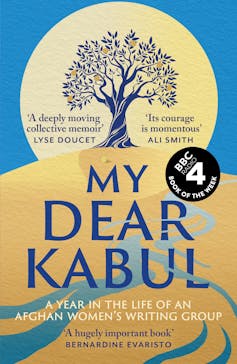
    1. My Dear Kabul: A Year in the Life of an Afghan Women’s Writing Group

    My Dear Kabul (2024) is not a traditional memoir told in a single voice, but a cartography of lived experience. It contains the voices of 21 Afghan women writers who ran a clandestine digital writing group as the Taliban consolidated power.

    Drawn from WhatsApp exchanges that have been downloaded, translated and compiled into a collective diary, the book is a visceral account of life as a political system collapses.

    Contributors vary in locale and literary temperament. Their entries oscillate between reportage, testimonies, narrative reflection and fragmented poetic utterance. The women in My Dear Kabul are mostly in their 20s and 30s, although there is one in her 60s. This plurality challenges monolithic representations of Afghan women.

    We experience personal fear through the story of Sadaf, a teacher who describes the abrupt end to her classroom when the head teacher interrupts an exam to dismiss her Year 8 students because the Taliban are entering the city.

    Fakhta, a law student from Daikundi province, had to flee the city along with other students in a university hostel. Her writing combines minute personal details with the existential uncertainty of the moment. “Towards an unknown fate,” she writes, “we all kept moving.”

    A second book, Rising After the Fall (2023), edited by Lucy Hannah and Zarghuna Kargar, with illustrations by Sara Rahmani, has adapted the collective concept of My Dear Kabul for younger readers. Rising After the Fall has voices of different ages.

    The book distils fragments of lived experience through glimpses of domestic resistance, displaced schooling and truncated freedoms. The edition situates Afghan girls not as passive recipients but as active narrators of their worlds. I find myself returning to it as an ideal birthday gift for young readers, a gesture of imaginative solidarity.

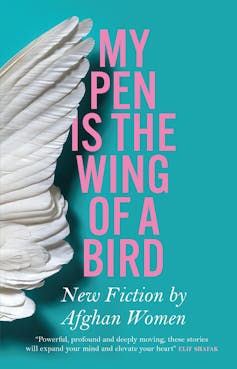
    • My Pen Is the Wing of a Bird: New Fiction by Afghan Women

    Edited by Lyse Doucet and Lucy Hannah, My Pen is the Wing of a Bird (2022) gathers short fiction by 18 Afghan women living inside the country. The stories have been written in Afghanistan’s two principal languages, Pashto and Dari, and translated into English by Afghans, several of them writers themselves.

    These narratives, some of which are set in the claustrophobic domestic sphere and others in speculative or transitional landscapes, interrogate the conditions of life under patriarchal authoritarianism.

    In Sharifa Pasun’s “The Late Shift”, for example, the reader encounters Sanga, a young mother and a journalist in 1980s Afghanistan, who navigates the overlapping demands of professional life, family responsibilities and existential threat.

    Sanga works evening shifts, broadcasting the day’s news under the constant threat of rocket fire. By day, she attends Kabul University, then returns home to her two-year-old child, Ghamai.

    Pasun uses the figure of a working mother to depict the labour of care against a backdrop of violence. As she writes:

    the roads were busy with ambulances. The rockets couldn’t be heard anymore. Sanga knew that the opposition had run out of rockets. They must be tired like her, she thought.

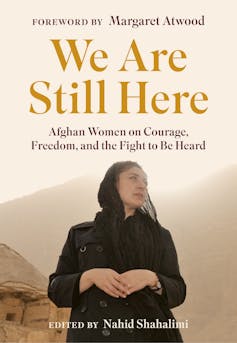
    • We Are Still Here: Afghan Women on Courage, Freedom, and the Fight to Be Heard

    Edited by Nahid Shahalimi, We Are Still Here (2022) compiles essays, testimonies and reflections by 13 Afghan women journalists, activists, educators, scientists, coders, musicians and artists. It covers the period before and after the Taliban’s takeover.

    Individual lives are situated within global militarisation, evacuation, refugee displacement and the international humanitarian regime, without personal voices being reduced to geopolitical abstractions. Contributors refuse both silence and pity.

    The book foregrounds women’s agency in shaping narratives of resistance, belonging and intellectual continuity.

    The story of Razia Barakzai, a former official who worked in Afghanistan’s presidential office, stands out. Barakzai describes how she and other young women organised demonstrations in Kabul, even as the risks became immediate and personal. They carried placards in Dari, Pashto and English, declaring that Afghan women still existed and demanded their rights.

    Her reflections capture the moral clarity driving these protests. Her story illustrates how Afghan women’s resistance often emerges through collective courage — transforming fear into solidarity and refusing both erasure and pity.

    “To be silent,” she writes, “would mean we were accepting and surrendering to the Taliban’s power.”

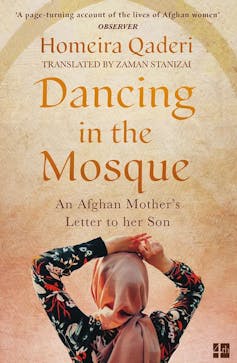
    • Dancing in the Mosque: An Afghan Mother’s Letter to Her Son

    Although Homeira Qaderi’s memoir Dancing in the Mosque (2021) predates the fall of Kabul, it gained renewed urgency in the post-2021 landscape. It is written as a letter to Qaderi’s son, whom she was forced to relinquish after divorcing her abusive husband. Afghan custody laws and social norms overwhelmingly favour fathers after divorce.

    The book’s title comes from a formative childhood memory. As a young girl, Qaderi accompanies her grandmother to a mosque where women gather to pray and mourn. At one point, carried away by a moment of joy, she begins to spin and dance. The reaction is immediate. The women around her reprimand her sharply, reminding her such movement is “inappropriate in a sacred space”.

    The moment becomes emblematic. The mosque, which should be a place of spiritual refuge, becomes a site where a girl first learns the boundaries placed on her body and voice. Yet the image of the girl dancing also signals a stubborn impulse toward freedom that persists even within those confines.

    The book moves associatively, drifting between childhood memories, reflections on motherhood, moments from Qaderi’s marriage, and the act of writing to her absent son. The narrative often circles back on itself, lingering on small sensory details: a room, a conversation, a fleeting moment of joy or grief.

    The fragmented structure mirrors the turbulence that shapes Qaderi’s life: the dislocations of war, the contradictions of love and loss, and the unresolved ache of separation from her child. The memoir is an intimate act of remembering, where memories surface unevenly, guided by feeling rather than the orderly progression of events.

    The looping, pausing and returning evokes the turbulence Afghan women have navigated. In a context where women’s education itself has been criminalised, Qaderi’s text stands as an enduring testament to the interior life as a site of resistance.

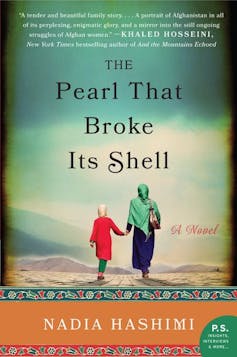
    • The Pearl that Broke Its Shell

    “I knew nothing about pearls and shells either,” Nadia Hashimi writes in The Pearl that Broke Its Shell (2014), “except that one had to free itself from the other.”

    The novel explores the quiet ingenuity with which Afghan women navigate restrictive gender norms. At its centre is Rahima, a young girl in Kabul who becomes a bacha posh (a girl temporarily raised in boys’ clothes so she can move freely in public and support her family).

    The transformation allows Rahima to experience freedoms otherwise denied to her, such as attending school, running errands, even riding a bicycle through the city streets. Yet this fragile autonomy is always temporary. As Rahima reflects, “To be a bacha posh is to borrow a boy’s freedom until you are old enough to give it back.”

    Across the 69 chapters of her novel, Hashimi interweaves Rahima’s story with that of her great-great-grandmother Shekiba – “born at the turn of the twentieth century, in an Afghanistan eyed lasciviously by Russia and Britain” – who also survived by inhabiting roles typically reserved for men.

    Through these parallel narratives, The Pearl that Broke Its Shell reveals how Afghan women have long devised creative strategies for survival within patriarchal systems. The result is a moving portrait of resilience, one that suggests that beneath the constraints placed on them, Afghan women have courage and aspirations that persist across generations.

  • The Coachbuilder’s Column: Volume 16: Issue 3:  23rd February, 2026:               Some books tackled since 1st January including Stone’s ‘Michelangelo’.

    I’ve continued reading since the Christmas/New Year period, and as always like to share something about that material which this time includes some older publications.  Only a short selection of readings this time, however some substantial commentary has been provided for the third listed book below.

    • Last One Out by Jane Harper, pub. 2025;
    • The Rainbow and the Rose, by Nevil Shute, pub. 1958;
    • The Agony and the Ecstasy: the biographical novel of Michelangelo, by Irving Stone, pub. 1961;
    • Atonement by Ian McEwan, pub. 2001.

    13th January

    The latest novel by Australian author Jane Harper called ‘Last One Out’, published in 2025, of 373 pages, a slow-moving novel which built up to its leading crescendo of awareness in the closing pages. A true mystery I guess, where the reader may well assume that the killer[s] are someone still in the town, but not revealed until the appropriate time. In some ways, as I read, I found myself silently saying ‘get on with the story’, yet still a difficult book to put down!! 

    “Last One Out” is a gripping mystery novel by Jane Harper that explores the disappearance of a young man and the haunting impact it has on his family and a small rural community.

    The story revolves around Ro Crowley, who is waiting for her son Sam to return home on the night of his 21st birthday. However, Sam never arrives, and his disappearance sends shockwaves through the community of Carralon Ridge, and eventually Ro leaves her husband Cliff as they both struggle in different ways to overcome their loss.

    Five years later, Ro returns to the now desolate town for Sam’s annual memorial, only to find it transformed by the encroaching coal mine that has driven most residents away. As she revisits the abandoned houses where Sam’s footprints were found, Ro seeks answers about her son’s fate, uncovering secrets that the remaining townsfolk may hold. The skeletal community is now an echo of itself, having fractured under the pressure of the coal mine operating on its outskirts.  But Ro still wants answers. Only a few people remain. If the truth is to be found in that town, does it lie among them? She has not given up hope that Sam is still alive and is desperate to make sense of his final hours

    From Australian Book Review of December, 2025, the reviewer, Barbara Pezzotti describes the affect of the mine on the town thus –  ‘In Harper’s descriptive language, the presence of the mine  is not only visible through the destruction of the landscape; it is also constantly felt and heard by the inhabitants of Carrolan Ridge. The rumbling and rattling of the machinery [24 hours a day] scarring the ground and destroying nature is constant, day and night. Replacing birdsong, it is the background to walking, eating, sleeping and talking….Heavy vehicles lumber their way up and down past people’s front doors. A grey layer of coal dust covers every flat surface, the taste of the water  and the smell of sulphur  in the air, a constant reminder of the mine’s devilish presence’

    She also describes [in line with my opening paragraph above]  where ‘In this slow-burn, stand-alone mystery, police investigation is non-existent and the burden of the enquiry rests only on Ro’s shoulders.  Through flashbacks, the narrative gives an account of Ro’s five-year-long investigation. A new, unexpected clue materialises only towards the end of the novel, bringing finality’.

    Chris Gordon, writing for Readings [Sept 2025] summarises the book as follows

    “Jane Harper’s latest novel is a heartbreaker. There is no ruggedly handsome detective trying to make sense of his own frailties while solving a murder. Last One Out does something different to Harper’s previous works. The story concentrates on a family with a son, Sam, who disappeared five years prior to the book’s beginning. The novel’s focus remains on the mother, Ro, a doctor who fled her marriage and the community after the initial trauma. Yet she returns each year to the failing town to acknowledge her loss and to connect with the friends and family who remain.  And here lies the other tragic component of the novel: the entire story is set in Carralon Ridge – an isolated rural town that has run out of steam and has been purchased for mining. The residents who haven’t left are bitter – defeated, even – and certainly nostalgic for times that now do not exist. The men seem to cower from change, while the women support everyone, clean, and hide their pain. Harper does an excellent job of working into the narrative the relentless nature of the dust, the noise of the mining, and the heat. This is not a town for tourists. This is a town that screams resentment and frustration. And this time, Ro’s annual visit uncovers the past – and her son’s murderer.

    Harper has written a wonderful literary exposé of a disappearing town. The metaphors she uses are damning of the environmental damage caused by mining. She perfectly captures the limbo in which the dispirited locals are trapped, along with the social fractures and fear the uncertainty causes. This is a universal story of decline. Readers of Harper’s previous crime novels – and this is another – will delight in her steady pace and astute character observations. I found this novel painfully affecting: our rural past is swept up in the dust with more than one victim.

    Reverting back to Pezzotti’s analysis –  ‘Last One Out lacks the rhythm and suspense of Harper’s earlier work [all of which I have read]. The sociological and psychological study of a disappearing community is compelling, but it distracts from the crime plot…………..This is not an uplifting story of resistance and empowerment, nor is it a sharp condemnation of the evils of neo-liberalism and globalisation. The moral of the story is simply to accept the inevitable consequences of corporate greed and focus on personal regeneration , even at the expense of community’. 

    In an article I included in this Column a few months ago, Harper’s novel was criticised to the extent, that as with her past books, the Aboriginal population did not feature . The original Australians don’t appear to have a place in this town or in her novels, so far!

    25th January

    A novel written many years ago, which I’ve just caught up with was ‘The Rainbow and the Rose’, by Nevil Shute, published in 1958, of 306 pages.    When seasoned pilot Johnny Pascoe tries to rescue a sick girl from the Tasmanian outback, his plane crashes and leaves him stranded and dangerously injured. Ronnie Clarke, who was trained by Pascoe, attempts to fly a doctor in to help, but rough weather makes his mission more difficult than he imagined. As he waits overnight at Pascoe’s house for a chance to try again the next day, Clarke revisits the past of this unusual man [which he does through dreams he has while asleep]—and reveals the shocking and tragic secrets that have influenced his life.

    The title is taken from a sonnet “The Treasure” by Rupert Brooke, which is quoted in full as a preface:

    Wikipedia summary of the novel [readers’ spoiler]

    The story concerns the life of Canadian Johnnie Pascoe, a retired commercial and military pilot, who has crashed while attempting a medevac flight in difficult weather conditions into a small airstrip a mountainous region of Tasmania. Unconscious and suffering from a dangerous head injury, he lies in the house of the child he had been sent to help, which is inaccessible by road and in contact with the outside world only by radio. Hearing of his plight, Ronnie Clarke — an airline pilot and student of Pascoe decades earlier — offers to try and land a young doctor. After two failed flights in one of Pascoe’s own Taylorcraft Auster aircraft from the small flight school Pascoe set up after retirement, Clarke rests overnight at Pascoe’s house, meets Pascoe’s two daughters, and narrates the life of his former mentor through three dream episodes.

    In the first episode, Pascoe is a young fighter pilot in the Royal Flying Corps during The Great War and marries an up-and-coming actress. At war’s end they separate when she accepts a role in Hollywood, moves in with another man, and files for divorce from there with sole custody of their daughter.

    A few years later, in the 1920s, Pascoe is chief pilot at the small flying school where Clarke learned to fly, and becomes romantically involved with a student pilot, Brenda Marshall, whose husband is in a mental asylum after sexually assaulting children. Things go awry after the birth of Pascoe’s and Marshall’s baby daughter, and when Marshall learns that her husband has refused to grant a divorce, she commits suicide by deliberately crashing her de Havilland Moth. Pascoe leaves the country, with the baby in the care of Marshall’s mother, and shortly afterwards he learns that the baby has died

    In the final dream episode, after having served with Ferry Command during the Second World War beside Clarke, Pascoe is a senior pilot with fictitious AusCan Airlines in the 1950s, flying routes between Canada and Australia, and approaching mandatory retirement at age 60. Peggy Dawson, a flight attendant and former nurse in her late 20s, asks to join his cabin crew and impresses him during the interview. They begin to spend more time together during layovers, and he develops feelings for her that he notes are non-sexual. With retirement approaching, Pascoe wants to find a way to keep Dawson in his life, so he proposes marriage, even though he does not believe that his feelings are romantic. Dawson reveals that she rightfully should be named Brenda Maragaret Pascoe. She is Pascoe’s daughter with Brenda Marshall, who Pascoe believed to have died in infancy; she had left nursing and joined AusCan airlines to observe her father and possibly to make contact with him. The framing story closes with Ronnie Clarke making a successful attempt to land the doctor and Pascoe’s daughter Nurse Dawson in clear weather the next morning, only to learn that Pascoe had died during the night. Dawson remains to arrange for an informal burial, then plans to hike 40 miles (64 km) back through to bush with the rescue party to deal with her father’s estate. There is a strong suggestion that Dawson and the young doctor have developed feelings for each other.

    Clarke returns to Melbourne, 36 hours after he left, and notes that his life is full of blessings with his spouse and children, while Pascoe, who was (in his opinion) the better man, had so little joy in life.

    Like Conrad, Shute often uses a narrator to tell the story; in The Rainbow and the Rose, the narrator periodically shifts from Clarke to Pascoe.

    16 February

    The Agony and the Ecstasy: the biographical novel of MICHELANGELO by Irving Stone, published in 1958, of 664 pages.  I can’t admit to reading this mammoth book in the hurry –  in fact recall when it actually came into my possession, many years ago, or whether it was a purchase or s gift.  My copy was personally signed by the author. In any case, I began to read it many years ago, put it aside, probably for a couple of decades, only getting back to it early this year, and determined to see it through!

    I found it not just a biography of a great artist [in novel form] but also a fascinating depiction of the historical events of the period of his life and of the political and religious strife of Italy and surrounding areas of the then Europe. Reading in particular about the Popes of those times –   well hardly comparative to the perceived moral and religious authority of the modern-day Pope. That’s a story on it’s own!!

    Just one of many examples:  [page 636] “Cardinal Giovanni Pietro Caraffa became Pope Paul IV. No-one quite knew how he had been elected. He was a thoroughly disagreeable man, violent of nature, intolerant of all about him. Pope Paul IV, knowing how completely he was hated, said: ‘I do not know why they elected me Pope, so I am bound to conclude that it is not the cardinals  but God who makes the Popes’.

    Published in 1961, this is a captivating novel that chronicles the life of Michelangelo Buonarroti, exploring his artistic genius and personal struggles during the Renaissance and exploring the historical context of the time. The book is not only a tribute to Michelangelo’s genius, and at times, hi complex character, and the often  tumultuous relationships he had with artists such as Leonardo de Vinci, but also a reflection on the broader tensions faced by artists in pursuit of their vision

    The narrative begins with a young Michelangelo, grappling with feelings of loneliness and a desire for love following the death of his mother. His journey into artistry sees him facing both physical and emotional struggles, driven by an insatiable pursuit of perfection and the agony of creating masterpieces only to witness their destruction, and regularly facing the demands and changes of those demands by different Popes and other authorities of the time. Announcing that it was his ambition to wipe out all heresy in Italy, he unleashed on the Roman people the horrors of the Spanish inquisition”.

    However, this book is about Michelangelo, although in reading through it, one quickly learns of the powerful influence that the various Popes of his time had on his work, his lifestyle, his relationships, and even at times, his life and freedom itself.

    The novel emphasizes several key themes, including:

    Irving Stone conducted extensive research for the novel including translating Michelangelo’s letters and studying his techniques. This meticulous approach allowed Stone to blend historical facts with fictional narrative, while the novel has been divided into precise sections that detail distinct periods of Michelangelo’s life, making the story both informative and engaging.  Stone trawled through every document, including Michelangelo’s bills and legal documents, and even worked sat one time in an Italian quarry.

    Writing in a publication from Sep 27-October3, 1997, called ‘The Vulture’ [an article which described itself as ‘Picks over the bones of contemporary culture], it was noted that ‘This version of the artist’s long, difficult life takes no risks. What we get is an intricate skeleton of events and a carefully textured skin of meticulous local colour. It is a fascinating canvas so long as you don’t expect much psychological flesh’.  Well, if merely  a skeleton, the 647 pages I read certainly contained plenty of skin and flesh!!

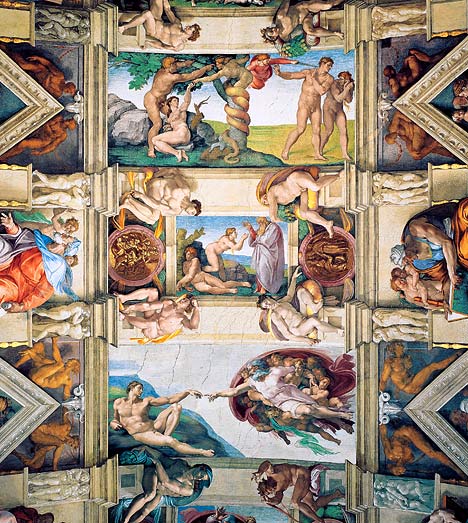
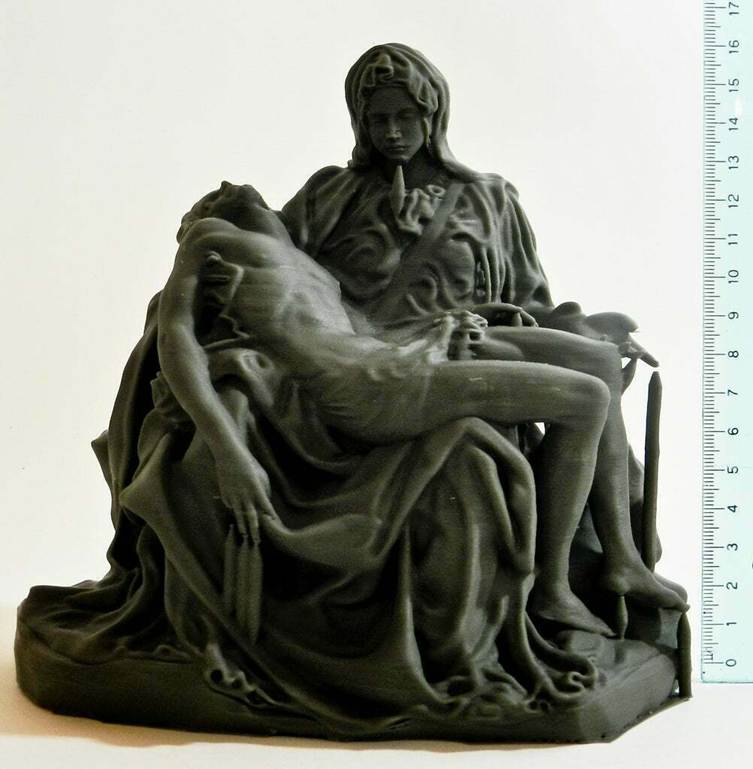
    Having noted also with special interest the years and efforts and trials Michelangelo put into creating many if not all of his ‘masterpieces’,  I found myself adding to my ‘bucket list of things I’ll never achieve’ a genuine desire to see in person those existing masterpieces such as the Sistine Chapel Ceiling, The Last Judgement, the statue David, The Garden of Eden, the Pieta, Moses,  St. Peters, and so on [see following].

    Getting back to the novel –

    Key characters include Lodovico, Michelangelo’s father, whose harsh expectations and lack of affection contribute significantly to Michelangelo’s personal challenges. Lorenzo de’ Medici, a significant patron, embodies the Renaissance ideals that inspire Michelangelo, while Contessina de’ Medici and Clarissa Saffi represent the romantic entanglements that are ultimately thwarted by social constraints and Michelangelo’s artistic obsessions. Vittoria Colonna, a devoted reformist, captures his admiration later in life, though their relationship remains platonic. Lastly, Tommaso de Cavalieri serves as a devoted companion in his later years, showcasing the importance of friendship amidst Michelangelo’s solitary existence. This rich tapestry of relationships illuminates the artist’s life, highlighting the balance of agony and ecstasy inherent in his quest for artistic immortality.

    As one reviewer noted –  the novel explores his quest to become the living representation of Renaissance humanism, a journey filled with personal and professional hurdles. Michelangelo must navigate familial opposition, religious constraints, political manoeuvrings, and the competitive nature of artistic patronage to fulfill his vision.

     From a Wikipedia summary we note that:

    Beginnings and Early Challenges

    Despite his father’s disapproval, young Michelangelo earns an apprenticeship under the painter Ghirlandaio, and later, the sculptor Bertoldo, who works under the sponsorship of Lorenzo de’ Medici, a prominent Florentine patron. Michelangelo quickly gains Lorenzo’s admiration and forms connections with his children, including future popes Giulio and Giovanni, and Contessina, his first love. He faces hostility from envious peers, including an infamous encounter with Torrigiani that leaves him physically marked, but through illicit study of anatomy, he hones the skills crucial to his craft. As Savonarola rises to power, threatening the Medici family and the cultural landscape of Florence, Michelangelo finds himself at a crossroads.

    Rome: A Turning Point

    Seeking refuge in Bologna during Savonarola’s reign, Michelangelo encounters Clarissa Saffi and creates “Bambino,” drawing the attention of Leo Baglioni. His first visit to Rome introduces him to influential figures such as banker Jacopo Galli, who commissions his work, and architects Giuliano Sangallo and Bramante, the latter becoming a rival. Here, Michelangelo sculpts the renowned Pieta, learns the intricacies of patronage, and becomes involved in the ambitious project of St. Peter’s Basilica, which will dominate his later years.

    Return to Florence

    Back in Florence, Michelangelo creates his monumental statue, “the Giant,” or David, which comes to symbolize the city itself. He crosses paths with Leonardo da Vinci, his chief rival, and Raphael, forming a triumvirate of Italian Renaissance art. Michelangelo’s rivalry with Leonardo intensifies as they compete to paint frescoes for Florence’s rulers. Pope Julius takes note of Michelangelo’s prowess and summons him to Rome, compelling him to work in bronze and undertake the monumental task of painting the Sistine Chapel ceiling. Julius’s vision of a new St. Peter’s aligns with Michelangelo’s burgeoning architectural ambitions.

    Under Papal Influence

    Following Julius, the Medici popes Giovanni and Giulio add new dimensions to Michelangelo’s challenges. Giovanni demands that Michelangelo procure marble from the remote Pietrasanta, inadvertently turning him into an engineer, while Giulio’s forces require him to fortify Florence, utilizing his engineering acumen. Pope Paul III commissions Michelangelo for the Last Judgment and appoints him architect of St. Peter’s amidst ongoing disputes. Michelangelo’s culminating achievement is the dome of St. Peter’s, a fitting testament to his artistic and architectural legacy. Alongside his professional triumphs, he finds personal solace in the company of Tommaso de Cavalieri, who would carry on his work on St. Peter’s, and Vittoria Colonna, his intellectual companion and muse.

    Looking at perhaps the most famous of his works, with copies of these to follow:

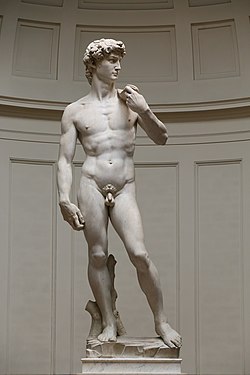
    David, completed by Michelangelo in 1504, is one of the most renowned works of the Renaissance.  The masterwork definitively established his prominence as a sculptor of extraordinary technical skill and strength of symbolic imagination –  created from 1501 to 1504.

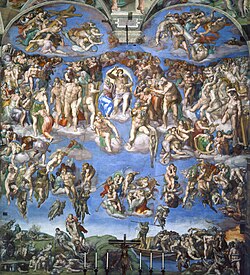
    The Last Judgement: is a fresco by the Italian Renaissance painter Michelangelo covering the whole altar wall of the Sistine Chapel in Vatican City. It is a depiction of the Second Coming of Christ and the final and eternal judgment by God of all humanity. 

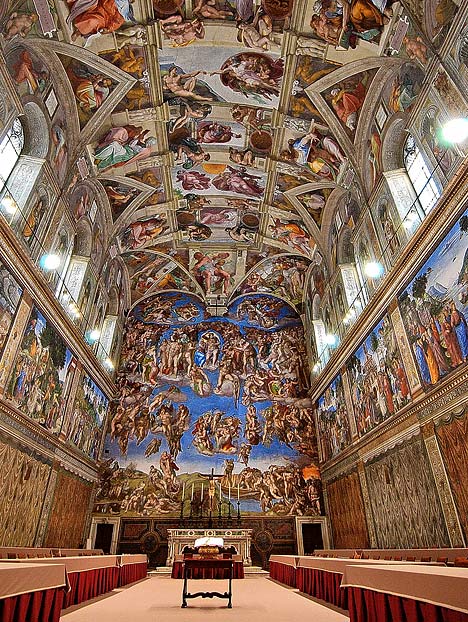
    The Sistine Chapel: from the creation to Noah in 175 individual paintings covering 12,000 square feet

    The creation of Adam (bottom), the creation of Eve from Adam’s rib (centre) and the temptation and expulsion of Adam and Eve from the Garden of Eden (top)

    The Pieta: this is Michelangelo’s masterpiece that depicts the Virgin Mary cradling the lifeless body of Jesus after his crucifixion.

    David by Michelangelo Florence Galleria dell’Accademia

    [David]

    The Last Judgement [1536-41]in the Sistine Chapel, Vatican City.

    The Sistine Chapel ceiling, in the Vatican Palace [1508-1512],  Vatican Palace, Vatican City

    The Creation

    Above -Madonna and Child [1524-34], Medici Chapel, Florence; and below, The Last Judgement [1536-41]in the Sistine Chapel, Vatican City.

    In conclusion, the night before Michelangelo died [in Irving Stone’s fictional biographical terms]

    [page 647] “That night, as he lay sleepless in bed, he thought, ‘Life has been good. God did not create me to abandon me. I have loved marble, yes, and paint too. I have loved architecture, and poetry too. I have loved my family and my friends. I have loved God, the forms of the earth and the heavens, and people too. I have loved life to the full, and now I love death as its natural termination. Il Magnifico would be happy: for me, the forces of destruction never overcame creativity.” 

    19th February

    Another book from earlier years –  Atonement by Ian McEwan, published in 2001, of 372 pages. This book was shortlisted for the 2001 Booker Prize, and after reading, I was not surprised with that nomination. Widely regarded as one of McEwan’s best works, ‘Time’ magazine named Atonement in its list of the 100 greatest English-language novels since 1923.

    It is set in three time periods, 1935 England, second World War England and France, and present-day England, and covers an upper-class girl’s half-innocent mistake that ruins lives, her adulthood in the shadow of that mistake, and a reflection on the nature of writing.

    On the hottest day of the summer of 1935, thirteen-year-old Briony Tallis sees from a distance,  her sister Cecilia strip off into her underwear, and plunge into the fountain in the garden of their country house to retrieve a vase that has been thrown in by the son of the estate’s cleaner, who has virtually been a part of the family since childhood. . Watching her too is that family friend,  Robbie Turner who, like Cecilia, has recently come down from Cambridge. By the end of that day, the lives of all three will have been changed for ever. Robbie and Cecilia will have crossed a boundary they had not even imagined at its start, and will young become innocent victims of a young girl’s imagination and writing ambitions as Briony commits a crime for which she will spend the rest of her life trying to atone, while the other two, and the extended family suffer  and have their lives changed in various ways.

    As noted on the ‘Bookaholic Academy’ a few years ago  –  ‘Some books are just stories, and then there are those that feel like they’ve crawled under your skin and left a mark. Ian McEwan’s Atonement falls into the latter category. It’s not just a novel – it’s a gut punch wrapped in beautiful prose, a story about guilt, love, and the slippery nature of truth. If you’ve ever wondered how one mistake can ripple through lives like a stone thrown into water, this book gives you the answer in heartbreaking detail’.

     That and the vivid heart-rending depictions of the allies and civilians as they flee from the Germans towards Dunkirk [the second period of the book], and the horrific [to a bystander as a reader] experiences of both Briony and her sister as nurses in the English  hospitals attending to the wounded arriving from across the Channel from France [third time period] emphasise so strongly that second category mentioned above.

    I’ve copied below the full synopsis of the book, as published by Wikipedia, which is basically a spoiler for those who may be intending to read the book.  As a ‘non-spoiler’,  a brief plot overview could be:-

    ‘At it’s core, Atonement is about Briony Tallis, a 13-year-old girl, with an overactive imagination. One hot summer day in 1935, she witnesses something she doesn’t fully understand. But instead of keeping her confusion to herself, she makes an accusation – one that changes the lives of her sister Cecilia and Cecilia’s lover, Robbie, forever. From there, McEwan drags us through the brutality of World War II, the fragility of love in a world torn apart, and the crushing weight of regret. The structure is layered, moving from a childhood mistake to its devastating consequences, and finally to the lasting scars left behind’.

    At this point, if you don’t want to read the spoiler, stop reading here!

    From a Wikipedia contribution about ‘Atonement’

    Part one

    Briony Tallis, a 13-year-old English girl with a talent for writing, lives at her family’s country estate with her parents Jack and Emily Tallis, who are members of the landed gentry. Her older sister Cecilia has recently graduated from the University of Cambridge with Robbie Turner, the Tallis family housekeeper’s son and Cecilia’s childhood friend, whose university education was funded by Jack Tallis.

    In the summer of 1935, Briony’s maternal cousins, 15-year-old Lola and 9-year-old twins Jackson and Pierrot, visit the family amidst their parents’ divorce. Cecilia’s older brother Leon returns from London, accompanied by his friend from Oxford, the well-off manufacturer Paul Marshall. Cecilia and Robbie bicker over a vase, which breaks and falls into a fountain. Cecilia strips to her underwear and dives in to retrieve the pieces, surprising Robbie. Briony, watching from a window, is confused and intrigued by Cecilia and Robbie’s actions. She is inspired to begin writing psychological realism, and the reader is informed that this will eventually become a hallmark of her fiction.

    In the wake of the incident by the pond, Robbie realizes he is attracted to Cecilia, and writes several drafts of a love letter to her. He gives the letter to Briony to deliver to Cecilia; however, he inadvertently gives her a version he had meant to discard, which contains lewd references (“In my dreams I kiss your cunt“). By the time Robbie realizes his mistake, Briony has already returned to the house with his letter.

    Despite Robbie’s instructions to the contrary, Briony opens the letter and reads it. She is shocked by its vulgar language, and becomes convinced that Robbie intends to harm Cecilia. An injured Lola goes to Briony for comfort, claiming that her younger brothers attacked her, although it is implied to have instead been Paul Marshall, who has a long scratch on his face. Briony relays the contents of the letter to Lola, who labels Robbie a “maniac,” re-affirming Briony’s feelings. Robbie arrives at the main house for a family dinner party, and is confronted by Cecilia. He confesses his feelings to her, and she responds in kind. Later the same evening, Briony walks in on Robbie and Cecilia having sex in the library. The immature Briony believes she interrupted a vicious assault on Cecilia, and stands stunned while Robbie and Cecilia quickly exit.

    At the dinner, which is generally tense, it is discovered the twins have run away. The party breaks into teams to search for them. When Cecilia goes with Leon, Robbie and Briony each set off on their own. In the darkness, while everyone is searching for the twins, Briony discovers her cousin Lola being raped by an assailant neither girl can clearly see. The attacker flees. Briony, convinced that it must have been Robbie, gets Lola to agree that she likely heard Robbie’s voice. The girls return home, and Briony identifies Robbie to the police as the rapist, claiming she saw his face in the dark. Lola is sedated by the local doctor, Cecilia screams at Briony and locks herself in her room, and Paul Marshall shares cigarettes with the policemen.

    Robbie does not return, and the family and police officers stay awake waiting for him. As dawn breaks, Robbie appears in the driveway with Jackson and Pierrot, having found and rescued them. He is arrested on the spot and taken away, with only Cecilia and his mother believing his protestations of innocence. Briony is satisfied by this conclusion to her mythologized version of the events, with her as the hero and Robbie as the villain.

    Part two

    By the time the Second World War has started, Robbie has spent several years in prison. He and Cecilia have passed several years exchanging letters, maintaining their love for each other. Robbie is released from prison on the condition he enlist in the army. Meanwhile, Cecilia has completed training as a nurse, and cut off all contact with her family for the parts they played in locking Robbie up. Shortly before Robbie is deployed to France, they meet once for half an hour, during Cecilia’s lunch break. Their reunion starts awkwardly, but they share a kiss before leaving each other.

    In France, the war is going badly, and the army is retreating to Dunkirk. As the injured Robbie makes his way there, he thinks about his love for Cecilia and his hatred for Briony. However, he eventually concludes that Briony was too young to be blamed fully, and writes Cecilia a letter encouraging her to reconnect with her family. His condition deteriorates over the course of the section; he weakens and becomes delirious. Robbie falls asleep in Dunkirk, one day before the evacuation begins.

    Part three

    A remorseful Briony, now eighteen years old, has refused her place at Cambridge and instead is a trainee nurse in London. She has realised the full extent of her mistake and decides it was Paul Marshall, Leon’s friend, whom she saw with Lola.

    Briony still writes fiction, and receives a letter from Cyril Connolly at the hospital where she works. Cyril is rejecting Briony’s submitted draft of her latest work to his magazine, Horizon, but providing kindly and constructive feedback. The work is in fact the first draft of the first section of this novel.

    Briony travels to attend the wedding of Paul Marshall and her cousin Lola, with the knowledge that Lola is marrying her rapist. Briony considers speaking up during the wedding, but does not. Afterwards, she visits Cecilia, who is cold but invites Briony in nonetheless. While Briony is apologizing to Cecilia, Robbie unexpectedly appears from the bedroom. He has been living with Cecilia while he is on leave from the army. Robbie expresses his fury at Briony, but with Cecilia’s soothing remains civil.

    Cecilia and Robbie both refuse to forgive Briony, who nonetheless tells them she will try to put things right. She promises to begin the legal procedures needed to exonerate Robbie, even though Paul Marshall will never be held responsible for his crime because of his marriage to Lola. As Briony leaves Cecilia’s, she is optimistic about her role in Robbie’s exoneration, thinking that it will be “a new draft, an atonement” and that she is ready to begin.

    Postscript

    The final section, titled “London 1999”, is narrated by Briony herself in the form of a diary entry. Now 77, she is a successful novelist who has recently been diagnosed with vascular dementia, so she is facing rapid mental decline.

    It is confirmed that Briony is the author of the preceding three sections of the novel. She attends a party in her honor at the Tallis family home, where the extended Tallis children perform The Trials of Arabella, the play that 13-year-old Briony had written and unsuccessfully attempted to stage with her cousins in the summer of 1935. Leon and Pierrot are in attendance, Jackson is fifteen years deceased, and Lola is alive but does not attend. Finally, Briony reveals to the reader that Robbie Turner died of septicaemia on the beaches of Dunkirk, that Cecilia was killed several months later when a bomb destroyed Balham Underground station during the Blitz, and that Briony’s story of seeing them together in 1940 was a fabrication. Briony did attend Lola’s wedding to Paul Marshall, but confesses she was too “cowardly” to visit the recently bereaved Cecilia to make amends. The novel, which she says is factually true apart from Robbie and Cecilia being reunited, is her lifelong attempt at “atonement” for what she did to them.

    Briony justifies her invented happy ending by saying she does not see what purpose it would serve to give readers a “pitiless” story. She writes, “I like to think that it isn’t weakness or evasion, but a final act of kindness, a stand against oblivion and despair, to let my lovers live and to unite them at the end.”

    _____________________________________________________________________—

  • The Coachbuilder’s Column: Volume 15: Issue 11: 15th July, 2025:  about the author Graham Greene, letters and novels.

    I’ve just read  ‘Graham Greene: A Life in Letters’ edited by Richard Greene [no relation], published in 2007 [446 pages]………….I’d never read any of Greene’s novels though knew I had one somewhere, eventually tracked it down, a Penguin paperback of The Honorary Consul’, first published in 1973, which I refer to later, as I decided I had to read at least one of his novels.

    As revealed through his letters, his novels were generally based upon people he’d met, or places and international conflicts that he found himself involved in. And as revealed through the letters, a vivid portrait of a fascinating writer, a mercurial man of courage, wit and passion. 

    As Amazon describes it – “One of the undisputed masters of twentieth-century English prose, Graham Greene (1904-1991) wrote tens of thousands of personal letters. This exemplary volume presents a new and engrossing account of his life constructed out of his own words. Impeccably edited by scholar Richard Greene, the letters–including many unavailable even to his official biographer–give a new perspective on a life that combined literary achievement, political action, espionage, travel, and romantic entanglement. The letters describe his travels in such places as Mexico, Vietnam, and Cuba, where he observed the struggles of mankind with a compassionate and truthful eye. Letters to friends such as Evelyn Waugh and Muriel Spark offer a glimpse into the literary culture in which he wrote, while others reveal the agonies of his heart. The sheer range of experience contained in Greene’s correspondence defies comparison”.

    These letters, as published by his namesake, were written over 70 years, from September, 1921 to the 21 March, 1991 [14 days before he died]. As a prolific writer of diaries, personal notes and reflections myself, I guess that was the reason I was attracted to the book. He was not just an author – but a journalist, reporter, investigator, confidante of the famous in both literary and political circles, constantly travelling around the world, usually to political hotspots and war or revolutionary zones in Asia, Central and South America, Africa, Russia and other Communist controlled countries during both the years of World War II, and the subsequent Cold War period, with his life and personal safety often at risk. His letters generally pulled no punches, many of a highly personal and romantic nature.  His correspondence relationship with so many great authors [many of whom I was not familiar with] including in particular that great novelist and diary writer, Evelyn Waugh [whom I always believed was a woman for some reason] provided for me, a fascinating insight into the world of writers, publishing and books in general.

    [Incidentally, I don’t have any of Waugh’s novels, but do have a massive volume of his life’s Diaries, which admittedly, I’ve not yet tried to tackle!!].

    In addition to the actual letters, there are footnotes on most pages. Providing either a brief biography of the person to whom he is writing, or where it was known why he was writing in particular instances. These notes of course do slow down the reading process, but are an invaluable aid to understanding [usually] the purpose of the letter and Greene’s connection with the recipient.

    Grahame Greene himself notes that – There have been a number of Graham Greene biographies, but none has captured his voice, his loves, hates, family and friends–intimate and writerly–or his deep understanding of the world, like this astonishing collection of letters…………………………………………………………………..
    Graham Greene is one of the few modern novelists who can be called great. In the course of his long and eventful life (1904—1991), he wrote tens of thousands of letters to family, friends, writers, publishers and others involved in his various interests and causes. A Life in Letters presents a fresh and engrossing account of his life, career and mind in his own words.

    In summary a comment from Google.books provides another encouraging description of the book  –  ‘In several letters, the individuals, events or places described provide the inspiration for characters, episodes or locations found in his later fiction. The correspondence describes his travels in Mexico, Africa, Malaya, Vietnam, Haiti, Cuba, Sierra Leone, Liberia and other trouble spots, where he observed the struggles of victims and victors with a compassionate and truthful eye. The volume includes a vast number of unpublished letters to authors Evelyn Waugh, Auberon Waugh, Anthony Powell, Edith Sitwell, R.K. Narayan and Muriel Spark, and to other more notorious individuals such as the double-agent Kim Philby. Some of these letters dispute previous assessments of his character, such as his alleged anti-Semitism or obscenity, and he emerges as a man of deep integrity, decency and courage. Others reveal the agonies of his romantic life, especially his relations with his wife, Vivien Greene, and with one of his mistresses, Catherine Walston. The letters can be poignant, despairing, amorous, furious or amusing, but the sheer range of experience contained in them will astound everyone who reads this book.’

    While from the book cover – “When he loved, he loved fervently, but he also struggled  to manage the  unpredictable mood swings, the highs and lows of bipolar disorder that drove him from exalted happiness to despair. Letters to friends like Evelyn Waugh, Muriel Spak, Anthony Powell and R.K. Narayan offer a glimpse 

    into the literary culture in which he wrote. Other letters reveal the agonies of his heart, how his manic depression wreaked havoc on his marriage to Vivien Greene and injured his relations with his mistress Catherine Walston.”

    A book that gives new perspective to a life that combined literary achievement, political action, espionage, travel and romantic entanglement….following him through joy and turmoil, from the gnarled and fissured forests of Indo-China to war-torn Sierra Leone, from the mountains of Switzerland to hotels in Havana and a connection of sorts with leaders like Fidel Castro, and various revolutionary characters from South America.

    The letters also reveal much about his support at times, and other times, conflict with the Catholic Church, and his inter-action with a couple of the Popes of his era, and other religious intermediaries.

    A brief comment on The Honorary Consul by Grahame Greene [published in 1973, of 268 pages [my Penguin edition].  After having read Greene’s letters, I expected his novels to be essentially based on parts of the world he had travelled to, often with the purpose of exploring those areas and lifestyles for incorporation into a planned novel. I wasn’t sure what to expect, not having read him previously.  This story, I found somewhat enjoyable, if at times, realistically unpleasant in terms of the subject matter.

    A gripping tragicomedy of a bungled kidnapping in a provincial Argentinean town, considered to be one of Greene’s finest novels. The story is set in the provincial city of Corrientes, part of the Argentine Littoral, on the shore of the Paraná River. Eduardo Plarr is an unmarried medical doctor of English descent who, as a boy, fled to Buenos Aires with his Paraguayan mother to escape the political turmoil of Paraguay. His English father remained in Paraguay as a political rebel and, aside from a single hand-delivered letter, they never hear from him again. Throughout the novel, there is much reflection by various characters on the absence of ‘father figures’ for numerous reasons. I believe the story is also set on the eve of Argentine’s ‘dirty War’ in the early 1970’s.

    In this provincial Argentinian community, Charley Fortnum – a British consul with dubious authority and a notorious fondness for drink – is kidnapped by rebels in a case of mistaken identity. Fortnum, 61 years old is married to Clara, a young ex-whore from Senora Sanchez’s brothel. The young but world-weary Doctor Eduardo Plarr, is left to pick up the pieces and secure Fortnum’s release, wading through a sea of incompetence and unearthing corruption among authorities and revolutionaries in the process.

    First published in 1973, The Honorary Consul is a British thriller novel, and  was one of Greene’s own favourites of his works and is regarded amongst his finest novels, with Plarr perhaps the most moving and convincing figure in his fiction.  The story is set in an unnamed city in northern Argentina, near the border with Paraguay which can be assumed to be the city of Corrientes.

    In what is described as a ‘perfectly executed narrative’, Greene explores the repercussions of the bungled kidnap, and gives special attention to Dr Plarr whose deficient emotions form the heart of the story.

    While I won’t go into the article itself, a piece written on a site named literarysum/com and titled ‘Unveiling the Layers: A Comprehensive Literary Analysis of The Honorary Consul by Graham Greene’, introduced the subject as follows – ‘The Honorary Consul by Graham Greene is a complex novel that delves into the themes of love, betrayal, and political intrigue. This article provides a comprehensive literary analysis of the novel, exploring its various layers and uncovering the hidden meanings behind its characters and plot. Through a close examination of the novel’s themes, symbolism, and narrative structure, this article aims to provide readers with a deeper understanding of Greene’s masterpiece’ which all indicates we have more than just a ‘British thriller novel’, another indication of Greene’s literary talents.

    As described at the time of publication, by the Daily Mail: ‘The prose is monkishly spare and taut.  The minor characters are brilliantly and sardonically drawn, that ever he has given us’. It sounds as though I made the right choice, in being introduced to Greene’s writings [apart from his letters].

    The book was made into the 1983 film The Honorary Consul (also released as Beyond the Limit), directed by John Mackenzie, with Richard Gere as Plarr and Michael Caine as Fortnum.[3][4] The soundtrack theme was composed by Paul McCartney and performed by John Williams.

  • The Coachbuilder’s Column: Volume 15: Issue 10: 24th June, 2025: some selected reading over recent months

    This contribution looks at a number of books and other publications which I have read and examined over the past two or three months, as listed briefly below.

    • Australian Foreign Affairs, Issue 23 ‘Planet Australia’;Escaping America’s Orbit’.   
    • Quarterly Essay No. 97: ‘Losing It. Can we stop violence against women and children’ [by Jess Hill];
    • Memorial Days’ by Geraldine Brooks [2025]; 
    • The Fallen Woman by Fiona McIntosh [2024];
    • Lyrebird by Jane Caro [2025];
    • The Historian: To you perceptive reader, I bequeath my history,  by Elizabeth Kostova [2005];
    • The Astonishing History of Ballarat, Volume 3: The Story of the Quartz Miners of Ballarat: 1851-1878  by Doug Bradby [2020];
    • Quarterly Essay No. 98 headed ‘Hard New World: Our Post-American Future’ by Hugh White.

    What is Australia’s place in the new global landscape?

    • ‘Until August’ by Gabriel Garcia Marquez’ [2024]; and,
    • ‘Melaleuca’ by Angie Faye Martin [2025].

    14th March

    Australian Foreign Affairs’ publication, Issue 23 titled ‘Planet Australia: Escaping America’s Orbit’.   

    This 23rd issue of Australian Foreign Affairs  [a publication issued three times a year] explored Australia’s changing fortunes as Donald Trump returns to the White House and threatens to dismantle the diplomatic, economic and defence foundations on which Canberra has long built its security and prosperity. It examines the consequences for Australia as some of its most important friends and partners – including India, Indonesia and the United States – shift towards authoritarianism and illiberalism. Featuring special contributions from our three most recent ambassadors to the United States, Planet Australia looks at how Australian leaders and diplomats should deal with Trump and prepare for looming challenges to the alliance, open trade, and a secure and stable Asia.

    Essays included:

    • James Curran explores Australia’s relationship with the US in the age of Trump. He points to the fact that the America Australia has become accustomed to, is changing.
    • Emma Shortis argues that Canberra should be bold as the global order shifts. Among other things, suggests that Trump does not care about Australia, so why should be cosy up to him, it won’t make Australia any safer.
    • Susan Stone analyses Trump’s economic plan and how Australia might benefit, in a fairly detailed analytical approach to that aspect of the economic relationship.
    • Kim Beazley, Joe Hockey and Arthur Sinodinos discuss the diplomatic challenges facing Australia in Washington DC. An interesting set of views from three former ambassadors. From Beazley – “Trump will be more disruptive and les predictable, but Australia is well placed to protect and advance its own interests’.  Hockey: “No matter what, the United States has [historically] had ‘disruptors in chief’ before. It’s institutions and constitution are robust enough to cope with the strain’.  From Sinodinos: “Swlf-reliance is not a code for appeasing China, we have stood up to China in recent years and weathered the trde and economic coercion  that followed – self-reliance also means putting our own house in order [and] in Trump world, the fate of regional groupings hangs in the balance”.

    Other items included a discussion of Kevin Rudd’s recent book ‘On Xi Jinping: How  Xi’s Marxist Nationalism Is Shaping China and the World’  –   worth a read I feel, although as Rudd himself warns, it is ‘a heavy read’ and parts of it have a deep textual analysis which might defeat the ordinary readers [where I might place myself]. The other interesting book review is of ‘Gret Game On: The Contest for Central Asia and Global Supremacy’ by Geoff Raby.  The reviewer suggests that Raby doesn’t cover in much detail the real states of central Asia – Kazakhstan, Kyrgyz Republic, Tajikistan, Turkmenistan, and Uzbekistan –  those areas or of interest to myself, I’d like to find a book specifically about their history and people, other than through this publication.

    28th March

    Quarterly Essay No. 97:  ‘Losing It. Can we stop violence against women and children

    What will it take to stop gendered violence?  This was a quite disturbing, and worrying essay, extremely well researched by Jess Hill, author of ‘See What You Made Me Do’

    What went wrong? Australian governments promised to end violence against women and children in a single generation. Instead, it is escalating: men have been murdering women at an increased rate, coercive control and sexual violence is becoming more complex and severe, and we see a marked rise in youth-on-youth sexual assault. Why?

    In Losing It, Jess Hill investigates Australia’s National Plan to End Violence Against Women and Children to find out what’s working and what’s not – and what we can do to turn things around. This compassionate, ground-breaking essay lifts the lid on a national crisis.

    “Over several years I often heard the same misgivings from academics, bureaucrats and frontline workers: many believed the [prevention] strategy … was too abstract and disconnected from the front line; that it did not reach the boys and men it needed to, and at worst was actually promoting backlash. Many were – and still are – afraid to say so openly.” – Jess Hill, Losing It.

    20th April

    Tonight, I finished reading ‘Memorial Days’ by Geraldine Brooks, published in 2025, just 207 pages,  a short easily read personal story full of pathos, unbelievable grief, and a reckoning with the inevitability of loss.

    In 2022. The award winning book ‘Horse’ by Geraldine was published, and I made comment on that book in the Coachbuilder’s Column that year.

    She was partway through the writing of that book, when, on Memorial Day in the USA, May 27, 2019, she received a ‘cold’ phone call from the local hospital, to tell her that her much loved husband, Tony Horwitz, had collapsed and died on the street, far from home, in the middle of his own strenuous book tour. The complex tasks required in the face of such a sudden death left her no time to properly grieve for him. Three years later, still feeling broken and bereft, she booked a flight to Flinders Island off the coast of Tasmania [where she and Tony had spent some together]. There, she pondered the ways other cultures deal with mourning and finally seized the time and space she needed for her own grief. Alone on a rugged stretch of coast, she revisited a 35-year marriage filled with risk, adventure, humour and love.

    ‘Memorial Days’ is Geraldine’s story of the loss of her husband and the immediate months that followed, the eventual publication of ‘Horse’, and her healing period of isolation on Flinders Island. A short book, short chapters, alternating between the immediate weeks following Tony’s death, and her time on Flinders Island.

    If readers feel this story might help with their owe loss of whatever nature, I recommend a read, In the meantime, four short quotations from ‘Memorial Days’.

    • [On Flinders Island] – Two of my friends approach, their faces grave. How an earth did they get here? One gently reaches out and touches my shoulder. ‘You said you wished there had been someone there with you, the last time, so we’ve come here to tell you….An immense dread. I wake up, heart pounding. The nightmare expresses my life’s sudden precarity. I absolutely cannot afford to lose anyone else [p.167-168];
    • Night is an even better time to be out here. If the island’s rocks put me in my place, it’s stars do, too. Nature is a remorseless reminder of human insignificance. Daytime, nighttime – there’s no escape from the realization of how little we matter [p. 191];
    •  I have written this because I needed to do it. Part of the treatment for ‘complicated grief’ is to relive the trauma of the death, returning to the moments again and again, striving each time to recall more detail. That’s what I have tried to do. [p.202];
    •  The time on Flinders Island  allowed me to set down one of the bundles in the baggage of my grief.  It’s the grief I’d been carrying for the life I would have had, the life U=I had counted on having.  It was the life with sunset-facing rocking chairs, growing old with Tony beside me, laughing, arguing over the news, revisiting shared memories, and taking pride as our sons moved confidently into manhood. That life is gone, nothing will get it back. I have accepted that.  I have embarked on making the life I have as vivid and consequential as I can. Do your work, said Bader Ginsburg. So, that is what I do [p. 204];

    23rd April

    The Fallen Woman’ by Fiona McIntosh [published in 2024] of 431 pages  –  an English historical fiction novel set in the English countryside, in a forgotten orchard and beneath the ancient spire of Salisbury Cathedral, basically a heart-wrenching story of family betrayal, loss and tragedy, the love of an unwanted  child, and the potential, almost lost through misunderstanding,  of a new previously undreamed of life, about a woman who finds that in her darkest hour, she can harness her greatest strength. The author, an internationally acclaimed best-selling Australian who roams the world for her writing research, and lives between Adelaide [SA] and Wiltshire, England.  An enjoyable read, away from the more serious deep-thinking non-fiction reads of recent times.

    In basic summary – Botanical artist Jane Saville is devastated when her manipulative mother banishes her to the countryside to protect someone else’s honour. Isolated far from home, she is forced to live an impoverished, secretive life to save the family from public shame.

    Guy Attwood is heir to a fortune, but prefers his quiet passion for rare-apple hunting on behalf of Royal Kew Gardens to building the family’s business empire. He sets out to find a critically endangered apple species that he dreams of gifting and re-naming for his friend, the soon-to-be coronated George V.

    When the paths of these people from two very different worlds collide, Jane begins to hope for a different future, but their new friendship is shattered by jealousy, misunderstanding, duty and treachery. A young boy will inspire Jane to defy the powers working against her and prove she is no woman to be outcast.

    Released into the congested Christmas market for 2025, The Fallen Woman went straight into the National Top 10.  Since then, it has consistently been praised as a favourite – if not THE favourite – of McIntosh’s recent historical novels.  It is Fiona’s 44th title.

    23rd April

    Another light read – ‘Lyrebird’ by Jane Caro [published in 2025], of 360 pages.   A modern crime thriller set within the Maitland – Newcastle – Barrington Tops area of NSW, when an ornithology student comes across a lyrebird in the remote Barrington area which she videos as it projects a variety of mimics, one of which is that of a woman screaming in terror, and realising that the lyrebird does not create its own  sounds but mimics those it hears, takes her video to the police, who after a cursory and ‘scornful’ investigation, drop any subsequent searches etc. Despite support from the newly minted detective, Megan Blaxland, with no missing person reported and no body, her evidence is ridiculed and dismissed. 

    Twenty years later, the remains of a woman are found in the area where the student had claimed the screams had been recorded. As well as an original mystery murder thriller, this novel also considers issues of injustice and prejudice, the slavery of the Asian sex-trade, and the vivid description of a major Australian bush fire in which many of story’s participants get caught up in.

    15th May

    I’ve just completed reading ‘The Historian: To you perceptive reader, I bequeath my history’ written by Elizabeth Kostova [published in 2005], of 642 pages. When I began this book, I wondered if I’d get through it, not quite in the mode of novel I generally prefer – the historical aspect of the novel was quite fascinating, but in my eyes, the unreality of what was been depicted went a bit far! However, the further I read, the more I was drawn in and keen to see the novel’s outcome.

    Bram Stoker wrote the novel ‘Dracula’ in 1897, and this was produced in 1992 as an American Gothic horror film. In 1462, Vlad Dracula returns from a victory in his campaign against the Ottoman Empire to find his beloved wife Elisabeta has committed suicide after his enemies falsely reported his death. A priest of the Romanian Orthodox Church tells him that his wife’s soul is damned to Hell for committing suicide. Enraged, Vlad desecrates the chapel and renounces God, declaring he will rise from the grave to avenge Elisabeta with all the powers of darkness. He then drives his sword into the chapel’s stone cross and drinks the blood that pours from it, becoming a vampire.

    Elizabeth Kostova’s novel is based on that story of Dracula, and the repercussions of his curse on a number of scientists and historians some 500 years later and set principally during the post -WWII period in the Communist controlled countries of eastern Europe at that time. It is a novel that blends fact and fiction to create a compelling story. The novel follows an unnamed narrator who accompanies her father, Paul, on a journey across Europe in the early 1970.

    The San Franciso Chronicle described her novel as – ‘The record-breaking phenomenon from Elizabeth Kostova is a celebrated masterpiece that “refashioned the vampire myth into a compelling contemporary novel, and a late-night page turner’. [Though perhaps not a book to read late at night with just oneself as company ☹].

    The novel is best summed up as follows from Kostova’s website

    Late one night, exploring her father’s library, a young woman finds an ancient book and a cache of yellowing letters. The letters are all addressed to “My dear and unfortunate successor,” and they plunge her into a world she never dreamed of, a labyrinth where the secrets of her father’s past and her mother’s mysterious fate connect to an inconceivable evil hidden in the depths of history.

    The letters provide links to one of the darkest powers that humanity has ever known and to a centuries-long quest to find the source of that darkness and wipe it out. It is a quest for the truth about Vlad the Impaler, the medieval ruler whose barbarous reign formed the basis of the legend of Dracula. Generations of historians have risked their reputations, their sanity, and even their lives to learn the truth about Vlad the Impaler and Dracula. Now one young woman must decide whether to take up this quest herself–to follow her father in a hunt that nearly brought him to ruin years ago, when he was a vibrant young scholar and her mother was still alive.

    What does the legend of Vlad the Impaler have to do with the modern world? Is it possible that the Dracula of myth truly existed and that he has lived on, century after century, pursuing his own unknowable ends? The answers to these questions cross time and borders, as first the father and then the daughter search for clues, from dusty Ivy League libraries to Istanbul, Budapest, and the depths of Eastern Europe. In city after city, in monasteries and archives, in letters and in secret conversations, the horrible truth emerges about Vlad the Impaler’s dark reign and about a time-defying pact that may have kept his awful work alive down through the ages.

    Parsing obscure signs and hidden texts, reading codes worked into the fabric of medieval monastic traditions-and evading the unknown adversaries who will go to any lengths to conceal and protect Vlad’s ancient powers-one woman comes ever closer to the secret of her own past and a confrontation with the very definition of evil. Elizabeth Kostova’s debut novel is an adventure of monumental proportions, a relentless tale that blends fact and fantasy, history and the present, with an assurance that is almost unbearably suspenseful-and utterly unforgettable.

    Looking for reviews of the book, we had both sides of extreme reactions – I’ve chosen one which is basically in tune with how I felt about the story but does also highlight some of the reasons why people did not like the story or writing style. One Book Club member wrote:

    “This is actually the second time I’ve read this book. For a first novel, it is outstanding. I was completely engrossed in the story. I really love history and the whole Dracula lore. I thought it was a great mix of both. It added a lot of suspense that made me read it with the lights on. I think I read it in about four days, I just couldn’t put it down. I will say this though, if you are not really into history or researching, I would skip it. If you are wanting to read it just because it has to do with Dracula, I would pick a much smaller book. However, I just love history and research (duh, I work in a library) so it was right up my alley. Actually, I’m doing a little research on it myself. I did read some of the comments on Amazon.com and wasn’t exactly surprised by the comments. It was either a “love it” or “hate it” book. That is why I throw my caution out there. Basically, people who didn’t enjoy it were out for a Dracula story and thought the history was “a drag”. I’m really into history so I thought it was pretty damn good. I will say I did discover a few historical inaccuracies, but I think I’ll let them fly for now. 😉All in all, a good read, especially for a rainy day.”:
    In sharp contrast, amongst many criticisms, but especially with regard to the ‘letters’ which form the basis of the novel, someone wrote – — “Unbelievably detailed letters! Now I have read a number of great books that use the format of letter writing to convey the plot. But this? Ridiculous. Not only are these letters insanely long, but they are insanely detailed as well, creating yet another reason why the book and the characters are completely unbelievable. If that’s how the author wanted to write this, why did she do the letter thing at all? “

    [I have to admit, that at times, it wasn’t always initially clear who was writing which particular letter, although that was eventually recognisable]

    19th May

    Another fascinating little  touch of Ballarat gold-mining history –  the book was titled ‘The Astonishing History of Ballarat’, Volume 3: The Story of the Quartz Miners of Ballarat: 1851-1878  by local author Doug Bradby, published in 2020, of 266 pages, personally signed by the author.  I have read, quite quickly at the time, many of Doug’s historical little books about Ballarat  –  this one I found to be much more technical, with lots of tables, and statistics, with his usual predominance of quotations of newspaper articles, etc –   which is probably why reading was deferred so any times over recent years [since being given to me at the end of 2021] and diverted to other reading material, finally returning to the book recently

    In 1856, at the height of the alluvial goldrush, Ballarat produced 823,334 ounces of gold. By 1878 the figure was a mere 12,984 ounces. Ballarat was ‘on its last legs’. However, in the Black Hill [near my former Ballarat home], Llanberris [where my Saturdays were spent at the subsequent athletics track in the 1960s], Temperance and Imperial mines, miners had developed efficient ways to find and extract gold from quartz.  Ballarat now had a fighting chance  of surviving.  Thank heavens they persevered, comments Doug Bradby. 

    This Astonishing History of Ballarat, Volume Three tells the story of those undervalued, marginalised miners, who from 1851 to 1878, laid the foundations for Ballarat’s transition from alluvial to quartz mining

    Speaking about his book for the Ballarat Times newspaper in July 2020, Bradby, in an article written by Edwina Williams, said “this period was one of great difficulty for miners trying to make a living in Ballarat, with the press describing the local industry as being “on its last legs.” This is when they know the alluvial gold in the buried rivers will run out and they’ll have to make a painful transition to an industrial, complex quartz mining system,” Bradby said. “They know at some point, they’ll have to go back to finding where the quartz came from, smashing it, and getting the gold out.

    “Ballarat in the 1870s was in diabolical trouble, in a depression. They struggle, and struggle and struggle, and by 1878, they haven’t succeeded, although there’s persistence and resilience from four mines that get better and better.”

    He said the three decades were packed full of conflict.

    There’s a big riot in Lydiard Street South, with thousands of men involved, laws are broken and shafts filled in. Another interesting story is a tar and feathering at the Temperance Mine in Little Bendigo.”

    All volumes of The Astonishing History of Ballarat have been timelessly and whimsically illustrated by Carson Ellis, a former history student of Bradby’s at North Tech.

    “He does a fantastic job. The cartoons bring out the seriousness of the situations, instantaneously and affectively summarising what’s going on,” Bradby said.

    7 June

    Quarterly Essay No. 98 headed ‘Hard New World: Our Post-American Future’ by Hugh White.

    What is Australia’s place in the new global landscape?

    Are we ready for our post-American future? In an era of rising danger for all, and dramatic choices for Australia, Hugh White explores how the world is changing and Australia should respond. We confront the world’s deepest and most dangerous international crisis in generations. The old global order faces direct challenge in three crucial regions, including our own. War has already engulfed Eastern Europe and the Middle East, and the risk in East Asia grows. White explores Australia’s responses to these crisis and lays out, in stark terms, the hard choices ahead and explains how we can make our way in a very different world I must day, those ‘stark terms’  were somewhat unsettling, especially with respect to his warnings about the potential use of nuclear weapons as a ‘last’ or ‘accidental’ resort!

    Under Donald Trump, America’s retreat from global leadership has been swift and erratic. China, Russia and India are on the move. White explains the big strategic trends driving the war in Ukraine, and why America has “lost” Asia. He discusses Albanese Labor’s record and its post-election choices, and why complacency about the American alliance – including AUKUS – is no longer an option. This essential essay urges us to make our way in a hard new world with realism and confidence.

    Hugh White breaks his essay up into a number of scenarios including:

    • American revolution;
    • What happens when America steps back from the role which has defined the global order for over three decades?
    • Putin’s gambit;
    • Russia’s invasion of Ukraine has brought nuclear weapons and the threat of nuclear war back to the central position in international politics that they occupied throughout the cold war;
    • Ukraine’s predicament and the future of Europe;
    • The balance of power in Asia;
    • The end of the world as we know it, yet Australia is not acknowledging that fact:  Australia today faces the biggest shift in our international circumstances since Europeans first settled here in 1788.

    A few quotations from the essay highlighting just a  snippet of  points from White’s ‘warnings’ and possible world scenarios, some of which may seem to some readers to be ‘over the top’ and almost scare-mongering, while writing how he sees it!!!

    [1] “The Canberra establishment is shocked by any suggestion that we should walk away from the ANZUS commitments. They think we can and must depend on America more than ever in today’s hard new world. But that misses the vital point. It is America that is walking away from the commitments it made in very different circumstances seventy-five years ago. That was plain enough under Joe Biden. It is crystal clear today under Trump.”—Hugh White, Hard New World

    [2] “But perhaps the most important reason why America and its allies have for so long downplayed the significance of nuclear weapons is that they raise a very awkward question. Is Washington willing to fight a nuclear war to defend the post-Cold War order, as it had been willing to do to contain the Soviets in the Cold War?  This is a question that no one in Washington wanted to consider too carefully, because they suspected the answer would be ‘no’. Now Putin has forced them to confront it, and Joe Biden gave the answer they all feared. Even before the invasion, he promised that, whatever happened, America would not go to war to defend Ukraine because, as he repeatedly said, ‘We will not fight the third world war in Ukraine’. His meaning was very clear, especially to people like him of the Cold War generation to whom the ‘third world war’ means only one thing – a full-scale nuclear conflict…Was he right to fear this?  Was the risk of nuclear war serios enough to deter Washington and its allies from giving Ukraine the only kind of help that would help it to win……………….US intelligence analysts assessed there was a 50 per cent chance that Putin would authorise the use of tactical nuclear weapons to prevent further losses. Putin certainly spoke as if that was so……But the Biden administration took his threats seriously….They were right to do so. A decision to use nuclear weapons would have been unprecedented, but so were the circumstances…[and from Putin’s viewpoint regarding any hint by to Biden to break his promise]….. would Putin have taken Washington’s threats seriously? Would he really have believed that Biden would risk [losing] New York and Washington  to save Ukraine? Or would he have called Biden’s bluff?”

    [3] and briefly on the Middle East tragedies: “It should not have been hard for the Biden administration to work out a response to the tragedy in Gaza that matched its professed commitment to avowed values and international law. The argument is not, after all, so very complex. Israel has a right to exist within secure and internationally recognised borders. The Palestinians have a right to a state in the West Bank and Gaza. Israel has refused to countenance the establishment of such a state. That does not justify Hama’s crimes on and since 7 October 2023. Equally, those crimes do not justify Israel’s assault on Gaza since then. Both sides are deeply in the wrong………..Upon that basis the Biden administration could have constructed a policy that accorded with its claims to global leadership.  Instead, seemingly from sheer moral and political weakness, it went along with the Netanyahu government’s crimes, tacitly adopting the view so neatly described by Tom Stevenson. ‘Any violence committed by Palestinians justifies all violence by Israel, and no violence committed by Israel justifies any by Palestinians.’ That is the opposite of leadership. Trump’s policies on Gaza are, of course, even worse, but they are less hypocritical. He doesn’t pretend to defend universal values, international law and the old vision of US global leadership.  In this respect the most prodigious liar in the history of US politics is more honest than his opponents”.

    20th June

    Tonight, I did indeed finish reading ‘Until August’ by Gabriel Garcia Marquez’ [published in 2024], just 129 pages   – basically, to my mind, a short romance, described by his son in the Preface as ‘not as polished as his greatest books’, none of which to this point in time, I’d sadly not given myself the opportunity to read.

    The reason for that description – little book published 10 years after the author’s death [in 2014] – in the words of his son again  –  “The memory loss our Father suffered in his final years….the way that loss diminished his ability to write with his customary rigor was a source of desperate frustration for him ….’Until August’ was the fruit of one last effort to carry on against all odds. The process was a race between his artistic perfectionism and his vanishing mental faculties” 

    Not long before his death Gabo’s final judgement ‘This book doesn’t work. It must be destroyed’. The family didn’t destroy it but set it aside, and as his family said “In an act of betrayal, we decided to put his readers’ pleasure ahead of all other considerations…it’s possible Gabo might forgive us’.

    Amongst other plaudits the ‘Guardian’ wrote ‘Few writers can be said to have written books that have changed the whole course of literature. Gabriel Garcia Marquez did just that’.

    So, having read Marquez for the first time, through this little book, I would think that description of his literary skills highly over-inflated.  Quite obviously I need to search out some of his original novels, of which there are at least seventeen which I’m assuming the basis of the ‘Guardians’ assessment related to.

    Until August by the Colombian author and  Nobel Prize Winner   –  romantic, sensual, a profound meditation on freedom, regret and the mysteries of love – you can read it at one sit  –  Goodreads, in describing the book as ‘an unexpected gift from one of the greatest writers the world has ever known’ – summarises the story briefly as “Sitting alone beside the languorous blue waters of the lagoon, Ana Magdalena Bach contemplates the men at the hotel bar. She has been happily married for twenty-seven years and has no reason to escape the life she has made with her husband and children. And yet, every August, she travels by ferry here to the island where her mother is buried, and for one night takes a new lover.  Across sultry Caribbean evenings full of salsa and boleros, lotharios and conmen, Ana journeys further each year into the hinterland of her desire and the fear hidden in her heart”.

    Meanwhile, I believe I have some enthralling explorations of Gabo’s literature ahead of me!

    23rd June.

    ‘Melaleuca’ by Angie Faye Martin, published in 2025, of 419 pages.  I think I saw a review of this book in the Ballarat Courier, made a note if it, and later searched it out.

    Easily read, a basic murder mystery set in in a small rural Australian ‘fictional’ township about 200 kms west of Brisbane on the Sturt Highway, which even came with a sketch map of the town which all of it’s major features as referred to in the book. Perhaps Queensland was an apt selection for this book with it’s strong references to Australia’s Indigenous history at the hands of colonisation, and the injustice and racism typical of Australia in those times, and particularly the early squatters and settlers of Queensland, though the setting is in later generations.  Described by one author as ‘A blistering outback noir that doesn’t flinch away from Australia’s Indigenous history at the hands of colonisation’. Meanwhile, the author herself, as someone who grew up in regional Queensland, the places and people of Angie Faye Martin’s Melaleuca are viscerally recognisable. 

    In summary – A country town, a brutal murder, a shameful past, a reckoning to come… The injustices of the past and dangers of the present envelop Aboriginal policewoman Renee Taylor, when her unwilling return to the small outback town of her childhood plunges her into the investigation of a brutal murder.

    Renee Taylor is planning to stay the minimum amount of time in her remote hometown – only as long as her mum needs her, then she is fleeing back to her real life in Brisbane.

    Seconded to the town’s sleepy police station, Renee is pretty sure work will hold nothing more exciting than delivering speeding tickets. Then a murdered woman is found down by the creek on the outskirts of town.

    Leading the investigation, Renee uncovers a perplexing connection to the disappearance of two young women thirty years earlier. As she delves deeper and the mystery unfurls, intergenerational cruelties, endemic racism, and deep corruption show themselves, even as dark and bitter truths about the town and its inhabitants’ past rise up and threaten to overwhelm the present.  Or as described by another author: ‘Powerful First Nations crime noir that interrogates law enforcement and how it intersects with Indigenous victims’.

    While in reading, one can develop one’s own ideas about who the ‘guilty parties’ are, the eventual unexpected revelations may still come as a surprise, which I guess should be the aim behind an authentic crime novel.  If readers like an easily read mystery with a strong connection to historical injustice and not so past social issues, this is the book for you.

  • The Coachbuilder’s Column: Volume 15: Issue 7: 12th March 2025: Comment on ‘Boy Swallows Universe’ by Trent Dalton, published in 2018

    Overnight, I finished reading ‘Boy Swallows Universe’ by Trent Dalton, my edition published in 2024, of 500 pages – I had read various reviews, mostly favourable, about this book, but for some reason it didn’t appeal to me, perhaps the title alone suggested something for much younger readers. Anyway, the other day in my favourite book shop, there it was on the shelf at a reasonable price, and curiosity got the better of me. This was intended as a brief posting, but for those who read through, I apologise for it’s unintended length 😊

    Right at the beginning, praise for the book from at least four sources was encouragement enough for me to proceed!

    • From The Sydney Morning Herald: ‘The best Australian novel I have read in more than a decade….’

    • From The Guardian: ‘One of the best Australian novels I’ve ever read’;

    • Goodreads writes “““A story of brotherhood, true love and the most unlikely of friendships, Boy Swallows Universe will be the most heartbreaking, joyous and exhilarating novel you will read all year. Trent Dalton writes for the award-winning The Weekend Australian Magazine”. , and,

    • The Washington Post ‘Hypnotizes you with wonder, and then hammers you with heartbreak’,

    At about page 60, I was beginning to doubt the sanity of those reviews – crude people, language, violence, criminal association, drugs – by then I’d decided I was not enjoying this story, not the kind of novel I get much pleasure from in my vintage years – but, going back to the SMH review where I read on “The last 100 pages of Boy Swallows Universe propel you like an express train to a conclusion that is profound and complex and unashamedly commercial…A rollicking ride, rich in philosophy, wit, truth and pathos’.

    So, with 440 pages to go, and deciding not to ignore a world of favourable reviews, I read on. And yes, it was all of those descriptions above – reminded me, near the end, of some of the Stephen King or Dean Koontz novels that I read three or four decades ago. And yes again, difficult to put aside over the last 100, even 200 pages. I won’t reveal the plot here [that will appear in a future Coschbuilder’s Column], but one interesting method used by the author – the numerous chapters throughout the book all begin with the word ‘Boy’, for example, Boy writes words; Boy loses luck; Boy stirs monster; Boy sees vision; Boy bites spider; and so on, with one exception, the final chapter – Girl saves boy!

    Wikipedia describes the book as Dalton’s semi-autobiographical coming-of-age novel, and if you read his reasons for writing the book, below, you will understand why.

    There is a movie version which I’ve not seen [would have had no appeal prior to reading the book] so some readers may be quite familiar with the storyline I’ve not illustrated here.

    And a brief summary to wet the reading appetite:

    An utterly wonderful novel of love, crime, magic, fate and coming of age, set in Brisbane’s violent working-class suburban fringe – Brisbane, 1983: A lost father, a mute brother, a mum in jail, a heroin dealer for a stepfather and a notorious crim for a babysitter. It’s not as if Eli’s life isn’t complicated enough already. He’s just trying to follow his heart, learning what it takes to be a good man, but life just keeps throwing obstacles in the way – not least of which is Tytus Broz, legendary Brisbane drug dealer.

    But Eli’s life is about to get a whole lot more serious. He’s about to fall in love. And, oh yeah, he has to break into Boggo Road Gaol on Christmas Day, to save his mum.

    Meanwhile, amongst the many Reviews I came across of this book, I decided to share just one with the readers – written in 2019, by a reviewer named Theresa Smith, who at the beginning, expresses similar doubts about the book, in the manner in which I began this contribution!!

    Smith writes:

    I wasn’t going to read this book on account of all the hype. But then I thought I’d better read it after all, because of, well, you know, all the hype. I’ve been burned by hyped up books in the past, the type of burns you never recover from – eg. Girl on the Train; I’m still scarred. I was most definitely not burned by this one though. Boy Swallows Universe more than lives up to all of its hype. It surpasses it and then some. It’s wholly unique, filled with so much about so many things. Could I be more vague? I’ll try my best to tell you why I loved this book so much without giving anything away because the less you know going in, the better.

    Is it a true story? Bits and pieces, no doubt. Many who have heard Trent Dalton speak since its publication have heard a lot about what’s true and what’s not. I haven’t heard anything; I live in the back of beyond where no one comes to speak about anything and then of course I wasn’t planning on reading it, so I deliberately didn’t read any articles either. Until last week when I read this really beautiful piece on the Booktopia blog written by Trent himself called, ‘Why I Wrote Boy Swallows Universe.’ After reading this article, I immediately unearthed my copy from my mountainous tbr, which instantly gives me away, because despite deciding not to read it, I had a copy on hand – because sometimes I like to challenge myself and buy a book I’m not intending to read just to see how long I can hold out. But this article was so moving, it reached me, and I knew I needed to read the book. Cut through the hype and judge for myself. Lucky I had that copy! (I held out for about eight months, by the way). It’s important to not get too caught up in what’s true in the book and what’s not. It’s a work of fiction, inspired largely by the author’s early life, but it’s not an autobiography. This separation of the author from the work enabled me to fully appreciate what Trent has done. I’ve read a few reviews that seemed to have trouble with this separation, even going so far as to call it Trent’s life story; autobiographical fiction (no such thing exists) that was too far-fetched to be believed. This is a work of fiction. That it’s heavily inspired by Trent’s early life certainly enhances it, but it doesn’t define it.

    Anyone who grew up rough will find the familiar within these pages. For those who didn’t, the book may or may not work for you, it probably all depends on how you approach it and what your tolerance levels for the nastier side of life are. For me, reading Boy Swallows Universe was a deeply personal journey back into my own early life; the good, and the not so good. I related to the story, as well as to Eli and Gus, on so many levels. The story was in turn blisteringly funny and achingly sad. It’s ultimately an adventure, a crime story, a family drama, solid gold Aussie, and in essence, it really reminded me of the Australian film, Two Hands, with its coming of age/standing at a crossroads vibe. Anyone who grew up in the 1980s, that tragic yet golden heyday, will be immersed in the nostalgic atmosphere. While I wouldn’t touch one now with a barge pole, back in the day, a devon and sauce sandwich always hit the spot. And those KT26’s; oh my goodness, we were all wearing them while walking around in the blazing sun without hats on sucking on Sunny Boys. And 80s TV shows. All those great shows Eli and Gus were growing up to. Kids today are learning their values from American MA15+ rated video games instead of cheesy, yet wholesome, American PG rated family sitcoms. The tragedy is very real. The 1980s just springs to life in this book. It’s a brilliant trip down memory lane; but it was also a difficult one. Because there are other parts of the 1980s that weren’t so great: domestic violence was nobody’s business, you probably asked for it; child protection was of little importance; welfare was rife in certain parts of Australia and for some, the dole was a career goal; QLD didn’t even sell mid-strength beer until later in the decade, exacerbating the violence that stemmed from pay day binge drinking; having a mental illness meant you were crazy and thus judged and ostracised accordingly; weapons were frequently brought to school and used in the playground; smoking was cool, those who didn’t do it were not; the police were not to be trusted, at least, not by the people in my neighbourhood. Nostalgia can work both ways, and it does so very well in this book.

    Ultimately, I took away a lot from reading Boy Swallows Universe, but there are a few things, take home messages I suppose, for want of a different way of putting it, that I particularly appreciated:

    1. At some point, everyone is faced with a choice: go this way, the same as everyone around me, or go that way, forge a new path. The cycle can be broken. You can go your own way. It’s not easy, but it is possible.

    2. Love is messy, particularly when it comes to family. You can hate what someone does, but still love them fiercely. You can be deeply ashamed of your family, but still love them wholly.

    3. There are shades of grey in all of us. Good people can do bad things. Bad people can do good things. Sometimes it’s not about the labels, but more about the moment of action.

    4. People make mistakes. People can be bad parents but still love their kids.

    5. Forgiveness can be as much for yourself as for the person you are forgiving.

    Trent Dalton’s reasons for writing the novel – it’s lengthy but I’ve decided to copy his comments in full to conclude this contribution.

    Dalton wrote:

    About three summers ago on a blazing hot Boxing Day in South-east Queensland I was standing at the back of a small blue Holden Barina with my mum. The boot hatchback door was up and I was helping my mum load a bunch of Christmas gifts and cooking equipment into her car. We’d all just enjoyed a good family catch-up in a shared Bribie Island holiday unit, one of those nice peaceful Christmases where nobody argues about who was supposed to make the coleslaw, and my mum was distracted for a moment by my daughter – she must have been about seven then – doing one of her impromptu interpretive dances through an avenue of coastal paperbark trees. I followed her eyes and was, naturally, also quickly ensnared in this vision… my girl’s hair blowing in the wind, her bare feet making ballet leaps between those trees, a stick in her hand acting as a wand…

    Then out of nowhere and for no apparent reason – not moving her eyes for a second away from my daughter – Mum said something beautiful. ‘I wouldn’t change any of it,’ Mum said. It sounds cheesy, I know, but that’s what she said. ‘I wouldn’t change any of it. If I had to go through it all again to get to this, I would do it. I wouldn’t change any of it.’

    I’m a journalist who has written thousands of words about the most harrowing stories about Australian life in the suburbs… tragedy, violence, trauma, upheaval, betrayal, death, destruction, families, abandonment, drugs, crime, hope and healing, no hope, no healing … and I’m often reminded by my gut that kicks from the inside sometimes how my own mother’s life story remains the most harrowing story I’ve ever had the strange and often unsettling honour of being a significant part of.

    She’s the one. ‘Who’s the most interesting person you’ve ever spoken to?’ people ask. Nah, not the Dalai Lama, nah, not John Howard or Bob Hawke or Priscilla flipping Presley or Heath Ledger or Matt Damon. Nah, it’s my Mum, by a damn sight. You’ll know why, when you read the book.

    Though to be honest, the book doesn’t say a tenth of what’s she’s been through and, in turn, my admiration for her, for coming out the other side of those things, for getting to the point one day three summers ago where she’s looking at her granddaughter dancing and she comes to the realisation that it was all heading somewhere – all the pain, all the social suffering, all the madness, all the longing, all the loss, all those bad choices and all those good choices – they were all leading to a girl she loves more than life itself dancing between some swaying trees. So that’s where the book started, by that boot of mum’s Holden Barina. It took a year to write between the hours of 8pm and 10pm after work, and it took my whole life to write. The research was really remembrance. Remembering all those years when the world around my small family crumbled. When people we loved were being taken away. When things we thought true were being turned false. Heads were being slammed into fibro walls. Dangerous people were knocking on doors at daytime. And when that world of ours crumbled – the world of prisons and small-time suburban crime – and my brothers and I went to live with my father who I never knew, that world we knew was replaced with a new world of a Brisbane Housing Commission cluster swirling with a hundred social issues – alcoholism, unemployment, domestic violence, generational social curses – all of which I would later write about as a journalist.

    All of me is in here. Everything I’ve ever seen. Everything I’ve ever done. Every girl I ever kissed on a wagged school day, every punch I ever threw, every tooth I ever lost in a Housing Commission street scrap and every flawed, conflicted, sometimes even dangerous Queenslander I’ve ever come across, as the son of two of the most incredible and beautiful and sometimes troubled parents a kid could ever be born to.

    The key characters all draw on the people I love most in the world. The most beautiful and complex people I’ve ever known, and I never even had to walk out the door of my house to find them. I just wanted to give the world a story. To turn all these crazy and sad and tragic and beautiful things I’ve seen into a crazy, sad, tragic and beautiful story.

    Love, above all else, is threaded through this novel. I wanted to write about how it is possible to love someone who has killed. How it is possible to love someone who has hurt you deeply. How love is the closest thing we have to the truly profound. The kid in the book is feeling love like he’s feeling the edge of the universe, and it’s so big and beyond him he can only see it in colours and explosions in the cosmos. He can explain those things he sees in his mind – even the things he might hear in his head – with about as much clarity as anyone can truly give the mysteries of true love. He can only feel these things.

    Ultimately, it’s a love story.

    All I think I’ve done as a journalist over 17 years, if I’m being really honest with myself, is process all the baggage of my life through the stories of thousands of Australians who tell me their deepest darkest secrets in the sacred spaces of their living rooms, and I take these secrets and turn them as respectfully as possible into magazine stories, and these stories help me learn and know and sometimes even heal … Boy Swallows Universe is me taking all my own secrets this time and turning them as respectfully as possible into a novel.

    This book is for the never believers and the believers and the dreamers. This book is for anyone around the world who has been 13 years old. This book is for a generation of Australians who were promised by their parents they would be told all the answers as soon as they were old enough. Well, now you’re old enough.

    Here are my answers:

    1. Every lost soul can be found again. Fates can be changed. Bad can become good.

    2. True love conquers all.

    3. There is a fine line between magic and madness and all should be encouraged in moderation.

    4. Australian suburbia is a dark and brutal place.

    5. Australian suburbia is a beautiful and magical place.

    6. Home is always the first and final poem.

    In conclusion, two quotations direct from the book where in [1],  the boys’ father is arguing against the fear that his boys are going to be taking away from him, and [2] the reaction of the non-speaking brother to school room teasing

    [1] ‘You think you’re serving your profession so nobly, so compassionately,’ Dad says. ‘You’ll take those boys from me and you’ll split ‘em up and you’ll strip ‘em bare of the only thing that keeps ‘em going, each other, and you’ll tell your friends over a bottle of chardonnay from Margaret River how you saved two boys from their monster dad who nearly killed them once and they’ll bounce from foster home to foster home until they find each other again at the gate of your house with a can of petrol and they’ll thank you for sticking your nose into our business as they’re burning your house down.

    [2] ‘Every now and then some unfortunate kid in August’s class makes fun of August and his refusal to speak. His reaction is always the same: he walks up to that month’s particularly foul-mouthed bully who is dangerously unaware of August’s hidden streak of psychopathic rage and, blessed by his inability to explain his actions, he simply attacks the boy’s unblemished jaw, nose and ribs with one of three sixteen-punch boxing combinations my mum’s long-time boyfriend, Lyle, has tirelessly taught us both across endless winter weekends with an old brown leather punching bag in the backyard shed. Lyle doesn’t believe in much, but he believes in the circumstance-shifting power of a broken nose.’

  • The Coachbuilder’s Column: Volume 15: Issue 5: 18th February 2025:  some comments on Peter FitzSimons’ new book ‘The Legend of Albert Jacka’.

    As has been his practice over recent years, this author has produced another non-fiction contribution to the world of books and literature.  ‘The Legend of Albert Jacka’ by Peter FitzSimons, published in 2024, of 463 pages, including some substantial section of Notes, References, etc. This book is the story of the first Australian soldier to be awarded the VC [Victoria Cross] in World War One – that award arising from his actions in Gallipoli, and later earning many accolades for his efforts on the various battlefields of France, actions which in the opinion of many [but not his seniors] should have earned him further VC’s.

    As with past contributions from FitzSimons, I found this a fascinating historical depiction of those years, though written in his inevitable style of the novel format. I must admit however, that after having already read many depictions of some of those crucial battles on the Western front in France during WWI, and now moving through  FitzSimons’ vivid up-front descriptions of those campaigns which cost so many thousands of lives, often with little reward for these human tragedies, many of which could have been avoided with more competent British leadership, I’m thinking I might desist from reading about that war for the time being. Though it does seem to have been a favoured topic for the author over recent years!!

    From the broadly accepted summary of the book, we read thus:

    ‘Our heroes can come from the most ordinary of places. As a shy lad growing up in country Victoria, no one in the district had any idea the man Albert Jacka would become.
    Albert ‘Bert’ Jacka was 21 when Britain declared war on Germany in August 1914. Bert soon enlisted in the Australian Imperial Force and the young private was assigned to 14th Battalion D Company. By the time they shipped out to Egypt he’d been made a Lance Corporal.
    On 26 April 1915, 14th Battalion landed at Gallipoli under the command of Brigadier General Monash’s 4th Infantry Brigade. It was here, on 20 May, that Lance Corporal Albert Jacka proved he was ‘the bravest of the brave’. The Turks were gaining ground with a full-scale frontal attack and as his comrades lay dead or dying in the trenches around him, Jacka single-handedly held off the enemy onslaught. The Turks retreated.
    Jacka’s extraordinary efforts saw him awarded the Victoria Cross, the first for an Australian soldier in World War I. He was a national hero, but Jacka’s wartime exploits had him moving on to France, where he battled the Germans at Pozières, earning a Military Cross for what historian Charles Bean called ‘the most dramatic and effective act of individual audacity in the history of the AIF’. Then at Bullecourt, his efforts would again turn the tide against the enemy. There would be more accolades and adventures before a sniper’s bullet and then gassing at Villers-Bretonneux sent Bert home’.

    And that ‘war injury’ in particular the gas injury which basically ended Jacka’s service in the field, though didn’t stop him from seeing out the war in other relevant areas, would see him return to Australia, but be dead by the age of 39 years.

    As for the horror and human waste of that time – well FitzSimons warns readers right at the beginning of this book as he introduces as to Jacka  “Starting out on this book, I already had a fair idea  of the sheer horror he had endured and triumphed over, given the books I had done  on Gallipoli, and the battles of Fromelles and Pozieres, together with the battles of Villers-Bretonneux and Hamel. It was fascinating to research and write as I kept discovering detail that put flesh on the bones of the story and showed it in all its gory glory, its wonder, its desperation and inspiration…………Allow me to say how much I came to like and admire Jacka the deeper I went – and how amazed I was that he managed to survive, given the risks he took and the furious fire he faced. He was an extraordinary soldier……”

    Meanwhile, the author and Jacka himself, back in Australia at war’s end, didn’t forget that other famous Australian military leader, Sir John Monash. While it is suggested in many quarters that Jacka did not receive additional awards of recognition for his courage and achievements under fire because he had so often being too ‘outspoken’ against some of his superiors; similarly with Monash, upon returning to Australia, he was overlooked for many roles that it was felt he had earned, and again some quarters would suggest that his Jewish background was used against him.   As FitzSimons put it  – “Jacka is dismayed at the lack of acclaim for the man who had saved more lives than any other Australian officer. Monash gained the eternal respect of his men simply by caring for them, and pursuing tactics that did not involve thoughtless slaughter as a starting point’ [page 380].

    About Jacka, FitzSimons writes: “Happily, as I uncovered ever more about what he had accomplished, and how he had not only overcome amazing odds in battle to triumph, but also against efforts that were made against his attempts to rise in a system ill-disposed to allow a man with strong opinions on how things should be run on the battlefield to prosper” [page xiv]’

    Jacka had a very similar attitude to those he served with and as a leader in the 14th Battalion  –  this attitude is perhaps reflected in the post-War years by  the following description by FitzSimons.

    [page 379] – ‘Activities with the RSL inevitably bring Jacka back into contact with Sir John Monash, which includes the two of them marching side by side every year in the annual Anzac Day marches down Collins Street. [In strict contrast to Jacko’s growing closeness to Monash is his public disdain for the likes of General James McCay, the Butcher of Fromelles as he is known, who had not only ordered his men over the top in that disastrous battle, but refused a truce with the Germans the following day that might have saved hundreds of Australian lives. When the two find themselves on the same stage for a fundraiser for the RSL, Jacka refuses to shake McCay’s hand].’

    Of course there is both praise and ridicule of FitzSimon’s books,  some of the latter quite harsh, for eg, two very contrasting opinions I noted recently among a series of reviews on the Goodreads website.

    [1] – Peter Fitzsimons is just so good at identifying a great story, especially his books covering Australians at war, and delivering an offering that can’t be put down, brings tears to your eyes, intense pride and raises the hairs on the back of your neck. Usually simultaneously.

    [2] – Sadly, a worthy subject and a life worth knowing has been let down by a writer who delights in mangling puns and similar juvenile comic effects. Rather than a proper biography it reads as an overblown piece from a weekend tabloid.

    The latter writer also points out numerous factual errors that appear in Jacka – whether they can be totally blamed on the author, or more correctly on the editor/publisher, etc, remains at issue.

    In a recent review within the November 2024 edition of the Australian Book Review, Robin Gerster reviews Peter Stanley’s book ‘Beyond the Broken Years: Australian military history in 1000 books’.  Speaking of FitzSimons, he writes “One theme, however binds the discussion: [t]he chasm between the more astringent academic approach and the bombastic nationalism of popular writers’. Stanley is disdainful of the so-called ‘storians’, the term coined by the ubiquitous Peter FitzSimons, whose steady stream of bloated blockbusters, including Kokoda [2004], Tobruk [2006], and Gallipoli [2014], pursues a familiar nationalist itinerary. FitzSimons seeks to put the ‘story’ in war history, by writing it in the manner of a novelist and taking liberties with mere facts. That may be all right if you are Leo Tolstoy. FitzSimons is an obvious target of derision; that his brick-size books [and here’s the rub] sell so well is a trickier issue to consider”.

    I guess I am one of those buyers who deserves to be a target of derision, based on Stanley’s viewpoint. So be it – while occasionally FitzSimon’s style of writing may seem a bit over-cooked, for myself, the stories depicted are a source of education which perhaps I find an easier way to ‘learn’ about events in preference to ploughing through a detailed historical analysis, which incidentally, I still do from time to time. Those of you who have read some of my past book reviews will note the range and variety of ‘historical novels’ I read ‘because’ they usually educate the reader about historical events, albeit written in the ‘manner of a novelist’ as described by Stanley.

    In any case as with all genres of books – the worth of a book on any subject is in the eyes of the reader.  Despite the criticism, I recommend ‘The Legend of Albert Jacka’ by Peter FitzSimons, and form your own opinion.

    As for Jacka, we conclude with the words of Charles Bean [famed journalist, and later the Official Australian Historian who was embedded with the AIF during WWI] when he wrote:

    ‘Jacka should have come out of the war the most decorated man in the A.I.F. One does not usually comment on the giving of decorations, but this was an instance in which something obviously went wrong. Everyone who knows the facts, knows that Jacka earned the Victoria Cross three times’