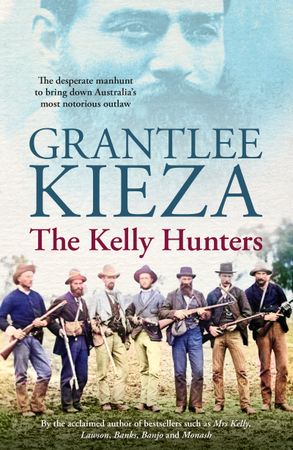
I just completed reading ‘The Kelly Hunters’ by Grantlee Kieza [published in 2022] of 327 pages. A different approach to the Ned Kelly story, we look at the other side, the story of the 20-month manhunt for Ned Kelly, and his three associates who lead the police and authorities through parts of north-east Victoria, and southern NSW., thwarting their pursuers at every turn. A chase marred by incompetence, costly and professional jealousies and conflicts amongst the police and a variety of trackers, together with the opposition and obstacles created by many in the local population providing support to the gang, and constantly sending the police on a ‘wild goose’ chase.
The general promo blurb of the story reads as follows.
When Ned Kelly and his band of young tearaways ambushed and killed three brave policemen in a remote mountain camp in 1878, they sparked the biggest and most expensive manhunt Australia had seen. The desperate search would end when Kelly and his gang, wearing suits of armour, tried to derail a train before waging their final bloody gun battle with police in the small Victorian town of Glenrowan.
In the 20 months between those shootouts and aided by a network of informers, hundreds of lawmen, soldiers, undercover agents and a team of Aboriginal trackers combed rugged mountains in freezing conditions in search of the outlaws. The police officers were brave, poorly paid and often ailing, some nearing retirement and others young with small children, but they risked death and illness in the hope of finding the men who had killed their comrades.
The hunt for the Kelly gang became a fierce battle of egos between senior police as they prepared for the final shootout with Australia’s most infamous bushrangers, a gun battle that etched Ned Kelly’s physical toughness and defiance of authority into Australian folklore. By the author of the critically acclaimed Mrs Kelly, as well as other bestsellers such as Banks, Monash and Banjo, The Kelly Hunters is a fascinating and compelling account of the other side of the legendary Kelly story.
In addition to the main story, Kieza concludes with a substantial series of Notes arising from each of the book’s 20 chapters; closing descriptions of the subsequent lives of the various characters [on both sides of the hunt]; a full listing of each of the subsequent recipients of the 8,000 Pound reward money which had being offered for information of action leading to the capture of the Kelly Gang, which sum was divided eventually amongst 66 individuals; a list of the names of all of the police who were present at Ned Kelly’s last stand at Glenrowan, include their method and time of arrival; and a concise bibliography of written material and internet sources relating to the Kelly families.
Throughout the book, there are references from time of the massacres of Indigenous people in Queensland, often by their own people employed as trackers by the local police and/or settlers – Queensland was a colony where the lives of Indigenous people were often given less value than that of the profits from sheep and cattle – one such group of black trackers led by a notorious Irish-born Sub-Inspector Stanhope O’Connor were recruited down to Victoria to assist in the manhunt for the Kelly gang, and while they were relatively unsuccessful, they were one group of pursuers that gave the greatest fear to Ned. This group, as with the Native Police in general throughout Queensland, were used as a paramilitary force by Queensland’s colonial government to provide protection to the settlers, but also to subdue, chase away or massacre their own people, under the direction of white men. Kieza suggests that the estimates of the number of Indigenous people killed on their raids over a 40-year span rany7ged from 20,000 to more than 41,000.
As noted in the blurb above, there was regular conflict and ego concerns between many of the police parties, and in particular with O’Connor and his trackers. Additionally, groups of police or individuals over much of the 20 months in question, had to endure severe climatic conditions in their attempts to track down the Kellys. One of the principal characters involved in the chase from time to time [and also in many disputes of authority etc] was Superintendent Frank Hare, the following description of whom gives some indication of the conditions under which the police and other searchers had to cope with.
From page 171: “Standish trusted Hare more than any of the other Kelly hunters. The big man was willing to endure all manner of privations in pursuit of the gang, setting off into the wilds with his men and packhorses at rhe vaguest of rumours for eight or ten days at a time. Hare was almost 50, but his bones ached like he was 100. ‘Our life was a very hard one ,’ Hare recalled, ‘sleeping in the open without tent or fire, living on potted beef, and biscuit, and sardines. Bushman think nothing of camping out for months but ask any of them in the winter months to camp out without a fire and see how long they will stand it’. [Of course the ‘no fire’ policy was aimed at preventing the Kelly gang from knowing the police were close].
Though not all thought highly of Hare.
From pages 176-177, Charles Nicolson, when he joined the pursuing forces, had a different approach to that of Hare – ‘he hardly ever sent out search parties, preferring to court spies and make deals with anyone likely to have the ear of the Kellys or their friends, especially Aaron Sherritt’ [who would be murdered as a traitor by one of the gang, a couple of days prior to the Glenrowan siege]l and from page 178 Nicholson ‘said Hare had been hunting the Kellys, with the largest body of police that ever was in the districts and with the artillery force at his command’, yet he said, ‘the whole colony was sneering at their efforts’.
The following is a brief selection of reviews of Kieza’s book, which are generally positive, with readers such as myself appreciating the book’s engaging narrative and style of reading, and while its aim to portray principally the Kelly pursuers, Kieza also provides a nuanced portrayal of the Kelly gang, and their 20 months on the run. I have to agree with each of the points made below, and for those interested, an easily read and followed historical depiction’
- The Australian: Praised for its engaging writing and detailed portrayal of the Kelly gang, this review highlights Kieza’s ability to bring the characters to life;
- Daily Telegraph: Described s vivid, detailed ad well-written, this review emphasises the book’s ability to capture the essence of the Kelly story;
- Betterreading.com.au: Calls it a staggering accomplishment, this review suggests that the book is a must-read for history buffs and story lovers alike;
- John Howard: Acknowledges Kieza’s clear and accessible writing style, which is well-crafted and extensively documented;
- Weekend Australian: Praised for its clear and accessible writing, this review suggests that Kieza has added hugely to the depth of knowledge about the Kelly gang.
Grantlee Kieza OAM has held senior editorial positions at The Daily Telegraph, The Sunday Telegraph and The Courier-Mail for many years and was awarded the Medal of the Order of Australia for his writing.


Leave a comment