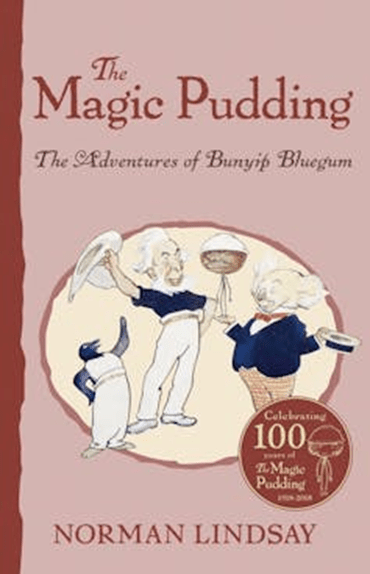
The following two articles, which appeared in the online newsletter ‘The Conversation: Books & Ideas’ on the 3rd April, past, I considered worthy of sharing with interested readers. They both submit a modern perspective on two children’s stories, one an Australian classic ‘The Magic Pudding’ [written & illustrated in 1918 by Norman Lindsay], and the second, an ancient fairy-tale, ‘The Emperor’s New Clothes’ [written by Hans Christian Anderson in 1837]. I have copied them below as they appeared in the said publication.
[1] How Norman Lindsay wrote The Magic Pudding to critique ‘Australian values’ – inspired by Nietzsche [essay by John Uhr, Emeritus Professor of Politics, Australian National University………………………………]The federal parliamentary seat of Lindsay, west of Sydney, was formed in 1984, honouring the great Australian illustrator and writer Norman Lindsay (1879-1969). The seat has been held since 2019 by the Liberal member, Melissa McIntosh.
When McIntosh’s colleague Angus Taylor was elected leader of the opposition in February, he immediately framed his political strategy around “Australian values”. He distanced himself from the government’s multiculturalism, called for a reduction to immigration and claimed to be in favour of “social inclusion” based on support for the “Australian way of life”.
Lindsay’s classic children’s book The Magic Pudding, first published in 1918, is an interesting commentary on those “Australian values”.
His story about a bad-tempered pudding, which never diminishes no matter how much you eat it, has been widely interpreted as defending our “way of life”. For a century, critics have praised Lindsay’s beautifully illustrated text as showcasing the “Australian dream” and the national character. The book has been celebrated for its depiction of the norm of blokey larrikinism and our love of mateship, at least among males.
In fact, The Magic Pudding is a clever critique. The wily Lindsay was warning readers that Australian culture and civic morality were dangerously shallow.
His tale was inspired by his reading of philosopher Friedrich Nietzsche. Lindsay was one of Australia’s first enthusiasts for Nietzsche, whose political philosophy was about transforming democratic culture, moving it away from what he called “slave morality” and towards a new world of the “master morality” of elite artists.
Lindsay treasured works by Nietzsche, such as Thus Spoke Zarathustra, with its message that “God is dead”. He feared that the crass philistinism of contemporary Australian democracy was tainted by “slave morality” and saw himself as a champion of “free spirits”.
The Magic Pudding was his attempt to tell that tale in a comic form.
‘Owners’ and ‘thieves’
The crafty depths of Lindsay’s critique can escape many first-time readers. But if they take a careful second look, many highly regarded “Australian values” emerge as second rate.
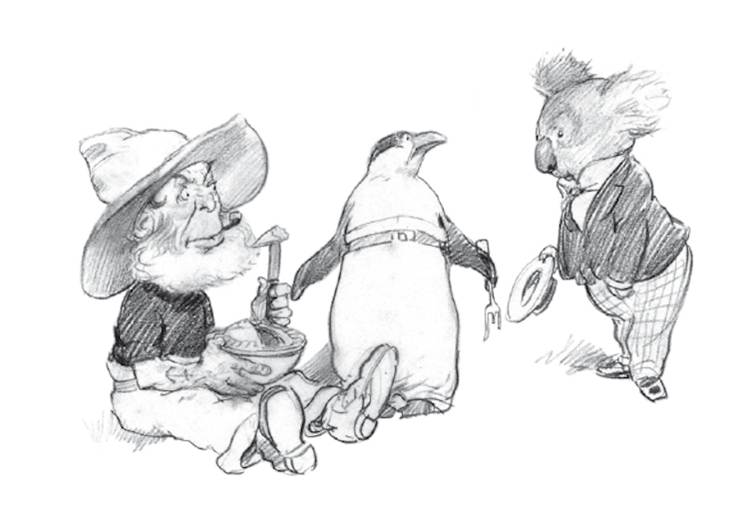
What many critics have fondly called the Australian dream is actually a grim picture of three self-declared “owners” monopolising control over a magically replenishing resource: Albert, the mean-spirited but endlessly edible pudding.
If Albert is the treasure of the story, then the koala Bunyip Bluegum is the hero. Bluegum initially appears as a young lad out to “see the world”. He might even be a potential artistic “free spirt”, having been coached by the unusual poet Egbert Rumpus Bumpus (who is also a koala).
But Bunyip Bluegum falls into company with Bill Barnacle and his sidekick, a penguin named Sam Sawnoff, the so-called “owners” of Albert. There follows a funny story about two gangs – pudding “owners” and pudding “thieves” – using their fists to fight for control of Albert.
But is it really true that, as critic Eleanor Whitcombe commented, Lindsay “created the ultimate ocker” in Albert the pudding? It might well be true that the book is “a true guide to the Australian national character” – but is Lindsay supporting or opposing this version of it?
In fact, Albert the pudding is an alien. He was “invented” out at sea by a non-Australian ship’s cook called Curry and Rice, whose sole ownership of the pudding caused Bill and Sam to become “justly enraged”.
The pair effectively drown Curry and Rice when they seize Albert, who never stops complaining about the malicious intervention of his new “owners”. The two “pudding thieves” see no legitimacy in the claims to ownership or the “the way of life” celebrated by Albert’s captors, who manage Albert as an alien slave.
Eventually, the two warring gangs end up in court, where Lindsay displays his most un-nationalistic portrait of the waywardness of Australian law and order. The mayor is ridiculous in his endless appetite for free bananas. The police officer is awkward and fearful of Albert’s rebellious distemper. The court usher is servile, treating the judge to repeated games of cards and plying him with glasses of port.
The hero Bunyip Bluegum beats the legal system with a clever lie that “Albert has been poisoned”. This so upsets the court that the “owners” are able to flee with their captive.
The tale ends with what many critics describe as an ideal conclusion: three “owners” high up in their tree, with the ever-miserable Albert secured in “a little Puddin’ paddock”.
Food and fighting
The Magic Pudding can be read as Lindsay’s black-humoured portrait of the primitive nature of a culture of “food and fighting”. The Australian way of life displayed in The Magic Pudding revolves around the life of the belly, not the life of the mind.
In a 1916 letter to publisher George Robertson, Lindsay describes Bunyip Bluegum as “the hero” of a story written against the background of “the brutal reality of war” – a story intended “to stiffen the younger generation to a more decent frame of mind”. Lindsay later wrote that his hope for “this generation” is “to see life clearly, and without the false equation of sentimentality”.
My conclusion is that Lindsay is not promoting civic pride in Australian nationality, but attempting to stimulate interest in alternative sources of national pride.
The Magic Pudding says nothing explicitly about Nietzsche, but it illustrates Lindsay’s deeply personal attempt to move beyond the ethos of military struggle at the end of the great war, in which he lost a younger brother in France at the end of 1916.
Nietzsche’s concept of the “higher man” sought to break free from the doctrine of social equality favoured by democratic movements.
What Lindsay learned from Nietzsche was that the military victory Australia earned in 1918 had merely protected a barbaric public culture.
In his book Creative Effort: An Essay in Affirmation, published not long after The Magic Pudding in 1920, Lindsay proposed that artistic “great souls” could use their talent for comedy to undermine the conventional “spirit of gravity” nurturing modern democracy, symbolised by the pre-eminence of “bellies” and lesser beasts like the “grunting pig”.
The aristocratic few, according to Lindsay, despise most ordinary citizens, who are “no more than a walking belly”. He observed sadly that “it is for the belly alone that half the energy of society is exerted”. The mind of the many fails to reach the higher levels of artistic spirit because it “is almost wholly concerned with the belly.”
The fate of Bunyip Bluegum, who is not given to fisticuffs, might be viewed in this sense as something of a cautionary tale. He is at his finest when he confronts the pudding-thieves and recites a long poem about the immorality of stealing, which moves the thieves to renounce “their evil courses”.
This is Lindsay’s most challenging test of Bunyip’s contribution to the society of pudding-owners: to try to use his poetic powers to turn the pudding thieves towards virtue.
Lindsay’s story is very much about Bunyip Bluegum rounding out the forceful skill-set of Bill and Sam – who clearly emerge as the very first pudding thieves, determined never to yield Albert to any competitor.
Gifted with poetic knowledge, Bunyip discovers that he has everything – “except food”. He uses his cleverness to help Bill and Sam, and is rewarded with a version of the high life, savoured by an endless supply of Albert’s hearty pudding.
But once he has access to Albert as a useful food slave, Bunyip loses interest in everything that might make his life more poetically noble.
Lindsay’s book warns readers that the humdrum complacency of Australian public culture needs the artistic excellence of “free spirits” as a cultural corrective to its misplaced dreaming. The Magic Pudding provides a belly full of laughs for children, but it is also a reminder of the importance of the life of the mind for adults uncomfortable with many practices of the “Australian way of life”.
Inspired by Nietzsche, Lindsay was hoping to provoke Australian readers to dream of something grander than a full belly.
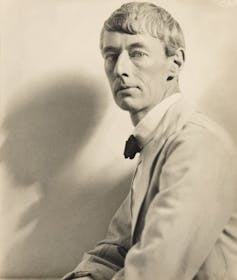
Top: Norman Lindsay in 1920. Picture Australia, Public domain, via Wikimedia Commons
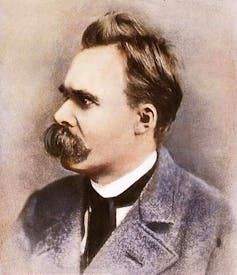
Bottom: Friedrich Nietzsche. Public domain, via Wikimedia Commons
[Comment: I retained a beautiful copy of this book as a gift for a future grandchild, but I fear that in 2026, it will probably hold little of interest for the members of that generation! I’d like to think I’m wrong!! – Bill]
[2] The Emperor’s New Clothes, by Hans Christian Anderson – a fairy tale for our times?
[essay by Nicola Welsh-Burke, Sessional Academic in Literary and Cultural Studies, Western Sydney University].
In mid-March, an activist group in Rutland County, Vermont, held its usual weekly rally protesting the actions of US president Donald Trump. One protester, Marsha Cassel, led the crowd, dressed as a naked Trump wearing a crown and holding a staff. Cassel was followed by another protester holding a sign proclaiming “THE EMPEROR HAS NO CLOTHES!”.
This is not the first time Trump has been compared to Hans Christian Andersen’s bumbling emperor, who marched naked through the streets while claiming to be dressed in finery – a fiction many of his subjects willingly indulged.
Who was Andersen, what aspects of his life informed this particular story and why might this be useful to know in the age of Trump?
Andersen was born in Odense, Denmark, in 1805. While his grandfather supposedly claimed noble origins for the family, Andersen’s father was a cobbler and his mother an illiterate washerwoman.
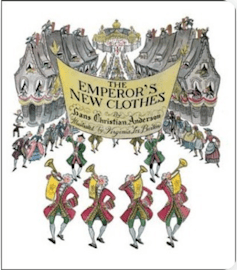
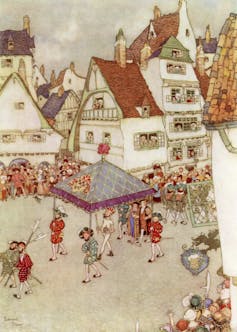
Top: book illustration.
Bottom: Illustration by Edmund Dulac from Stories from Hans Andersen, published 1938. Universal Images Group via Getty Images
After his father died, Andersen moved to Copenhagen for work, where he found a patron, theatre director Jonas Collin, who paid for his education. Andersen started writing after graduating from university, becoming well known for his fairy tales, which he began publishing in the 1830s.
The Emperor’s New Clothes is in his 1837 work, Fairy Tales Told for Children, which featured other memorable tales such as The Steadfast Tin Soldier and The Little Mermaid.
The story follows a vain and clothes-obsessed emperor who commissions clothing from two travelling conmen. These men, posing as weavers, visit his court to show off a new kind of material, which is supposedly rendered invisible to a man “unfit for the office he held”, or “extraordinarily simple in character”.
Afraid to reveal that he cannot see the material, the emperor sends in several aides to review the process, who all lie about being able to see the clothes being made.
Once the “outfit” is finished, the emperor dons it and parades naked through the town. The townsfolk compliment the garments, until a small child bursts the bubble, yelling out that the emperor has no clothes.
Unable to admit this, the emperor continues on his way. But the townsfolk now laugh.
This simple tale powerfully criticises rulers who tell untruths, performing intelligence and leadership, as well as those who uncritically allow this.
An outsider looking in
Like many fairy tales, the origins of this one stretch back centuries. Older versions date to medieval times. All feature people in power being duped by conmen who play on their vanities about their own intelligence. Literary scholar Hollis Robbins suggests Andersen’s version reflects a newly-emerging working class culture where “professional competence” was “quickly overtaking legitimacy and heritage as a source of aristocratic anxiety”.
In his book The Enchanted Screen: The Unknown History of Fairy-Tale Films, fairy tale scholar Jack Zipes claims Andersen was “embarrassed by his proletarian background” and “rarely mingled with the lower classes” once he found success as a writer.
Andersen never married and more recently, has been understood as a bisexual man. He had infatuations with both men and women, including Edvard Collin (the son of his patron Jonas) and Swedish opera singer Jenny Lind. After a fall in 1872, from which he never recovered, he died in 1875.
Andersen’s lower class background, argues Zipes, meant he was particularly well suited to biting cultural commentary about the difficult path for those escaping poverty.
In one translation of The Emperor’s New Clothes, the child who proclaims the nudity of the emperor is called “the voice of innocence” by his father. This voice spreads through the crowd, leading to the comical image of the naked emperor’s aides striving to lift the invisible train of his outfit even higher.
Regardless of one’s position in life, this story suggests you cannot escape “suffering, humiliation, and torture,” writes Zipes.
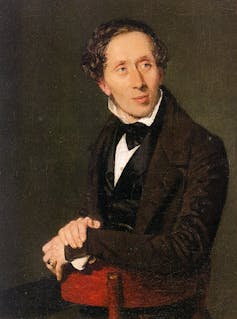
Hans Christian Andersen in an 1836 portrait. Wikimedia Commons
Indeed, many of Andersen’s tales feature characters (often frail, young women) who suffer immensely before dying nobly. The Emperor’s New Clothes, with its child character as the voice of reason, has an ending that, while not “happily ever after”, is as light-hearted as Andersen gets.
The power of fairy tales
The fairy tale is one of the most recognisable literary genres. We hear them from such a young age it is almost like we were born knowing them. Beginning as oral folktales, many of the tales we know today were first written down in 16th and 17th century France, Italy and Germany as social commentary and educational stories.
It is difficult to identify the “originals” of many tales, given their folkloric origins. Still, while it is almost stereotypical now to note that the “original fairy tales” (before contemporary Disney adaptations) were surprisingly dark Andersen’s are noticeably, and notably, bleak.
The Emperor’s New Clothes has been retold many times, with print, screen and musical adaptations. As Donald Trump, in the words of one pundit, continues to “construct a narrative, declare it to be true and relentlessly force the world to submit to it”, the story resonates today.
Indeed, literary academic Naomi Wood has argued that in a post 9/11 world, a “terrifying possibility” emerges in readings of the tale.
The truth of the fairy tale is not its glorification of the voice of innocence, free from corruption and untruth. Rather, it is that adults will continue to believe their own lies, even when they are clearly revealed. As a result, we allow the parade to continue, even while knowing it is farcical.


Leave a Reply