I’ve continued reading since the Christmas/New Year period, and as always like to share something about that material which this time includes some older publications. Only a short selection of readings this time, however some substantial commentary has been provided for the third listed book below.
- Last One Out by Jane Harper, pub. 2025;
- The Rainbow and the Rose, by Nevil Shute, pub. 1958;
- The Agony and the Ecstasy: the biographical novel of Michelangelo, by Irving Stone, pub. 1961;
- Atonement by Ian McEwan, pub. 2001.
13th January
The latest novel by Australian author Jane Harper called ‘Last One Out’, published in 2025, of 373 pages, a slow-moving novel which built up to its leading crescendo of awareness in the closing pages. A true mystery I guess, where the reader may well assume that the killer[s] are someone still in the town, but not revealed until the appropriate time. In some ways, as I read, I found myself silently saying ‘get on with the story’, yet still a difficult book to put down!!
“Last One Out” is a gripping mystery novel by Jane Harper that explores the disappearance of a young man and the haunting impact it has on his family and a small rural community.
The story revolves around Ro Crowley, who is waiting for her son Sam to return home on the night of his 21st birthday. However, Sam never arrives, and his disappearance sends shockwaves through the community of Carralon Ridge, and eventually Ro leaves her husband Cliff as they both struggle in different ways to overcome their loss.
Five years later, Ro returns to the now desolate town for Sam’s annual memorial, only to find it transformed by the encroaching coal mine that has driven most residents away. As she revisits the abandoned houses where Sam’s footprints were found, Ro seeks answers about her son’s fate, uncovering secrets that the remaining townsfolk may hold. The skeletal community is now an echo of itself, having fractured under the pressure of the coal mine operating on its outskirts. But Ro still wants answers. Only a few people remain. If the truth is to be found in that town, does it lie among them? She has not given up hope that Sam is still alive and is desperate to make sense of his final hours
From Australian Book Review of December, 2025, the reviewer, Barbara Pezzotti describes the affect of the mine on the town thus – ‘In Harper’s descriptive language, the presence of the mine is not only visible through the destruction of the landscape; it is also constantly felt and heard by the inhabitants of Carrolan Ridge. The rumbling and rattling of the machinery [24 hours a day] scarring the ground and destroying nature is constant, day and night. Replacing birdsong, it is the background to walking, eating, sleeping and talking….Heavy vehicles lumber their way up and down past people’s front doors. A grey layer of coal dust covers every flat surface, the taste of the water and the smell of sulphur in the air, a constant reminder of the mine’s devilish presence’
She also describes [in line with my opening paragraph above] where ‘In this slow-burn, stand-alone mystery, police investigation is non-existent and the burden of the enquiry rests only on Ro’s shoulders. Through flashbacks, the narrative gives an account of Ro’s five-year-long investigation. A new, unexpected clue materialises only towards the end of the novel, bringing finality’.
Chris Gordon, writing for Readings [Sept 2025] summarises the book as follows
“Jane Harper’s latest novel is a heartbreaker. There is no ruggedly handsome detective trying to make sense of his own frailties while solving a murder. Last One Out does something different to Harper’s previous works. The story concentrates on a family with a son, Sam, who disappeared five years prior to the book’s beginning. The novel’s focus remains on the mother, Ro, a doctor who fled her marriage and the community after the initial trauma. Yet she returns each year to the failing town to acknowledge her loss and to connect with the friends and family who remain. And here lies the other tragic component of the novel: the entire story is set in Carralon Ridge – an isolated rural town that has run out of steam and has been purchased for mining. The residents who haven’t left are bitter – defeated, even – and certainly nostalgic for times that now do not exist. The men seem to cower from change, while the women support everyone, clean, and hide their pain. Harper does an excellent job of working into the narrative the relentless nature of the dust, the noise of the mining, and the heat. This is not a town for tourists. This is a town that screams resentment and frustration. And this time, Ro’s annual visit uncovers the past – and her son’s murderer.
Harper has written a wonderful literary exposé of a disappearing town. The metaphors she uses are damning of the environmental damage caused by mining. She perfectly captures the limbo in which the dispirited locals are trapped, along with the social fractures and fear the uncertainty causes. This is a universal story of decline. Readers of Harper’s previous crime novels – and this is another – will delight in her steady pace and astute character observations. I found this novel painfully affecting: our rural past is swept up in the dust with more than one victim.
Reverting back to Pezzotti’s analysis – ‘Last One Out lacks the rhythm and suspense of Harper’s earlier work [all of which I have read]. The sociological and psychological study of a disappearing community is compelling, but it distracts from the crime plot…………..This is not an uplifting story of resistance and empowerment, nor is it a sharp condemnation of the evils of neo-liberalism and globalisation. The moral of the story is simply to accept the inevitable consequences of corporate greed and focus on personal regeneration , even at the expense of community’.
In an article I included in this Column a few months ago, Harper’s novel was criticised to the extent, that as with her past books, the Aboriginal population did not feature . The original Australians don’t appear to have a place in this town or in her novels, so far!
25th January
A novel written many years ago, which I’ve just caught up with was ‘The Rainbow and the Rose’, by Nevil Shute, published in 1958, of 306 pages. When seasoned pilot Johnny Pascoe tries to rescue a sick girl from the Tasmanian outback, his plane crashes and leaves him stranded and dangerously injured. Ronnie Clarke, who was trained by Pascoe, attempts to fly a doctor in to help, but rough weather makes his mission more difficult than he imagined. As he waits overnight at Pascoe’s house for a chance to try again the next day, Clarke revisits the past of this unusual man [which he does through dreams he has while asleep]—and reveals the shocking and tragic secrets that have influenced his life.
The title is taken from a sonnet “The Treasure” by Rupert Brooke, which is quoted in full as a preface:
Wikipedia summary of the novel [readers’ spoiler]
The story concerns the life of Canadian Johnnie Pascoe, a retired commercial and military pilot, who has crashed while attempting a medevac flight in difficult weather conditions into a small airstrip a mountainous region of Tasmania. Unconscious and suffering from a dangerous head injury, he lies in the house of the child he had been sent to help, which is inaccessible by road and in contact with the outside world only by radio. Hearing of his plight, Ronnie Clarke — an airline pilot and student of Pascoe decades earlier — offers to try and land a young doctor. After two failed flights in one of Pascoe’s own Taylorcraft Auster aircraft from the small flight school Pascoe set up after retirement, Clarke rests overnight at Pascoe’s house, meets Pascoe’s two daughters, and narrates the life of his former mentor through three dream episodes.
In the first episode, Pascoe is a young fighter pilot in the Royal Flying Corps during The Great War and marries an up-and-coming actress. At war’s end they separate when she accepts a role in Hollywood, moves in with another man, and files for divorce from there with sole custody of their daughter.
A few years later, in the 1920s, Pascoe is chief pilot at the small flying school where Clarke learned to fly, and becomes romantically involved with a student pilot, Brenda Marshall, whose husband is in a mental asylum after sexually assaulting children. Things go awry after the birth of Pascoe’s and Marshall’s baby daughter, and when Marshall learns that her husband has refused to grant a divorce, she commits suicide by deliberately crashing her de Havilland Moth. Pascoe leaves the country, with the baby in the care of Marshall’s mother, and shortly afterwards he learns that the baby has died
In the final dream episode, after having served with Ferry Command during the Second World War beside Clarke, Pascoe is a senior pilot with fictitious AusCan Airlines in the 1950s, flying routes between Canada and Australia, and approaching mandatory retirement at age 60. Peggy Dawson, a flight attendant and former nurse in her late 20s, asks to join his cabin crew and impresses him during the interview. They begin to spend more time together during layovers, and he develops feelings for her that he notes are non-sexual. With retirement approaching, Pascoe wants to find a way to keep Dawson in his life, so he proposes marriage, even though he does not believe that his feelings are romantic. Dawson reveals that she rightfully should be named Brenda Maragaret Pascoe. She is Pascoe’s daughter with Brenda Marshall, who Pascoe believed to have died in infancy; she had left nursing and joined AusCan airlines to observe her father and possibly to make contact with him. The framing story closes with Ronnie Clarke making a successful attempt to land the doctor and Pascoe’s daughter Nurse Dawson in clear weather the next morning, only to learn that Pascoe had died during the night. Dawson remains to arrange for an informal burial, then plans to hike 40 miles (64 km) back through to bush with the rescue party to deal with her father’s estate. There is a strong suggestion that Dawson and the young doctor have developed feelings for each other.
Clarke returns to Melbourne, 36 hours after he left, and notes that his life is full of blessings with his spouse and children, while Pascoe, who was (in his opinion) the better man, had so little joy in life.
Like Conrad, Shute often uses a narrator to tell the story; in The Rainbow and the Rose, the narrator periodically shifts from Clarke to Pascoe.
16 February
The Agony and the Ecstasy: the biographical novel of MICHELANGELO by Irving Stone, published in 1958, of 664 pages. I can’t admit to reading this mammoth book in the hurry – in fact recall when it actually came into my possession, many years ago, or whether it was a purchase or s gift. My copy was personally signed by the author. In any case, I began to read it many years ago, put it aside, probably for a couple of decades, only getting back to it early this year, and determined to see it through!
I found it not just a biography of a great artist [in novel form] but also a fascinating depiction of the historical events of the period of his life and of the political and religious strife of Italy and surrounding areas of the then Europe. Reading in particular about the Popes of those times – well hardly comparative to the perceived moral and religious authority of the modern-day Pope. That’s a story on it’s own!!
Just one of many examples: [page 636] “Cardinal Giovanni Pietro Caraffa became Pope Paul IV. No-one quite knew how he had been elected. He was a thoroughly disagreeable man, violent of nature, intolerant of all about him. Pope Paul IV, knowing how completely he was hated, said: ‘I do not know why they elected me Pope, so I am bound to conclude that it is not the cardinals but God who makes the Popes’.
Published in 1961, this is a captivating novel that chronicles the life of Michelangelo Buonarroti, exploring his artistic genius and personal struggles during the Renaissance and exploring the historical context of the time. The book is not only a tribute to Michelangelo’s genius, and at times, hi complex character, and the often tumultuous relationships he had with artists such as Leonardo de Vinci, but also a reflection on the broader tensions faced by artists in pursuit of their vision
The narrative begins with a young Michelangelo, grappling with feelings of loneliness and a desire for love following the death of his mother. His journey into artistry sees him facing both physical and emotional struggles, driven by an insatiable pursuit of perfection and the agony of creating masterpieces only to witness their destruction, and regularly facing the demands and changes of those demands by different Popes and other authorities of the time. Announcing that it was his ambition to wipe out all heresy in Italy, he unleashed on the Roman people the horrors of the Spanish inquisition”.
However, this book is about Michelangelo, although in reading through it, one quickly learns of the powerful influence that the various Popes of his time had on his work, his lifestyle, his relationships, and even at times, his life and freedom itself.
The novel emphasizes several key themes, including:
- Artistic Struggle: It portrays Michelangelo’s relentless pursuit of artistic perfection and the challenges he faced, including opposition from family, rivals, and societal expectations.
- Renaissance Humanism: Stone illustrates Michelangelo as a complete artist—painter, sculptor, poet, architect—embodying the ideals of Renaissance humanism.
- Historical Context: The book provides insights into the political and cultural landscape of Renaissance Italy, including the influence of powerful figures like Lorenzo de’ Medici and various popes
Irving Stone conducted extensive research for the novel including translating Michelangelo’s letters and studying his techniques. This meticulous approach allowed Stone to blend historical facts with fictional narrative, while the novel has been divided into precise sections that detail distinct periods of Michelangelo’s life, making the story both informative and engaging. Stone trawled through every document, including Michelangelo’s bills and legal documents, and even worked sat one time in an Italian quarry.
Writing in a publication from Sep 27-October3, 1997, called ‘The Vulture’ [an article which described itself as ‘Picks over the bones of contemporary culture], it was noted that ‘This version of the artist’s long, difficult life takes no risks. What we get is an intricate skeleton of events and a carefully textured skin of meticulous local colour. It is a fascinating canvas so long as you don’t expect much psychological flesh’. Well, if merely a skeleton, the 647 pages I read certainly contained plenty of skin and flesh!!
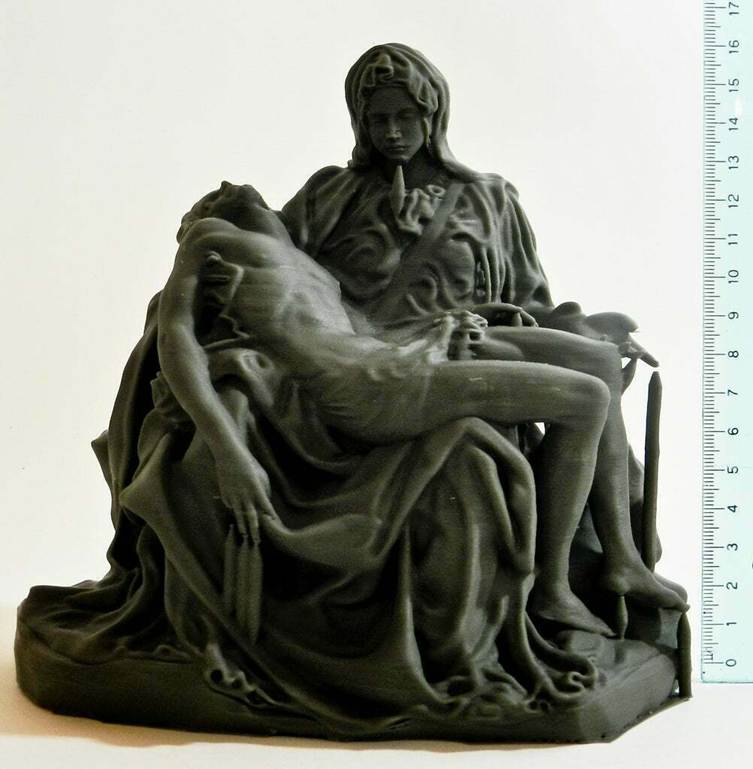
Having noted also with special interest the years and efforts and trials Michelangelo put into creating many if not all of his ‘masterpieces’, I found myself adding to my ‘bucket list of things I’ll never achieve’ a genuine desire to see in person those existing masterpieces such as the Sistine Chapel Ceiling, The Last Judgement, the statue David, The Garden of Eden, the Pieta, Moses, St. Peters, and so on [see following].
Getting back to the novel –
Key characters include Lodovico, Michelangelo’s father, whose harsh expectations and lack of affection contribute significantly to Michelangelo’s personal challenges. Lorenzo de’ Medici, a significant patron, embodies the Renaissance ideals that inspire Michelangelo, while Contessina de’ Medici and Clarissa Saffi represent the romantic entanglements that are ultimately thwarted by social constraints and Michelangelo’s artistic obsessions. Vittoria Colonna, a devoted reformist, captures his admiration later in life, though their relationship remains platonic. Lastly, Tommaso de Cavalieri serves as a devoted companion in his later years, showcasing the importance of friendship amidst Michelangelo’s solitary existence. This rich tapestry of relationships illuminates the artist’s life, highlighting the balance of agony and ecstasy inherent in his quest for artistic immortality.
As one reviewer noted – the novel explores his quest to become the living representation of Renaissance humanism, a journey filled with personal and professional hurdles. Michelangelo must navigate familial opposition, religious constraints, political manoeuvrings, and the competitive nature of artistic patronage to fulfill his vision.
From a Wikipedia summary we note that:
Beginnings and Early Challenges
Despite his father’s disapproval, young Michelangelo earns an apprenticeship under the painter Ghirlandaio, and later, the sculptor Bertoldo, who works under the sponsorship of Lorenzo de’ Medici, a prominent Florentine patron. Michelangelo quickly gains Lorenzo’s admiration and forms connections with his children, including future popes Giulio and Giovanni, and Contessina, his first love. He faces hostility from envious peers, including an infamous encounter with Torrigiani that leaves him physically marked, but through illicit study of anatomy, he hones the skills crucial to his craft. As Savonarola rises to power, threatening the Medici family and the cultural landscape of Florence, Michelangelo finds himself at a crossroads.
Rome: A Turning Point
Seeking refuge in Bologna during Savonarola’s reign, Michelangelo encounters Clarissa Saffi and creates “Bambino,” drawing the attention of Leo Baglioni. His first visit to Rome introduces him to influential figures such as banker Jacopo Galli, who commissions his work, and architects Giuliano Sangallo and Bramante, the latter becoming a rival. Here, Michelangelo sculpts the renowned Pieta, learns the intricacies of patronage, and becomes involved in the ambitious project of St. Peter’s Basilica, which will dominate his later years.
Return to Florence
Back in Florence, Michelangelo creates his monumental statue, “the Giant,” or David, which comes to symbolize the city itself. He crosses paths with Leonardo da Vinci, his chief rival, and Raphael, forming a triumvirate of Italian Renaissance art. Michelangelo’s rivalry with Leonardo intensifies as they compete to paint frescoes for Florence’s rulers. Pope Julius takes note of Michelangelo’s prowess and summons him to Rome, compelling him to work in bronze and undertake the monumental task of painting the Sistine Chapel ceiling. Julius’s vision of a new St. Peter’s aligns with Michelangelo’s burgeoning architectural ambitions.
Under Papal Influence
Following Julius, the Medici popes Giovanni and Giulio add new dimensions to Michelangelo’s challenges. Giovanni demands that Michelangelo procure marble from the remote Pietrasanta, inadvertently turning him into an engineer, while Giulio’s forces require him to fortify Florence, utilizing his engineering acumen. Pope Paul III commissions Michelangelo for the Last Judgment and appoints him architect of St. Peter’s amidst ongoing disputes. Michelangelo’s culminating achievement is the dome of St. Peter’s, a fitting testament to his artistic and architectural legacy. Alongside his professional triumphs, he finds personal solace in the company of Tommaso de Cavalieri, who would carry on his work on St. Peter’s, and Vittoria Colonna, his intellectual companion and muse.
Looking at perhaps the most famous of his works, with copies of these to follow:
David, completed by Michelangelo in 1504, is one of the most renowned works of the Renaissance. The masterwork definitively established his prominence as a sculptor of extraordinary technical skill and strength of symbolic imagination – created from 1501 to 1504.
The Last Judgement: is a fresco by the Italian Renaissance painter Michelangelo covering the whole altar wall of the Sistine Chapel in Vatican City. It is a depiction of the Second Coming of Christ and the final and eternal judgment by God of all humanity.
The Sistine Chapel: – from the creation to Noah in 175 individual paintings covering 12,000 square feet
The creation of Adam (bottom), the creation of Eve from Adam’s rib (centre) and the temptation and expulsion of Adam and Eve from the Garden of Eden (top)
The Pieta: this is Michelangelo’s masterpiece that depicts the Virgin Mary cradling the lifeless body of Jesus after his crucifixion.
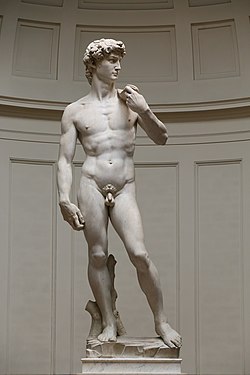
[David]
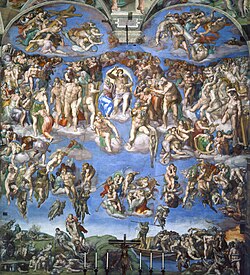
The Last Judgement [1536-41]in the Sistine Chapel, Vatican City.
–
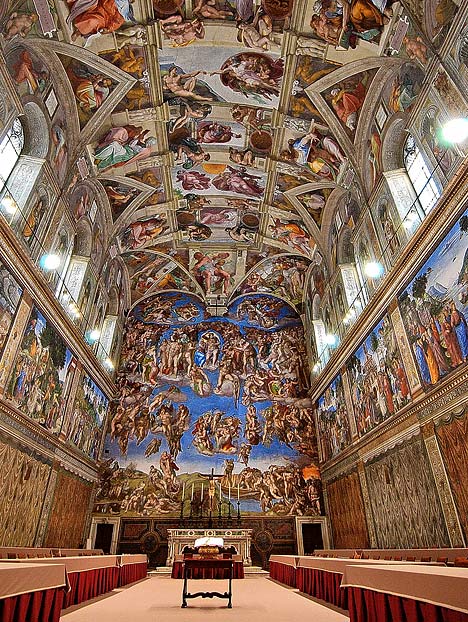
The Sistine Chapel ceiling, in the Vatican Palace [1508-1512], Vatican Palace, Vatican City
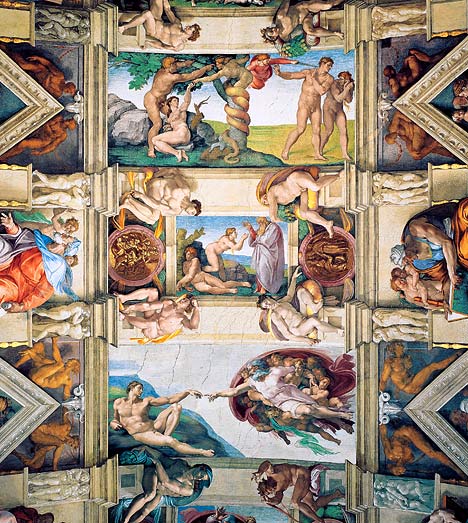
The Creation
Above -Madonna and Child [1524-34], Medici Chapel, Florence; and below, The Last Judgement [1536-41]in the Sistine Chapel, Vatican City.
In conclusion, the night before Michelangelo died [in Irving Stone’s fictional biographical terms]
[page 647] “That night, as he lay sleepless in bed, he thought, ‘Life has been good. God did not create me to abandon me. I have loved marble, yes, and paint too. I have loved architecture, and poetry too. I have loved my family and my friends. I have loved God, the forms of the earth and the heavens, and people too. I have loved life to the full, and now I love death as its natural termination. Il Magnifico would be happy: for me, the forces of destruction never overcame creativity.”
19th February
Another book from earlier years – Atonement by Ian McEwan, published in 2001, of 372 pages. This book was shortlisted for the 2001 Booker Prize, and after reading, I was not surprised with that nomination. Widely regarded as one of McEwan’s best works, ‘Time’ magazine named Atonement in its list of the 100 greatest English-language novels since 1923.
It is set in three time periods, 1935 England, second World War England and France, and present-day England, and covers an upper-class girl’s half-innocent mistake that ruins lives, her adulthood in the shadow of that mistake, and a reflection on the nature of writing.
On the hottest day of the summer of 1935, thirteen-year-old Briony Tallis sees from a distance, her sister Cecilia strip off into her underwear, and plunge into the fountain in the garden of their country house to retrieve a vase that has been thrown in by the son of the estate’s cleaner, who has virtually been a part of the family since childhood. . Watching her too is that family friend, Robbie Turner who, like Cecilia, has recently come down from Cambridge. By the end of that day, the lives of all three will have been changed for ever. Robbie and Cecilia will have crossed a boundary they had not even imagined at its start, and will young become innocent victims of a young girl’s imagination and writing ambitions as Briony commits a crime for which she will spend the rest of her life trying to atone, while the other two, and the extended family suffer and have their lives changed in various ways.
As noted on the ‘Bookaholic Academy’ a few years ago – ‘Some books are just stories, and then there are those that feel like they’ve crawled under your skin and left a mark. Ian McEwan’s Atonement falls into the latter category. It’s not just a novel – it’s a gut punch wrapped in beautiful prose, a story about guilt, love, and the slippery nature of truth. If you’ve ever wondered how one mistake can ripple through lives like a stone thrown into water, this book gives you the answer in heartbreaking detail’.
That and the vivid heart-rending depictions of the allies and civilians as they flee from the Germans towards Dunkirk [the second period of the book], and the horrific [to a bystander as a reader] experiences of both Briony and her sister as nurses in the English hospitals attending to the wounded arriving from across the Channel from France [third time period] emphasise so strongly that second category mentioned above.
I’ve copied below the full synopsis of the book, as published by Wikipedia, which is basically a spoiler for those who may be intending to read the book. As a ‘non-spoiler’, a brief plot overview could be:-
‘At it’s core, Atonement is about Briony Tallis, a 13-year-old girl, with an overactive imagination. One hot summer day in 1935, she witnesses something she doesn’t fully understand. But instead of keeping her confusion to herself, she makes an accusation – one that changes the lives of her sister Cecilia and Cecilia’s lover, Robbie, forever. From there, McEwan drags us through the brutality of World War II, the fragility of love in a world torn apart, and the crushing weight of regret. The structure is layered, moving from a childhood mistake to its devastating consequences, and finally to the lasting scars left behind’.
At this point, if you don’t want to read the spoiler, stop reading here!
From a Wikipedia contribution about ‘Atonement’
Part one
Briony Tallis, a 13-year-old English girl with a talent for writing, lives at her family’s country estate with her parents Jack and Emily Tallis, who are members of the landed gentry. Her older sister Cecilia has recently graduated from the University of Cambridge with Robbie Turner, the Tallis family housekeeper’s son and Cecilia’s childhood friend, whose university education was funded by Jack Tallis.
In the summer of 1935, Briony’s maternal cousins, 15-year-old Lola and 9-year-old twins Jackson and Pierrot, visit the family amidst their parents’ divorce. Cecilia’s older brother Leon returns from London, accompanied by his friend from Oxford, the well-off manufacturer Paul Marshall. Cecilia and Robbie bicker over a vase, which breaks and falls into a fountain. Cecilia strips to her underwear and dives in to retrieve the pieces, surprising Robbie. Briony, watching from a window, is confused and intrigued by Cecilia and Robbie’s actions. She is inspired to begin writing psychological realism, and the reader is informed that this will eventually become a hallmark of her fiction.
In the wake of the incident by the pond, Robbie realizes he is attracted to Cecilia, and writes several drafts of a love letter to her. He gives the letter to Briony to deliver to Cecilia; however, he inadvertently gives her a version he had meant to discard, which contains lewd references (“In my dreams I kiss your cunt“). By the time Robbie realizes his mistake, Briony has already returned to the house with his letter.
Despite Robbie’s instructions to the contrary, Briony opens the letter and reads it. She is shocked by its vulgar language, and becomes convinced that Robbie intends to harm Cecilia. An injured Lola goes to Briony for comfort, claiming that her younger brothers attacked her, although it is implied to have instead been Paul Marshall, who has a long scratch on his face. Briony relays the contents of the letter to Lola, who labels Robbie a “maniac,” re-affirming Briony’s feelings. Robbie arrives at the main house for a family dinner party, and is confronted by Cecilia. He confesses his feelings to her, and she responds in kind. Later the same evening, Briony walks in on Robbie and Cecilia having sex in the library. The immature Briony believes she interrupted a vicious assault on Cecilia, and stands stunned while Robbie and Cecilia quickly exit.
At the dinner, which is generally tense, it is discovered the twins have run away. The party breaks into teams to search for them. When Cecilia goes with Leon, Robbie and Briony each set off on their own. In the darkness, while everyone is searching for the twins, Briony discovers her cousin Lola being raped by an assailant neither girl can clearly see. The attacker flees. Briony, convinced that it must have been Robbie, gets Lola to agree that she likely heard Robbie’s voice. The girls return home, and Briony identifies Robbie to the police as the rapist, claiming she saw his face in the dark. Lola is sedated by the local doctor, Cecilia screams at Briony and locks herself in her room, and Paul Marshall shares cigarettes with the policemen.
Robbie does not return, and the family and police officers stay awake waiting for him. As dawn breaks, Robbie appears in the driveway with Jackson and Pierrot, having found and rescued them. He is arrested on the spot and taken away, with only Cecilia and his mother believing his protestations of innocence. Briony is satisfied by this conclusion to her mythologized version of the events, with her as the hero and Robbie as the villain.
Part two
By the time the Second World War has started, Robbie has spent several years in prison. He and Cecilia have passed several years exchanging letters, maintaining their love for each other. Robbie is released from prison on the condition he enlist in the army. Meanwhile, Cecilia has completed training as a nurse, and cut off all contact with her family for the parts they played in locking Robbie up. Shortly before Robbie is deployed to France, they meet once for half an hour, during Cecilia’s lunch break. Their reunion starts awkwardly, but they share a kiss before leaving each other.
In France, the war is going badly, and the army is retreating to Dunkirk. As the injured Robbie makes his way there, he thinks about his love for Cecilia and his hatred for Briony. However, he eventually concludes that Briony was too young to be blamed fully, and writes Cecilia a letter encouraging her to reconnect with her family. His condition deteriorates over the course of the section; he weakens and becomes delirious. Robbie falls asleep in Dunkirk, one day before the evacuation begins.
Part three
A remorseful Briony, now eighteen years old, has refused her place at Cambridge and instead is a trainee nurse in London. She has realised the full extent of her mistake and decides it was Paul Marshall, Leon’s friend, whom she saw with Lola.
Briony still writes fiction, and receives a letter from Cyril Connolly at the hospital where she works. Cyril is rejecting Briony’s submitted draft of her latest work to his magazine, Horizon, but providing kindly and constructive feedback. The work is in fact the first draft of the first section of this novel.
Briony travels to attend the wedding of Paul Marshall and her cousin Lola, with the knowledge that Lola is marrying her rapist. Briony considers speaking up during the wedding, but does not. Afterwards, she visits Cecilia, who is cold but invites Briony in nonetheless. While Briony is apologizing to Cecilia, Robbie unexpectedly appears from the bedroom. He has been living with Cecilia while he is on leave from the army. Robbie expresses his fury at Briony, but with Cecilia’s soothing remains civil.
Cecilia and Robbie both refuse to forgive Briony, who nonetheless tells them she will try to put things right. She promises to begin the legal procedures needed to exonerate Robbie, even though Paul Marshall will never be held responsible for his crime because of his marriage to Lola. As Briony leaves Cecilia’s, she is optimistic about her role in Robbie’s exoneration, thinking that it will be “a new draft, an atonement” and that she is ready to begin.
Postscript
The final section, titled “London 1999”, is narrated by Briony herself in the form of a diary entry. Now 77, she is a successful novelist who has recently been diagnosed with vascular dementia, so she is facing rapid mental decline.
It is confirmed that Briony is the author of the preceding three sections of the novel. She attends a party in her honor at the Tallis family home, where the extended Tallis children perform The Trials of Arabella, the play that 13-year-old Briony had written and unsuccessfully attempted to stage with her cousins in the summer of 1935. Leon and Pierrot are in attendance, Jackson is fifteen years deceased, and Lola is alive but does not attend. Finally, Briony reveals to the reader that Robbie Turner died of septicaemia on the beaches of Dunkirk, that Cecilia was killed several months later when a bomb destroyed Balham Underground station during the Blitz, and that Briony’s story of seeing them together in 1940 was a fabrication. Briony did attend Lola’s wedding to Paul Marshall, but confesses she was too “cowardly” to visit the recently bereaved Cecilia to make amends. The novel, which she says is factually true apart from Robbie and Cecilia being reunited, is her lifelong attempt at “atonement” for what she did to them.
Briony justifies her invented happy ending by saying she does not see what purpose it would serve to give readers a “pitiless” story. She writes, “I like to think that it isn’t weakness or evasion, but a final act of kindness, a stand against oblivion and despair, to let my lovers live and to unite them at the end.”
_____________________________________________________________________—
 Site Title
Leave a comment