This contribution looks at a number of books and other publications which I have read and examined over the past two or three months, as listed briefly below.
- Australian Foreign Affairs, Issue 23 ‘Planet Australia’;Escaping America’s Orbit’.
- Quarterly Essay No. 97: ‘Losing It. Can we stop violence against women and children’ [by Jess Hill];
- Memorial Days’ by Geraldine Brooks [2025];
- The Fallen Woman by Fiona McIntosh [2024];
- Lyrebird by Jane Caro [2025];
- The Historian: To you perceptive reader, I bequeath my history, by Elizabeth Kostova [2005];
- The Astonishing History of Ballarat, Volume 3: The Story of the Quartz Miners of Ballarat: 1851-1878 by Doug Bradby [2020];
- Quarterly Essay No. 98 headed ‘Hard New World: Our Post-American Future’ by Hugh White.
What is Australia’s place in the new global landscape?
- ‘Until August’ by Gabriel Garcia Marquez’ [2024]; and,
- ‘Melaleuca’ by Angie Faye Martin [2025].
14th March
‘Australian Foreign Affairs’ publication, Issue 23 titled ‘Planet Australia: Escaping America’s Orbit’.
This 23rd issue of Australian Foreign Affairs [a publication issued three times a year] explored Australia’s changing fortunes as Donald Trump returns to the White House and threatens to dismantle the diplomatic, economic and defence foundations on which Canberra has long built its security and prosperity. It examines the consequences for Australia as some of its most important friends and partners – including India, Indonesia and the United States – shift towards authoritarianism and illiberalism. Featuring special contributions from our three most recent ambassadors to the United States, Planet Australia looks at how Australian leaders and diplomats should deal with Trump and prepare for looming challenges to the alliance, open trade, and a secure and stable Asia.
Essays included:
- James Curran explores Australia’s relationship with the US in the age of Trump. He points to the fact that the America Australia has become accustomed to, is changing.
- Emma Shortis argues that Canberra should be bold as the global order shifts. Among other things, suggests that Trump does not care about Australia, so why should be cosy up to him, it won’t make Australia any safer.
- Susan Stone analyses Trump’s economic plan and how Australia might benefit, in a fairly detailed analytical approach to that aspect of the economic relationship.
- Kim Beazley, Joe Hockey and Arthur Sinodinos discuss the diplomatic challenges facing Australia in Washington DC. An interesting set of views from three former ambassadors. From Beazley – “Trump will be more disruptive and les predictable, but Australia is well placed to protect and advance its own interests’. Hockey: “No matter what, the United States has [historically] had ‘disruptors in chief’ before. It’s institutions and constitution are robust enough to cope with the strain’. From Sinodinos: “Swlf-reliance is not a code for appeasing China, we have stood up to China in recent years and weathered the trde and economic coercion that followed – self-reliance also means putting our own house in order [and] in Trump world, the fate of regional groupings hangs in the balance”.
Other items included a discussion of Kevin Rudd’s recent book ‘On Xi Jinping: How Xi’s Marxist Nationalism Is Shaping China and the World’ – worth a read I feel, although as Rudd himself warns, it is ‘a heavy read’ and parts of it have a deep textual analysis which might defeat the ordinary readers [where I might place myself]. The other interesting book review is of ‘Gret Game On: The Contest for Central Asia and Global Supremacy’ by Geoff Raby. The reviewer suggests that Raby doesn’t cover in much detail the real states of central Asia – Kazakhstan, Kyrgyz Republic, Tajikistan, Turkmenistan, and Uzbekistan – those areas or of interest to myself, I’d like to find a book specifically about their history and people, other than through this publication.
28th March
Quarterly Essay No. 97: ‘Losing It. Can we stop violence against women and children
What will it take to stop gendered violence? This was a quite disturbing, and worrying essay, extremely well researched by Jess Hill, author of ‘See What You Made Me Do’
What went wrong? Australian governments promised to end violence against women and children in a single generation. Instead, it is escalating: men have been murdering women at an increased rate, coercive control and sexual violence is becoming more complex and severe, and we see a marked rise in youth-on-youth sexual assault. Why?
In Losing It, Jess Hill investigates Australia’s National Plan to End Violence Against Women and Children to find out what’s working and what’s not – and what we can do to turn things around. This compassionate, ground-breaking essay lifts the lid on a national crisis.
“Over several years I often heard the same misgivings from academics, bureaucrats and frontline workers: many believed the [prevention] strategy … was too abstract and disconnected from the front line; that it did not reach the boys and men it needed to, and at worst was actually promoting backlash. Many were – and still are – afraid to say so openly.” – Jess Hill, Losing It.
Tonight, I finished reading ‘Memorial Days’ by Geraldine Brooks, published in 2025, just 207 pages, a short easily read personal story full of pathos, unbelievable grief, and a reckoning with the inevitability of loss.
In 2022. The award winning book ‘Horse’ by Geraldine was published, and I made comment on that book in the Coachbuilder’s Column that year.
She was partway through the writing of that book, when, on Memorial Day in the USA, May 27, 2019, she received a ‘cold’ phone call from the local hospital, to tell her that her much loved husband, Tony Horwitz, had collapsed and died on the street, far from home, in the middle of his own strenuous book tour. The complex tasks required in the face of such a sudden death left her no time to properly grieve for him. Three years later, still feeling broken and bereft, she booked a flight to Flinders Island off the coast of Tasmania [where she and Tony had spent some together]. There, she pondered the ways other cultures deal with mourning and finally seized the time and space she needed for her own grief. Alone on a rugged stretch of coast, she revisited a 35-year marriage filled with risk, adventure, humour and love.
‘Memorial Days’ is Geraldine’s story of the loss of her husband and the immediate months that followed, the eventual publication of ‘Horse’, and her healing period of isolation on Flinders Island. A short book, short chapters, alternating between the immediate weeks following Tony’s death, and her time on Flinders Island.
If readers feel this story might help with their owe loss of whatever nature, I recommend a read, In the meantime, four short quotations from ‘Memorial Days’.
- [On Flinders Island] – Two of my friends approach, their faces grave. How an earth did they get here? One gently reaches out and touches my shoulder. ‘You said you wished there had been someone there with you, the last time, so we’ve come here to tell you….An immense dread. I wake up, heart pounding. The nightmare expresses my life’s sudden precarity. I absolutely cannot afford to lose anyone else [p.167-168];
- Night is an even better time to be out here. If the island’s rocks put me in my place, it’s stars do, too. Nature is a remorseless reminder of human insignificance. Daytime, nighttime – there’s no escape from the realization of how little we matter [p. 191];
- I have written this because I needed to do it. Part of the treatment for ‘complicated grief’ is to relive the trauma of the death, returning to the moments again and again, striving each time to recall more detail. That’s what I have tried to do. [p.202];
- The time on Flinders Island allowed me to set down one of the bundles in the baggage of my grief. It’s the grief I’d been carrying for the life I would have had, the life U=I had counted on having. It was the life with sunset-facing rocking chairs, growing old with Tony beside me, laughing, arguing over the news, revisiting shared memories, and taking pride as our sons moved confidently into manhood. That life is gone, nothing will get it back. I have accepted that. I have embarked on making the life I have as vivid and consequential as I can. Do your work, said Bader Ginsburg. So, that is what I do [p. 204];
23rd April
‘The Fallen Woman’ by Fiona McIntosh [published in 2024] of 431 pages – an English historical fiction novel set in the English countryside, in a forgotten orchard and beneath the ancient spire of Salisbury Cathedral, basically a heart-wrenching story of family betrayal, loss and tragedy, the love of an unwanted child, and the potential, almost lost through misunderstanding, of a new previously undreamed of life, about a woman who finds that in her darkest hour, she can harness her greatest strength. The author, an internationally acclaimed best-selling Australian who roams the world for her writing research, and lives between Adelaide [SA] and Wiltshire, England. An enjoyable read, away from the more serious deep-thinking non-fiction reads of recent times.
In basic summary – Botanical artist Jane Saville is devastated when her manipulative mother banishes her to the countryside to protect someone else’s honour. Isolated far from home, she is forced to live an impoverished, secretive life to save the family from public shame.
Guy Attwood is heir to a fortune, but prefers his quiet passion for rare-apple hunting on behalf of Royal Kew Gardens to building the family’s business empire. He sets out to find a critically endangered apple species that he dreams of gifting and re-naming for his friend, the soon-to-be coronated George V.
When the paths of these people from two very different worlds collide, Jane begins to hope for a different future, but their new friendship is shattered by jealousy, misunderstanding, duty and treachery. A young boy will inspire Jane to defy the powers working against her and prove she is no woman to be outcast.
Released into the congested Christmas market for 2025, The Fallen Woman went straight into the National Top 10. Since then, it has consistently been praised as a favourite – if not THE favourite – of McIntosh’s recent historical novels. It is Fiona’s 44th title.
23rd April
Another light read – ‘Lyrebird’ by Jane Caro [published in 2025], of 360 pages. A modern crime thriller set within the Maitland – Newcastle – Barrington Tops area of NSW, when an ornithology student comes across a lyrebird in the remote Barrington area which she videos as it projects a variety of mimics, one of which is that of a woman screaming in terror, and realising that the lyrebird does not create its own sounds but mimics those it hears, takes her video to the police, who after a cursory and ‘scornful’ investigation, drop any subsequent searches etc. Despite support from the newly minted detective, Megan Blaxland, with no missing person reported and no body, her evidence is ridiculed and dismissed.
Twenty years later, the remains of a woman are found in the area where the student had claimed the screams had been recorded. As well as an original mystery murder thriller, this novel also considers issues of injustice and prejudice, the slavery of the Asian sex-trade, and the vivid description of a major Australian bush fire in which many of story’s participants get caught up in.
15th May
I’ve just completed reading ‘The Historian: To you perceptive reader, I bequeath my history’ written by Elizabeth Kostova [published in 2005], of 642 pages. When I began this book, I wondered if I’d get through it, not quite in the mode of novel I generally prefer – the historical aspect of the novel was quite fascinating, but in my eyes, the unreality of what was been depicted went a bit far! However, the further I read, the more I was drawn in and keen to see the novel’s outcome.
Bram Stoker wrote the novel ‘Dracula’ in 1897, and this was produced in 1992 as an American Gothic horror film. In 1462, Vlad Dracula returns from a victory in his campaign against the Ottoman Empire to find his beloved wife Elisabeta has committed suicide after his enemies falsely reported his death. A priest of the Romanian Orthodox Church tells him that his wife’s soul is damned to Hell for committing suicide. Enraged, Vlad desecrates the chapel and renounces God, declaring he will rise from the grave to avenge Elisabeta with all the powers of darkness. He then drives his sword into the chapel’s stone cross and drinks the blood that pours from it, becoming a vampire.
Elizabeth Kostova’s novel is based on that story of Dracula, and the repercussions of his curse on a number of scientists and historians some 500 years later and set principally during the post -WWII period in the Communist controlled countries of eastern Europe at that time. It is a novel that blends fact and fiction to create a compelling story. The novel follows an unnamed narrator who accompanies her father, Paul, on a journey across Europe in the early 1970.
The San Franciso Chronicle described her novel as – ‘The record-breaking phenomenon from Elizabeth Kostova is a celebrated masterpiece that “refashioned the vampire myth into a compelling contemporary novel, and a late-night page turner’. [Though perhaps not a book to read late at night with just oneself as company 
The novel is best summed up as follows from Kostova’s website
Late one night, exploring her father’s library, a young woman finds an ancient book and a cache of yellowing letters. The letters are all addressed to “My dear and unfortunate successor,” and they plunge her into a world she never dreamed of, a labyrinth where the secrets of her father’s past and her mother’s mysterious fate connect to an inconceivable evil hidden in the depths of history.
The letters provide links to one of the darkest powers that humanity has ever known and to a centuries-long quest to find the source of that darkness and wipe it out. It is a quest for the truth about Vlad the Impaler, the medieval ruler whose barbarous reign formed the basis of the legend of Dracula. Generations of historians have risked their reputations, their sanity, and even their lives to learn the truth about Vlad the Impaler and Dracula. Now one young woman must decide whether to take up this quest herself–to follow her father in a hunt that nearly brought him to ruin years ago, when he was a vibrant young scholar and her mother was still alive.
What does the legend of Vlad the Impaler have to do with the modern world? Is it possible that the Dracula of myth truly existed and that he has lived on, century after century, pursuing his own unknowable ends? The answers to these questions cross time and borders, as first the father and then the daughter search for clues, from dusty Ivy League libraries to Istanbul, Budapest, and the depths of Eastern Europe. In city after city, in monasteries and archives, in letters and in secret conversations, the horrible truth emerges about Vlad the Impaler’s dark reign and about a time-defying pact that may have kept his awful work alive down through the ages.
Parsing obscure signs and hidden texts, reading codes worked into the fabric of medieval monastic traditions-and evading the unknown adversaries who will go to any lengths to conceal and protect Vlad’s ancient powers-one woman comes ever closer to the secret of her own past and a confrontation with the very definition of evil. Elizabeth Kostova’s debut novel is an adventure of monumental proportions, a relentless tale that blends fact and fantasy, history and the present, with an assurance that is almost unbearably suspenseful-and utterly unforgettable.
Looking for reviews of the book, we had both sides of extreme reactions – I’ve chosen one which is basically in tune with how I felt about the story but does also highlight some of the reasons why people did not like the story or writing style. One Book Club member wrote:
“This is actually the second time I’ve read this book. For a first novel, it is outstanding. I was completely engrossed in the story. I really love history and the whole Dracula lore. I thought it was a great mix of both. It added a lot of suspense that made me read it with the lights on. I think I read it in about four days, I just couldn’t put it down. I will say this though, if you are not really into history or researching, I would skip it. If you are wanting to read it just because it has to do with Dracula, I would pick a much smaller book. However, I just love history and research (duh, I work in a library) so it was right up my alley. Actually, I’m doing a little research on it myself. I did read some of the comments on Amazon.com and wasn’t exactly surprised by the comments. It was either a “love it” or “hate it” book. That is why I throw my caution out there. Basically, people who didn’t enjoy it were out for a Dracula story and thought the history was “a drag”. I’m really into history so I thought it was pretty damn good. I will say I did discover a few historical inaccuracies, but I think I’ll let them fly for now. 
In sharp contrast, amongst many criticisms, but especially with regard to the ‘letters’ which form the basis of the novel, someone wrote – — “Unbelievably detailed letters! Now I have read a number of great books that use the format of letter writing to convey the plot. But this? Ridiculous. Not only are these letters insanely long, but they are insanely detailed as well, creating yet another reason why the book and the characters are completely unbelievable. If that’s how the author wanted to write this, why did she do the letter thing at all? “
[I have to admit, that at times, it wasn’t always initially clear who was writing which particular letter, although that was eventually recognisable]
19th May
Another fascinating little touch of Ballarat gold-mining history – the book was titled ‘The Astonishing History of Ballarat’, Volume 3: The Story of the Quartz Miners of Ballarat: 1851-1878 by local author Doug Bradby, published in 2020, of 266 pages, personally signed by the author. I have read, quite quickly at the time, many of Doug’s historical little books about Ballarat – this one I found to be much more technical, with lots of tables, and statistics, with his usual predominance of quotations of newspaper articles, etc – which is probably why reading was deferred so any times over recent years [since being given to me at the end of 2021] and diverted to other reading material, finally returning to the book recently
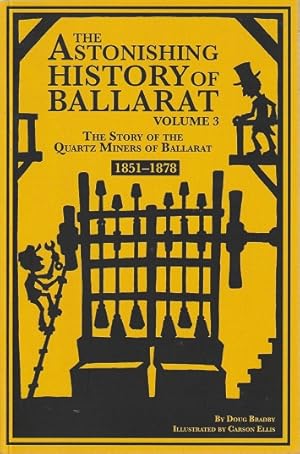
In 1856, at the height of the alluvial goldrush, Ballarat produced 823,334 ounces of gold. By 1878 the figure was a mere 12,984 ounces. Ballarat was ‘on its last legs’. However, in the Black Hill [near my former Ballarat home], Llanberris [where my Saturdays were spent at the subsequent athletics track in the 1960s], Temperance and Imperial mines, miners had developed efficient ways to find and extract gold from quartz. Ballarat now had a fighting chance of surviving. Thank heavens they persevered, comments Doug Bradby.
This Astonishing History of Ballarat, Volume Three tells the story of those undervalued, marginalised miners, who from 1851 to 1878, laid the foundations for Ballarat’s transition from alluvial to quartz mining
Speaking about his book for the Ballarat Times newspaper in July 2020, Bradby, in an article written by Edwina Williams, said “this period was one of great difficulty for miners trying to make a living in Ballarat, with the press describing the local industry as being “on its last legs.” This is when they know the alluvial gold in the buried rivers will run out and they’ll have to make a painful transition to an industrial, complex quartz mining system,” Bradby said. “They know at some point, they’ll have to go back to finding where the quartz came from, smashing it, and getting the gold out.
“Ballarat in the 1870s was in diabolical trouble, in a depression. They struggle, and struggle and struggle, and by 1878, they haven’t succeeded, although there’s persistence and resilience from four mines that get better and better.”
He said the three decades were packed full of conflict.
There’s a big riot in Lydiard Street South, with thousands of men involved, laws are broken and shafts filled in. Another interesting story is a tar and feathering at the Temperance Mine in Little Bendigo.”
All volumes of The Astonishing History of Ballarat have been timelessly and whimsically illustrated by Carson Ellis, a former history student of Bradby’s at North Tech.
“He does a fantastic job. The cartoons bring out the seriousness of the situations, instantaneously and affectively summarising what’s going on,” Bradby said.
7 June
Quarterly Essay No. 98 headed ‘Hard New World: Our Post-American Future’ by Hugh White.
What is Australia’s place in the new global landscape?
Are we ready for our post-American future? In an era of rising danger for all, and dramatic choices for Australia, Hugh White explores how the world is changing and Australia should respond. We confront the world’s deepest and most dangerous international crisis in generations. The old global order faces direct challenge in three crucial regions, including our own. War has already engulfed Eastern Europe and the Middle East, and the risk in East Asia grows. White explores Australia’s responses to these crisis and lays out, in stark terms, the hard choices ahead and explains how we can make our way in a very different world I must day, those ‘stark terms’ were somewhat unsettling, especially with respect to his warnings about the potential use of nuclear weapons as a ‘last’ or ‘accidental’ resort!
Under Donald Trump, America’s retreat from global leadership has been swift and erratic. China, Russia and India are on the move. White explains the big strategic trends driving the war in Ukraine, and why America has “lost” Asia. He discusses Albanese Labor’s record and its post-election choices, and why complacency about the American alliance – including AUKUS – is no longer an option. This essential essay urges us to make our way in a hard new world with realism and confidence.
Hugh White breaks his essay up into a number of scenarios including:
- American revolution;
- What happens when America steps back from the role which has defined the global order for over three decades?
- Putin’s gambit;
- Russia’s invasion of Ukraine has brought nuclear weapons and the threat of nuclear war back to the central position in international politics that they occupied throughout the cold war;
- Ukraine’s predicament and the future of Europe;
- The balance of power in Asia;
- The end of the world as we know it, yet Australia is not acknowledging that fact: Australia today faces the biggest shift in our international circumstances since Europeans first settled here in 1788.
A few quotations from the essay highlighting just a snippet of points from White’s ‘warnings’ and possible world scenarios, some of which may seem to some readers to be ‘over the top’ and almost scare-mongering, while writing how he sees it!!!
[1] “The Canberra establishment is shocked by any suggestion that we should walk away from the ANZUS commitments. They think we can and must depend on America more than ever in today’s hard new world. But that misses the vital point. It is America that is walking away from the commitments it made in very different circumstances seventy-five years ago. That was plain enough under Joe Biden. It is crystal clear today under Trump.”—Hugh White, Hard New World
[2] “But perhaps the most important reason why America and its allies have for so long downplayed the significance of nuclear weapons is that they raise a very awkward question. Is Washington willing to fight a nuclear war to defend the post-Cold War order, as it had been willing to do to contain the Soviets in the Cold War? This is a question that no one in Washington wanted to consider too carefully, because they suspected the answer would be ‘no’. Now Putin has forced them to confront it, and Joe Biden gave the answer they all feared. Even before the invasion, he promised that, whatever happened, America would not go to war to defend Ukraine because, as he repeatedly said, ‘We will not fight the third world war in Ukraine’. His meaning was very clear, especially to people like him of the Cold War generation to whom the ‘third world war’ means only one thing – a full-scale nuclear conflict…Was he right to fear this? Was the risk of nuclear war serios enough to deter Washington and its allies from giving Ukraine the only kind of help that would help it to win……………….US intelligence analysts assessed there was a 50 per cent chance that Putin would authorise the use of tactical nuclear weapons to prevent further losses. Putin certainly spoke as if that was so……But the Biden administration took his threats seriously….They were right to do so. A decision to use nuclear weapons would have been unprecedented, but so were the circumstances…[and from Putin’s viewpoint regarding any hint by to Biden to break his promise]….. would Putin have taken Washington’s threats seriously? Would he really have believed that Biden would risk [losing] New York and Washington to save Ukraine? Or would he have called Biden’s bluff?”
[3] and briefly on the Middle East tragedies: “It should not have been hard for the Biden administration to work out a response to the tragedy in Gaza that matched its professed commitment to avowed values and international law. The argument is not, after all, so very complex. Israel has a right to exist within secure and internationally recognised borders. The Palestinians have a right to a state in the West Bank and Gaza. Israel has refused to countenance the establishment of such a state. That does not justify Hama’s crimes on and since 7 October 2023. Equally, those crimes do not justify Israel’s assault on Gaza since then. Both sides are deeply in the wrong………..Upon that basis the Biden administration could have constructed a policy that accorded with its claims to global leadership. Instead, seemingly from sheer moral and political weakness, it went along with the Netanyahu government’s crimes, tacitly adopting the view so neatly described by Tom Stevenson. ‘Any violence committed by Palestinians justifies all violence by Israel, and no violence committed by Israel justifies any by Palestinians.’ That is the opposite of leadership. Trump’s policies on Gaza are, of course, even worse, but they are less hypocritical. He doesn’t pretend to defend universal values, international law and the old vision of US global leadership. In this respect the most prodigious liar in the history of US politics is more honest than his opponents”.
20th June
Tonight, I did indeed finish reading ‘Until August’ by Gabriel Garcia Marquez’ [published in 2024], just 129 pages – basically, to my mind, a short romance, described by his son in the Preface as ‘not as polished as his greatest books’, none of which to this point in time, I’d sadly not given myself the opportunity to read.
The reason for that description – little book published 10 years after the author’s death [in 2014] – in the words of his son again – “The memory loss our Father suffered in his final years….the way that loss diminished his ability to write with his customary rigor was a source of desperate frustration for him ….’Until August’ was the fruit of one last effort to carry on against all odds. The process was a race between his artistic perfectionism and his vanishing mental faculties”
Not long before his death Gabo’s final judgement ‘This book doesn’t work. It must be destroyed’. The family didn’t destroy it but set it aside, and as his family said “In an act of betrayal, we decided to put his readers’ pleasure ahead of all other considerations…it’s possible Gabo might forgive us’.
Amongst other plaudits the ‘Guardian’ wrote ‘Few writers can be said to have written books that have changed the whole course of literature. Gabriel Garcia Marquez did just that’.
So, having read Marquez for the first time, through this little book, I would think that description of his literary skills highly over-inflated. Quite obviously I need to search out some of his original novels, of which there are at least seventeen which I’m assuming the basis of the ‘Guardians’ assessment related to.
Until August by the Colombian author and Nobel Prize Winner – romantic, sensual, a profound meditation on freedom, regret and the mysteries of love – you can read it at one sit – Goodreads, in describing the book as ‘an unexpected gift from one of the greatest writers the world has ever known’ – summarises the story briefly as “Sitting alone beside the languorous blue waters of the lagoon, Ana Magdalena Bach contemplates the men at the hotel bar. She has been happily married for twenty-seven years and has no reason to escape the life she has made with her husband and children. And yet, every August, she travels by ferry here to the island where her mother is buried, and for one night takes a new lover. Across sultry Caribbean evenings full of salsa and boleros, lotharios and conmen, Ana journeys further each year into the hinterland of her desire and the fear hidden in her heart”.
Meanwhile, I believe I have some enthralling explorations of Gabo’s literature ahead of me!
23rd June.
‘Melaleuca’ by Angie Faye Martin, published in 2025, of 419 pages. I think I saw a review of this book in the Ballarat Courier, made a note if it, and later searched it out.
Easily read, a basic murder mystery set in in a small rural Australian ‘fictional’ township about 200 kms west of Brisbane on the Sturt Highway, which even came with a sketch map of the town which all of it’s major features as referred to in the book. Perhaps Queensland was an apt selection for this book with it’s strong references to Australia’s Indigenous history at the hands of colonisation, and the injustice and racism typical of Australia in those times, and particularly the early squatters and settlers of Queensland, though the setting is in later generations. Described by one author as ‘A blistering outback noir that doesn’t flinch away from Australia’s Indigenous history at the hands of colonisation’. Meanwhile, the author herself, as someone who grew up in regional Queensland, the places and people of Angie Faye Martin’s Melaleuca are viscerally recognisable.
In summary – A country town, a brutal murder, a shameful past, a reckoning to come… The injustices of the past and dangers of the present envelop Aboriginal policewoman Renee Taylor, when her unwilling return to the small outback town of her childhood plunges her into the investigation of a brutal murder.
Renee Taylor is planning to stay the minimum amount of time in her remote hometown – only as long as her mum needs her, then she is fleeing back to her real life in Brisbane.
Seconded to the town’s sleepy police station, Renee is pretty sure work will hold nothing more exciting than delivering speeding tickets. Then a murdered woman is found down by the creek on the outskirts of town.
Leading the investigation, Renee uncovers a perplexing connection to the disappearance of two young women thirty years earlier. As she delves deeper and the mystery unfurls, intergenerational cruelties, endemic racism, and deep corruption show themselves, even as dark and bitter truths about the town and its inhabitants’ past rise up and threaten to overwhelm the present. Or as described by another author: ‘Powerful First Nations crime noir that interrogates law enforcement and how it intersects with Indigenous victims’.
While in reading, one can develop one’s own ideas about who the ‘guilty parties’ are, the eventual unexpected revelations may still come as a surprise, which I guess should be the aim behind an authentic crime novel. If readers like an easily read mystery with a strong connection to historical injustice and not so past social issues, this is the book for you.
 Site Title
Leave a comment