This contribution looks at a variety of reading genres over recent weeks about which I have made a few personal comments together with the views of an occasional more professional writer. Books covered in this article are as follows:
- The Eye of the Storm by Patrick White [1973];
- The Shortest History of Scandinavia by Mart Kuldkepp [2025];
- Outback Reunion by Rachel Johns [2024];
- Under the Greenwood Tree’ by Thomas Hardy [1972]; and,
- The Shortest History of France’ by Colin Jones [2025]
28th July
‘The Eye of the Storm’ by Patrick White, published in 1973 [of 608 pages].
This was the 3rd of White’s novels I’ve managed to read – and in truth, all have proved a difficult choice of reading, at times somewhat tedious, and with occasions of long-drawn-out periods of prose. Yet at the same time, in this book as with the others, White’s intuition of life’s realities and human nature, as certainly relevant in his era, kept this reader interested. One frustration to my mind was the ‘annoying’ inclusion of various sections of prose [generally relating to the interpretation of dreams experienced by some the characters] where ‘no punctuation’ at all is used, at one stage near the end of the book, covering nearly two and half pages!!
I also admit that I inherited this book from my late Mother, after giving it to her as a Christmas gift in December 1973. I wonder if she ever actually got around to reading it?
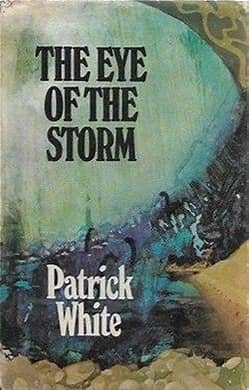
Patrick White [1912-1990] was awarded numerous prizes throughout his career as an author and playwright, the most notable of which was the Nobel Prize for Literature in 1973 after the publication of ‘The Eye of the Storm’, although he pleaded illness as the reason for not attending to accept the award. The Nobel citation praised him “for an epic and psychological narrative art, which has introduced a new continent into literature”. He was also awarded the Australian of the Year in 1973. In his acceptance speech, he said that Australia Day should be “a day of self-searching rather than trumpet blowing” and that historian Manning Clark, comedian Barry Humphries and communist trade union leader Jack Mundey were more worthy of the award.
White was also among the first group of the Companions of the Order of Australia in 1975 but he resigned in June 1976 in protest against the dismissal of the Whitlam government in November 1975 by the Governor-General Sir John Kerr and the subsequent reintroduction of knighthoods as part of the order.
I would imagine that this is not a book that the average modern ‘novel’ reader would take much interest or delight in. ‘The Eye of the Storm’ was apparently written about the meaning of the author’s own mother’s death.
Wikipedia describes White as an Australian novelist and playwright who explored themes of religious experience, personal identity and the conflict between visionary individuals and a materialistic, conformist society…. developing a complex literary style and a body of work which challenged the dominant realist prose tradition of his home country, and was satirical of Australian society, and sharply divided local critics. That kind of description in 2025 is probably a complete turn-off to the modern novel reader!!
In short, the novel tells the story of Elizabeth Hunter, the powerful matriarch of her family, who still maintains a destructive iron grip on those who come to say farewell to her in her final moments upon her deathbed.
From the Patrick White Catalogue
Plot: In her large Sydney home, Elizabeth Hunter is dying, attended by her longtime German Jewish housekeeper, a succession of hired nurses, and a solicitor with a long memory. Elizabeth is a dominating force who heavily influenced her two children, both of whom have lived in Europe for many years and return to be with their mother. Sir Basil, a famous, womanising actor based in London, is down on his luck financially. His sister Dorothy, the Princess de Lascabanes, has long left her colonial past behind to develop a new identity, and a return to Australia is especially confronting for her. Both siblings hope to reconcile with their past – and perhaps gain something from their mother’s death.
Elizabeth is plunged into the past, especially memories of her deceased husband Bill, and a revelatory moment on Brumby Island when she came face to face with the eye of a storm, and an incredible sense of calm and meaning like never before. But the past looms large and has space for everyone: Basil, Dorothy, the housekeeper Lotte who survived the Holocaust, the passionately loyal solicitor Arnold Wyburd, and the three nurses who give in to its demands despite their own personal doubts. Each of these figures must reassess their lives in the wake of this startling woman…. Yet her true complexity will never be understood by those closest to her, especially not her children, who have yet to experience anything as transcendent as has she.
Described as a profound exploration of family dynamics and societal norms, centred around the dying matriarch Elizabeth Hunter and her complex relationships with her children, White dramatizes the universal themes of love, loneliness, old age and death. He reveals the flux of power and dependency, the ultimate nuances of love and hatred that fester beneath the surface of family relationships.
Writing in literopedia.com in 2024, we read the following.
“The Eye of the Storm” is a novel written by the Australian author Patrick White, who was awarded the Nobel Prize in Literature in 1973. Published in the same year, the novel is considered one of White’s most significant works and a notable contribution to Australian literature. The narrative is set in post-colonial Australia and revolves around the Vass family, particularly the aging and wealthy matriarch, Elizabeth Hunter.
The story commences with the death of Elizabeth’s husband, Sir Athol Hunter, bringing the family together for the funeral. As the plot unfolds, it exposes the intricate dynamics within the Vass family, revealing strained relationships, power struggles, and hidden secrets. The title, “The Eye of the Storm,” metaphorically reflects the deceptive calm at the centre of tumultuous family and societal dynamics.
Key themes explored in the novel include family relationships, social class distinctions, individual identity, and the impact of the past on the present. White’s narrative technique involves shifting perspectives, providing readers with insights into the thoughts and emotions of various characters.
The plot introduces significant characters such as Basil and Dorothy, Elizabeth’s estranged children, as well as nurses Flora and Nurse Davidson, whose arrival disrupts the family’s established order. The novel masterfully navigates issues of power, control, and the facade of societal respectability.
White’s exploration of complex characters, coupled with his keen observations on societal norms and human psychology, contributes to the novel’s critical acclaim. “The Eye of the Storm” received the prestigious Miles Franklin Award in 1973 and has since remained an important part of the Australian literary canon.
The novel has been praised for its intricate narrative structure, rich character development, and exploration of themes that transcend cultural and geographical boundaries. White’s storytelling prowess and his ability to capture the essence of human relationships make “The Eye of the Storm” a timeless work that continues to be studied and appreciated by readers and scholars alike’.
Whether that ‘description’ would apply to te modern scholar in 2025, I have my doubts.
2nd August
A touch of history now – ‘The Shortest History of Scandinavia’ by Mart Kuldkepp, published in 2025 by Black Inc [of 258 pages]\ – an abbreviated history, one of a set of three that I purchased a few weeks ago from Swartz Media.
This was an interesting read, although at times, I found the various scenarios between the ‘separate’ Scandinavian nations to be a little confusing and difficult to keep track of, and found myself wishing I had an individual history separately of Sweden, Norway, Denmark Finland [even Iceland].. However, as one reviewer noted, the book was ‘the perfect starting point for anyone interested in Scandinavian history’. The fault most likely remained with myself, in that so often [especially of late], while finding the material I’m reading of essential historical interest, my ability to retain much of that information would probably restrict my passing an examination of the facts just read!! I had previously read [and reviewed in the Coachbuilder’s Column] the book ‘Saga Land’ by Richard Fidler & Kari Gislason’ published in 2017 which dealt with the stories of Iceland from the time of the Vikings
So, what does this short history cover? Basically, ‘from the Stone Age to ‘Scandimania’ – a brisk, illuminating journey through 14,000 years of Nordic history’ referencing the five nations mentioned plus Greenland, and the more substantial islands off the Scandinavian coastline.
As noted in one of the reviews, outsiders have long viewed Scandinavia as special, starting with the ancient Greeks and their myths of ultima Thule, a place ‘where the Sun goes to rest’. Today, we admire Scandinavia for its universal welfare, equality, peacefulness and untouched nature – not to mention its interior design, crime literature and love of all things hygge. Yet Nordic history has had its hardships and dark periods too: pandemics, war, the expansionism of the Viking Age and the eighteenth century, alliances with Nazi Germany in World War II and a eugenics movement in the twentieth century.
In The Shortest History of Scandinavia, historian Mart Kuldkepp masterfully sketches the outlines of Scandinavia’s rich history – from the first known peoples of the region, who followed the ice sheet north as it retreated at the end of the last Ice Age, to the Scandinavians living in nations that are among the happiest in the world today. The author, Mart Kuldkdepp, is a professor and researcher of Estonian and Nordic history at University College London, where he specialises in the political history of the Baltic and Nordic regions.
In this short but deeply insightful volume, Kuldkepp illuminates the concept of ‘Nordicness’ – a hard-to-define quality that has nonetheless steered the region to respond to major challenges, actively shaping their history and exerting a considerable influence on European and global history in the process. Throughout their history, there are numerous changes in the relationships and alliances between these nations, and I have to admit that it was the complexity of those alliances which I found hard to kept abreast of at times. Apart from the very early history, and in particular the sections dealing with the Viking and other related invasions of early Britain and continental Europe, I did find the examination of the author’s coverage of the political and economic changes that occurred in the C20th and early C21st centuries of special interest. I’d not also realised the extent of the ‘hold’ or dominance that Russia held over Finland for such a long period in that time, while the supposed ‘neutrality’ of Sweden during WWII and the difficulties faced in trying to ‘satisfy the needs of both sides of the conflict without appearing to favour one over the other, made for interesting reading.
Throughout the book there are various ‘text boxes’ which often provide a more detailed if not brief analysis of a particular aspect of Scandinavian history, lifestyle, culture and artistic successes referred to only sparsely in the main text.
Writing in the August 2025 edition of The Australian Book Review, Margaret Clunies Ross notes ‘That important Scandinavian artists, writers and thinkers are largely confined to the text boxes, while associated cultural movements are mentioned briefly, sometimes obscurely, in the main narrative. One of the important intellectual movements of the late eighteenth and early nineteenth centuries, Romantic nationalism, is described briefly in Chapter Eleven, but how this movement was enriched by philosophers like Soren Kierkegaard, poets such as Adam Oehlenschlager, and the multifaceted endeavours of the influential Danish writer N.F.S. Grundtvig is not clearly explained. Hans Christian Anderson, on the other hand, gets both a picture of his statue in Copenhagen and a whole text box to himself”. That criticism may well simply reflect the personal prejudices of the reviewer [who apparently is a Knight of the Icelandic Order of the Falcon] and her desire for specific features to be covered in a book which the author himself admits in his Preface that ‘It goes without saying that any short history of a whole region must be selective, in terms of what it covers and how it is structured’ and this limitation should be recognised by any reader.
I’ll just copy one small section from the closing pages of the book which provides one summary aspect of Scandinavia’s history.
From pages 234-235.
‘It was the Viking Age, with its raids, trade and settler colonialism, that rudely pushed Scandinavia into the centre of European awareness. The pacification of these militant pagans of the north took centuries, and, in the end, the problem did not have a military solution. Instead, gradual and voluntary Christianisation, along with the wealth amassed in the Viking Age, helped to kickstart the successful development of European-style kingdoms in Scandinavia. Going forward, these remained mostly concerned with succession struggles and conflicts with each other, and no longer presented an acute threat to the rich countries of Western Europe. At the same time, Scandinavia managed to avoid the fate that befell some other parts of the Baltic Sea region, which were targeted by medieval crusades and Christianisation by force, leading to foreign dominance and serfdom of the native population”.
One aspect revealed in the book which I found disturbing – Sweden during the post-war period, as part of that country’s ambitious social-welfare plans, indulged in a philosophy which led Scandinavia down a darker path involving forced sterilisations of people seen as not ‘productive enough’, a moral failure largely concealed by the overall success story of the Nordic welfare state’ [p.238].
4th August
For something very different – ‘Outback Reunion’ by Rachel Johns, published in 2024 [of 334 pages]. An easily read, relatively light-hearted ‘Australian rural romance’ novel, read over about 24 hours. Another Aussie female author who writes fictional novels about rural life in her country – I think from memory, this is the first of her books I’ve read, simply chosen at random, as after some fairly heavy recent reading, I felt the need for a quick easily digested story, and this took me exactly to that ‘place’!’ Apparently this story is one of series of novels set in the fictional town of Bunyip Bay in Western Australia.
In basic outline: –
A moving story of lost love, second chances, and the healing power of truth under the big top in a small town. They spent one magical night together, but when he woke up she was gone …
Eight years later, Gabriela Jimenez is hoping a couple of weeks in Bunyip Bay with the Grand Jimenez Family Circus will give her and Luna, her daughter, the chance to reconnect after the tragic death of Luna’s father. The last thing Gabi expects is to run into the man she once knew. Mark Morgan is still as sweet and sexy as she remembers, but Gabi is harbouring guilt and dealing with the grief of her in-laws. She can’t afford to let him get under her skin again.
After his successful career in AFL was cut short due to a crushing injury, Mark is struggling to readjust to small-town life and working the family farm. As if this isn’t bad enough, his wife’s betrayal means he may never be able to risk his heart to love again. Mark couldn’t be less interested in the circus that has arrived in town … until he discovers that the woman who vanished from his bed all those years ago without saying goodbye is part of it.
Will a chance meeting lead to something more?
As described by the publishers and others – The unforgettable, hotly anticipated return to Bunyip Bay from bestselling Australian romance author Rachael Johns.
So, if it’s the Romance genre your looking for, this is the book for you. I enjoyed the storyline, but generally only turn to this type of fictional story for a bit of occasional light-reading.
AN EXCERPT: [near the beginning]
‘For one crazy moment, she contemplated staying right where she was, never going back to the circus. Maybe there could be something between she and Mark? Could she give up everything she’d ever known and risk a new life?
But then she glanced around Mark’s bedroom, taking in his footy posters and barbell weights in the corner, remembering what he’d said about not really having time for dating, and she knew staying was an even worse idea than what she’d already done.
So, for the second time that night, she snuck out on someone sleeping.
Only this time she wasn’t running away from her life, but back to it’.
13th August
A bit of a Hardy classic, ‘Under the Greenwood Tree’ by Thomas Hardy [first published in 1972, this a 1982 Penguin edition], of 248 pages. Presumably passed to my mother from her sister, Jean in the 1980s, and subsequently inherited by myself! One of the small paperbacks I’ve retained from time to time in the car glovebox reading a few pages at a time while waiting for appointments, etc. I decided to remove it from that location, and complete a reading. An interesting little novel, and in some ways, fairly simple in its construction and storyline once the reader manoeuvres their way through C19th English cadences and accents of some of the characters depicted.
Described as the best-loved, and certainly the happiest of all Hardy’s novels, his second published novel, and a story which led to the writing of a series of ‘Wessex’ novels by Hardy.
The story is best described as a pastoral romantic novel by Thomas Hardy, that explores themes of love, tradition, and change in a rural English village. An interesting little novel, in some ways, fairly simple in its construction and storyline once the reader manoeuvres their way through C19th English cadences and accents of some of the characters depicted, with their mode of talk, described as being full of observation and humour. It was apparently based upon a vivid and authentic recreation of the author’s own childhood environment, and modelled the villagers in the novel, on people he had known intimately.
The novel explores several themes, including:
- Love and Relationships: The love triangle between Dick, Fancy, and Maybold highlights the complexities of romantic relationships and societal expectations.
- Tradition vs. Modernity: The conflict between the traditional choir and the new mechanical organ symbolizes the broader changes occurring in rural society during the Victorian era.
- Community and Identity: The close-knit village life and the characters’ interactions reflect the importance of community in shaping individual identities.
Thomas Hardy [1840-1928] was himself actually a struggling provincial architect in the mid-1800s, and he began to write novels [and poetry] in order to make money. This novel set him on the way to making a living. During his ‘literary’ life, he wrote up to 18 novels, numerous short stories, poetry [which was his first love], And in his senior years, some drama productions.
17th August
‘The Shortest History of France’ by Colin Jones, published in 2025, of 260 pages.
Another relatively easily read book, although, as with the Scandinavia short history, there were many aspects of this reading that I would have liked to explore in more detail and depth, eg, France’s 1789 revolution, or the despised role of the Vichy in France and its collaboration with the NAZIS especially in respect of the Jewish situation, during WWII, or the country’s racism and brutality arising from its colonisation of Algeria, and participation later in the slave trade in various parts of the globe..
This short history covers more than two millennia of France’s history from so-called ‘glorious defeat’ in 52BCE to Julius Caesar to what was described as a somewhat unexpected triumph of the 2024 Paris Olympics shortly after a national election. A ‘melting pot’ of influences from internal conflicts, European neighbours and international circumstances.
Black Inc, publishers of this book and others in the Shortest History series describe this publication ss follows.
From Roman conquest to Emmanuel Macron, the Gauls to de Gaulle, trade to war, religion to migration, colonialism to slavery, Joan of Arc to Asterix …
France is the most popular tourist destination in the world, thanks to its unsurpassed cultural and historical riches. Gothic architecture, Louis XIV opulence, revolutionary spirit, café society, haute cuisine and couture – what could be more quintessentially French?
Rarely, however, do we think of France as a melting pot, but historian Colin Jones asserts it’s no less a mélange of foreign ingredients than the United States, and by some measures more. As nationalism and anti-immigration rhetoric surge in France (and elsewhere), The Shortest History of France presents a portrait of a nation whose politics and society have always been shaped by global forces.
Clear-eyed and avoiding traps of national exceptionalism, Jones unfolds France’s first millennium of invasions and subjugation by its neighbours and iterations of the Roman Empire, to the Enlightenment, The Universal Declaration of Human Rights, and The Paris Agreement. Meanwhile, its darker moments have included overseas colonisation, the Vichy regime and the Algerian War, along with persistent racism, police brutality, and civil unrest. The Shortest History of France is a dynamic, global story enhanced with touches of cultural radiance – truly a retelling for our times.
After reading this book, I must admit that my idyllic view of France as a cultural and in some ways ‘peace-loving’ European nation has somewhat been thwarted by many of the events described and covered in this short history, even up to more recent times.
Barnes & Noble describe the book as – The Shortest History of France reveals a nation whose politics and society have always been shaped by global forces. With up-to-date scholarship that avoids the traps of national exceptionalism, Jones reminds us that it was only after the first millennium of French history—after constant subjugation to the Roman Empire and Germanic tribal forces—that a nation-state began to emerge, while absorbing influences from its European neighbours. Later, the Crusades and subsequent overseas colonization paved the way for cultural exchange with Africa, the Caribbean, East Asia, and elsewhere. France has been home to the Enlightenment, the Universal Declaration of Human Rights, and the Paris Agreement . . . but also to the Vichy regime, the Algerian War, and persistent racism and civil unrest. By turns serious and spirited, The Shortest History of France is a dynamic, global story for our times.
Jones himself, as the author, argues that (though his terms aren’t quite so blatant) the French aren’t really French at all. “Scratch a French icon,” he writes about Asterix, “and traces of the wider world are never far beneath the surface.” We are reminded that the cartoon character meant to embody the spirit of the Gaulois resistance was, in fact, created by a Polish Jew. He also writes at length of the conflicting influences that have shaped France’s hexagonal frontiers and the nation within it. “French borders have always been porous,” Jones writes, suggesting the history of France is truly the history of who most influenced France at any given time. Certainly, this aspect is revealed time and again throughout the book.
Writing for The Standard.co.uk in March, 2025, William Hosier suggests that ‘Jones’ book should appeal to both philistines and experts: it reads as A History of France for Dummies as well as an encyclopedia of erudition. The tone is journalistic and fancy-free, its author darting nimbly from the Aristotelian influence on medieval universities to the differences between Romanesque and Capetian architectural styles. The style is learned, yet unsnobby: it doesn’t matter how much or little you know about the figures mentioned, since all are described in simple monikers (“leading politician Léon Gambetta”, “statesman Jules Ferry”). A bit repetitive, perhaps: but immeasurably more helpful than the opposite’.
As for the author, Colin Jones, CBE, FBA, is Emeritus Professor of History at Queen Mary University of London. He is the author and editor of many works on French history, including The Cambridge Illustrated History of France, The Great Nation: France from Louis XV to Napoleon, The Fall of Robespierre: 24 Hours in Revolutionary Paris and a host of others.
An interesting read, with perhaps the reservations on brevity mentioned above, where more detail and expansion of the subject matter to be searched out through other avenues.
 Site Title
Leave a comment