Tag: book-review

  • The Coachbuilder’s Column: Volume 15: Issue 11: 15th July, 2025:  about the author Graham Greene, letters and novels.

    I’ve just read  ‘Graham Greene: A Life in Letters’ edited by Richard Greene [no relation], published in 2007 [446 pages]………….I’d never read any of Greene’s novels though knew I had one somewhere, eventually tracked it down, a Penguin paperback of The Honorary Consul’, first published in 1973, which I refer to later, as I decided I had to read at least one of his novels.

    As revealed through his letters, his novels were generally based upon people he’d met, or places and international conflicts that he found himself involved in. And as revealed through the letters, a vivid portrait of a fascinating writer, a mercurial man of courage, wit and passion. 

    As Amazon describes it – “One of the undisputed masters of twentieth-century English prose, Graham Greene (1904-1991) wrote tens of thousands of personal letters. This exemplary volume presents a new and engrossing account of his life constructed out of his own words. Impeccably edited by scholar Richard Greene, the letters–including many unavailable even to his official biographer–give a new perspective on a life that combined literary achievement, political action, espionage, travel, and romantic entanglement. The letters describe his travels in such places as Mexico, Vietnam, and Cuba, where he observed the struggles of mankind with a compassionate and truthful eye. Letters to friends such as Evelyn Waugh and Muriel Spark offer a glimpse into the literary culture in which he wrote, while others reveal the agonies of his heart. The sheer range of experience contained in Greene’s correspondence defies comparison”.

    These letters, as published by his namesake, were written over 70 years, from September, 1921 to the 21 March, 1991 [14 days before he died]. As a prolific writer of diaries, personal notes and reflections myself, I guess that was the reason I was attracted to the book. He was not just an author – but a journalist, reporter, investigator, confidante of the famous in both literary and political circles, constantly travelling around the world, usually to political hotspots and war or revolutionary zones in Asia, Central and South America, Africa, Russia and other Communist controlled countries during both the years of World War II, and the subsequent Cold War period, with his life and personal safety often at risk. His letters generally pulled no punches, many of a highly personal and romantic nature.  His correspondence relationship with so many great authors [many of whom I was not familiar with] including in particular that great novelist and diary writer, Evelyn Waugh [whom I always believed was a woman for some reason] provided for me, a fascinating insight into the world of writers, publishing and books in general.

    [Incidentally, I don’t have any of Waugh’s novels, but do have a massive volume of his life’s Diaries, which admittedly, I’ve not yet tried to tackle!!].

    In addition to the actual letters, there are footnotes on most pages. Providing either a brief biography of the person to whom he is writing, or where it was known why he was writing in particular instances. These notes of course do slow down the reading process, but are an invaluable aid to understanding [usually] the purpose of the letter and Greene’s connection with the recipient.

    Grahame Greene himself notes that – There have been a number of Graham Greene biographies, but none has captured his voice, his loves, hates, family and friends–intimate and writerly–or his deep understanding of the world, like this astonishing collection of letters…………………………………………………………………..
    Graham Greene is one of the few modern novelists who can be called great. In the course of his long and eventful life (1904—1991), he wrote tens of thousands of letters to family, friends, writers, publishers and others involved in his various interests and causes. A Life in Letters presents a fresh and engrossing account of his life, career and mind in his own words.

    In summary a comment from Google.books provides another encouraging description of the book  –  ‘In several letters, the individuals, events or places described provide the inspiration for characters, episodes or locations found in his later fiction. The correspondence describes his travels in Mexico, Africa, Malaya, Vietnam, Haiti, Cuba, Sierra Leone, Liberia and other trouble spots, where he observed the struggles of victims and victors with a compassionate and truthful eye. The volume includes a vast number of unpublished letters to authors Evelyn Waugh, Auberon Waugh, Anthony Powell, Edith Sitwell, R.K. Narayan and Muriel Spark, and to other more notorious individuals such as the double-agent Kim Philby. Some of these letters dispute previous assessments of his character, such as his alleged anti-Semitism or obscenity, and he emerges as a man of deep integrity, decency and courage. Others reveal the agonies of his romantic life, especially his relations with his wife, Vivien Greene, and with one of his mistresses, Catherine Walston. The letters can be poignant, despairing, amorous, furious or amusing, but the sheer range of experience contained in them will astound everyone who reads this book.’

    While from the book cover – “When he loved, he loved fervently, but he also struggled  to manage the  unpredictable mood swings, the highs and lows of bipolar disorder that drove him from exalted happiness to despair. Letters to friends like Evelyn Waugh, Muriel Spak, Anthony Powell and R.K. Narayan offer a glimpse 

    into the literary culture in which he wrote. Other letters reveal the agonies of his heart, how his manic depression wreaked havoc on his marriage to Vivien Greene and injured his relations with his mistress Catherine Walston.”

    A book that gives new perspective to a life that combined literary achievement, political action, espionage, travel and romantic entanglement….following him through joy and turmoil, from the gnarled and fissured forests of Indo-China to war-torn Sierra Leone, from the mountains of Switzerland to hotels in Havana and a connection of sorts with leaders like Fidel Castro, and various revolutionary characters from South America.

    The letters also reveal much about his support at times, and other times, conflict with the Catholic Church, and his inter-action with a couple of the Popes of his era, and other religious intermediaries.

    A brief comment on The Honorary Consul by Grahame Greene [published in 1973, of 268 pages [my Penguin edition].  After having read Greene’s letters, I expected his novels to be essentially based on parts of the world he had travelled to, often with the purpose of exploring those areas and lifestyles for incorporation into a planned novel. I wasn’t sure what to expect, not having read him previously.  This story, I found somewhat enjoyable, if at times, realistically unpleasant in terms of the subject matter.

    A gripping tragicomedy of a bungled kidnapping in a provincial Argentinean town, considered to be one of Greene’s finest novels. The story is set in the provincial city of Corrientes, part of the Argentine Littoral, on the shore of the Paraná River. Eduardo Plarr is an unmarried medical doctor of English descent who, as a boy, fled to Buenos Aires with his Paraguayan mother to escape the political turmoil of Paraguay. His English father remained in Paraguay as a political rebel and, aside from a single hand-delivered letter, they never hear from him again. Throughout the novel, there is much reflection by various characters on the absence of ‘father figures’ for numerous reasons. I believe the story is also set on the eve of Argentine’s ‘dirty War’ in the early 1970’s.

    In this provincial Argentinian community, Charley Fortnum – a British consul with dubious authority and a notorious fondness for drink – is kidnapped by rebels in a case of mistaken identity. Fortnum, 61 years old is married to Clara, a young ex-whore from Senora Sanchez’s brothel. The young but world-weary Doctor Eduardo Plarr, is left to pick up the pieces and secure Fortnum’s release, wading through a sea of incompetence and unearthing corruption among authorities and revolutionaries in the process.

    First published in 1973, The Honorary Consul is a British thriller novel, and  was one of Greene’s own favourites of his works and is regarded amongst his finest novels, with Plarr perhaps the most moving and convincing figure in his fiction.  The story is set in an unnamed city in northern Argentina, near the border with Paraguay which can be assumed to be the city of Corrientes.

    In what is described as a ‘perfectly executed narrative’, Greene explores the repercussions of the bungled kidnap, and gives special attention to Dr Plarr whose deficient emotions form the heart of the story.

    While I won’t go into the article itself, a piece written on a site named literarysum/com and titled ‘Unveiling the Layers: A Comprehensive Literary Analysis of The Honorary Consul by Graham Greene’, introduced the subject as follows – ‘The Honorary Consul by Graham Greene is a complex novel that delves into the themes of love, betrayal, and political intrigue. This article provides a comprehensive literary analysis of the novel, exploring its various layers and uncovering the hidden meanings behind its characters and plot. Through a close examination of the novel’s themes, symbolism, and narrative structure, this article aims to provide readers with a deeper understanding of Greene’s masterpiece’ which all indicates we have more than just a ‘British thriller novel’, another indication of Greene’s literary talents.

    As described at the time of publication, by the Daily Mail: ‘The prose is monkishly spare and taut.  The minor characters are brilliantly and sardonically drawn, that ever he has given us’. It sounds as though I made the right choice, in being introduced to Greene’s writings [apart from his letters].

    The book was made into the 1983 film The Honorary Consul (also released as Beyond the Limit), directed by John Mackenzie, with Richard Gere as Plarr and Michael Caine as Fortnum.[3][4] The soundtrack theme was composed by Paul McCartney and performed by John Williams.

  • The Coachbuilder’s Column: Volume 15: Issue 9: 16th April 2025: some reflections about ‘The Bush’ written by Don Watson.

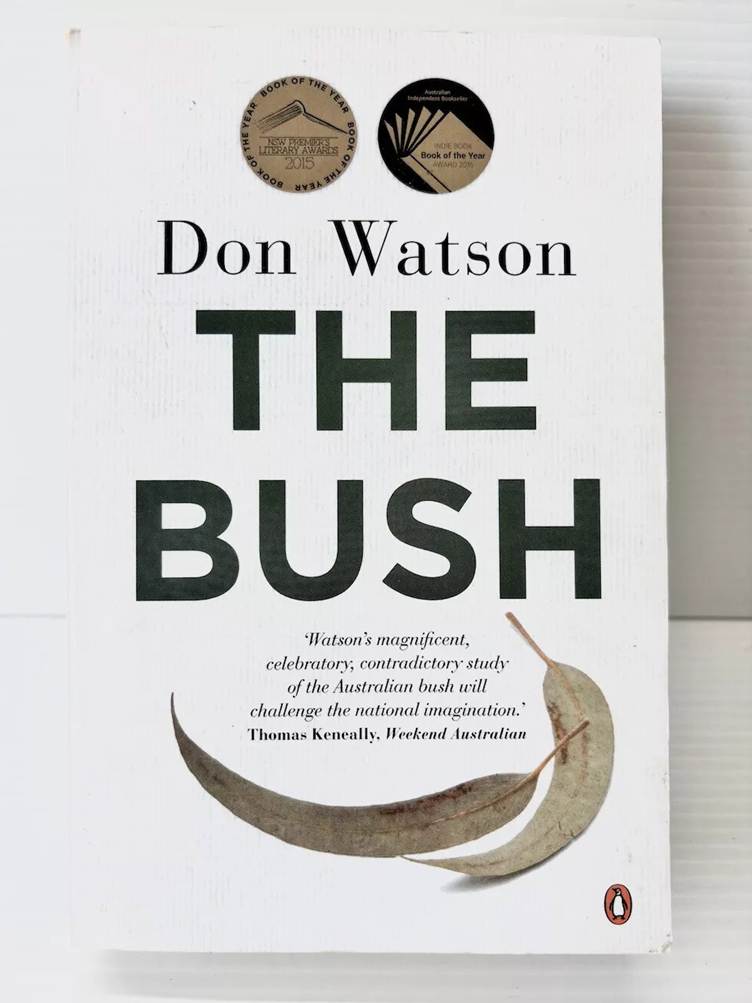
    ‘A magnificent, celebratory, contradictory study of the Australian bush, which challenged the national imagination’, so wrote Thomas Keneally in the Weekend Australian newspaper, in describing ‘The Bush’ by Don Watson [published in 2014], a Penguin edition of 427 pages, which I completed reading two months after it’s purchase.

    I found this book by Watson, some ten years ago, a fascinating history of Australia taken from a different perspective – yet despite that fascination, it was not an easy 427 pages of reading, mainly because of the depth of detail and broad range of subject matter that Watson included – not just about the ‘bush’ as such, but so many different aspects of life in this country in the early and nor so recent of European settlement. As noted by the reviewer whose opinion I have included later, this book could well be aptly described as a ‘meandering book’.

    A couple of other statements about this book, amongst many, include:

    • A milestone work of memoir, travel writing and history. The Bush takes us on a profoundly revelatory and entertaining journal through the Australian landscape and character [nsw.gov.au];
    • The Bush offers a narrative  that includes Indigenous people, colonists, settlers,  and migrants in a wide-ranging and sophisticated appreciation of our bush heritage [The Newtown Review of Books].

      I list below, some examples of that ‘meandering’ and ‘wide-ranging’ coverage,  though these really only scratch the surface of the full content.

    • about the people in lived in the bush, and either cared for it, or more often  were challenged by the differing environments [compared to what they were perhaps used to] both prior to and after European colonisation [or if you prefer the term, European invasion];
    • the relationship between early towns as they developed from the original bush settlements and farming communities;
    • descriptions of the brutal and generally one-sided clashes between the squatters and early settlers which generally resulted in massacres of hundreds, maybe thousands of the original Indigenous  inhabitants [in Queensland alone, as Mary Durack wrote “it became the view of white people that western Queensland would only be habitable when the last of the blacks was wiped out’ [p.329];
    • the vividly detailed discussions throughout the book,  of the plant, animal and bird  life both before and after European settlement, and the disastrous way often, those elements changed as settlement and changes to the environment took place;
    • the manner in which the native animals and birds were so often considered [and subsequently annihilated] as opponents of what those early settlers wanted to achieve in turning the lands they came across to their own advantage and use [one such ‘pest’, the emu, was virtually wiped out of existence in some areas [for, eg, when speaking of  national emblems of the kangaroo and the emu, Watson notes [on p. 377] that “In 1944 emus were declared vermin and in the next fifteen years the bounty of 4 shillings per beak [and six-pence for eggs] was claimed on 284,704 emus”;
    • the consequences of prolonged droughts, and floods, disease, rabbit and mice plagues, which often resulted in the prolonged deaths of thousands of cattle and sheep [with such outcomes continuing to be a modern day hazard of farming,  as is currently being experienced in parts of Queensland from the effect of floods];
    • Finally, in his closing chapter,  titles ‘Waiting For The Fire’, Watson talks much about the vegetation and wildlife [and how it also has changed] in the area of his current home base – which is Mount Macedon here in Victoria, where is a few kms north of my own home in Sunbury; this includes the manner in which the original trees of the area were gradually by basically ‘imported’ trees, and that environment further changed from the asfter—affects of bushfires, the most recent of course being the tragic Ash Wednesday fires of February 1983.  

    In that chapter, Watson writes on p.365: “A fire will come to Mt. Macedon one day and burn us all out. People will say we should never have been allowed to live here. Too much fuel, they’ll say. Bloody idiots, they’ll say. Don’t know anything about the bush. I’m inclined to agree. Probably our houses should sit on an acre of lawn or gravel surrounded by curtains of poplars and pistachios, fire resistant exotics, which have slowed, stopped or turned bushfires in recent years. We would not be living in the bush of old, but who does?  And even if the surrounding vegetation were nearer to pristine, is it living in the bush to work in the town or the city and spend the evenings in the spa on your entertaining deck….”  

    And much more, going so far beyond what one might expect from simply looking at the book title of ‘The Bush’ However, one generally shared view of this book reveals how misleading that impression is.

    From ‘Goodreads”

    ‘Most Australians live in cities and cling to the coastal fringe, yet our sense of what an Australian is – or should be – is drawn from the vast and varied inland called the bush. But what do we mean by ‘the bush’, and how has it shaped us? Starting with his forebears’ battle to drive back nature and eke a living from the land, Don Watson explores the bush as it was and as it now the triumphs and the ruination, the commonplace and the bizarre, the stories we like to tell about ourselves and the national character, and those we don’t. Via mountain ash and mallee, the birds and the beasts, slaughter, fire, flood and drought, swagmen, sheep and their shepherds, the strange and the familiar, the tragedies and the follies, the crimes and the myths and the hope – here is a journey that only our leading writer of non-fiction could take us on. At once magisterial in scope and alive with telling, wry detail, The Bush lets us see our landscape and its inhabitants afresh, examining what we have made, what we have destroyed, and what we have become in the process. No one who reads it will look at this country the same way again. ‘Nothing he has written quite matches the wonders of The Bush . . .’

    Whilst reading through the book, I highlighted many areas and sections that I wanted to share as an indication of the wide expanse of subjects which Don Watson covered in this highly acclaimed piece of writing. However, as an alternative to my ‘cutting and pasting’, I’ve decided to share an excellent review of ‘The Bush’ as written by Rosemary Sorensen in November 2014 in the ‘Sydney Review of Books’. This is quite lengthy, but worth a read for those who feel that the contents might be of interest for a complete read at some stage, something that Rosemary, right at the beginning suggests is essential for all Australians.  Though I fear most would not bother!!

    From the Sydney Review of Books by Rosemary Sorensen [2014]

    This is a book every Australian should read. The kind of people we are, the kind of nation this is, the big myths and the way they have been forged – these are the stones with which Watson’s builds his book.

    When my stout Sealyham terrier trod on an ant, she yelped so piteously I took her to the vet. A smear of salve on her paw, I headed back to our bush block blaming Don Watson. If his magnificent book The Bush had not included information about the bull ants known as jumping jacks, the sting of which can cause a fatal anaphylactic reaction, I might have rubbed the pooch’s paw, told her to toughen up, and taken her home to another girth-expanding treat, rather than to the vet, where we discussed jumping jacks. The vet said she had come across them when she was a kid and remembered the bite was nasty. We talked too about how many snake bites she had treated already this spring (four, not bad for October). I told her I had been reading Watson, and was trying hard to modify my hatred of the browns and blacks we encounter throughout summer as they hunt bushrats and frogs, turning up when you least expect to see them. As Watson told a gathering in Bendigo Library a few weeks back, more Australian deaths have been caused by horses than snakes, but we don’t take to horses with spades every time we see one.

    The vet had never heard of Don Watson. This is, I think, about as odd as my not knowing, until Watson told me in The Bush, that koalas have a design-fault, due to their being descended from wombats. Their pouches open downwards, but the fortuitous development of a ‘kind of drawstring’ prevents the baby koala falling out. We love our fabulous and unique animals and like to boast about their cuteness or scariness – but not so much that we bother to become educated about them, and certainly not enough to be ashamed about the brutal ways we have found to slaughter them across the years. And to be fair (if that’s the right word), the killing of non-native animals has an equally macabre history. If it moves, chop it up; if it doesn’t, chop it down.

    Brought up on a Gippsland dairy farm and educated at La Trobe University, Watson has lived for the past eight years in the bush at Macedon, 60 kilometres north of Melbourne. My vet, whose practice is in Castlemaine, another 60 kilometres up the Calder Highway towards Bendigo, likes to read and is interested in many things, but in my brisk run-down of Watson’s career, only the reference to his having written many of Paul Keating’s speeches connected. Ah, she said, did Watson write the Redfern speech? Her question would, perhaps, make both Watson and Keating grimace, since Watson’s account of that 1992 speech in his memoir, Recollections of a Bleeding Heart (2002), prompted a public argument between the two men about who had the right to claim authorship.

    The Bush is not likely to enter the popular discussion with nearly as much drama and force as that speech, or that book, or that controversy. But it deserves to. This is a book every Australian should read. The kind of people we are, the kind of nation this is, the big myths and the way they have been forged – these are the stones with which Watson’s builds his book. The Bush is many roomed, with many staircases leading up to attics where junk is stored and down into dark cellars where the bodies are buried, and with balconies overlooking gardens and outhouses. It is time for the ignorance to end. What kind of education leaves out such intriguing facts as the koala’s ingenious pouch, or any of the other information Watson imparts about the fauna of the country we live in? As for the flora, speaking as someone who latterly has become enamoured, if not overwhelmed, by the multitudes of flowering trees and shrubs we live among, what kind of nation not only works hard to remove most of them, but also leaves more than half its plant species unclassified?

    Ignorance of which way a koala’s pouch opens is not a heinous crime, it’s true, but my failure to know supports Watson’s suggestion that there has been, since European arrival and settlement, a general lack of interest – which swerves towards belligerent animosity – in the continent’s natural history, just as there has been a tendency to elide uncomfortable facts about the history of colonisation. Sometimes, as in the complete lack of reference to Indigenous Australians in the Waltzing Matilda museum at Winton, which leaps from the age of the dinosaurs to the arrival of pioneering pastoralist Ernest Henry ‘in a single bound’, this signals what Watson calls ‘cowardice’. He wonders, in his eloquent and sometimes sardonic way, why it is that other countries with vicious and even genocidal pasts can talk about their history and acknowledge what happened in order to understand why, but in Australia we prefer to uphold the bush tradition of pretending certain things never happened, or at least finding euphemisms to neutralise them.

    What happened to Indigenous people when the British turned up is an essential part of the history of the bush, and in his second-last chapter, ironically titled ‘No smallness in it’, Watson uses accounts written by the white settlers themselves to refute claims that ‘dispersal’ did not mean killing and that the numbers do not indicate genocidal intent. He goes on to describe meeting Tom Donovan, a man of Kalkadoon and Irish-Afghan descent, who has scratched out a living in the vast cattle country around Mount Isa. This contemporary portrait sits alongside a description of how the spinifex and brigalow country, like so much land across the continent, has been changed by fire, grazing, development, salinity, clearing and the extraordinarily stupid introduction of weeds and pests. The portrait of Tom, with his no-bullshit attitude and his passion for fossicking, allows Watson to approach his account of frontier violence in a steady and personalised way, a technique he uses beautifully throughout the book, which is balanced between historical accounts, analysis, commentary and challenging inquiry.

    No matter how many times you read first-hand accounts of frontier violence, they never lose their distressing impact. After a description of Tom Donovan’s stoic and suicidal tendency to consider snake bites a part of life, the chapter takes us to Battle Mountain, 100 kilometres north-east of Mount Isa, where in 1880 about 200 Kalkadoon were killed by Inspector Frederick Urquhart’s assault party in reprisal for the killings of several people over a number of years. Watson doesn’t follow up Urquhart’s story, although the Australian Dictionary of Biography, after mentioning the ‘slaughter’ of Kalkadoon at Battle Mountain, tells us Urquhart went on to take charge of the criminal investigation branch of the police force and that, despite his ‘vindictive and tyrannical nature’, he was appointed Queensland’s chief inspector in 1905, with the support of political friends. The Dictionary also tells us he was considered ‘well read’, with a ‘cultivated intelligence’, and apparently wrote a book of verse titled Blood Stains.

    Watson does not treat his readers with anything less than respect. He never overstates the bleeding obvious, such as the cruel logic by which, time and again, a white death was avenged by the deaths of dozens of Indigenous people. Neither does he sell us short; his selection of information is delivered in prose that has the cadence of an elegy, but with a sharp edge:

    In 1883, at Lawn Hill station in the far north-west, a travelling companion of the intrepid Caroline Creaghe told her ‘he saw 40 pairs of blacks’ ears’ nailed around the manager’s walls. The manager, Jack Watson, was notoriously ‘hard on the blacks’. In the east, Korah Halcomb Wills, the first mayor of Bowen, whose daughter married the manager of the Australian Joint Stock Bank, was hard on them too – ‘for the good of the whole civilized world’, he said. For the good of his soul, perhaps, while the rest of a hunting party looked on, he dissected and flayed the flesh from an Aboriginal man and took the skull and bones home in his saddlebags. In his day, the blacks were ‘dispersed in hundreds if not thousands’.

    No underlining of the awful irony is necessary when Watson later quotes from the papers of Sylvester Doig, who justified his murderous ways by pointing out that the Indigenous people did not have ‘any idea of the English law of trespass’.

    Much of the power of these pages comes from the almost casual build-up. Watson, on the road as he has been for much of the book, arrives in a cloud of dust at Hughenden in north-central Queensland. You have seen the inside of the hotel he describes, if not in reality then in one of those popular gothic-horror Australian films about psychopathic bush murderers. ‘No hotel actually being used for the purpose of serving food and drink ever hosted a more miserable scene,’ Watson writes, and adds a few more sentences that circle almost delicately around his distaste:

    One could not be happy in that hotel. If it had any good purpose at all it would be as evidence in the case for hunting and gathering.

    He gathers his strength, controls his anger, and marshalls his powers for what he must go on to write. His next paragraph takes us to the heart of the area’s terrible history, which the people of Hughenden, some of whom can be found slouched at the bar in that dreadful hotel, continue to refuse to acknowledge as terrible:

    Evidence for the case against that way of life can be found a few kilometres east at Skull Creek, one of the many going by the name in Australia. There is another one – Skull Hole Creek, about 220 kilometres south, near Winton. This, the tourist brochure says, ‘was the site of a massacre of aborigines in retaliation for the murder of a teamster’. The hunt ‘climaxed at Skull Hole’, which is a ‘good place for a picnic and bird watching’.

    Watson’s journey in The Bush takes us across land and through time, as well as around ideas. When he tells the stories of people past and present, he lets descriptions of their lives and their own words do much of the work. He tries to understand what kind of people lived and live in what his own family called ‘the country’, rather than the bush. We meet settlers like Robert and Lucy Gray, who were ‘not exactly landed gentry, but through their Queensland enterprise they planned to make enough money to correct this disadvantage’. A bit greedy, wonderfully optimistic and insouciant, unquestioningly racist, and yet self-justifying and patronising, they were your average colonial profiteers. They looked on their time in the colony as an opportunity to make good and, if possible, enjoy themselves. In Lucy’s diaries, we hear her talking about how her husband was ‘out all day after niggers … giving the blacks a lesson … after the blacks’. Unlike many who found themselves in a continent so different to the place they had come from, she rather liked the sky and landscape of Queensland, and was excited by the romance of mustering.

    This almost physical lust for the masculinst ideals at the root of Australia’s mateship myth runs through many of the stories Watson recounts. He pursues the reasons behind simplistic, unchallenged attitudes held by Prime Ministers and poets alike. Watson wants to know what motivated the people who, within the space of a lifetime, damaged the bush so thoroughly it is ludicrous to hope for remediation. He starts out determined not to judge, but it would take a saint to document the tragic lunacy that led to the destruction of irreplaceable landscapes without a shaking of the head or a wagging of the finger. All through The Bush, people are scrutinised without rancour, though you can sense the effort of self-control behind pages which describe particularly nasty or stupid behaviour.

    When Watson spoke to an appreciative audience in Bendigo, he smiled at his propensity for what Keating called ‘returning to the dark to feed’, a wonderful description of someone who refuses easeful ignorance. Predictably, perhaps, a fellow got up at the end of the talk to ‘have a go’ at the writer, saying that humanity’s plague-like numbers have made a return to the ways of the first Australians impossible, so we might as well accept that we will go on impoverishing the land in the name of progress, no matter how short-term the benefits. Watson mildly turned his answer back to the main theme of his book: the disconnect between what we see and what we feel about it. The accusation that Watson is advocating a bleeding-heart return to some pre-European Australian Eden is as wrong-headed as an attempt to control prickly pear by shooting emus. ‘You can’t kill myths,‘ he writes at the end of The Bush, ‘but that doesn’t mean there is no other way of seeing things or that you can’t cultivate something more profound and useful to coexist with them.’ We need to ‘love’ the bush he says, not try to tame it, or punish it for not being like somewhere else, or possess and exploit it to satisfy our pathologies. Indeed, he says, ‘we need to love it as it is and can be, not the way it was and never will be again’.

    Part of what gives The Bush is symphonic quality is that its thematic sweep is constantly undercut by the note of irony. Here is a man jaded by the opinionated chattering of city life turning to the bush for relief, as the pseudo-gentry of nineteenth-century Melbourne did with their estates in the Black Forest. You would have to be mad to think it’s going to be a walk in the park.

    In the chapter ‘A Collision of Cultures’, he describes driving through the Victorian Mallee in 2011, when one of the periodic mouse plagues was in full swing. As he hears and feels the mice under his car wheels, he captures the eerie horror that the bush evokes, which is deep in the national psyche, and examines his objectives:

    Down the floodlit tunnel of death I went, zombie-like, as if in a nightmare that wouldn’t stop. It seemed to be a metaphor for the human, as much as the mouse, condition. But by the time this thought came to me, the horror had passed and I was pretty well immune to the carnage, and this also seemed to be a metaphor for something. For the history of settler colonialism, perhaps; for the frontier where moral immunity issues from the act of possession itself, however egregious the act may be. It might have been a metaphorical way of saying that folly lies at the heart of the search for historical understanding (if that is how the objective of this and many other trips I took might be defined). Why try to recover the unrecoverable and awaken the dead? To blame them, when you know you would have done the same? To punish the living, the good people watching telly by the lights that every now and again I could see faintly on the plains?

    The darkest moments of this account are often followed by glimmers of hope, as though Watson is rallying himself along with his reader. He follows this gruesome scene of rodent carnage with a description of meeting two wonderful Mallee people, Ken and Val Stewart, who have a solid sense of right and wrong, and a clear understanding of the damage done to the land they have lived on all their lives.

    Watson’s questioning of his objectives has less to do with his own misgivings than it does with his investigations into what former Prime Minister John Howard, following Geoffrey Blainey, called ‘black armband’ history. The term is used as a patriotic ticking off of anyone who dares to criticise (‘If you don’t love it, leave’), but it also signals a complex yearning for community that can be easily exploited in cynical ways, and expresses the conviction that we have to stick together, as mates, no matter what. The mateship myth exercises Watson a great deal in The Bush because he believes there is a fundamental dishonesty in its construction and that tracing it to its source in the bush can help us understand why it is held so dear. Here, as in every aspect of this rich book, Watson has prepared his ground with formidable reading, and while he could have included more details about sources and who said what where, there is a joy in reading a text that shares so much information from other works without becoming bogged down. Russel Ward, for example, was just one of a gaggle of authors who wrote with hearty conviction about the Australian ethos being forged in the bush and how this gave rise to an ideal type that was ‘pragmatic, intolerant of authority and class distinction, sceptical and profane, but with a collectivist rather than an individualist faith’ and to men ‘who believed in sticking together, a fair go for all – mateship’.

    ‘Not in our neck of the bush,’ says Watson, who describes the values of the Presbyterian farming community in which he was raised: ‘indolence was unforgivable, along with all forms of ostentation, vanity, immodesty and observable ambition’. The mawkish sentimentality that accompanied the hard steel of intolerance in so many tough bush souls also disguised what Barcroft Boake called the ‘fiend melancholia’, which drove him and others to suicide. ‘As much as the Australian frontier drew folk together,’ writes Watson, ‘both the records and the literature suggest it drove others in on themselves, put a wobble in their psyches – buggered them, they might have said.’ A recent news report about a triple shooting in north-west Victoria included reactions from locals who talked about supporting each other ‘because that’s what country people do’. The same report suggested that the killings were the result of a neighbourhood dispute about dust. The bush might put a wobble in susceptible psyches, but it also attracts psyches that are pretty wobbly to start with.

    One of the big existential questions Watson asks is: what might be the effect on those who make often heroic efforts to crash their way into and through the bush? The history of clearing and unsustainable land use is one of mistakes and failures. These can be discussed relatively dispassionately so that we might, perhaps, do better in the future. But there is another way to think about, for example, the story of the annihilation of the northern New South Wales ‘Big Scrub’, with its majestic red cedars, now all gone; or of the many ‘first-rate forests destroyed for second-rate farms’, as a forestry department boss declared back in the 1920s. In the chapter entitled ‘Striving to Stay in Existence’, Watson writes about the essence of trees, their spiritual significance throughout history, and the way in which, perversely, some of those who felled trees with a religious sense of purpose were convinced they were doing God’s work: ‘The sooner they clear the trees, the sooner God’s sight can be restored and His kingdom on earth realised.’ Against this, he sets our own sight: what we cannot fail to see when we look at trees, ‘not as an impediment or a utility’, but as a powerful presence:

    The colour, light, movement and sound it generates; the vigour, strength, fecundity, the life force. The moods, the terror and the wonder it excites. Trees provoke the imagination and enliven the senses; they suggest mystery, remind us of freedom, lift our spirits, and carry us, if unconsciously and only for an instant, back to nature and in proportion to it. … We plant trees for their many practical uses but also to affirm life and commemorate birth and death. The power exerted by trees on our minds, and the strength of our relationship to them, may exist quite independently of their vast utility to our species.

    Such musings will not appeal to those who prefer to compartmentalise their reading into fact and fiction, poetry and philosophy, science and art. But for those who admire the unfolding and beckoning richness of W. G. Sebald, say, or enjoy falling in to the viscous depths of an Alice Munro story, the moments in The Bush when Watson lifts his head to the sky to ask simple but huge questions are mesmerising. If trees are so important for human well-being, in not just practical but also spiritual ways, what can it mean for someone to ‘fell, ringbark, poison, root out or in some other way bring about the death of trees’? In a recent memoir, quoted by Watson, Lyle Courtney wrote that his father’s part in helping to ‘destroy for farmland perhaps the best hardwood forest the world has ever seen’ caused such guilt that he was haunted by it all his life. Courtney’s dad acquired a ‘deep repentant understanding and mateship with nature’. I suppose some would call that a black armband view.

    Like Courtney’s father, Watson yearns for this new kind of mateship, one that learns from the undeniable mess made of the bush over the last 200 years and commits to doing better. Surveying the slashed, bludgeoned and burnt Mallee, Watson recalls one Reverend Sutherland, who ‘saw God in the mallee roots’ because of their ability to spring back to life after sustaining so much damage. Trying once again to find hope beneath smothering religious fanaticism and avidity, Watson wants to know if ‘men wreak havoc on the natural world because it is in their nature to do so or because they imagine their existence depends on it’. Whatever the answer to that question, he says, ‘hope seems to rest on their willingness to look upon the other parts of nature with the same reverence that they look upon the part that is themselves’.

    When Watson visits the busy and impressive Michael O’Brien, who practises no-till chemical farming in the black soil-plains around Walgett, he comes away sceptical, perhaps because he does not perceive reverence or love in this trail-blazing farmer’s ambition and success. Yet stories like O’Brien’s, and that of Tammy Atze, who farms saltbush near Waikerie, are examples of what is being done with new knowledge about the bush and its relationship with human society. Watson has ‘a little rush of faith’ when he meets people such as David Millson, who has a ‘dream’ for his property at Mount Hope (fair dinkum) in Victoria that will restore native vegetation on the wasteland it had become. Millson’s dream is pretty simple: he wants to ensure that the land can still be farmed in another twenty or 50 or 100 years – a hope that was not part of the equation for the pioneer settlers, pastoralists and farmers.

    That is where Watson’s journey through the bush takes us. In the final chapter (which is not quite the final chapter, as it is followed by an appendix in the form of an essay about the two animals on our coat of arms), he returns to his home in the so-called Black Forest at the tail-end of the Great Dividing Range. He wanders around his ‘bit of bush’ with all his collected knowledge to see if he can come up with, if not a new approach to old problems, then at least a better understanding of what the problems are.

    But it is a bit like the never-ending nightmare of the squashed mice: the Black Forest, renowned for its mighty trees and glorious autumnal colours, is a mishmash of regrowth in the wake of fire and clearing, like every other bush landscape Watson has visited. He recalls William Ferguson, who was appointed Victorian Inspector of Forests in 1872, and who ‘with great assiduousness’ established a state nursery at Macedon by clearing native regrowth and planting Himalayan and Californian trees: 27 species of conifer, firs, pines, cypresses and cedars. What a relief, the Inspector of Forests declared, from the ‘dismal appearance’ of native forests.

    Watson is not fanatical, like one of my neighbours, who has crowded his modest bush block with so many ‘local’ plants, each one wrapped in a green plastic sleeve, that it looks overstocked and unnatural. Grass cutting is a bourgeois affectation, apparently, so the cheek-by-jowl acacias and grevilleas have to compete with feathery grasses turning sere for the fire season. Watson’s nurseryman is a purist too, selling only plants endemic to the region. There is a lot of interest in this kind of thinking and Watson is in two minds, because he knows how quickly Australian plants from other regions can take over and destroy locals, but he also has ‘confused and contradictory affections’ for the kind of landscape created by European oaks and maples. As he contemplates what it means to be pulled in two directions, practically and emotionally, he draws together once more the broad boundaries of his arguments to make the point that what we do with the bush, how we behave in it, is as much about saving ourselves as it is about saving the planet.

    Quoting the historian W. K. Hancock writing in the 1930s, Watson notes that people destroyed the bush ‘with the best of themselves, not the worst’. They sought ‘a romance of the spirit, a fulfilment of the soul’. But if ‘much that is good in us comes from the bush’, it is also the case that turning away from the past, refusing to face its consequences, perpetuates the false Australian identity Watson identifies. It continues the violence inflicted on both the landscape and our souls. ‘So long as the narcissistic myth endures and we go on looking at the bush for flattering images of ourselves, we must remain to some degree unacquainted with both parties.’

    When Watson sums up his meandering book, we are asked as many questions as are answered for us. He is uncomfortable as a campaigner, preferring to persuade by thoroughness of argumentation rather than brow-beating. Although The Bush has a graceful fluency, he must have found some of the writing difficult, particularly when grappling with mythical and spiritual ideas. His loathing of imprecise and dishonest language – the ‘weasel words’ favoured by advertisers and governments – has made him a guru of plain-speaking. But can plain-speaking cope with such a magnificent expanse of a topic as the bush? Yes indeed: Watson’s final pages move from a prognosis of the likelihood that things will change, to an analysis of what it would take to initiate change, to a suggestion of how we might proceed if we were to undertake such a change. In the bush, he says, we can know ourselves, and that can be as beneficial for us as it is for the bush.

    It is (or perhaps should be) difficult to say ‘we’ when Australians are so diverse. But we go on doing it. This ‘we’, which Watson shows depends on our bush myths, has some peculiar characteristics. He returns often to his point about how strongly the ideal of mateship is identified with the ‘boy / man from the bush’ mythic type. This is despite the fact that established country people came to consider themselves a different breed from the bush hicks who preceded them. The celebration of bush identity is selective. People visit the Waltzing Matilda museum in Winton in search of ‘authenticity’, or linger in Jerilderie, a town which ‘leverages’ the Ned Kelly myth by plastering images of the gun-toting bushranger in his helmet everywhere (despite the fact the bank in that town was robbed without armour). Watson points out that John Monash has much more to do with Jerilderie than the ‘ironclad sociopath’, but Monash doesn’t provide the kitsch interest of Ned Kelly, he decides.

    Open The Bush at any page and there are observations and considerations that lead to ideas about what it means to be Australian. Such ideas were, for a while, much debated, but they are now increasingly subsumed beneath reactive debates. Watson challenges ‘us’ to change social and national values that are a higgledy-piggledy compendium of received wisdom, often wrong-headed and self-justifying. By showing how Victorian values shaped the bush and our image of it, Watson makes us wonder what might have been, if a different people had colonised the continent at a different period of history – or if it hadn’t been colonised at all. It can be sensible to regret, but it is not useful if it only fosters nostalgia, and Watson cautions against the ‘regressive spirit’ of a nation that resorts to clichés about the bush rather than taking pride in production, research or manufacturing skills: ‘So long as we believe that some part of us is a sort of stringybark-and-greenhide, natural-born bushie or woodland elf, we spare ourselves the effort to excel in more sophisticated things.’

  • The Coachbuilder’s Column: Volume 15: Issue 8: 10th April 2025: the sharing of two opinion pieces -politics and literature.

    In this edition of the Coachbuilder’s Column, I’m wanting a couple of recent articles on two very different subjects – on international politics by former Australian prime minister, Malcolm Turnbull – and a literary article published by the State Library of Victoria concerning a new publication about the life of Australian author, Miles Franklin.

    1. FROM AUSTRALIAN FOREIGN AFFAIRS MONTHLY – VOICES FROM ASIA:  AFA Monthly [12/3/2025] – Voices from Asia  –  ‘What Albanese should do about Trump’ by Malcolm Turnbull

    Every day Australians’ news is dominated by Donald Trump, and every day we are reminded that the United States, under his leadership, is no longer committed to the values that our nations used to share.

    Australians used to fret that the United States would not come to our aid in times of peril. We have always gone to great lengths to remind the Americans of what compliant allies we have been, joining them in every war – even the most ill-conceived, like Vietnam and Iraq.

    But now the United States has a president who does not even pretend to care about alliances. He has threatened to pull out of NATO; he has threatened a NATO ally, Denmark, with sanctions if it does not hand over Greenland; and he has bullied and threatened Canada, a neighbour, calling on it to become the fifty-first American state.

    Trump has always admired Russian president Vladimir Putin. I saw that up close when I was in their company at G20 meetings. But now he has, effectively, switched sides and is doing everything he can to force Ukraine to submit to Russian domination. He humiliated Volodymyr Zelensky in the Oval Office on 28 February, then suspended both military supplies to and intelligence sharing with Ukraine. In doing so, he made it much easier for Putin to kill Ukrainians and much harder for Ukrainians to fight back.

    Trump believes might is right: that American power should be used not to protect ideals such as democracy but simply to extort the best possible deal for itself. The more dependent a country is on the United States, the greater the opportunity for exploitation – as Ukraine, Canada and Denmark can each attest.

    What has been the response of our leaders? In a chorus of bipartisan gaslighting, we are assured that nothing has changed and the US alliance is as strong as ever. Behind the scenes it’s not much better: the consensus decision within government appears to be to hide under the doona, try not to attract the attention of this thin-skinned and vindictive president, and hope that in four years there is a return to normalcy.

    In 2016 Donald Trump did not expect to win and was not prepared to govern. He filled key posts with qualified people, such as Jim Mattis as Secretary of Defense, who sought to steer him towards more conventional policies. This time he is surrounded by people chosen for their loyalty and who share his ‘MAGA’ vision. Moreover, he now controls the Republican Party. There is no reason to assume that at the end of Trump’s second term (assuming he does not try to run for a third), the system will snap back to a conventional style of administration.

    Prime Minister Anthony Albanese, to his credit, has said he is open to Australian troops participating in a peacekeeping force in Ukraine, expressing solidarity with the European initiative led by British prime minister Keir Starmer and French president Emmanuel Macron. This at least represents a subtle divergence from Trump – which is more than can be said for Opposition leader Peter Dutton.

    But neither has acknowledged that Trump’s dramatic foreign-policy shifts have real implications for Australia and raise big questions.

    How should we defend ourselves if we cannot rely on the Americans?

    How should we advance our national interests in a ‘might is right’ world in which the United States’ foreign policy seems more aligned with Russia’s than with ours or our allies’?

    How can we best support friends and allies such as Canada when they are threatened and bullied?

    What are we to do with AUKUS? What is our plan B if, or when, the promised submarines do not turn up?

    In short, how do we stand up for Australia?

    Throughout his time in office, Albanese has been ultra-cautious – an approach that, coupled with his often, underwhelming advocacy, has created the impression that he is weak. To project strength, he needs to have something to say that shows Australia will not be bullied. What should he do?

    First, he should stop the gaslighting. He doesn’t have to criticise Trump or try to change him. But he should at least acknowledge what all of us can see: the United States is no longer committed to its allies, or to our foundational values of democracy and the rule of law. The United States no longer shares our commitment to the international rules-based order, which ensures that the strong cannot simply do as they wish while the weak suffer.

    Second, we need to review every aspect of our alliance with the Americans, and in particular AUKUS. Like the Europeans, we must start to make ourselves self-reliant. Albanese should make it clear that we must prepare to defend this country by ourselves. While we can always hope that the United States and other allies will come to our aid, we cannot assume they will. We should invest more in our defence, focusing on capabilities built in Australia; if that is impossible, we should at least ensure we have absolute sovereign control over them. In other words, they must be deployable without any other country’s consent.

    The government’s claim that the AUKUS submarines (if they ever appear) will be entirely sovereign assets is not credible. The much less complex F-16s operated by Ukraine have been, effectively, disabled by Trump’s withdrawal of technical and intelligence support. Even the United Kingdom’s nuclear fleet, and nuclear deterrent, cannot be operated without US concurrence.

    Third, Albanese should accelerate our advocacy for our values and interests with like-minded middle countries such as the United Kingdom, Japan and Indonesia. The Comprehensive and Progressive Agreement for Trans-Pacific Partnership is a good model. But we have to stop seeing our relationships as a series of spokes leading to the hub of Washington DC; rather, they should be a mesh of alignments, especially in our region. That was my agenda as prime minister, but regrettably Scott Morrison reversed this and made Australia far more dependent on America, right at the time it was becoming less dependable. Albanese, fearing a political wedge on national security, adopted Morrison’s policies.

    Will a more independent Australia offend the United States? Will it result in tariffs, or in scornful social media blasts and patronising lectures from J.D. Vance? Well, it might. But what’s the alternative? Trump has made it very clear that the more dependent and vulnerable you are, the more he will exploit you. He is not an altruist. His slogan is ‘America First’.

    Above all we need to have an open and honest conversation about these issues. Right now, too many Australians – and not just politicians – are biting their tongues for fear of incurring the wrath of Trump.

    Immediately following an interview I gave on Bloomberg on Tuesday, Trump posted on Truth Social that I was weak and ineffectual and didn’t know anything about China – among other disparaging comments. He was apparently upset that I had made the obvious point that Trump’s chaotic bullying style of government creates an opportunity for China to be the reverse – consistent where he is erratic, respectful where he is abusive, constructive where he is combative. This would be a change from the approach that China took in the first Trump administration and would cause many countries which are not as closely aligned to the US as Australia is to move closer to China.

    This may be regarded as a penetrating glimpse of the obvious and is something I have said many times before, but Trump apparently saw it and fired back his personal abuse. That was surprising, but less surprising than the reaction from NewsCorp whose publications promptly said I had, by daring to speak my mind, torpedoed any exemption from steel and aluminium tariffs. It was disappointing to see the ABC taking the same line, effectively asking me why I didn’t self-censor for fear of offending the thin-skinned President.

    It’s time for our leaders, and all of us, to put Australia first.

     [Malcolm Turnbull was Prime Minister of Australia from 2015 to 2018].

    • From The Conversation: Books & Ideas, 14th March 2025

    Friday essay: Miles Franklin’s other brilliant career – her year as an undercover servant [by Kerrie Davies – Senior Lecturer, School of the Arts & Media, UNSW Sydney], published 14th March 2025

    In the Miles Franklin archive in the State Library of New South Wales there are two brown, cloth-bound volumes, titled, “When I was Mary-Anne, A Slavey”. The thick, handwritten pages are amended with glued paper inserts copied from the missing diary the author of My Brilliant Career kept for roughly a year between April 1903 and April 1904. In an accompanying summary, on which Franklin based her 1904 letter to the Bulletin about the experience, she wrote:

    Some people wonder what domestic servants have to complain about […] No one could understand the depth of the silent feud between mistress and maid without, in their own person, testing the matter …

    There is a picture of Franklin in the archive too, dressed in her “get up”: a black-and-white tunic and apron, with a lacy parlour cap pinned atop her piled-up brunette hair. The photograph, taken in a studio in Melbourne, is captioned “yr little mary-anne”. She beckons you into her impersonation.

    Along with the letters Franklin wrote or received during the year, the summary and photo authenticate her little known upstairs–downstairs experiment in Sydney and Melbourne, which she details in the manuscript. She cooked in flammable kitchens, plunged her hands into steaming washing up, and swept the dust that scattered behind her employers’ shoes.

    In today’s Instagram culture, it is improbable that a celebrity like Franklin could work incognito and not be recognised. But this was the Edwardian era of the early 1900s, when a photograph was a special occasion and names were known more widely than faces. Franklin loved that a lady she’d once met at a government reception unknowingly flung her coat at her when she opened the door, and that she stoked the fire while guests discussed My Brilliant Career.

    Aged 21, Franklin dazzled Australia with her debut novel. Published in 1901, My Brilliant Career inspired young women to write to her about their own frustrations and dreams. She denied her novel was autobiographical, to little effect. She was compared to novelist Charlotte Bronte and to Marie Bashkirtseff, the Russian–Parisian teen artist who declared in her memoir, “I am my own heroine”.


    Despite Franklin’s later fervent wish that My Brilliant Career’s heroine, Sybylla Melvyn, would be forgotten, the book endured. It became a feminist literary classic, and in 1979 a film, produced by Margaret Fink and directed by Gillian Armstrong. Today, her cultural touchstone continues with her bequest of the Miles Franklin Literary Award and recent stage adaptations of My Brilliant Career. The Stella literary prize is named in her honour, after her first given name, Stella Maria Sarah Miles Franklin.

    Franklin’s iconic success is, however, misleading. Like many authors, she experienced fame and acclaim, but minimal royalties, in part due to an unfair contract for colonial authors with her Edinburgh publisher, William Blackwood and Sons. Books were also a luxury during the punishing Federation drought, which lasted from 1895 to 1902.

    Franklin could have married. Her grandmother took every opportunity to remind her she was expected to wed. “Have you found anyone you like better than yourself?” she archly asked.

    Instead, she disappeared into undercover journalism.

    Franklin was likely inspired by the “gonzo” women journalists known as “girl stunt reporters”, who disrupted male-dominated journalism in the late 19th and early 20th centuries.

    To prove their journalistic chops, they risked their safety and health to go undercover and expose factory exploitation and illegal abortion clinics. Most famously, New York reporter Nellie Bly feigned hysteria to gain admission to the city’s public women’s mental health institution for ten days in 1887. Their stories captivated audiences, as much as their daring.

    American journalist Elizabeth Banks transported the trend to London, where she worked as a servant, leaving her poodle, Judge, with a friend. Her reports in “In Cap and Apron” for the Weekly Sun caused a sensation, and Banks’ memoir Autobiography of a Newspaper Girl was reviewed in Australia in late 1902 and early 1903.

    Apart from Catherine Hay Thomson’s investigation of Kew Asylum and Melbourne Hospital in 1886, the “stunt girl reporter” only noticeably appeared in Australia in 1903.

    That year, the fledgling New Idea magazine published a series of undercover articles, including about experiences such as working in a tobacco factory and applying for domestic service at an employment agency. Unlike Franklin, the New Idea journalist stopped there, while Franklin spent a full, gruelling year as a servant.

    The “servant question” was an ideal local investigation. The newly federated Australia was growing due to the wool industry – “on the sheep’s back”. But in the cities, factories were an alternative engine for young women’s employment rather than domestic service. Fretting “mistresses” complained about the dearth of remaining girls available.

    Servants retorted that if they were treated better, perhaps they would stay. One suggested scandalously that mistresses should give references about how they treat servants to prospective hires, pre-dating contemporary suggestions that owners and agencies should prove their fitness as landlords to tenants.

    The debate around “the servant question” exposed Australia’s myth of equality. Franklin’s family was no exception. While drought drove her parents off their farm, Stillwater, to a plot in Penrith (then a rural town outside Sydney), they were cultured and educated. Franklin’s wealthy grandmother ran a station in the Snowy Mountains, on which Franklin based the elegant homestead, Caddagat, in My Brilliant Career. A governess or nurse was acceptable, she wrote in her accompanying summary to her manuscript, but “a servant raised considerable horror among my circle”.

    Franklin was undeterred. As well as a new writing project, she needed money and a roof if she wanted to live in the city rather than at home. Suffragette Rose Scott, who called Franklin her “spirit child”, invited her to stay. But while Franklin appreciated the support, at times Rose was suffocating.

    Revealing the independent streak that would define her life, Franklin wrote, “it was imperative I get work to sustain myself”.

    Franklin’s real servant pseudonym was “Sarah Frankling”, a play on her middle name and her surname. “Mary-Anne”, at the time a well known slang name for servants, was only used for the manuscript, to hide identities.

    Franklin’s live-in domestic servant positions included kitchen maid, parlour maid and “general” servant. She worked in a terrace she dubbed a “cubby house”, an upmarket boarding house, a harbourside villa, a wealthy merchant home, and mansions in Sydney and Melbourne. Franklin stayed a maximum of two months at each post for a year in total, after which she planned to write.

    Senator and High Court judge Richard Edward O’Connor and his large family were her most high-profile employer. Their mansion, Keston, which is close to the prime minister’s Sydney residence, Kirribilli House, and the boarding house around the corner survive, as does the terrace, near Bronte in the city’s eastern suburbs. All are now apartment buildings.

    In the manuscript, Franklin recounts that she rapidly lost weight and felt her spirit become “suppressed” by the monotony and tiring nature of servant work. Depending on the number of staff and her duties, she hand-rolled heavy, wet clothes through a washing mangle; served pre-breakfast tea and toast in bed, which she thought was an obscene indulgence; cooked and served full hot breakfasts and dinners daily; waited on guests in the boarding house’s dining room, nicknamed “the zoo”; cleaned the guest rooms and parlours; and helped at high-society balls. She kept fires burning in winter and sweated through heavy housework and cooking in summer.

    The hours were brutal. She usually woke at dawn, and only finished after the evening dinners were served, or if she was a kitchen maid, after she cleaned the mess away. Not all her employers offered a luxurious whole afternoon off per week. She worked through burns sustained on the job, and was brought to tears by a mistress who ordered her to change her carefully arranged hair. The house’s Irish cook opined that the mistress was threatened by Franklin’s “toy figure” and “fairy face”.

    As the months passed at different employers, fatigue turned to anger, and loneliness to friendships with fellow servants. It is heartening to see a snobby young Franklin mature and change as she rubbed tired elbows with those she previously saw as beneath her status. She cheekily flirted with a lovestruck tradie, just as she traded Shakespearian quips with an intrigued young naval officer staying at the posh boarding house.

    When Scott learned Franklin was working as a servant, she chided her for not refusing the conditions as an example to others. However, Franklin knew any insolence or objection meant instant dismissal, ruining her research and current livelihood.

    Scott also misread Franklin’s long-term goal – writing the servant book. In her diary, Franklin recorded what she could not say out loud. She cynically noted that “to be sensitive would be unfortunate” for a servant. “The maid must not want for pleasure,” Franklin warned, “because she will have no time to gratify it”. Be presentable but not too pretty, she advised; be polite but not so fancy or fussy to refuse tiny, “ill-aired” servant quarters next to the laundry.

    The servant year confirmed her lifelong views of marriage as stifling. Echoing My Brilliant Career, Franklin vented her feminist frustration in the diary entries. She wrote of the terrace’s “Mistress”: “sooth, when a woman of ordinary intelligence gives the whole of her time, brain and energy to the running of a miniature establishment”.

    As for the husband, an irritated Franklin wrote that he was “boss of his own backyard and lord of his little suburban dining room”.

    Biographies of Miles Franklin have largely followed the traditional “cradle to grave” of her life, in which the critical servant year has been brushed over like a quick sweep of the biographical floor. One of Franklin’s first biographers, Marjorie Barnard, dismissed Mary-Anne as of little interest.

    Jill Roe, author of the epic biography Stella Miles Franklin, read the existing Mary-Anne draft manuscript, describing it in her book as Franklin’s “social experiment”. Yet even Roe is succinct about Mary-Anne, compared to other years in Franklin’s eventful life. Roe lists Franklin’s known servant employers, admires her pluck and commiserates over it not being published due to concerns she had defamed her employers. (Franklin’s pseudonyms for her employers were chiffon thin, so easily identifiable.)

    There were other intractable problems too with the manuscript, though Franklin may have edited another draft before submitting it for publication. The existing draft is overlong, unwieldy and inconsistent in its point of view. Franklin switches between “I” and later, “Mary-Anne”, as if she fully collapses into her servant life.

    Despite her failure to find a publisher for her manuscript, Franklin continued her journalism. She began writing for the Sydney Morning Herald, which suited her fast writing style, and helped her earn money with a pen.

    In 1908, Franklin joined the women’s trade union movement and advocated for working women, all the while working on her own novel, writing and resisting the status quo of the Edwardian era. She finally returned to literary acclaim with the award-winning All That Swagger in 1936, a colonial saga of a pioneering family, and another historical series she wrote under the pseudonym “Brent of Bin Bin”.

    Upon her death in 1954, tributes reported that “Australian literature lost one of its great figures”.

    Franklin’s investigation of the servant question now seems quaint. Appliances have changed from washing mangles and melting iceboxes to sleek stainless steel and glossy white machines that beep and hum in the background.

    Yet demand for service remains. “Servants” are still in our lives; they just answer to an app rather than a bell. They clean our houses while we are out, or they are chefs on call who cook meals delivered by mobile waiters on electric bikes and scooters who brave traffic as they dash to door to door. Uber and Dido chauffeurs compete to pick us up from wherever we happen to be.

    The exploitation remains, too. At the extreme, the Sri Lankan Embassy in Canberra has been ordered to pay $117,000 in back wages to its domestic servant, paid 90 cents an hour. More broadly, Fair Work last year moved to protect gig workers in the share economy, recognising its endemic lack of rights and risks.

    Since Franklin’s Mary-Anne, low-wage service work has been revisited periodically by writers interested in social justice. In 1933, inspired by Jack London, George Orwell chronicled the months he spent impoverished and doing menial jobs in Down and Out in Paris and London.

    In 2001, Barbara Ehrenreich published the acclaimed Nickel and Dimed, about working and living on minimum wage. Elisabeth Wynhausen wrote an Australian version, Dirt Cheap: Life at the wrong end of the job market in 2005. Alexandrea J. Ravenelle brought the history full circle in 2019 with her collected stories of 80 gig economy workers in her book, Hustle and Gig. All these authors had similar conclusions to Franklin: low-wage service work is grinding and exploitative.

    At its core, the servant question hasn’t changed at all since Franklin’s investigation over a hundred years ago.


    Miles Franklin Undercover by Kerrie Davies is published by Allen & Unwin

  • The Coachbuilder’s Column: Volume 15: Issue 7: 12th March 2025: Comment on ‘Boy Swallows Universe’ by Trent Dalton, published in 2018

    Overnight, I finished reading ‘Boy Swallows Universe’ by Trent Dalton, my edition published in 2024, of 500 pages – I had read various reviews, mostly favourable, about this book, but for some reason it didn’t appeal to me, perhaps the title alone suggested something for much younger readers. Anyway, the other day in my favourite book shop, there it was on the shelf at a reasonable price, and curiosity got the better of me. This was intended as a brief posting, but for those who read through, I apologise for it’s unintended length 😊

    Right at the beginning, praise for the book from at least four sources was encouragement enough for me to proceed!

    • From The Sydney Morning Herald: ‘The best Australian novel I have read in more than a decade….’

    • From The Guardian: ‘One of the best Australian novels I’ve ever read’;

    • Goodreads writes “““A story of brotherhood, true love and the most unlikely of friendships, Boy Swallows Universe will be the most heartbreaking, joyous and exhilarating novel you will read all year. Trent Dalton writes for the award-winning The Weekend Australian Magazine”. , and,

    • The Washington Post ‘Hypnotizes you with wonder, and then hammers you with heartbreak’,

    At about page 60, I was beginning to doubt the sanity of those reviews – crude people, language, violence, criminal association, drugs – by then I’d decided I was not enjoying this story, not the kind of novel I get much pleasure from in my vintage years – but, going back to the SMH review where I read on “The last 100 pages of Boy Swallows Universe propel you like an express train to a conclusion that is profound and complex and unashamedly commercial…A rollicking ride, rich in philosophy, wit, truth and pathos’.

    So, with 440 pages to go, and deciding not to ignore a world of favourable reviews, I read on. And yes, it was all of those descriptions above – reminded me, near the end, of some of the Stephen King or Dean Koontz novels that I read three or four decades ago. And yes again, difficult to put aside over the last 100, even 200 pages. I won’t reveal the plot here [that will appear in a future Coschbuilder’s Column], but one interesting method used by the author – the numerous chapters throughout the book all begin with the word ‘Boy’, for example, Boy writes words; Boy loses luck; Boy stirs monster; Boy sees vision; Boy bites spider; and so on, with one exception, the final chapter – Girl saves boy!

    Wikipedia describes the book as Dalton’s semi-autobiographical coming-of-age novel, and if you read his reasons for writing the book, below, you will understand why.

    There is a movie version which I’ve not seen [would have had no appeal prior to reading the book] so some readers may be quite familiar with the storyline I’ve not illustrated here.

    And a brief summary to wet the reading appetite:

    An utterly wonderful novel of love, crime, magic, fate and coming of age, set in Brisbane’s violent working-class suburban fringe – Brisbane, 1983: A lost father, a mute brother, a mum in jail, a heroin dealer for a stepfather and a notorious crim for a babysitter. It’s not as if Eli’s life isn’t complicated enough already. He’s just trying to follow his heart, learning what it takes to be a good man, but life just keeps throwing obstacles in the way – not least of which is Tytus Broz, legendary Brisbane drug dealer.

    But Eli’s life is about to get a whole lot more serious. He’s about to fall in love. And, oh yeah, he has to break into Boggo Road Gaol on Christmas Day, to save his mum.

    Meanwhile, amongst the many Reviews I came across of this book, I decided to share just one with the readers – written in 2019, by a reviewer named Theresa Smith, who at the beginning, expresses similar doubts about the book, in the manner in which I began this contribution!!

    Smith writes:

    I wasn’t going to read this book on account of all the hype. But then I thought I’d better read it after all, because of, well, you know, all the hype. I’ve been burned by hyped up books in the past, the type of burns you never recover from – eg. Girl on the Train; I’m still scarred. I was most definitely not burned by this one though. Boy Swallows Universe more than lives up to all of its hype. It surpasses it and then some. It’s wholly unique, filled with so much about so many things. Could I be more vague? I’ll try my best to tell you why I loved this book so much without giving anything away because the less you know going in, the better.

    Is it a true story? Bits and pieces, no doubt. Many who have heard Trent Dalton speak since its publication have heard a lot about what’s true and what’s not. I haven’t heard anything; I live in the back of beyond where no one comes to speak about anything and then of course I wasn’t planning on reading it, so I deliberately didn’t read any articles either. Until last week when I read this really beautiful piece on the Booktopia blog written by Trent himself called, ‘Why I Wrote Boy Swallows Universe.’ After reading this article, I immediately unearthed my copy from my mountainous tbr, which instantly gives me away, because despite deciding not to read it, I had a copy on hand – because sometimes I like to challenge myself and buy a book I’m not intending to read just to see how long I can hold out. But this article was so moving, it reached me, and I knew I needed to read the book. Cut through the hype and judge for myself. Lucky I had that copy! (I held out for about eight months, by the way). It’s important to not get too caught up in what’s true in the book and what’s not. It’s a work of fiction, inspired largely by the author’s early life, but it’s not an autobiography. This separation of the author from the work enabled me to fully appreciate what Trent has done. I’ve read a few reviews that seemed to have trouble with this separation, even going so far as to call it Trent’s life story; autobiographical fiction (no such thing exists) that was too far-fetched to be believed. This is a work of fiction. That it’s heavily inspired by Trent’s early life certainly enhances it, but it doesn’t define it.

    Anyone who grew up rough will find the familiar within these pages. For those who didn’t, the book may or may not work for you, it probably all depends on how you approach it and what your tolerance levels for the nastier side of life are. For me, reading Boy Swallows Universe was a deeply personal journey back into my own early life; the good, and the not so good. I related to the story, as well as to Eli and Gus, on so many levels. The story was in turn blisteringly funny and achingly sad. It’s ultimately an adventure, a crime story, a family drama, solid gold Aussie, and in essence, it really reminded me of the Australian film, Two Hands, with its coming of age/standing at a crossroads vibe. Anyone who grew up in the 1980s, that tragic yet golden heyday, will be immersed in the nostalgic atmosphere. While I wouldn’t touch one now with a barge pole, back in the day, a devon and sauce sandwich always hit the spot. And those KT26’s; oh my goodness, we were all wearing them while walking around in the blazing sun without hats on sucking on Sunny Boys. And 80s TV shows. All those great shows Eli and Gus were growing up to. Kids today are learning their values from American MA15+ rated video games instead of cheesy, yet wholesome, American PG rated family sitcoms. The tragedy is very real. The 1980s just springs to life in this book. It’s a brilliant trip down memory lane; but it was also a difficult one. Because there are other parts of the 1980s that weren’t so great: domestic violence was nobody’s business, you probably asked for it; child protection was of little importance; welfare was rife in certain parts of Australia and for some, the dole was a career goal; QLD didn’t even sell mid-strength beer until later in the decade, exacerbating the violence that stemmed from pay day binge drinking; having a mental illness meant you were crazy and thus judged and ostracised accordingly; weapons were frequently brought to school and used in the playground; smoking was cool, those who didn’t do it were not; the police were not to be trusted, at least, not by the people in my neighbourhood. Nostalgia can work both ways, and it does so very well in this book.

    Ultimately, I took away a lot from reading Boy Swallows Universe, but there are a few things, take home messages I suppose, for want of a different way of putting it, that I particularly appreciated:

    1. At some point, everyone is faced with a choice: go this way, the same as everyone around me, or go that way, forge a new path. The cycle can be broken. You can go your own way. It’s not easy, but it is possible.

    2. Love is messy, particularly when it comes to family. You can hate what someone does, but still love them fiercely. You can be deeply ashamed of your family, but still love them wholly.

    3. There are shades of grey in all of us. Good people can do bad things. Bad people can do good things. Sometimes it’s not about the labels, but more about the moment of action.

    4. People make mistakes. People can be bad parents but still love their kids.

    5. Forgiveness can be as much for yourself as for the person you are forgiving.

    Trent Dalton’s reasons for writing the novel – it’s lengthy but I’ve decided to copy his comments in full to conclude this contribution.

    Dalton wrote:

    About three summers ago on a blazing hot Boxing Day in South-east Queensland I was standing at the back of a small blue Holden Barina with my mum. The boot hatchback door was up and I was helping my mum load a bunch of Christmas gifts and cooking equipment into her car. We’d all just enjoyed a good family catch-up in a shared Bribie Island holiday unit, one of those nice peaceful Christmases where nobody argues about who was supposed to make the coleslaw, and my mum was distracted for a moment by my daughter – she must have been about seven then – doing one of her impromptu interpretive dances through an avenue of coastal paperbark trees. I followed her eyes and was, naturally, also quickly ensnared in this vision… my girl’s hair blowing in the wind, her bare feet making ballet leaps between those trees, a stick in her hand acting as a wand…

    Then out of nowhere and for no apparent reason – not moving her eyes for a second away from my daughter – Mum said something beautiful. ‘I wouldn’t change any of it,’ Mum said. It sounds cheesy, I know, but that’s what she said. ‘I wouldn’t change any of it. If I had to go through it all again to get to this, I would do it. I wouldn’t change any of it.’

    I’m a journalist who has written thousands of words about the most harrowing stories about Australian life in the suburbs… tragedy, violence, trauma, upheaval, betrayal, death, destruction, families, abandonment, drugs, crime, hope and healing, no hope, no healing … and I’m often reminded by my gut that kicks from the inside sometimes how my own mother’s life story remains the most harrowing story I’ve ever had the strange and often unsettling honour of being a significant part of.

    She’s the one. ‘Who’s the most interesting person you’ve ever spoken to?’ people ask. Nah, not the Dalai Lama, nah, not John Howard or Bob Hawke or Priscilla flipping Presley or Heath Ledger or Matt Damon. Nah, it’s my Mum, by a damn sight. You’ll know why, when you read the book.

    Though to be honest, the book doesn’t say a tenth of what’s she’s been through and, in turn, my admiration for her, for coming out the other side of those things, for getting to the point one day three summers ago where she’s looking at her granddaughter dancing and she comes to the realisation that it was all heading somewhere – all the pain, all the social suffering, all the madness, all the longing, all the loss, all those bad choices and all those good choices – they were all leading to a girl she loves more than life itself dancing between some swaying trees. So that’s where the book started, by that boot of mum’s Holden Barina. It took a year to write between the hours of 8pm and 10pm after work, and it took my whole life to write. The research was really remembrance. Remembering all those years when the world around my small family crumbled. When people we loved were being taken away. When things we thought true were being turned false. Heads were being slammed into fibro walls. Dangerous people were knocking on doors at daytime. And when that world of ours crumbled – the world of prisons and small-time suburban crime – and my brothers and I went to live with my father who I never knew, that world we knew was replaced with a new world of a Brisbane Housing Commission cluster swirling with a hundred social issues – alcoholism, unemployment, domestic violence, generational social curses – all of which I would later write about as a journalist.

    All of me is in here. Everything I’ve ever seen. Everything I’ve ever done. Every girl I ever kissed on a wagged school day, every punch I ever threw, every tooth I ever lost in a Housing Commission street scrap and every flawed, conflicted, sometimes even dangerous Queenslander I’ve ever come across, as the son of two of the most incredible and beautiful and sometimes troubled parents a kid could ever be born to.

    The key characters all draw on the people I love most in the world. The most beautiful and complex people I’ve ever known, and I never even had to walk out the door of my house to find them. I just wanted to give the world a story. To turn all these crazy and sad and tragic and beautiful things I’ve seen into a crazy, sad, tragic and beautiful story.

    Love, above all else, is threaded through this novel. I wanted to write about how it is possible to love someone who has killed. How it is possible to love someone who has hurt you deeply. How love is the closest thing we have to the truly profound. The kid in the book is feeling love like he’s feeling the edge of the universe, and it’s so big and beyond him he can only see it in colours and explosions in the cosmos. He can explain those things he sees in his mind – even the things he might hear in his head – with about as much clarity as anyone can truly give the mysteries of true love. He can only feel these things.

    Ultimately, it’s a love story.

    All I think I’ve done as a journalist over 17 years, if I’m being really honest with myself, is process all the baggage of my life through the stories of thousands of Australians who tell me their deepest darkest secrets in the sacred spaces of their living rooms, and I take these secrets and turn them as respectfully as possible into magazine stories, and these stories help me learn and know and sometimes even heal … Boy Swallows Universe is me taking all my own secrets this time and turning them as respectfully as possible into a novel.

    This book is for the never believers and the believers and the dreamers. This book is for anyone around the world who has been 13 years old. This book is for a generation of Australians who were promised by their parents they would be told all the answers as soon as they were old enough. Well, now you’re old enough.

    Here are my answers:

    1. Every lost soul can be found again. Fates can be changed. Bad can become good.

    2. True love conquers all.

    3. There is a fine line between magic and madness and all should be encouraged in moderation.

    4. Australian suburbia is a dark and brutal place.

    5. Australian suburbia is a beautiful and magical place.

    6. Home is always the first and final poem.

    In conclusion, two quotations direct from the book where in [1],  the boys’ father is arguing against the fear that his boys are going to be taking away from him, and [2] the reaction of the non-speaking brother to school room teasing

    [1] ‘You think you’re serving your profession so nobly, so compassionately,’ Dad says. ‘You’ll take those boys from me and you’ll split ‘em up and you’ll strip ‘em bare of the only thing that keeps ‘em going, each other, and you’ll tell your friends over a bottle of chardonnay from Margaret River how you saved two boys from their monster dad who nearly killed them once and they’ll bounce from foster home to foster home until they find each other again at the gate of your house with a can of petrol and they’ll thank you for sticking your nose into our business as they’re burning your house down.

    [2] ‘Every now and then some unfortunate kid in August’s class makes fun of August and his refusal to speak. His reaction is always the same: he walks up to that month’s particularly foul-mouthed bully who is dangerously unaware of August’s hidden streak of psychopathic rage and, blessed by his inability to explain his actions, he simply attacks the boy’s unblemished jaw, nose and ribs with one of three sixteen-punch boxing combinations my mum’s long-time boyfriend, Lyle, has tirelessly taught us both across endless winter weekends with an old brown leather punching bag in the backyard shed. Lyle doesn’t believe in much, but he believes in the circumstance-shifting power of a broken nose.’

  • The Coachbuilder’s Column: Volume 15: Issue 5: 18th February 2025:  some comments on Peter FitzSimons’ new book ‘The Legend of Albert Jacka’.

    As has been his practice over recent years, this author has produced another non-fiction contribution to the world of books and literature.  ‘The Legend of Albert Jacka’ by Peter FitzSimons, published in 2024, of 463 pages, including some substantial section of Notes, References, etc. This book is the story of the first Australian soldier to be awarded the VC [Victoria Cross] in World War One – that award arising from his actions in Gallipoli, and later earning many accolades for his efforts on the various battlefields of France, actions which in the opinion of many [but not his seniors] should have earned him further VC’s.

    As with past contributions from FitzSimons, I found this a fascinating historical depiction of those years, though written in his inevitable style of the novel format. I must admit however, that after having already read many depictions of some of those crucial battles on the Western front in France during WWI, and now moving through  FitzSimons’ vivid up-front descriptions of those campaigns which cost so many thousands of lives, often with little reward for these human tragedies, many of which could have been avoided with more competent British leadership, I’m thinking I might desist from reading about that war for the time being. Though it does seem to have been a favoured topic for the author over recent years!!

    From the broadly accepted summary of the book, we read thus:

    ‘Our heroes can come from the most ordinary of places. As a shy lad growing up in country Victoria, no one in the district had any idea the man Albert Jacka would become.
    Albert ‘Bert’ Jacka was 21 when Britain declared war on Germany in August 1914. Bert soon enlisted in the Australian Imperial Force and the young private was assigned to 14th Battalion D Company. By the time they shipped out to Egypt he’d been made a Lance Corporal.
    On 26 April 1915, 14th Battalion landed at Gallipoli under the command of Brigadier General Monash’s 4th Infantry Brigade. It was here, on 20 May, that Lance Corporal Albert Jacka proved he was ‘the bravest of the brave’. The Turks were gaining ground with a full-scale frontal attack and as his comrades lay dead or dying in the trenches around him, Jacka single-handedly held off the enemy onslaught. The Turks retreated.
    Jacka’s extraordinary efforts saw him awarded the Victoria Cross, the first for an Australian soldier in World War I. He was a national hero, but Jacka’s wartime exploits had him moving on to France, where he battled the Germans at Pozières, earning a Military Cross for what historian Charles Bean called ‘the most dramatic and effective act of individual audacity in the history of the AIF’. Then at Bullecourt, his efforts would again turn the tide against the enemy. There would be more accolades and adventures before a sniper’s bullet and then gassing at Villers-Bretonneux sent Bert home’.

    And that ‘war injury’ in particular the gas injury which basically ended Jacka’s service in the field, though didn’t stop him from seeing out the war in other relevant areas, would see him return to Australia, but be dead by the age of 39 years.

    As for the horror and human waste of that time – well FitzSimons warns readers right at the beginning of this book as he introduces as to Jacka  “Starting out on this book, I already had a fair idea  of the sheer horror he had endured and triumphed over, given the books I had done  on Gallipoli, and the battles of Fromelles and Pozieres, together with the battles of Villers-Bretonneux and Hamel. It was fascinating to research and write as I kept discovering detail that put flesh on the bones of the story and showed it in all its gory glory, its wonder, its desperation and inspiration…………Allow me to say how much I came to like and admire Jacka the deeper I went – and how amazed I was that he managed to survive, given the risks he took and the furious fire he faced. He was an extraordinary soldier……”

    Meanwhile, the author and Jacka himself, back in Australia at war’s end, didn’t forget that other famous Australian military leader, Sir John Monash. While it is suggested in many quarters that Jacka did not receive additional awards of recognition for his courage and achievements under fire because he had so often being too ‘outspoken’ against some of his superiors; similarly with Monash, upon returning to Australia, he was overlooked for many roles that it was felt he had earned, and again some quarters would suggest that his Jewish background was used against him.   As FitzSimons put it  – “Jacka is dismayed at the lack of acclaim for the man who had saved more lives than any other Australian officer. Monash gained the eternal respect of his men simply by caring for them, and pursuing tactics that did not involve thoughtless slaughter as a starting point’ [page 380].

    About Jacka, FitzSimons writes: “Happily, as I uncovered ever more about what he had accomplished, and how he had not only overcome amazing odds in battle to triumph, but also against efforts that were made against his attempts to rise in a system ill-disposed to allow a man with strong opinions on how things should be run on the battlefield to prosper” [page xiv]’

    Jacka had a very similar attitude to those he served with and as a leader in the 14th Battalion  –  this attitude is perhaps reflected in the post-War years by  the following description by FitzSimons.

    [page 379] – ‘Activities with the RSL inevitably bring Jacka back into contact with Sir John Monash, which includes the two of them marching side by side every year in the annual Anzac Day marches down Collins Street. [In strict contrast to Jacko’s growing closeness to Monash is his public disdain for the likes of General James McCay, the Butcher of Fromelles as he is known, who had not only ordered his men over the top in that disastrous battle, but refused a truce with the Germans the following day that might have saved hundreds of Australian lives. When the two find themselves on the same stage for a fundraiser for the RSL, Jacka refuses to shake McCay’s hand].’

    Of course there is both praise and ridicule of FitzSimon’s books,  some of the latter quite harsh, for eg, two very contrasting opinions I noted recently among a series of reviews on the Goodreads website.

    [1] – Peter Fitzsimons is just so good at identifying a great story, especially his books covering Australians at war, and delivering an offering that can’t be put down, brings tears to your eyes, intense pride and raises the hairs on the back of your neck. Usually simultaneously.

    [2] – Sadly, a worthy subject and a life worth knowing has been let down by a writer who delights in mangling puns and similar juvenile comic effects. Rather than a proper biography it reads as an overblown piece from a weekend tabloid.

    The latter writer also points out numerous factual errors that appear in Jacka – whether they can be totally blamed on the author, or more correctly on the editor/publisher, etc, remains at issue.

    In a recent review within the November 2024 edition of the Australian Book Review, Robin Gerster reviews Peter Stanley’s book ‘Beyond the Broken Years: Australian military history in 1000 books’.  Speaking of FitzSimons, he writes “One theme, however binds the discussion: [t]he chasm between the more astringent academic approach and the bombastic nationalism of popular writers’. Stanley is disdainful of the so-called ‘storians’, the term coined by the ubiquitous Peter FitzSimons, whose steady stream of bloated blockbusters, including Kokoda [2004], Tobruk [2006], and Gallipoli [2014], pursues a familiar nationalist itinerary. FitzSimons seeks to put the ‘story’ in war history, by writing it in the manner of a novelist and taking liberties with mere facts. That may be all right if you are Leo Tolstoy. FitzSimons is an obvious target of derision; that his brick-size books [and here’s the rub] sell so well is a trickier issue to consider”.

    I guess I am one of those buyers who deserves to be a target of derision, based on Stanley’s viewpoint. So be it – while occasionally FitzSimon’s style of writing may seem a bit over-cooked, for myself, the stories depicted are a source of education which perhaps I find an easier way to ‘learn’ about events in preference to ploughing through a detailed historical analysis, which incidentally, I still do from time to time. Those of you who have read some of my past book reviews will note the range and variety of ‘historical novels’ I read ‘because’ they usually educate the reader about historical events, albeit written in the ‘manner of a novelist’ as described by Stanley.

    In any case as with all genres of books – the worth of a book on any subject is in the eyes of the reader.  Despite the criticism, I recommend ‘The Legend of Albert Jacka’ by Peter FitzSimons, and form your own opinion.

    As for Jacka, we conclude with the words of Charles Bean [famed journalist, and later the Official Australian Historian who was embedded with the AIF during WWI] when he wrote:

    ‘Jacka should have come out of the war the most decorated man in the A.I.F. One does not usually comment on the giving of decorations, but this was an instance in which something obviously went wrong. Everyone who knows the facts, knows that Jacka earned the Victoria Cross three times’

  • Coachbuilder’s Column: Volume 14: Issue 8:  30th September, 2024: Some more books to be considered.

    The following is another selection of books I’ve read in recent months with brief personal comments and the occasional inclusion of a more professional opinion of the book in question. Books in this post are:

    • War of the Windsors by Nigel Cawthorne [2023];
    • The Big Treasury of Australian Folk Lore: Two Centuries of Tales, Epics, Ballads, Myths & Legends, compiled by A.K.MacDougall [1990];
    • Quarterly Essay No: 94 titles ‘Highway To Hell: Climate Change and Australia’s Future’ by Joelle Gergis;
    • ‘The Wild Date Palm’ by Diane Armstrong [2024];
    • ‘To Kill A Mockingbird’ by Lee Harper, [1960];
    • ‘Legacy of War’ by Wilbur Smith [with David Churchill], [2021];
    • ‘Free’ by Meg Keneally [2024];
    • ‘The Celts’ by Nora Chadwick, [1971, a Folio Society edition of 1997];
    • ‘The Crag’ by Claire Sutherland [2024];
    • ‘Quarterly Essay No. 95’ titled ‘High Noon: Trump, Harris and America on the Brink’ by Don Watson [2024]
    • ‘Sister Viv’ by Grantlee Kieza, [2024];

    1st June

    War of the Windsors: The inside Story of Charles, Andrew and the Rivalry that has defined the Royal Family’ by Nigel Cawthorne [published in 2023, 311 pages]  –  a rather eye-opening read.

    An initial reaction –  I always had a lot of respect for the late Queen Elizabeth – after reading this book, I’m afraid my level of respect for both Charles and Andrew is severely diminished! My main criticism of the Queen is that she didn’t demonstrate very good mothering skills or empathy towards Charles and Anne, but she had turned that around by the time Andrew came along, he became the ‘apple of her eye’ and despite all his adult ‘troubles’ basically remained that way. Even Prince Phillip’s approach to the young Andrew, and then Edward, was much more conciliatory than his often ‘harsh’ attitude to what he expected the young Charles to accept in his growing and schooling years.

    “But as this book has tried to demonstrate, the two brothers are more alike than they know – petulant, churlish, self-regarding, self-important, self-serving, self-aggrandising, grasping, greedy, amoral and corrupt. Addicted to pomp and uniforms. They acquire wealth, privately and publicly; as if no amount of money is ever enough. If they weren’t living the high life as royals, protected by their royal status, they would surely have suffered much worse fates for their misbehaviour. As I also hope this book proves, they are everything their mother was not. Where she commanded respect, they get sycophancy. They can’t understand why she was loved and they’re not…” [page 309].

    ‘Raised for vastly different futures, one burdened with the responsibility of becoming the future king and the other destined to live in his shadow, Charles and Andrew have spent their lives on different sides of the same coin’

    The book the story of their lives from children to modern day, this fascinating and revelatory new book looks at the fraught relationship (and fiery rivalry) between King Charles and Prince Andrew.  For the first time [apparently], it is described as the complete story of Charles and Andrew from their diverging childhoods to their current struggles. It looks at the distinct but overlapping stories of the two heirs, Charles and Andrew, who have spent their lives on different sides of the same coin.  Yet ostensibly separated in their early years and the Queen’s supposed overindulgence of Andrew to the competition for Lady Diana and finally, Charles’ ascension to throne while his brother is stripped of Royal duties. And it explores whether, with the scandals around Andrew still fresh in public memory, Charles will ever let his brother back into the family.

    The author’s extensive research and expert sourcing, reveals the  inside story of a family in turmoil. Recounting the highs and lows of a brotherhood then turned into a rivalry, royal author and journalist Nigel Cawthorne looks at the makings of a decades long feud and questions whether, ultimately, the brothers will one day band together again……………………….

    4th June

    A book I purchased many years ago, though don’t recall when or where from, but at the time I  started to read it and finally got back to it a few weeks ago, reading a few pages at a time  –  The Big Treasury of Australian Folk Lore: Two Centuries of Tales, Epics, Ballads, Myths & Legends, compiled by A.K.MacDougall, and printed by The Currawong Press, 1st published in 1990 by Reed Books, this edition 1992, published by Currawong Press, an imprint of Reed Books, 320 pages

    Some interesting historical reading of Australian heritage, legends and stories.

    An anthology of the tales, ballads, epics, myths and legends inspired by two hundred years of white settlement in Australia. Chapters include Slanguage’, Good sports’ and Conflict and strife’. Illustrated with photographs and line drawings. In a beautifully illustrated volume, we find the essence of much of Australia’s rich and unique ‘Folklore-tall Tales And True One’s of many of our legendary characters and deeds, ballads and songs of bush heroes, stories of shipwrecks and sagas of the Australian outback, together with grim echoes of the convict days.

    The thing that needs to be remembered in reading through these stories, that in the main, they are written and told solely  from the perspective of the ‘European’ colonisers and settlers, etc, with little credence given to the original inhabitants of this land, the Indigenous people who were here for many thousands of years before the white man came.

    So while there is some entertaining reading in this volume, that latter statement needs to be kept in mind.

    16th June

    June saw the release of  Quarterly Essay No: 94 titled ‘Highway To Hell: Climate Change and Australia’s Future’ by Joelle Gergis  –  a very interesting, very disturbing and insightful discussion on this ongoing crucial topic.

    From the Promo:  Australia is in peril. Do we truly grasp the impact of a warming planet – in particular, what it will mean for our sunburnt country? As temperatures rise, the climates of our capital cities will change. The sea will rise, and we will see increased fire and drought.
    In this powerful essay, Joëlle Gergis, a leading climate scientist, depicts the likely future in vivid and credible detail. Working from the science, she discusses the world and Australia’s efforts to combat climate change. She outlines how far Australia is from keeping its promises to cut emissions. She takes aim at false solutions and the folly of “adaptation” rather than curbing fossil fuel use. This is an essay about government paralysis and what is at stake for all of us. It’s about getting real, in the face of an unprecedented threat.
    “How many disasters does it take to wake people up to the fact that Australia’s climate is becoming more extreme, with today’s destruction set to be dwarfed by things to come? Do people realise that adapting to climate change won’t be possible in some parts of the country?” — Joëlle Gergis, Highway to Hell.

    There are many disturbing, albeit fascinating  statements of scientific fact that come out of this essay, too many to try and quote here, but for anyone who has been trying to make sense of the debate over the past two decades, it’s well worth working your bad through Gergis’s arguments and proposals.

    Additionally, this publication included some very interesting responses to the previous Essay ‘Bad Cop’ [about Peter Dutton, by Lech Blaine].The comments of one responder, Paul Strangio [author or editor of a dozen books on Australian politics] in which he is comparing former Whitlam government minister, Bill Hayden with Peter Dutton, I thought worth sharing. Strangio writes:-

    “While Hayden’s expansive legacy as Labor leader laid the groundwork for the Hawke/Keating reform era,  marking him out as possibly Australian’s finest Opposition leader who never became prime minister, Dutton’s mission in opposition  appears aimed at debauching the national political conversation, and about sidling into office by frightening voters into submission”…..He goes on “So, despite the similarities in their back stories, the differences between Hayden and Dutton could hardly be starker.  Arguably, the contrast is a disturbing marker of the degeneration of the political class across generations, of the retreat from a milieu of enlightened social-democratic optimism to irrational conservative populist pessimism, and of the decline of a political sensibility of compassion and empathy to one of stony-heartedness”.

    Strangio also talks about leadership styles, using three examples delineated by Australia’s Graham Little –   – strong, inspirational and group. Strong leaders were people like Howard, Abbott, and now Dutton. In contrast, Labor leaders are more likely to fall into the latter two categories.”What particularly defines the strong leader is their trading in fear and insecurity. They project the world as a menacing place, with competition the primary motor force of human relations. These are the hallmarks of Dutton’s politics. The challenge for the strong leader is to conjure up and orchestrate community anxieties, to identify threats and to establish themselves as a decisive counter-agent to those threats…”

    26 June

    ‘The Wild Date Palm’ by Diane Armstrong, published in 2024, 363 pages –  this proved a wonderful, if not tragic story, another historical novel based on true events, again, situated in the Middle East during World War And once again, featuring the courage and determination of a lone woman trying to save the future of her Jewish  community, in a Turkish controlled small outpost of the Ottoman Empire. Interesting that many of the military personnel and civilians such as Lawrence of Arabia, the Australian Light Horse, etc,  all become featured during the story –  in other words, I have once again revisited the environment and times of that period from other fiction and non-fiction books read and noted on these pages in recent months.. As the cover suggests, a novel which explores the fate of ordinary people whose mission collides with the secret agenda of powerful countries, such as Britain, France & Turkey and the associated Arab people of that area. And when life is at stake, how far will we go to reach the limits of our dreams?

    Set from 1910 to 1917 with a more contemporary view in 1967 to round out the tale and shed light on some of the mysteries, the novel is a powerful telling of the machinations of world powers in this much disputed region. It’s a very timely written book, when one considers the current Middle East conflict, as it speaks of the many migrations and expulsions of people of different faiths that have led to today’s political picture.

    The author, Diane Armstrong is a child Holocaust survivor who arrived in Australia from Poland in 1948, and is now an award-winning journalist and bestselling author, who currently lives in Sydney. 

    From the generally accepted promotional description of the book, we read that –

    From a bestselling Australian author comes a gripping novel of espionage, passion and sacrifice set in the Middle East during World War I. Based on an astonishing true story, it asks what are you willing to die for?
    During a train journey across Turkey’s Anatolian Plain in 1915 during World War I, Shoshana Adelstein witnesses the slaughter of the Armenians and knows she has just come face to face with her destiny.
    Convinced that her Jewish community in a small outpost of the Ottoman Empire will soon meet a similar fate, she is desperate to save her people. With Turkey and Britain locked in a global conflict, she orchestrates an audacious plan. Enlisting a group of co-conspirators who include her charismatic lover Eli and her impetuous brother Nathan, this young woman forms a clandestine spy ring. Conquering almost insurmountable obstacles, they risk betrayal, torture and death to spy on the Turks and pass on intelligence to the British to help them win the war.

    From a Review by Norrie Sanders of the Queensland Reviewers Collective [April 2024]

    Some true stories deserve a novel. This is one of them. Even the title of Diane Armstrong’s latest novel is a clever and poignant take on a date palm that did not exist when the story took place, and an historian might overlook, but a novelist could see the romantic symbolism.

    Palestine in 1910 was a place where Jews and Arabs co-existed under the watch of the once mighty Ottoman empire. The last desperate kick of that empire was a particularly nasty one – the forced expulsion and mass murder of Armenians, a large Christian minority within Anatolia.   In fear of reprisals against other minorities, one small group of Jews in a Palestinian village saw the outbreak of the Great war as both threat and opportunity.

    The opportunity was to help the Ottoman’s enemies – notably Britain – to defeat them and to perhaps  secure a permanent homeland in the middle east. The central figures are Jews from a village south east of Haifa (now in Israel), who decide to spy on the Turks and send vital military intelligence to the British.

    At the same time, another minority in the empire, formed the Arab revolt under the leadership of Faisal ibn Hussein (later King of Iraq) and guided by the British officer, T.E. Lawrence [Lawrence of Arabia]. The Jews and the Arabs had a similar intent to overthrow the Ottomans, but both had their eyes on the same homeland, sowing the seeds for future conflict.

    The facts and circumstances of the Jewish spy ring (Nili) are well documented and the main protagonists are important historical figures, particularly in Israel. The plot of the novel appears to adhere to the historical accounts,

    ‘Shoshana’ and her brother ‘Nathan’ (Sarah and Aaron Aaronsohn) dominate the book, but for most of the time are in different countries. The novel form permits the exploration of topics only hinted at in the historic accounts – the dread of discovery by the Turks, frustrations with British incompetence, conflicts amongst the villagers, Shoshana’s relationship with her sister ‘Leah’ and lover ‘Eli’ and the rivalry with Lawrence.

    [The author wrote in a note on page 362] World War 1 in the Middle East offers a rich and unfamiliar tableau of exciting action and larger than life characters. One of them is Lawrence of Arabia. While researching this novel, I was fascinated to learn that he had actually visited Atlit and sketched the ruined crusader castle that dominates the coastline. But did he ever meet Sarah? We know that he met Sarah’s brother in Cairo and that during her visit to Cairo, British officers praised her beauty and courage, but the trail ends there, offering a writer of historical fiction the opportunity to explore the potential.  [p362, Author’s note].

    The Wild Date Palm is a skilfully constructed story of a seminal time in Middle Eastern history. The re-creation of the human element – and particularly the bravery and single-minded determination of Shoshana – brings the narrative to life. Diane Armstrong may not have added to the historical record, but she has transported readers into a fascinating and dangerous world and celebrated the lives of some true heroes.

    July 14th

    ‘To Kill A Mockingbird’ by Lee Harper, published in 1960 [this copy was a Vintage Publication from 2004, with 307 pages].   I don’t know why I have never read this before, the winner of the Pulitzer Prize.  Anyway, well worth the delayed reading where the author explores the issues of race and class in the Deep South of the USA in the 1930s, and centred around a town ‘steeped in prejudice and hypocrisy’, a story generally told through the eyes of a pre-teen girl, who we would probably have been described in those times as a bit of a ‘tom boy’!

    According to a note in Wikipedia, when it was published in July 1960, the book became instantly successful, and at the time was widely read in schools, becoming a classic of modern American literature. The plot and characters are loosely based on Lee Harper’s observations of her family, her neighbours and an event that occurred near her hometown of Monroeville, Alabama in 1936, when she was ten.

    The primary themes of To Kill a Mockingbird involve racial injustice and the destruction of innocence. Scholars have noted that Lee also addresses issues of class, courage, compassion, and gender roles in the Deep South, with lessons from the book emphasizing tolerance and the rejection of prejudice.  With those subjects in mind, brief reference is made late in the story to the developing persecution of the Jews in Nazi Germany, and the growth of Hitler’s power in that nation.

    As Penguin Books summarise the story –  ‘Shoot all the bluejays you want, if you can hit ’em, but remember it’s a sin to kill a mockingbird.’  ‘A lawyer’s advice to his children as he defends the real mockingbird of Harper Lee’s classic novel – a black man falsely charged with the rape of a white girl. Through the young eyes of Scout and Jem Finch, Harper Lee explores with exuberant humour the irrationality of adult attitudes to race and class in the Deep South of the 1930s. The conscience of a town steeped in prejudice, violence and hypocrisy is pricked by the stamina of one man’s struggle for justice. But the weight of history will only tolerate so much.

    To Kill a Mockingbird is a coming-of-age story, an anti-racist novel, a historical drama of the Great Depression and a sublime example of the Southern writing tradition’.

    Or from ‘Amazon’ – ‘The unforgettable novel of a childhood in a sleepy Southern town and the crisis of conscience that rocked it’, 

    A synopsis of the novel –

    The story, told by Jean Louise Finch, takes place during three years (1933–35) of the Great Depression  in the fictional town of Maycomb, Alabama, the seat of Maycomb County. Nicknamed Scout, the narrator, who is six years old at the beginning of the book, lives with her older brother Jeremy, nicknamed Jem, and their widowed father Atticus, a middle-aged lawyer. They also have a black cook, Calpurnia, who has been with the family for many years and helps Atticus raise the two children.

    Jem and Scout befriend a boy named Dill, who visits Maycomb to stay with his aunt each summer. The three children are terrified, yet fascinated, by their neighbour, the reclusive  Arthur “Boo” Radley. The adults of Maycomb are hesitant to talk about Boo, and many of them have not seen him for many years. The children feed one another’s imagination with rumours about his appearance and reasons for remaining hidden, and they fantasize about how to get him out of his house. After two summers of friendship with Dill, Scout and Jem find that someone is leaving them small gifts in a tree outside the Radley place. Several times the mysterious Boo makes gestures of affection to the children, but, to their disappointment, he never appears in person.

    Judge Taylor appoints Atticus to defend Tom Robinson, a black man who has been accused of raping a young white woman, Mayella Ewell. Although many of Maycomb’s citizens disapprove, Atticus agrees to defend Tom to the best of his ability. Other children taunt Jem and Scout for Atticus’s actions, calling him a “nigger – lover”. Scout is tempted to stand up for her father’s honour by fighting, even though he has told her not to. One night, Atticus faces a group of men intent on lynching Tom. Scout, Jem, and Dill unexpectedly show up, and Scout inadvertently breaks the mob mentality by recognizing and talking to a classmate’s father, causing the would-be lynchers to disperse.

    Atticus does not want Jem and Scout to be present at Tom Robinson’s trial. No seat is available on the main floor, but the Rev. Sykes, the pastor of Calpurnia’s church, invites Jem, Scout and Dill to watch from the coloured balcony. Atticus establishes that Mayella Ewell and her father, Bob, are lying. It is revealed that Mayella made sexual advances toward Tom, resulting in her being beaten by her father. The townspeople refer to the Ewells as “white trash”  who are not to be trusted, but the jury convicts Tom regardless. Jem’s faith in justice is badly shaken. Atticus is hopeful that he can get the verdict overturned, but Tom is shot and killed while trying to escape from prison.

    Despite Tom’s conviction, Bob Ewell is humiliated by the events of the trial. Atticus explains that he destroyed Ewell’s last shred of credibility. Ewell vows revenge, spitting in Atticus’ face, trying to break into the judge’s house and menacing  Tom Robinson’s widow. Finally, he attacks Jem and Scout while they are walking home on a dark night after the school Hallowewen pageant. Jem suffers a broken arm and is knocked unconscious in the struggle, but amid the confusion, someone comes to the children’s rescue. The mysterious man carries Jem home, where Scout realizes that he is Boo Radley.

    Sheriff Tate arrives and discovers Ewell dead from a knife wound. Atticus believes that Jem was responsible, but Tate is certain it was Boo. The sheriff tells Atticus that, to protect Boo’s privacy, he will report that Ewell simply fell on his own knife during the attack. Boo asks Scout to walk him home. After she says goodbye to him at his front door, he disappears, never to be seen again by Scout. While standing on the Radley porch, Scout imagines life from Boo’s perspective.

    Overall, enormously popular, it was translated into some 40 languages, sold more than 40 million copies worldwide, and was one of the most-assigned novels in American schools, a novel was praised for its sensitive treatment of a child’s awakening to racism and prejudice in the American South.

    24th August

    ‘Legacy of War’ by Wilbur Smith [with David Churchill], published in 2021, 459 pages –  another thriller by this author [now deceased] but with a more modern approach set mainly in Africa in the C20th.  In broad terms, ‘the war is over, Hitler is dead, and yet his evil legacy lives on   –  while further afield in Kenya, the last outcrop of the colonial empire is feeling the stirrings of rebellion. Saffron Courtney and her beloved husband Gerhard only just survived the brutal conflict, but Gerhard’s Nazi-supporting brother, Konrad, is still free and determined to regain power. As a dangerous game of cat-and-mouse develops, a plot against the couple begins to stir. One that will have ramifications throughout Europe.  Further afield in Kenya, the last outcrop of the colonial empire is feeling the stirrings of rebellion. As the situation becomes violent, and the Courtney family home is under threat, Leon Courtney finds himself caught between two powerful sides – and a battle for the freedom of a country.
    As usual with Smith’s novels, a fair degree of brutal violence, etc is depicted, which admittedly in my later years, has disturbed me a little more than it did in the past. Nevertheless, a fast-reading novel, action always happening, as the storyline progresses.

    However, an historical thriller set in the aftermath of World War II.   Legacy of War  is a nail-biting story of courage, bravery, rebellion and war from the master of adventure fiction. A bit of lighter reading, albeit, somewhat brutal in many parts of the story.

    30th August

    ‘Free’ by Meg Keneally, published in 2024, 328 pages: – from horse thief to the merchant queen of Sydney Cove – how did one woman rise so far? 

    It is a harsh land – yes, for you especially – but people can also rise here …’ 

    Born into poverty in eighteenth-century England, her future was predetermined. But throughout her life Molly Thistle refused to follow the path laid out before her. Her headstrong nature, disdain for convention and desire for freedom were always destined to determine her fate. 

    Following her involvement in a fatal childhood prank, Molly dresses as a boy and flees on a stolen horse. Her new-found freedom ends with her arrest and an uncertain journey towards Britain’s farthest prison colony. 

    Undaunted, Molly navigates her way through a society that denies power to her sex and scorns those who have not ‘arrived free’. Her quick wit, resilience and ambition will attract the love of her life and the opportunity to forge a commercial empire. And those very same characteristics will create enemies intent on destroying all that she has battled to build for herself and her family. 

    Inspired by historical figures and actual events, Free shines a light on the indomitable figure who first made her appearance in The Wreck. In a story told with warmth and compassion for those who struggled, survived and sometimes even prevailed – and for those who did not – Meg Keneally once again brings the complexity and brutality of colonial Australia vividly to life. 

    A wonderful read.  One reviewer describing the book wrote – Meg Keneally brings to vivid life one of the most extraordinary stories in Australia’s early history, and we can’t help but fall in love with her heroine – brave, feisty and, despite all the odds, utterly determined to allow nothing, and no one, to stand in her way. An enthralling journey into a world that fascinates, and horrifies, by turn.’  Or as Collins Book Shops describe it  “…a story told with warmth and compassion for those who struggled, survived and sometimes even prevailed – and for those who did not..” 

    6th September

    ‘The Celts’ by Nora Chadwick, first published in 1971, this edition a Folio Society edition of 1997; 317 pages, another book published many years ago. I purchased this copy some considerable years back, started to read it at the time, but found it heavy going, put it aside for other reads. This time around – still heavy going, but interesting nevertheless, especially the first few chapters dealing with the history, development and spread of the Celts throughout Europe and across to Britain.  Chadwick’s detailed descriptions of evidence of aspects of Religion and Mythology, Christianity, Art and Literature were at times a little over-whelming with much in the way of Celtic and Irish definitions, sometimes with the English equivalent specified but less often in my view. She obviously has an Irish background, and with the Irish and Welsh dialects in particular regularly used, her writing was given the appearance that she assumed all her readers had the same background!!

    Irrespective of all that, a broad description as depicted by many book sellers and reviewers, sums the book up as follows  – 

    A history of Celtic culture in Britain from its origins to its transformation under the Romans and Saxons.
    The Celts possessed a self-contained and remarkable culture whose influence is by no means restricted to those parts of Britain traditionally regarded as ‘Celtic’. A proud and independent nation developed from a number of smaller states; brilliant art and a unique way of life flourished, although the evidence of this, unfortunately, is often sketchy.  A noted Celtic scholar, Nora Chadwick spent much of her life researching this field. Here she describes the rise and spread of the Celts and their arrival in the British Isles in about the eighth century BC. Chapters on their literature and art, their institutions and religion, punctuate the historical narrative and provide an illuminating insight into the Celtic way of life.

    The Celtic period was one of tremendous expansion, the last phase of European material and intellectual development before the Mediterranean world spread northwards over the Continent and linked it to modern times.

     Nora Chawick (1891-1972) spent most of her life studying Celtic (or, modern conveyance, “Keltic”) history. She wrote many books and articles on the topic   As the Folio Society described it – Licentious pagans or mystical druids? Rapacious vandals or noble adversaries? The images we have of the Celts are certainly dramatic, and in this highly acclaimed account, Nora Chadwick reveals the truth about their lives. With its copious illustrations and handsome binding, this newly revised Folio edition pays homage to a classic account. Also included is a preface and introductory chapter by Sir Barry Cunliffe.

    9th September

    ‘The Crag’ , a debut novel by Claire Sutherland, published a few weeks ago, in 2024, with 314 pages.  

    Easily read over a day or so, probably unlikely to win any literary prizes, but an enthralling little contemporary crime/mystery novel  –  the story is set around the Wimmera region of western Victoria, and specifically centred around the crags and immediate area of Mount Arapiles, but with plenty of casual reference to the towns between there and Melbourne.  Fairly simply written with a completely unexpected twist and outcome, which I won’t give away. I congratulate the author on keeping us ‘page turning’ as her story continues.

    Basically, the storyline from general promotional material reads thus   –   ‘While walking on an isolated track in the windswept Wimmera, rock-climber Skye discovers the body of a young woman. The body has injuries that suggest a rock-climbing accident, but it’s been found more than 5km from the nearest cliffs at Mount Arapiles.  The local police ask Skye to help them navigate the perilous world of rock climbing as they try to unravel what happened. Skye is secretly thrilled to be part of the investigation, but as it becomes clear that a killer is on the loose, all thrill turns to fear. In the isolated crags of the mountain, stark beauty can conceal horrific truths’,,

    As the front cover suggests ‘Sometimes the truth is just out of reach…’

    Fiona Hardy of Readings Books wrote the following review of ‘The Crag’

    Mount Arapiles, in Western Victoria, is a haven for climbers – hundreds of metres of rugged cliff faces and outcrops for all who love the sport, from beginners to experts breaking records with new routes. Paramedic Skye Sayers and her partner Callum live for the exhilaration and focus of climbing, having moved from Melbourne to a more easygoing lifestyle in nearby Horsham – a haven threatened by Skye’s discovery of a dead body while she is walking their dogs. When the police discover that the body shows signs of death by climbing fall, Detective Elly Shaw calls on Skye’s expertise to assist her in the field. As the two of them travel back and forth from Melbourne to Horsham and up and down the rockface searching for the truth, their determination reveals the cracks in their own lives and their insecurities.

    Elly is a skilled detective who lives a solitary life, afraid of letting anybody in, afraid of revealing her worst self-doubt. Skye’s decision to start a family with Callum fills her with both hope for the future and a fear of his past, and of his inability to remove himself fully from the grip of his brother Andrew, a man about to be sentenced for a drug-fuelled hit-and-run. The two women circle each other, Elly pushing back against Skye’s eagerness, and Skye pushing all of Elly’s boundaries, both unsure of the friendship that blossoms. The Crag is both a thrilling police procedural set against the backdrop of Arapiles’ unsettling, looming beauty, and a simmering exploration of the cruelty that women can face from men: from the everyday dismissal of a friend’s bad behaviour towards women, to a disturbing look into job offers for tourists and refugees in regional Australia, and, finally, to murder. This is for readers who love Margaret Hickey, Adrian Hyland, Dervla McTiernan, or a gripping read that traverses the Australian landscape.

    .

    24th September

    September saw the publication of  ‘Quarterly Essay No. 95’ titled ‘High Noon: Trump, Harris and America on the Brink’  Is the United States disintegrating?

    In ‘High Non’  Don Watson offers a report from the United States that catches the madness and theatre of an election like no other.
    This is a historically informed, mordant account of Donald Trump, Kamala Harris and a country approaching democratic high noon. From Los Angeles to New York, from Detroit to Kalamazoo, Watson observes America in all its diversity and conflict, reality and unreality. Above all, he sees the threat posed by Trump and his movement, with its blend of menace and glee, Great Replacement theory and electoral malpractice. Do Harris and the Democrats have what it takes? Can America mend its divisions? Do enough of its voters even want to?
    An essential essay about a crucial moment of choice, and of course, very topical.

    Certainly  a wide-ranging piece of writing, and for a while I wondered when Watson was going to get to the point of the Essay, interesting historical perspective leading up to both candidates.

    Interesting that this afternoon, after reading the essay, I for some reason found myself watching a Trump rally, and later,  part of a rally by his opponent in the upcoming US election  Trump had nothing good to say about anyone not on his side, and that attitude dominated much of his 90 minutes. Kamala Harris not to the same degree.  Anyone who is an opponent of Trump should fear for their future should Trump win the election –  vindictive, unforgiving, revengeful. In both cases, one has to admit that the mass rallies of supporters was somewhat infectious – or could we say more accurately, certainly in Trump’s case, perhaps, brainwashed.

    26th September

    Another book about an inspiring Australian woman – titled ‘Sister Viv’ by Grantlee Kieza, [published in 2024, of 344 pages] – this is the heart-rending, yet inspirational story of the nursing hero who survived a wartime massacre and dedicated her life to saving others.

    Bangka Island, 1942: Australian Army nurse Vivian Bullwinkel was just twenty-six when Japanese soldiers marched her and her fellow nurses into the shallow waters of a remote beach to be executed.

    Earlier, when the Japanese attacked Singapore in 1942, she and sixty-four other nurses were ordered to evacuate, but soon their ship was bombed by enemy aircraft. Some of the women drowned, but Viv made it to Radji Beach on Bangka Island, off Sumatra, with twenty-one of her nursing colleagues………………………………………………

    There Japanese soldiers forced the women to wade back into the sea, and as Vivian felt a bullet slam into her back, she fell face down into the water then waited to die as the soldiers bayonetted survivors. Somehow Vivian lived. For the next three and a half years Viv was a prisoner of war in a series of brutal Japanese camps where she helped other inmates survive the horror [and believe me, reading this book, it was so often, unimageable horror]. When peace was restored, she went on to become a giant of Australian nursing – and was a key driver of Operation Babylift, the mass rescue of young orphans during the Vietnam War. For her extraordinary efforts, Vivian was awarded numerous honours, but she never forgot her fallen colleagues, whose lives she paid tribute to with her service to nursing.

    On a personal note, my Father was a returned serviceman from World War Two where he was part of the Australian forces defending New Guinea and potentially Australia from the invading Japanese forces, a service which included a period with Field Ambulance divisions. Dad had a gentle Christian soul, who in his brief post-war life, as well as being a loving and devoted father, husband son and brother, dedicated most of his spare hours to caring for others less fortunate than himself, including the disturbed and mentally ill, especially young people. And yet despite the kindness in his heart to all he met, he would find it, in those early post war years, so difficult to forgive the Japanese soldiers and their leaders for their brutality and inhumanity during the 2nd World War, and in the years previous as Japan invaded and ravaged with equal brutality, the people of China. This book makes it easy to understand why forgiveness would be so difficult at that time.

    In retrospect, had he been given the opportunity of an extended life, I’m certain those difficulties would have faded, and his views become more moderate with the new generations of Japanese people. Perhaps at the time of his passing, those views, some 24 years after the war’s end, already had changed.

    Reading ‘Sister Viv’ is not a pleasant exercise. In addition to the 21 nurses on the beach, so many of her other associate nurses who survived the early escape from Singapore, and ended up with Viv in the Japanese POW camps, did not survive that ordeal, whether through torture, execution, starvation, or disease.

    On the 18th September, 1945 [my Dad’s 24th birthday], the Age newspaper reported that – “Further graphic stories which revealed their fortitude during three years and a half of terrible trials as prisoners of war were related today by a party of 24 nurses, who were liberated in Sumatra only 48 hours ago…….The nurses are survivors of a party of 65 evacuated from Singapore on February 12, 1942. Of the remaining 41, 33 were either drowned off Banka Island [after their ‘escape’ vessel was bombed] or else shot or bayoneted to death in a mass murder on the seashore near Mundok on February 15, 1942, and eight died in the Sumatra prison camp this year of malnutrition and cerebral malaria. Among the rescued nurses is Staff Nurse V. Bullwinkel, who is the only survivor of the Mundok horror……..She was shot through the side, fell into the water, and lost consciousness, but she was washed ashore. Later, she recovered, and struggled into the jungle. Realising that starvation was near, she surrendered to a Japanese naval officer [she surrendered together with a seriously wounded young English soldier, she had earlier found hiding in the jungle, who’d also being shot on the beach, but survived].

    Not sure if the world has learnt much about the sanctity of life since that time, as we watch daily on our TV screens, etc, the horrors currently been carried out in Ukraine, the Middle East, the Sudan, and Myanmar to name a few.