Blog

  • The Coachbuilder’s Column: Volume 15: Issue 7: 12th March 2025: Comment on ‘Boy Swallows Universe’ by Trent Dalton, published in 2018

    Overnight, I finished reading ‘Boy Swallows Universe’ by Trent Dalton, my edition published in 2024, of 500 pages – I had read various reviews, mostly favourable, about this book, but for some reason it didn’t appeal to me, perhaps the title alone suggested something for much younger readers. Anyway, the other day in my favourite book shop, there it was on the shelf at a reasonable price, and curiosity got the better of me. This was intended as a brief posting, but for those who read through, I apologise for it’s unintended length 😊

    Right at the beginning, praise for the book from at least four sources was encouragement enough for me to proceed!

    • From The Sydney Morning Herald: ‘The best Australian novel I have read in more than a decade….’

    • From The Guardian: ‘One of the best Australian novels I’ve ever read’;

    • Goodreads writes “““A story of brotherhood, true love and the most unlikely of friendships, Boy Swallows Universe will be the most heartbreaking, joyous and exhilarating novel you will read all year. Trent Dalton writes for the award-winning The Weekend Australian Magazine”. , and,

    • The Washington Post ‘Hypnotizes you with wonder, and then hammers you with heartbreak’,

    At about page 60, I was beginning to doubt the sanity of those reviews – crude people, language, violence, criminal association, drugs – by then I’d decided I was not enjoying this story, not the kind of novel I get much pleasure from in my vintage years – but, going back to the SMH review where I read on “The last 100 pages of Boy Swallows Universe propel you like an express train to a conclusion that is profound and complex and unashamedly commercial…A rollicking ride, rich in philosophy, wit, truth and pathos’.

    So, with 440 pages to go, and deciding not to ignore a world of favourable reviews, I read on. And yes, it was all of those descriptions above – reminded me, near the end, of some of the Stephen King or Dean Koontz novels that I read three or four decades ago. And yes again, difficult to put aside over the last 100, even 200 pages. I won’t reveal the plot here [that will appear in a future Coschbuilder’s Column], but one interesting method used by the author – the numerous chapters throughout the book all begin with the word ‘Boy’, for example, Boy writes words; Boy loses luck; Boy stirs monster; Boy sees vision; Boy bites spider; and so on, with one exception, the final chapter – Girl saves boy!

    Wikipedia describes the book as Dalton’s semi-autobiographical coming-of-age novel, and if you read his reasons for writing the book, below, you will understand why.

    There is a movie version which I’ve not seen [would have had no appeal prior to reading the book] so some readers may be quite familiar with the storyline I’ve not illustrated here.

    And a brief summary to wet the reading appetite:

    An utterly wonderful novel of love, crime, magic, fate and coming of age, set in Brisbane’s violent working-class suburban fringe – Brisbane, 1983: A lost father, a mute brother, a mum in jail, a heroin dealer for a stepfather and a notorious crim for a babysitter. It’s not as if Eli’s life isn’t complicated enough already. He’s just trying to follow his heart, learning what it takes to be a good man, but life just keeps throwing obstacles in the way – not least of which is Tytus Broz, legendary Brisbane drug dealer.

    But Eli’s life is about to get a whole lot more serious. He’s about to fall in love. And, oh yeah, he has to break into Boggo Road Gaol on Christmas Day, to save his mum.

    Meanwhile, amongst the many Reviews I came across of this book, I decided to share just one with the readers – written in 2019, by a reviewer named Theresa Smith, who at the beginning, expresses similar doubts about the book, in the manner in which I began this contribution!!

    Smith writes:

    I wasn’t going to read this book on account of all the hype. But then I thought I’d better read it after all, because of, well, you know, all the hype. I’ve been burned by hyped up books in the past, the type of burns you never recover from – eg. Girl on the Train; I’m still scarred. I was most definitely not burned by this one though. Boy Swallows Universe more than lives up to all of its hype. It surpasses it and then some. It’s wholly unique, filled with so much about so many things. Could I be more vague? I’ll try my best to tell you why I loved this book so much without giving anything away because the less you know going in, the better.

    Is it a true story? Bits and pieces, no doubt. Many who have heard Trent Dalton speak since its publication have heard a lot about what’s true and what’s not. I haven’t heard anything; I live in the back of beyond where no one comes to speak about anything and then of course I wasn’t planning on reading it, so I deliberately didn’t read any articles either. Until last week when I read this really beautiful piece on the Booktopia blog written by Trent himself called, ‘Why I Wrote Boy Swallows Universe.’ After reading this article, I immediately unearthed my copy from my mountainous tbr, which instantly gives me away, because despite deciding not to read it, I had a copy on hand – because sometimes I like to challenge myself and buy a book I’m not intending to read just to see how long I can hold out. But this article was so moving, it reached me, and I knew I needed to read the book. Cut through the hype and judge for myself. Lucky I had that copy! (I held out for about eight months, by the way). It’s important to not get too caught up in what’s true in the book and what’s not. It’s a work of fiction, inspired largely by the author’s early life, but it’s not an autobiography. This separation of the author from the work enabled me to fully appreciate what Trent has done. I’ve read a few reviews that seemed to have trouble with this separation, even going so far as to call it Trent’s life story; autobiographical fiction (no such thing exists) that was too far-fetched to be believed. This is a work of fiction. That it’s heavily inspired by Trent’s early life certainly enhances it, but it doesn’t define it.

    Anyone who grew up rough will find the familiar within these pages. For those who didn’t, the book may or may not work for you, it probably all depends on how you approach it and what your tolerance levels for the nastier side of life are. For me, reading Boy Swallows Universe was a deeply personal journey back into my own early life; the good, and the not so good. I related to the story, as well as to Eli and Gus, on so many levels. The story was in turn blisteringly funny and achingly sad. It’s ultimately an adventure, a crime story, a family drama, solid gold Aussie, and in essence, it really reminded me of the Australian film, Two Hands, with its coming of age/standing at a crossroads vibe. Anyone who grew up in the 1980s, that tragic yet golden heyday, will be immersed in the nostalgic atmosphere. While I wouldn’t touch one now with a barge pole, back in the day, a devon and sauce sandwich always hit the spot. And those KT26’s; oh my goodness, we were all wearing them while walking around in the blazing sun without hats on sucking on Sunny Boys. And 80s TV shows. All those great shows Eli and Gus were growing up to. Kids today are learning their values from American MA15+ rated video games instead of cheesy, yet wholesome, American PG rated family sitcoms. The tragedy is very real. The 1980s just springs to life in this book. It’s a brilliant trip down memory lane; but it was also a difficult one. Because there are other parts of the 1980s that weren’t so great: domestic violence was nobody’s business, you probably asked for it; child protection was of little importance; welfare was rife in certain parts of Australia and for some, the dole was a career goal; QLD didn’t even sell mid-strength beer until later in the decade, exacerbating the violence that stemmed from pay day binge drinking; having a mental illness meant you were crazy and thus judged and ostracised accordingly; weapons were frequently brought to school and used in the playground; smoking was cool, those who didn’t do it were not; the police were not to be trusted, at least, not by the people in my neighbourhood. Nostalgia can work both ways, and it does so very well in this book.

    Ultimately, I took away a lot from reading Boy Swallows Universe, but there are a few things, take home messages I suppose, for want of a different way of putting it, that I particularly appreciated:

    1. At some point, everyone is faced with a choice: go this way, the same as everyone around me, or go that way, forge a new path. The cycle can be broken. You can go your own way. It’s not easy, but it is possible.

    2. Love is messy, particularly when it comes to family. You can hate what someone does, but still love them fiercely. You can be deeply ashamed of your family, but still love them wholly.

    3. There are shades of grey in all of us. Good people can do bad things. Bad people can do good things. Sometimes it’s not about the labels, but more about the moment of action.

    4. People make mistakes. People can be bad parents but still love their kids.

    5. Forgiveness can be as much for yourself as for the person you are forgiving.

    Trent Dalton’s reasons for writing the novel – it’s lengthy but I’ve decided to copy his comments in full to conclude this contribution.

    Dalton wrote:

    About three summers ago on a blazing hot Boxing Day in South-east Queensland I was standing at the back of a small blue Holden Barina with my mum. The boot hatchback door was up and I was helping my mum load a bunch of Christmas gifts and cooking equipment into her car. We’d all just enjoyed a good family catch-up in a shared Bribie Island holiday unit, one of those nice peaceful Christmases where nobody argues about who was supposed to make the coleslaw, and my mum was distracted for a moment by my daughter – she must have been about seven then – doing one of her impromptu interpretive dances through an avenue of coastal paperbark trees. I followed her eyes and was, naturally, also quickly ensnared in this vision… my girl’s hair blowing in the wind, her bare feet making ballet leaps between those trees, a stick in her hand acting as a wand…

    Then out of nowhere and for no apparent reason – not moving her eyes for a second away from my daughter – Mum said something beautiful. ‘I wouldn’t change any of it,’ Mum said. It sounds cheesy, I know, but that’s what she said. ‘I wouldn’t change any of it. If I had to go through it all again to get to this, I would do it. I wouldn’t change any of it.’

    I’m a journalist who has written thousands of words about the most harrowing stories about Australian life in the suburbs… tragedy, violence, trauma, upheaval, betrayal, death, destruction, families, abandonment, drugs, crime, hope and healing, no hope, no healing … and I’m often reminded by my gut that kicks from the inside sometimes how my own mother’s life story remains the most harrowing story I’ve ever had the strange and often unsettling honour of being a significant part of.

    She’s the one. ‘Who’s the most interesting person you’ve ever spoken to?’ people ask. Nah, not the Dalai Lama, nah, not John Howard or Bob Hawke or Priscilla flipping Presley or Heath Ledger or Matt Damon. Nah, it’s my Mum, by a damn sight. You’ll know why, when you read the book.

    Though to be honest, the book doesn’t say a tenth of what’s she’s been through and, in turn, my admiration for her, for coming out the other side of those things, for getting to the point one day three summers ago where she’s looking at her granddaughter dancing and she comes to the realisation that it was all heading somewhere – all the pain, all the social suffering, all the madness, all the longing, all the loss, all those bad choices and all those good choices – they were all leading to a girl she loves more than life itself dancing between some swaying trees. So that’s where the book started, by that boot of mum’s Holden Barina. It took a year to write between the hours of 8pm and 10pm after work, and it took my whole life to write. The research was really remembrance. Remembering all those years when the world around my small family crumbled. When people we loved were being taken away. When things we thought true were being turned false. Heads were being slammed into fibro walls. Dangerous people were knocking on doors at daytime. And when that world of ours crumbled – the world of prisons and small-time suburban crime – and my brothers and I went to live with my father who I never knew, that world we knew was replaced with a new world of a Brisbane Housing Commission cluster swirling with a hundred social issues – alcoholism, unemployment, domestic violence, generational social curses – all of which I would later write about as a journalist.

    All of me is in here. Everything I’ve ever seen. Everything I’ve ever done. Every girl I ever kissed on a wagged school day, every punch I ever threw, every tooth I ever lost in a Housing Commission street scrap and every flawed, conflicted, sometimes even dangerous Queenslander I’ve ever come across, as the son of two of the most incredible and beautiful and sometimes troubled parents a kid could ever be born to.

    The key characters all draw on the people I love most in the world. The most beautiful and complex people I’ve ever known, and I never even had to walk out the door of my house to find them. I just wanted to give the world a story. To turn all these crazy and sad and tragic and beautiful things I’ve seen into a crazy, sad, tragic and beautiful story.

    Love, above all else, is threaded through this novel. I wanted to write about how it is possible to love someone who has killed. How it is possible to love someone who has hurt you deeply. How love is the closest thing we have to the truly profound. The kid in the book is feeling love like he’s feeling the edge of the universe, and it’s so big and beyond him he can only see it in colours and explosions in the cosmos. He can explain those things he sees in his mind – even the things he might hear in his head – with about as much clarity as anyone can truly give the mysteries of true love. He can only feel these things.

    Ultimately, it’s a love story.

    All I think I’ve done as a journalist over 17 years, if I’m being really honest with myself, is process all the baggage of my life through the stories of thousands of Australians who tell me their deepest darkest secrets in the sacred spaces of their living rooms, and I take these secrets and turn them as respectfully as possible into magazine stories, and these stories help me learn and know and sometimes even heal … Boy Swallows Universe is me taking all my own secrets this time and turning them as respectfully as possible into a novel.

    This book is for the never believers and the believers and the dreamers. This book is for anyone around the world who has been 13 years old. This book is for a generation of Australians who were promised by their parents they would be told all the answers as soon as they were old enough. Well, now you’re old enough.

    Here are my answers:

    1. Every lost soul can be found again. Fates can be changed. Bad can become good.

    2. True love conquers all.

    3. There is a fine line between magic and madness and all should be encouraged in moderation.

    4. Australian suburbia is a dark and brutal place.

    5. Australian suburbia is a beautiful and magical place.

    6. Home is always the first and final poem.

    In conclusion, two quotations direct from the book where in [1],  the boys’ father is arguing against the fear that his boys are going to be taking away from him, and [2] the reaction of the non-speaking brother to school room teasing

    [1] ‘You think you’re serving your profession so nobly, so compassionately,’ Dad says. ‘You’ll take those boys from me and you’ll split ‘em up and you’ll strip ‘em bare of the only thing that keeps ‘em going, each other, and you’ll tell your friends over a bottle of chardonnay from Margaret River how you saved two boys from their monster dad who nearly killed them once and they’ll bounce from foster home to foster home until they find each other again at the gate of your house with a can of petrol and they’ll thank you for sticking your nose into our business as they’re burning your house down.

    [2] ‘Every now and then some unfortunate kid in August’s class makes fun of August and his refusal to speak. His reaction is always the same: he walks up to that month’s particularly foul-mouthed bully who is dangerously unaware of August’s hidden streak of psychopathic rage and, blessed by his inability to explain his actions, he simply attacks the boy’s unblemished jaw, nose and ribs with one of three sixteen-punch boxing combinations my mum’s long-time boyfriend, Lyle, has tirelessly taught us both across endless winter weekends with an old brown leather punching bag in the backyard shed. Lyle doesn’t believe in much, but he believes in the circumstance-shifting power of a broken nose.’

  • The Coachbuilder’s Column: Volume 15: Issue 6: 26th February 2025:  ‘the belburd’ by Nardi Simpson, a 2024 release

    I purchased this book from QBD in Melton a few days ago – “The Belburd’ by Nardi Simpson, published in 2024, of 310 pages, a very different piece of reading in terms of my reading diet!

    Described in a way which was unlikely to attract me to this book initially – as a lyrical and masterfully woven novel about women, creation, belonging and the precious fragility of a life – yet something about the promotional material written about it and the author herself prompted a purchase a few days ago when I was seeking out something lighter. Yes, it was that, read in a few hours over a couple of days, though still not sure if I can say I actually enjoyed it!!
    Another description applied to this book – ‘the belburd is a powerful story that shows us we are all connected from before we began to long after we begin again’.
    Let’s examine the basic storyline first – Ginny Dilboong is a young poet, fierce and deadly. She’s making sense of the world and her place in it, grappling with love, family and the spaces in which to create her art. Like powerful women before her, Ginny hugs the edges of waterways, and though she is a daughter of Country, the place that shapes her is not hers. Determined and brave, Ginny seeks to protect the truth of others while learning her own. The question is how? And, all the while, others are watching. Some old, some new. They are the sound of the belburd as it echoes through the world; the sound of cars and trucks and trains. They are in trees and paper and the shape of ideas. They are the builder and the built. Everything, even Ginny, is because of them.

    What does that actually tell us? As a young Indigenous poet, Ginny writes her poems, then sprinkles the paper on which they are written with water [from a bottle she usually carries with her or from any other sources of dampness she can find at the time] and then buries the poem on which they are written in soil or under a rock etc – and those various locations are her publishing house, which off the cuff when asked, she called ‘Dreamtime Books’.
    The second ‘description’ mentioned above – well that forms the basis of the other part of this story which are supposedly connected – yet I found it difficult to describe both that connection, and the actual nature of that other part of the book? Books + Publishing says – ‘’The most beautiful montage of life and death . . . The Belburd will leave you with a lasting appreciation of place, nature and life itself’ – while other promotors, book sellers, etc write – ‘The Belburd is a powerful story that shows us we are all connected from before we began to long after we begin again’.

    I found a review in the Arts Hub internet site summary to be the best way to place the foregoing into some kind of perspective: From November 2024. Barrina South writes:
    “The Belburd is the long-awaited second novel for celebrated Yuwaalaraay author and musician, Nardi Simpson. The novel explores what it means to belong, and is told through two story threads that loop and twist throughout. The first thread is when we are introduced to Ginny, an inner Sydney Blak poet. The second is a more universal story exploring life – from birth to death.
    Ginny’s story focuses on what it is to connect with Country that isn’t yours, how to navigate life after a broken relationship, plus the day-to-day challenges of being Blak. Her narrative also touches on the deep sadness Aboriginal people feel when we witness the impact of the urban sprawl on Country and the cultural responsibility to take care of it.
    The second story focuses on Sprite, an egg, who is waiting to be placed by Eel Mother, to be born. Sprite’s wish eventually comes true and, when transplanted, Sprite spends the gestation period pondering on what both birth and life will be like.
    Sprite and Ginny share a common story – to become what they want to be and to feel a sense of belonging.
    Simpson is a lyrical, magical weaver of words who encourages the reader to read with not only their eyes, but with their whole body. This is evident when introduced to Eel Mother. The visceral imagery of this character will make you feel as though you too are safe and protected in her folds, cradled on the moving currents and captivated by her shimmering colours.
    In part three, ‘The Ground’ contrasts with the world of Sprite and Eel Mother, moving as it does, to the New South Wales colony and into the present. It is in this section we learn the fate of Dilboong (the Eora word for Manorina melanophrys – the bellbird) and that of her mother, Barangaroo. Here the reader reflects on the impact of building a city like Sydney, which causes injuries and wounds to Country, disrupting a sense of place.
    [South has a couple of criticisms too, which I had to agree in particular with the connection factor]
    There were times reading The Belburd where I didn’t feel sufficiently guided by the author through complex themes with confidence. By the end the two stories felt jarring, unravelling from each other. The novel would have also benefited from the inclusion of images of Dilboong, and both Barangaroo and Bennelong, two seminal figures in the history of the NSW colony, and one of the first black love stories of modern Australia. A map to point out key places mentioned in the stories also would have been useful, especially for those not familiar with Sydney.
    A slightly more revealing review comes from ‘Readings’ Teddy Peak where he writes:
    “The Belburd is a story of The Dreaming and of dreaming, of creation and of motherhood. Nardi Simpson weaves together two threads of experience: the story of Ginny, a blak poet recovering from loss, who is trying to contend with poetry, publishing, storytelling and tradition; and, second, of being and non-being, the experiences from before you’re born and after you die. Here, Simpson’s focus is both universal and localised, considering the infinite nature of being, both within and outside a human life.
    Despite this metaphysicality, The Belburd is deeply grounded, deeply relatable. Ginny lives on Gadigal land, a familiar landscape with familiar people. She goes to poetry readings and is affronted by university students who tell her to post the event on social media for likes, she goes to garage sales and meets her neighbours for the first time after years of living next to each other, she goes to her local café and simplifies her name for the barista.
    The other being, whom we know as ‘Sprite’ and as ‘Splat’ and a series of other names, also has universal experiences, even if they are not ones we remember – Sprite waits with the ‘Eel mother’ to be conceived, then spends months in their mother’s uterus imagining what it will be like to be born. Both Sprite and Ginny are trying to become people, become themselves, unbecome the parts of themselves they do not like.
    With a lyrical mastery only further cultivated since her debut, Song of the Crocodile, Simpson finds the sublime in the quotidian, elevating experiences (as base as being born or dying, as complex as grief or motherhood) to an art form. She shows that life is a series of becomings, experienced by humans and animals and the world alike – we all become together”
    To me, a final intriguing end to the second aspect of the story – the ‘baby’ Sprite describes her experience as she is born [and borne] through her mother’s birth canal – which sequence we return to a few months later, where Sprite [and also her mother it seems] has died, and she now describes that phase of death as her body disintegrates into ash and nothingness, in the soil of her grave, intermingles with various insects, and then various building materials etc, as a bridge is constructed over the river in which we first met her – reading from page 295 in Chapter 41:

    “The me that was fashioned into an arch is so deep a grey that I appear black. My darkness sparkles with winks of silver, as if a million stars are trapped inside my colour. And of course they are. Stars and paint and melted rock and rust. I am all of it. Stardust and steel……Being made into a bridge and painstakingly pierced together over the great waterway means I can see it all. I look through my foundations and cradle time in my hands. Just as I easily peer into future sunrises. My view from here is endless………………All I loved are in my breath and I am in theirs. When they eat at their fires, I am with them in the flames and the smouldering coals that embrace them. I am in the water they drink and the words they speak, and the dreams they make at night. And not just theirs. I am in everything, old and new. I am the sound of the belburd as it rings through the world. I am the cars and trucks and trains. I am the birds with jet engines. I am trams and sand that has been heated into the glass of your windows and computer screens and mobile phones. I am the concrete and metal of all the new pathways, bridges and overpasses, tunnels and causeways, and I am the rock that is moved and sold to make them. I am in trees and paper and the shape of ideas. I am words and ink and have been waiting so that you should know. No longer am I a sprite. Or a spit or splat. Or a scatter of ash. I am heiress. Your mistress. The builder and built. Everything you have and see in this place is because of me. I am the universe, the belburd. Everything, even you, is because of me”.

    As Books + Publishing states “The Belburd will leave you with a lasting appreciation of place, nature and life itself: – I’m still struggling to get my head around that!!
    .

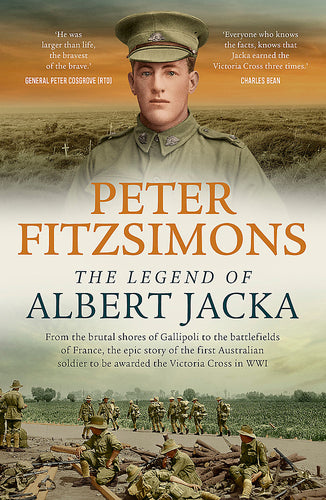
  • The Coachbuilder’s Column: Volume 15: Issue 5: 18th February 2025:  some comments on Peter FitzSimons’ new book ‘The Legend of Albert Jacka’.

    As has been his practice over recent years, this author has produced another non-fiction contribution to the world of books and literature.  ‘The Legend of Albert Jacka’ by Peter FitzSimons, published in 2024, of 463 pages, including some substantial section of Notes, References, etc. This book is the story of the first Australian soldier to be awarded the VC [Victoria Cross] in World War One – that award arising from his actions in Gallipoli, and later earning many accolades for his efforts on the various battlefields of France, actions which in the opinion of many [but not his seniors] should have earned him further VC’s.

    As with past contributions from FitzSimons, I found this a fascinating historical depiction of those years, though written in his inevitable style of the novel format. I must admit however, that after having already read many depictions of some of those crucial battles on the Western front in France during WWI, and now moving through  FitzSimons’ vivid up-front descriptions of those campaigns which cost so many thousands of lives, often with little reward for these human tragedies, many of which could have been avoided with more competent British leadership, I’m thinking I might desist from reading about that war for the time being. Though it does seem to have been a favoured topic for the author over recent years!!

    From the broadly accepted summary of the book, we read thus:

    ‘Our heroes can come from the most ordinary of places. As a shy lad growing up in country Victoria, no one in the district had any idea the man Albert Jacka would become.
    Albert ‘Bert’ Jacka was 21 when Britain declared war on Germany in August 1914. Bert soon enlisted in the Australian Imperial Force and the young private was assigned to 14th Battalion D Company. By the time they shipped out to Egypt he’d been made a Lance Corporal.
    On 26 April 1915, 14th Battalion landed at Gallipoli under the command of Brigadier General Monash’s 4th Infantry Brigade. It was here, on 20 May, that Lance Corporal Albert Jacka proved he was ‘the bravest of the brave’. The Turks were gaining ground with a full-scale frontal attack and as his comrades lay dead or dying in the trenches around him, Jacka single-handedly held off the enemy onslaught. The Turks retreated.
    Jacka’s extraordinary efforts saw him awarded the Victoria Cross, the first for an Australian soldier in World War I. He was a national hero, but Jacka’s wartime exploits had him moving on to France, where he battled the Germans at Pozières, earning a Military Cross for what historian Charles Bean called ‘the most dramatic and effective act of individual audacity in the history of the AIF’. Then at Bullecourt, his efforts would again turn the tide against the enemy. There would be more accolades and adventures before a sniper’s bullet and then gassing at Villers-Bretonneux sent Bert home’.

    And that ‘war injury’ in particular the gas injury which basically ended Jacka’s service in the field, though didn’t stop him from seeing out the war in other relevant areas, would see him return to Australia, but be dead by the age of 39 years.

    As for the horror and human waste of that time – well FitzSimons warns readers right at the beginning of this book as he introduces as to Jacka  “Starting out on this book, I already had a fair idea  of the sheer horror he had endured and triumphed over, given the books I had done  on Gallipoli, and the battles of Fromelles and Pozieres, together with the battles of Villers-Bretonneux and Hamel. It was fascinating to research and write as I kept discovering detail that put flesh on the bones of the story and showed it in all its gory glory, its wonder, its desperation and inspiration…………Allow me to say how much I came to like and admire Jacka the deeper I went – and how amazed I was that he managed to survive, given the risks he took and the furious fire he faced. He was an extraordinary soldier……”

    Meanwhile, the author and Jacka himself, back in Australia at war’s end, didn’t forget that other famous Australian military leader, Sir John Monash. While it is suggested in many quarters that Jacka did not receive additional awards of recognition for his courage and achievements under fire because he had so often being too ‘outspoken’ against some of his superiors; similarly with Monash, upon returning to Australia, he was overlooked for many roles that it was felt he had earned, and again some quarters would suggest that his Jewish background was used against him.   As FitzSimons put it  – “Jacka is dismayed at the lack of acclaim for the man who had saved more lives than any other Australian officer. Monash gained the eternal respect of his men simply by caring for them, and pursuing tactics that did not involve thoughtless slaughter as a starting point’ [page 380].

    About Jacka, FitzSimons writes: “Happily, as I uncovered ever more about what he had accomplished, and how he had not only overcome amazing odds in battle to triumph, but also against efforts that were made against his attempts to rise in a system ill-disposed to allow a man with strong opinions on how things should be run on the battlefield to prosper” [page xiv]’

    Jacka had a very similar attitude to those he served with and as a leader in the 14th Battalion  –  this attitude is perhaps reflected in the post-War years by  the following description by FitzSimons.

    [page 379] – ‘Activities with the RSL inevitably bring Jacka back into contact with Sir John Monash, which includes the two of them marching side by side every year in the annual Anzac Day marches down Collins Street. [In strict contrast to Jacko’s growing closeness to Monash is his public disdain for the likes of General James McCay, the Butcher of Fromelles as he is known, who had not only ordered his men over the top in that disastrous battle, but refused a truce with the Germans the following day that might have saved hundreds of Australian lives. When the two find themselves on the same stage for a fundraiser for the RSL, Jacka refuses to shake McCay’s hand].’

    Of course there is both praise and ridicule of FitzSimon’s books,  some of the latter quite harsh, for eg, two very contrasting opinions I noted recently among a series of reviews on the Goodreads website.

    [1] – Peter Fitzsimons is just so good at identifying a great story, especially his books covering Australians at war, and delivering an offering that can’t be put down, brings tears to your eyes, intense pride and raises the hairs on the back of your neck. Usually simultaneously.

    [2] – Sadly, a worthy subject and a life worth knowing has been let down by a writer who delights in mangling puns and similar juvenile comic effects. Rather than a proper biography it reads as an overblown piece from a weekend tabloid.

    The latter writer also points out numerous factual errors that appear in Jacka – whether they can be totally blamed on the author, or more correctly on the editor/publisher, etc, remains at issue.

    In a recent review within the November 2024 edition of the Australian Book Review, Robin Gerster reviews Peter Stanley’s book ‘Beyond the Broken Years: Australian military history in 1000 books’.  Speaking of FitzSimons, he writes “One theme, however binds the discussion: [t]he chasm between the more astringent academic approach and the bombastic nationalism of popular writers’. Stanley is disdainful of the so-called ‘storians’, the term coined by the ubiquitous Peter FitzSimons, whose steady stream of bloated blockbusters, including Kokoda [2004], Tobruk [2006], and Gallipoli [2014], pursues a familiar nationalist itinerary. FitzSimons seeks to put the ‘story’ in war history, by writing it in the manner of a novelist and taking liberties with mere facts. That may be all right if you are Leo Tolstoy. FitzSimons is an obvious target of derision; that his brick-size books [and here’s the rub] sell so well is a trickier issue to consider”.

    I guess I am one of those buyers who deserves to be a target of derision, based on Stanley’s viewpoint. So be it – while occasionally FitzSimon’s style of writing may seem a bit over-cooked, for myself, the stories depicted are a source of education which perhaps I find an easier way to ‘learn’ about events in preference to ploughing through a detailed historical analysis, which incidentally, I still do from time to time. Those of you who have read some of my past book reviews will note the range and variety of ‘historical novels’ I read ‘because’ they usually educate the reader about historical events, albeit written in the ‘manner of a novelist’ as described by Stanley.

    In any case as with all genres of books – the worth of a book on any subject is in the eyes of the reader.  Despite the criticism, I recommend ‘The Legend of Albert Jacka’ by Peter FitzSimons, and form your own opinion.

    As for Jacka, we conclude with the words of Charles Bean [famed journalist, and later the Official Australian Historian who was embedded with the AIF during WWI] when he wrote:

    ‘Jacka should have come out of the war the most decorated man in the A.I.F. One does not usually comment on the giving of decorations, but this was an instance in which something obviously went wrong. Everyone who knows the facts, knows that Jacka earned the Victoria Cross three times’

  • Introductory greetings to billsspacebooksand comment

    As can be seen from past postings from an earlier wordpress account, the postings that will appear on my page will relate to but not be restricted to the following. If any readers would like to get some idea of what I’ve written about in the past – well there are a number of years of contributions now imported to this site, as is perhaps indicated by the heading of my most recent contribution, dated 31 January 2025 – the Coachbuilder’s Column Vol 15 Issue 5, with the 15 representing the 15th year of contributions. In any case, the following is a brief summary of what you can generally expect!! 🙂

    1. Regular reviews of books and/or articles I have read, incorporating my opinion and the reviews of more professional commentators, as acknowledged; in recent years, this area has been the prime focus of my contributions, I’m an avid book reader on a wide variety of book genres, and I like to share the nature of what I’ve read for all so interested.
    2. Comments of my own or shared from writers on a range of social, political and environment issues, at all times, hopefully attempting to incorporate both viewpoints of an issue in question.
    3. Comment on items of a specific ‘Australian’ related nature be that society, sport, music, art and so on.
    4. I always welcome feedback on my contributions, though generally prefer not to get bogged down into ‘aggressive’ debate on a subject – happy to share different opinions, and leave it at that.

    I’m currently working on my first contribution under my new blog setup. Happy to hear from anyone.

    Bill.

    Incidentally, my home is the township of Sunbury, which is about 40 kms northwest of Victoria’s capital city Melbourne, in the State of Victoria, Australia.

  • The Coachbuilder’s Column: Volume 15: Issue 4:  some early reading in the opening month of 2025.

    This selection includes the following publications.

    • ‘The Life and Times of King George VI’ [1895-1952] [pub. 1950s], and, Royalty Annual, No. 5 [pub circa 1956/57];
    • Watsonia: A Writing Life by Don Watson [2020];
    • The Ghosts of August, by Peter Watt [2024]; and,
    • On the Beach’ by Nevil Shute [1957].

    January

    This month, a couple of royalty books that have been sitting on my book shelves for decades, so I finally decided to have a proper read,  whilst trying to maintain a touch of fitness on the exercise bike!!

    ‘The Life and Times of King George VI’ [1895-1952], 160 pages, and up to 200 black & white photographs, set up and printed in Australia by The Herald and Weekly Times Ltd. The year of publication is uncertain, although I’m assuming it was in the middle to late 1950’s following the King’s death and the succession of Queen Elizabeth, his eldest daughter to the throne.

    I can’t recall how I came across this book which I’ve had in my possession for many years. I can only assume it was passed down to me at some stage by my grandmother prior to her death in 1980.  The book was actually a gift to one of the sisters of her father – Mrs Alice Rodgers [nee Jenkin] from a Howard Reed. Alice died at the age of 96 years, in 1969, so obviously she received the book most likely in the 1950s/1960s period.  I’ve been unable to find reference to this precise book on the internet, but basically, it is described as a pictorial record of the years of one who was a much-loved monarch in his time.  Within the 160 pages, every phase of the King’s life over 56 momentous years, is mirrored with nearly 200 vivid, photographs which were supplemented  by descriptive captions. One Internet Archive I came across, which appears to have the same ‘Appreciation’ of 6 pages at the beginning of the book, suggest it was published in 1946, which cannot of course be correct, with the King’s death and funeral in 1952 fully covered. I was not yet 6 years of age at that time, and cannot admit to any recalled knowledge of those events.

    In any case after the section entitled ‘An Appreciation’ written by a Malcom Thomson, the book is then introduced by a tribute by the then Prime Minister of the United Kingdom, The Rt Hon. Winston S. Churchill, O.M, C.H., M.P.

    The book cover leaflet provides the following description.

    ‘Here are scenes from King George’s childhood and early manhood, his years as Duke of York, world traveller, sportsman, devoted husband and father, happy Royal family pictures, memories of the funeral of King George V, the Coronation, Royal tour of Canada and USA, the war years, visits to blitzed cities, visits to war zones, Victory celebrations, Royal tour of South Africa, Princess Elizabeth’s wedding, Royal Silver Wedding, the Royal grandchildren, opening of the Festival of Britain. Finally, there are the impressive scenes of the lying in State and of the Royal funeral, including some of the most remarkable camera studies of our day. It is, in truth, a book to treasure for a lifetime’.

    So this book has lasted in my possession for a large part of my lifetime, and I can only hope that someone following me will regard it in that way, basically as a family treasure. I have a few books of that nature, including of course the Family Bible passed down through my grandmother’s family, and I do admittedly have concerns as to what will become of that and others of similar nature!!

    Royalty Annual No. 5:  published in 1957:  a gift from my father’s sister back in the 1950’s or thereabouts, the British Royal family of that time being much more highly regarded than is the case in 2024.  This was apparently the 5th such annual published since the start of the reign of Queen Elizabeth II in February 1952, basically a summary of royal occasions, family life etc during that period of around July 1955 to June 1956, filled with news about the British royal family, Queen Elizabeth, in particular, and the first chapter is titled, “Christmas at Sandringham. 

    The copy I have consist of 128 pages, with an original dust jacket, which is slightly damaged, though otherwise, the book is in good condition, the cover printed in Red cloth material with gilt lettering. It contains black and white photographic plates, and has detailed summaries of the many Royal activities, ceremonies, family lives and individuals over the period referred to. It was written and produced by Godfrey Talbot and Wynford Vaughan Thomas and printed by London Andrews Dakers Ltd. This particular edition is currently available on many of the relevant sites for around $AUS42.00.

    Amongst some of the topics covered are:

    • Homes and hobbies and historic public engagements of the Queen and the Duke of Edinburgh and their relatives;
    • Tour of Nigeria & other travels;
    • Royal theatre-going, film and book tastes, and fashions;
    • The great houses of Windsor, Osborne and Sandringham;
    • Princess Margaret;
    • Trooping the Colour;
    • Royal Wales;
    • Educating Prince Charles;
    • Queen and Parliament;
    • Europe’s Royal families;
    • Her Majesty’s horses;
    • A Royal Duke at home; and so much more.

    The introductory paragraph on page 3 reads as follows.

    “Our fifth Royalty Annual appears in the fifth year of the reign of Her Majesty Queen Elizabeth the Second. In our first edition we reflected the confidence of the nation that our new Sovereign would maintain the tradition of devoted service to the State which was the driving force in the life of her father, King George VI. The whole world now knows how nobly the nation’s hopes have been fulfilled. Her Majesty has not been content merely to continue in the paths already laid down for her – admirable though they be.  She has struck out on her own policy and made a fresh appraisal of the relationship between the Crown and the People……She has travelled more widely and more swiftly than any other ruler in our history. She has put the stamp of her own vigorous personality on the new Elizabethan Age. That age now appears as one of speedy and exciting social and constitutional change….:

    22nd January

    Watsonia: A Writing Life’ by Don Watson [published in 2020 a Black Inc pub], 561 pages.

    This book was a collection of essays, columns, op-eds, and occasional addresses by Don Watson, basically over the 40 years from 1980. Indeed, a wide Range of topics and subject matters included in quite an extensive collection. I purchased the book recently from a second-hand bookshop in Daylesford, Central Victoria.

    As Black Inc relate:

    Watsonia gathers the fruits of a writing life. It covers everything from Australian humour to America gone berserk; from Don Bradman to Oscar Wilde; from birds and horses to history and politics. Wherever Don Watson turns his incisive gaze, the results are as illuminating as they are enjoyable.

    Watsonia displays the many sides of Don Watson: historian, speechwriter, social critic, humourist, biographer and lover of nature and sports. Replete with wit, wisdom and diverse pleasures, this comprehensive collection includes a wide-ranging introduction by the author and several previously unpublished pieces. No other writer has journeyed further into the soul of Australia and returned to tell the tale.

    Rather ironic that one of the major articles [in fact a Quarterly Essay contribution] dealing with politics in the USA was discussing the pre-election campaigning for the 2016 election [Trump versus Hilary Clinton], ironic because we have just seen Trump re-elected, in 2025.

    The collection also included a very interesting piece about the US writer, Mark Twain.

    Artfully arranged, Watsonia showcases the many sides of Don Watson- historian, speechwriter, commentator, humourist, nature writer and biographer. It also features, as mentioned,  several previously unpublished lectures and a wide-ranging introduction by the author. This comprehensive anthology – replete with wit, wisdom and diverse pleasures – is essential reading [for a small minority I guess, I thoroughly enjoyed the variety of subjects in any case!!]

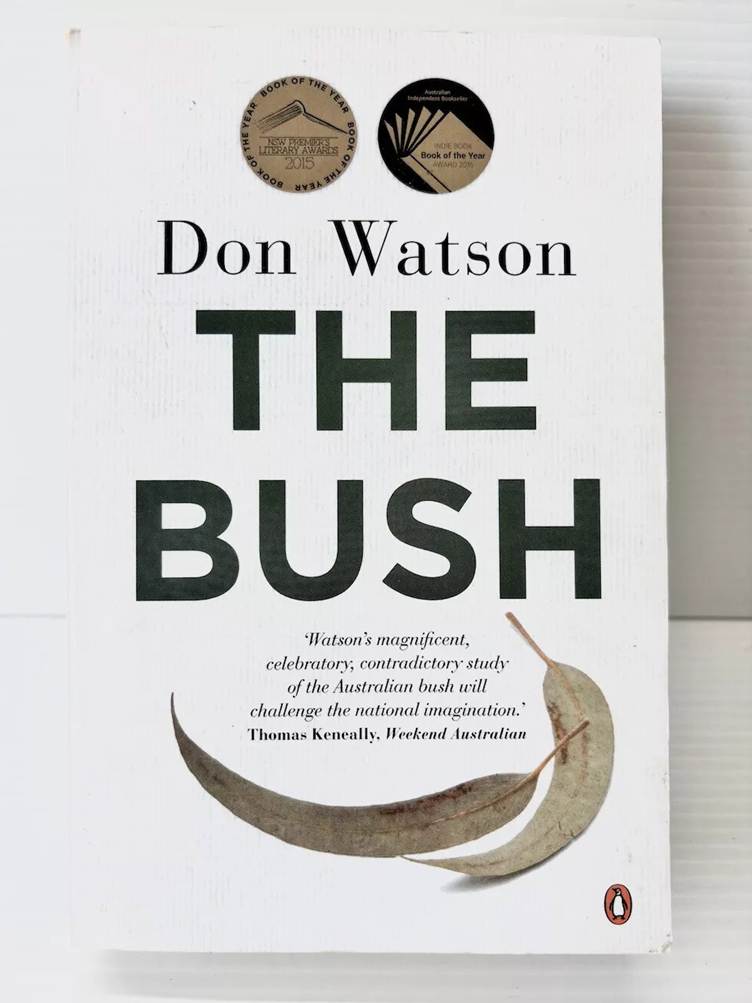
    Don Watson is the author of many acclaimed books, including Caledonia AustraliaRecollections of a Bleeding HeartAmerican JourneysThe BushWatsonia and The Story of Australia.

    28th January 2025

    ‘The Ghosts of August’ by Peter Watt, published in 2024, 401 pages, another great contribution from Watt, at times a very moving and almost, emotional piece of reading! This was another inspiring and fast-moving contribution by Watt who has been publishing since about 1999, and who personally signed for me, one of his releases in 2008 at the Sunbury Library. The story [an ongoing one of the generations of the Steele family] is centred around the years of World War I, an historical novel, with fictional characters in the main, involved in factual events.

    Watt reminds us that while most attention on WWI for Australia revolves around Gallipoli or the Charge of the Light Horse Brigade at Beersheba, he, through his novels draws attention to events generally overlooked or forgotten aspects of our military history.  As he writes in his notes for example “…most are ignorant that a mere matter of weeks after war was declared in August 1914, we also undertook a coastal landing to our north. It was not a campaign on behalf of the British Empire but a pre-emptive  strike to defend our own eastern shores against the possibility of a German naval bombardment, as outlined in a prewar operational plan by the German Imperial Navy…..I have attempted to briefly describe what might be considered a skirmish, but it did cost the lives of Australian soldiers and sailors and the loss of an Australian submarine, the AE1, which was only recently discovered with its crew still entombed”.

    And further he writes: “An overlooked campaign fought in the deserts of Egypt and Palestine by the Australian Light Horse in company with the New Zealand Mounted Infantry and the British Yeomanry mounted troopers was critical to the eventual victory by the Allied forces, and yet most Australians only know about a charge at Beersheba”.

    Certainly, this book reminds us of the horrors of war as fought at Gallipoli, the western front, and in the deserts, and often doesn’t make for pleasant reading, as I guess the truth seldom does!. Peter Watt, amongst other sources, uses the direct experiences of Australian author Ion Idriess [whose many books I inherited from my late father] where Idriess recorded his personal experiences at Gallipoli and Palestine in his book ‘The Desert Column’, and Watt uses these experiences as told through the lives of his fictional characters.  Incidentally, Ion Idriess was wounded twice, once at Gallipoli and again in Palestine before he was discharged after the war.

    30th January

    Probably, as an after-thought, I should have avoided doing so, but I followed Watt’s book up with a quick read of Nevil Shute’s 1957 classic ‘On the Beach’ [a paperback edition by Pan Books of 267 pages] which was subsequently made into a movie in 1959, principally centred in Melbourne, and starring Gregory Peck, Ava Gardner, Fred Astaire and Anthony Perkins and directed by Stanley Kramer.

    Basically, as per the novel, in 1964, World War III has devastated the Northern Hemisphere, killing all humans there. Air currents are slowly carrying the radio-active fallout to the Southern Hemisphere where the occupants of Melbourne, Australia, will be the last major city on Earth to perish. The story covers the final few months in the lives of five people in particular as the final weeks and days are counted down. As suggested, in retrospect, in view of current world conflicts, etc, it might have been wiser to put this book aside, as the very nature of the topic was somewhat depressing, though not unexpected as I have watched the movie on a few occasions.

    A Wikipedia summary of the ‘film’ plot [in which there are subtle differences to the book, and my bracketed comments refer to some of those discrepancies] – however, this summary is a fairly succinct outline of the story, so I’ve copied that  version here.

    The American nuclear submarine USS Sawfish, commanded by Capt. Dwight Towers, arrives in Melbourne and is placed under Royal Australian Navy command. Peter Holmes, a young Australian Naval officer with a wife and infant child, is assigned to be Towers’ liaison. Holmes invites Towers to his home for a party, where Towers meets Julian Osborn, a depressive nuclear scientist who helped build the bombs, and Moira Davidson, a lonely alcoholic with whom Towers develops a tentative attraction. Although Davidson falls in love with Towers, he finds himself unable to return her feelings, because he can’t bring himself to admit his wife and children in the United States are dead.

    Meanwhile, a new scientific theory postulates that radiation levels in the Northern Hemisphere might have fallen faster than anticipated, suggesting radiation may disperse before reaching the Southern Hemisphere, or at least leaving Antarctica habitable [this theory is quickly discounted as misleading in the book version]. Soon after, the Australians also detect an incomprehensible continuous Morse code signal coming from the West Coast of the United States, where there should be nobody alive to send it. Towers is ordered to take the Sawfish, with Peter and Julian, to investigate.

    Arriving at Point Barrow, Alaska, the sub crew discovers that the radiation levels are not only highly lethal but higher than in the mid-Pacific Ocean, meaning the dispersal theory is incorrect. There will be no salvation from the radiation. Stopping next in San Francisco, Sawfish finds the city devoid of life. A crew member with family in the city deserts and swims ashore, so he can die at home.

    The submarine next stops at a refinery near San Diego, which has been pinpointed as the source of the mysterious Morse signals. A crew member discovers the power source is still running on automatic control. Nearby, a telegraph key has become entangled in a window shade’s pull cord and a half-full Coca-Cola bottle, and is being randomly pulled by an ocean breeze, causing the radio signals.

    Sawfish returns to Australia to await the inevitable. Towers is reunited with Davidson at her father’s farm. He learns that all US Navy personnel in Brisbane are dead and he has been given command of all remaining US Naval forces. Osborn, having bought the fastest Ferrari in Australia, wins the Australian Grand Prix [during the final weekend as the radiation begins to infiltrate the Melbourne area] in which many racers, with nothing left to lose, die in fiery crashes.

    Fulfilling Towers’ wish, Davidson has used her connections to get the trout season opened early. Towers and Davidson go on a fishing trip to the country. As drunken revelers sing “Waltzing Matilda” in the hotel bar, Towers and Davidson make love in their room [a bit of film levity here, with the book revealing no true intimacy between the two, as Towers remains true to his US family to the end , intending to ‘return home, and having purchased gifts for his wife and children with the support of Davidson]. ’Returning to Melbourne, Towers learns the first of his crew members has radiation sickness. There is little time left. Towers takes a vote among his crew [some of whom] decide they want to ‘ return to the United States’ to die. Osborn shuts himself in a garage with his Ferrari and starts the engine, to end his life by carbon monoxide poisoning. Others queue to receive government-issued suicide pills. Before they take their pills, Peter and Mary reminisce about the day they met, “on the beach.”

    Towers says farewell to Davidson at the docks. Choosing duty over love, he takes the Sawfish back to sea. Heartbroken, Davidson watches from a cliff as the Sawfish submerges. It is implied that Towers and Davidson ended their lives shortly afterward, although their deaths are not depicted onscreen. [In fact, Towers intends to sink Sawfish in Bass Strait just beyond the Heads, taking himself and his willing crew members down with the ship, while Davidson has driven at breakneck speed to reach the clifftops at Barwon Heads so that she can ‘be with Towers’ and ‘die with him’  – he had earlier refused her request to go with him on the Sawfish because it was against naval regulations]

    Within a few days, the streets of Melbourne are empty, silent, desolate and without any sign of motor vehicles, animal or human life.  A Salvation Army street banner, seen several times before in the film, reads: “There is still time .. Brother”.

    [Bill Kirk 31/1/2025]

  • The Coachbuilder’s Column: Volume 15: Issue 3:  26th January 2025: Some essential Australia Day reads as recommended by historians.

    The following article came from ‘The Conversation: Books and Ideas’ [a weekly online newsletter], dated the 24th January 2025, and provided the suggestions of various writers as to the most appropriate and essential reading recommended for Australia Day. I thought I’d like to share those ideas on this day.

    The Conversation asked some of our leading historians to choose an essential Australia Day read. Here are the works they consider crucial to understanding our culture and history.

    The Australian Legend – Russel Ward

    Russel Ward’s The Australian Legend (1958) has had some bad press over the years. Based on a PhD thesis about bush ballads, the book was a brief study of a figure Ward called “the typical Australian”. While Ward believed convicts, Irish, bush-rangers and gold miners had contributed something to the national image, he thought the pastoral worker, especially the shearer, was the quintessential national type. A white bushman as “the typical Australian” and mateship as his creed. Oh, dear!

    Needless to say, such arguments formed a handy target for critics as the 1960s and 1970s unfolded. Surely Australia was one of the most urbanised countries in the world, so what about city people? What about women? And what of Indigenous Australians? Were they simply to be written out of the national story by Ward, as they had been so often by previous historians? And wasn’t his bushman also hostile to Asians?

    Ward explained that he was exploring a national image, a stereotype, but one that had influenced how people actually behaved and how they thought of themselves. For that reason, the book remains essential reading for anyone wishing to understand this country. The image Ward examined remains alive within Australia, and perhaps especially beyond it as a resilient global image.

    [by] Frank Bongiorno, Professor of History, Australian National University; Distinguished Fellow, Whitlam Institute, Western Sydney University

    Näku Dhäruk: The Bark Petitions – Clare Wright

    For a book that challenges and deepens your understanding of Australia I would turn to Clare Wright’s new, compelling history of the Yirrkala Bark Petitions, Ṉäku Dhäruk. This is pacy, epic storytelling about beautiful bilingual documents formally presented by the Yolngu people of north-eastern Arnhem Land to the Commonwealth Parliament in 1963. The dramatic narrative unfolds month by month throughout one year; the book is cinematic in its evocation of land, weather, seasons, politics and people.

    How did the Australian government receive this respectful and deeply spiritual petition from a people who have always remained on their land and never ceded it to the invaders? I think readers know the answer, but as we reflect on our nation’s history, let’s consider paths not taken as well as opportunities that still beckon. Australia is a continental constellation of sovereign peoples whose histories deepen and enrich any understanding of the modern nation. This book takes you on a roller-coaster ride into another world, an Australia most of us hardly know.

    [by] Tom Griffiths, Emeritus Professor of History, Australian National University

    Truth: the third pillar, alongside Voice and Treaty, of the Uluru Statement from the Heart. We historians have been truth telling about colonisation for decades, and there’s no shortage of books that illuminate why 26 January is better known as Invasion Day.

    For this year’s dose of truth, I’d recommend a new release: Clare Wright’s Näku Dhäruk: The Bark Petitions, the third book in her Democracy Trilogy. In this rollicking read, Wright tells how the people of Yirrkala asserted their sovereignty against mining interests and birthed the modern land-rights movement. It’s a tale of resistance and survival in the face of dispossession, but also an extraordinary glimpse into the sophistication of Yolŋu culture and governance. We settlers should be so lucky to live alongside such wisdom.

    Yet the true history of this continent is not only contained in history books. Truth telling is sometimes more potent in the creative arts, and I have found First Nations poetry especially affecting. Two personal favourites are Natalie Harkin’s Archival-Poetics and Ambelin Kwaymullina’s Living on Stolen Land. Both remind us that the past isn’t past and – as Kwaymullina puts it – “there is no space of innocence”. Having reckoned with that fact, what will we each do next?

    [by] Yves Rees, Senior Lecturer in History, La Trobe University

    Mixed Relations: Asian-Aboriginal contact in north Australia – Regina Ganter

    This beautiful book (with contributions also from Julia Martinez and Gary Lee) turns the map upside-down, to examine the continent’s entanglement with Asia starting centuries before the arrival of the British. Looking north, it begins with Macassan trepang (sea cucumber) fishermen travelling south from Sulawesi each year to trade with First Nations Australians along the coast, from Western Australia to the Gulf of Carpentaria.

    Exploring the rich cosmopolitan exchange between Japanese, Chinese, Filipino, Malay and Afghan people across the country’s north, Mixed Relations is based on more than 100 interviews combined with extensive historical research. It explores topics such as pearling in the north of Western Australia, government “protection” of Aboriginal people from Asians, and the Asian culture of Darwin.

    These are stories that should be central to our national history. And especially precious to me is that Mixed Relations overflows with gorgeous images, bringing this past to life.

    [by] Jane Lydon, Wesfarmers Chair of Australian History, The University of Western Australia

    Words to Sing the World Alive: Celebrating First Nations Languages, edited by Jasmin McGaughey and The Poet’s Voice

    When Captain Arthur Phillip raised the flag of Great Britain at Warrane (Sydney Cove) on 26 January 1788, the invading nation dispossessed the original owners of more than their property. We often hear that the vast majority of the 250 Indigenous languages spoken prior to 1788 were “lost”.

    As those First Nations’ elders, writers and artists now engaged in the arduous, vital process of language revitalisation are at pains to point out, language wasn’t clumsily lost, like a set of car keys down the back of the couch. Language, like land, was stolen.

    Words to Sing the World Alive, is more than simply “a celebration of First Nations Languages”, as this beautiful, moving, important book humbly claims in its subtitle. It is a timely and necessary intervention into Australia’s exceptionally and stubbornly monolingual national culture.

    It shows us that if history is the lock, language is the key.

    [by] Clare Wright, Professor of History and Professor of Public Engagement, La Trobe University

    Winners and Losers – Stuart Macintyre

    In Winners and Losers: The Pursuit of Social Justice in Australian History (1985), Stuart Macintyre offers a thematic single-volume history of Australia since the British government established a penal settlement at Port Jackson. His theme is inequality – what inequalities people noticed and cared about, and what they did to overcome them.

    Macintyre devotes chapters to the struggles of convicts, small settlers, wage-earners, the unemployed, those not supported by wage labour, the school-aged, women and Aboriginal people.

    There has been no single agenda of social justice. Rather, in each of the chapters Macintyre discusses a particular set of reformers, each advancing a particular conception of a more equal Australia. Each movement shaped the state and established common expectations of what governments, if they are serious about a “fair go”, must do.

    The result is a compact, readable, evolutionary account of what Australians have come to expect a state to do for those it governs.

    [by] Tim Rowse, Emeritus Professor, Institute for Culture and Society, Western Sydney University

    Deep Time Dreaming: Uncovering Ancient Australia – Billy Griffiths

    I first read Billy Griffiths’ Deep Time Dreaming: Uncovering Ancient Australia when it came out in 2018, and loved how it charts the recognition of Australia’s ancient history. It’s a story of how settler colonial Australia slowly realised that the continent’s human history didn’t begin with colonisation, but stretched over millennia, reaching into an expanse of time that seems almost unimaginable. “The New World had become Old”, he explains.

    When I returned to study last year, I read Deep Time Dreaming again and it was even better second time around. Griffiths’ book isn’t simply about ancientness, but about the nature of Deep Time itself, patiently explained by First Nations Knowledge Holders, he acknowledges, shared by communities, measured by science and humanities, and held in archives on Country. “Beneath a thin veneer, the evidence of ancient Australia is everywhere, a pulsing presence”, Griffiths writes. This is a book I’ll keep returning to and hope others do, too, on this significant weekend.

    [by] Anna Clark, Professor of Public History, University of Technology Sydney

    Australia – W.K. Hancock

    Although it was published in 1930, W.K. Hancock’s Australia remains essential reading for anyone interested in the dynamics that established Australian politics, economics and culture.

    Hancock dissects the key developments of early 20th century Australia, what he terms elsewhere the “settled polices”: White Australia, industry protection, and Australia’s unique system of industrial arbitration, all of them the product of Deakinite liberalism, established with the support of the Labor Party.

    These policies were inspired by a radical spirit and were meant to create a better Australia. They ultimately failed because they had unintended consequences, and because the “idealism” of Australians did not take account of the realities of the wider world. Protectionism led to industries becoming increasingly unviable without government support. The industrial system threatened productivity because it linked wage increases to rises in the cost of living, rather than increasing output. As for White Australia, Hancock commented that Australians put up barriers because they could not trust themselves to be just to people different to themselves; they believed that homogeneity was a precondition for a just society.

    Hancock’s Australia is still relevant today because it explains how a particular form of “cultural patterning” shaped Australia for a large part of the 20th century. Moreover, it is a wonderfully written book, full of wit, and a model for how to write good history.

    [by] Greg Melleuish, Professor of History and Politics, School of Humanities and Social Inquiry, University of Wollongong

    Ecstasy and Economics: American Essays for John Forbes – Meaghan Morris

    History has always been the glamour discipline of the Australian humanities. In this country, we have history wars, not criticism wars or philosophy wars. Our public intellectuals tend to be historians; works of history are the ones most likely to find readers beyond academia; the scholarly debates that erupt into public awareness are generally historical.

    History’s stature is evident in the ease with which one could fill a bookshelf with landmark volumes of Australian history – books that have changed how large and diverse readerships think about Australia’s past, and so understand its present and imagine its future.

    But by both professional training and personal inclination, I’m a particular fan of books that approach history more indirectly: books that look to artworks of one kind or another as what Theodor Adorno once called “the unconscious historiography of their epoch”. And here pickings are slimmer.

    One stand-out text that delivers on the promise of this approach is Meaghan Morris’s Ecstasy and Economics: American Essays for John Forbes, an extended reading of two poems by Forbes. When it was first published in 1992, it provided a singularly acute historical analysis of the Keating revolution and its implications for Australia’s place in the world. Three decades on, it offers an unparalleled insight into the libidinal machinations of neoliberalism – an era which, globally, appears now to have ended. Five stars.

    [by] Thomas H. Ford, Senior Lecturer in English, La Trobe University

    People Power: How Australian referendums are lost and won – George Williams and David Hume

    Australia has changed dramatically since 1901, but the constitution still reflects the 19th century language and ideas of its authors. In People Power, George Williams and David Hume have managed to turn referendum history into a page turner. Republished following the defeat of the Voice to Parliament in last year’s referendum, it is a fascinating account of why our current system makes it so easy for popular ideas to be defeated.

    The Voice in 2023, a republic in 1999, 4-year terms in 1988, these are all ideas most Australians supported, but a lack of bipartisanship followed by similar negative campaigns, unchecked disinformation, and the age old appeal to ignorance – if you don’t know vote no – saw each of them fail.

    This book reminds us that hope is not lost. Free of legal jargon, it offers practical measures that can return referendums to public ownership and make it more likely that good ideas will prevail over bad politics. Australia Day is an ideal time to consider what we want out democracy to look like.

    [by] Benjamin T. Jones, Senior Lecturer in History, CQUniversity Australia

    Finally, when asked to nominate a book I consider essential to understanding Australian history, a few come to mind. Clarrie Cameron’s Elephants in the Bush and Other Yamatji YarnsBusted Out Laughing: Dot Collard’s Story, and Robert Merritt’s The Cake Man show the gentle strength and beauty of Aboriginal thought and language in the face of recent brutality. David Burramurra’s Oceanal Man: An Aboriginal View of Himself – an article rather than a book – shows the depth of history of the continent.

    The list of people continuing the storytelling tradition is long. You can’t go wrong reading the stories of Bill Neidjie or Charlie McAdam.

    I would nominate Why Warriors Lie Down and Die: Djambatj Mala by Richard Trudgen as essential to understanding how we got to where we are. The book clearly explains why resurgence is still possible. It is an outstanding representation of Aboriginal voices, and an example of the compelling storytelling that is still emerging from the ancient oral traditions of this place.

    [by] Lawrence Bamblett, Senior Lecturer, Australian Centre for Indigenous History, Australian National University

  • The Coachbuilder’s Column: Volume 15: Issue 2:  25th January 2025: the Australian of the Year Awards.

    The Australian of the Year Awards were announced in a traditional 25th January ceremony [on the eve of Australia Day] in our national Capital, Canberra this evening. As usual, there were four categories of Awards, and the respective nominations for each of those were:

    Australian of the Year:

    • Northern Territory: Grant Ngulmiya Nundhirribala:  internationally recognised musician and cultural leader, 
    • South Australia: Professor Leigh Bromfield: Director and Chair of the Australian Centre for Child Protection;
    • ACT: Megan Gilmour: after her son survived a traumatic illness, the ACT’s nominee vowed to support the 1.2 million children at risk of missing school due to chronic conditions., and co-founded MIssingSchool;
    • Tasmania: Sam Elson: led the way in commercialising a new way to reduce methane emissions, a key climate change contributor;
    • Western Australia:  Dianne and Ian Haggerty: Natural Intelligence Farming founders Dianne and Ian Haggerty have pioneered modern farming practises;
    • NSW: Kath Koschel: A former professional cricketer and ironman competitor, Kath Koschel has faced unimaginable hurdles. Ms Koschel was told in her 20s that she would never walk again and in 2015 founded the Kindness Factory, which teaches the “power of kindness” to kids.
    • Queensland:  Geoffrey Smith: is addressing a skills shortage in the technology industry by tapping into the potential of neurodivergent people, and is co-founder  Australian Spatial Analytics, where 80% of employees are neurodivergent;
    • Victoria:  Neale Daniher: is a co-founder of FightMND, a charity that has raised $115m into research to find a cure for motor neurone disease.

    Senior Australian of the Year

    • ACT: Peter and Marilyn Ralston: have made it possible for people with vision impairment or other disabilities in the ACT to walk or run at mainstream events and enjoy the benefits of an active lifestyle.
    • NSW: Dr Karl Kruszelnicki, Australia’s lovably eccentric science enthusiast and educator;
    • Northern Territory:  Michael Foley: dedicated most of his life to giving back to his community: for more than 40 years community volunteer and founder of Seniors Of Excellence NT Michael Foley OAM has been contributing to the recognition of senior citizens in our communities and their mental wellbeing.
    • Queensland: Dr Bronwyn Herbert: Social worker and scholar, she completed a Bachelor of Social Work at the age of 40, her master’s at age 61, and was awarded her PhD last year at the age of 90.
    • South Australia: Charles Jackson: Indigenous advocate and knowledge holder Charles Jackson OAM’s passion has been working with Indigenous Australians for more than 50 years.
    • Tasmania: Associate Professor Penelope Blomfield, women’s cancer specialist: as a Gynaecological oncologist her life’s work has been dedicated to improving the quality and longevity of life for her patients and others affected by gynaecological cancers;
    • Victoria: Dr. Peter Brukner: Sports medicine leader and health campaigner Dr Peter Brukner OAM profoundly inspired a generation of sports medicine practitioners as the co-author of the widely used textbook, Clinical Sports Medicine.
    • Western Australia: Brother Thomas Oliver Pickett: Brother Thomas Oliver (Olly) Pickett AM co-founded Wheelchairs For Kids in 1996 to provide adjustable wheelchairs and occupational therapy expertise for children in developing countries, free of charge. Since then, more than 60,000 custom-built wheelchairs have been given to children in over 80 countries.

    Young Australian of the Year

    • Northern Territory:  Nilesh (Nil) Dilushan: community service leader, she inspires and unites young people from diverse backgrounds to serve their community: as co-founder of two not-for-profit organisations, the 29-year-old fosters youth-driven initiatives for social change;
    • ACT: Daniel Bartholomaeus:  is a 21-year-old artist with an innate ability to inspire and motivate others, especially within the neurodivergent community;
    • NSW: Maddison O’Grsdey-Lee:  mental health advocate and researcher, she aims to improve the measurement of mental ill-health for Aboriginal and Torres Strait Islander young people through her PhD;
    • Queensland: Dr Katrina Wruck: her scientific research is giving back to remote communities: based on her research, Katrina has set up a profit for-purpose business, Nguki Kula Green Labs, which is poised to transform the consumer goods sector by harnessing the power of green chemistry, while inspiring others to step into STEM;
    • South Australia: Amber Brock-Fabel: is ensuring youth voices are heard:  Amber founded the South Australian Youth Forum in 2021 at just 17 years old: it empowers those aged 14 to 18 to discuss critical issues such as climate change, period poverty, gender equality and youth loneliness: the insights gathered – including surveys and models of engagement – are then presented to lawmakers and relevant organisations.
    • Tasmania: Ariane Titmus: swimming legend: with her quiet strength and determination, the 24-year-old has become a role model for young swimmers but she has also enjoyed inspiring young people beyond her sport;
    • Victoria: Aishwarya Kansakar, who taught herself computing amid the Nepalese civil war: she is a globally renowned AI and automation entrepreneur, not-for-profit executive, STEM education innovator and an automation engineer who speaks six languages.
    • Western Australia:  Jack Anderson:  at the age of 24, the extent of Elucidate Educationco-founder Jack Anderson’s achievements in the education space and beyond are impressive; he is a keynote speaker, documentary maker, author and a Harvard University Teaching Fellow and scholarship recipient, through which he is pursuing a Master of Education:   Jack founded ThrivEd when he was only 18. The student-run charity produced educational materials and donated them to disadvantaged schools; ThrivEd later merged with another charity to become Elucidate Education, encompassing some 70 volunteers and expanding its reach to tens of thousands of students in Australia and globally

    Local Hero of 2025

    • ACT: Vanessa Brettell & Hannah Costello: are harnessing the power of hospitality  to lift and empower those most vulnerable in their community, through their business Café Stepping Stone;
    • NSW: Martha Jabour: helped establish the Homicide Victims Support Group in 1993 to care for families and friends of homicide victims in NSW; but especially native wildlife
    • Northern Territory: Mignon McHendrie: for over 30 years, she has brought compassion and education to her community, rescuing and caring  for the NT’s unique wildlife;
    • Queensland:  Claire Smith; Wildlife Rescue Sunshine Coast founder, is a fierce protector of all living things;
    • South Australia: Sobia & Irfan Hashmi: for more than 20 years, this pair of pharmacists and migrant community leaders have transformed healthcare in remote and rural communities in SA;
    • Tasmania: Keren Franks: has first hand experience of the power of inclusion for people living with disability and those around them;
    • Victoria: Jasmine Hirst: over the past 15 years, she has given hundreds of girls and women the opportunity to play soccer, and giving females  access to scarce local facilities, grounds and equipment; 
    • Western Australia: Dr. Jacinta Vu: uses her considerable specialist skill in dentistry and oral health to generously give back to others, and played a large role in the operations of Healing Smiles, an organisation to assist women escaping domestic violence with their oral and dental health.

    During the Ceremony in Canberra tonight at the National Arboretum, Prime Minister Anthony Albanese  announced the 2025 Australian of the Year, Senior Australian of the Year, Young Australian of the Year and Local Hero,  and the following four Winners were presented with their Award by Mr Albanese.

    All of the nominees in each category listed above were fully deserving of being similarly recognised as the winners listed below.

    Australian of the Year for 2025

    Neale Daniher [Victoria]: is a co-founder of FightMND, a charity that has raised $115m into research to find a cure for motor neurone disease. Since his diagnosis in 2013, Neale and his family  have been battling the effects of the disease, but he remains a tireless campaigner for a cure and is always raising awareness of MND. With amazing courage and relentless, he’s dedicated his life to helping prevent the suffering of those who’ll be diagnosed in the future.

    The average time between diagnosis and death in MND is three years, with only 10 per cent of those diagnosed surviving beyond eight years, according to the Royal Australian College of General Practitioners.
    “When Neale was diagnosed, he was told to just tick off his bucket list. But the type of person that he is, he decided that he wanted to do something with the time he had left,” his wife Jan said after her husband was awarded the 2025 Victorian Australian of the Year.

    Senior Australian for 2025

    Brother Thomas Oliver Pickett: Brother Thomas Oliver (Olly) Pickett AM co-founded Wheelchairs For Kids in 1996 to provide adjustable wheelchairs and occupational therapy expertise for children in developing countries, free of charge. Since then, more than 60,000 custom-built wheelchairs have been given to children in over 80 countries.

    With over 250 retiree workshop volunteers, Wheelchairs For Kids is one of Western Australia’s largest (and with an average age of 74, one of Australia’s oldest) volunteer-led charities. A further 550 people from aged care and community groups sew covers for wheelchair soft supports, and crochet rugs and soft toys. 

    Thomas also spearheaded the development of an innovative, low-cost wheelchair design to World Health Organization standards that grows as the children do – a world first.  Wheelchairs For Kids is just one way that Thomas has improved the lives of others. For 26 continuous years, his life-changing community service has ignited a ripple effect of kindness and generosity.   

    Young Australian for 2025

    Dr Katrina Wruck [Qld]: her scientific research is giving back to remote communities: based on her research, Katrina has set up a profit for-purpose business, Nguki Kula Green Labs, which is poised to transform the consumer goods sector by harnessing the power of green chemistry, while inspiring others to step into STEM;

    Her career in chemistry has focused on giving back to remote communities by transforming mining by-products into usable non-toxic materials like laundry detergent. Wruck is a proud Mabuigilaig and Goemulgal woman, who has advocated for First Nations knowledge and participated in community engagement programs. 

    Local Hero for 2025

    Vanessa Brettell & Hannah Costello [from the ACT[: are harnessing the power of hospitality  to lift and empower those most vulnerable in their community, through their business Café Stepping Stone; this business operates as a social enterprise, employing women mostly from migrant and refugee backgrounds and others who have experienced significant barriers to employment. The sustainable vegetarian café has two locations which offer culturally and linguistically diverse women employment pathways, on-the-job training and qualifications through partnerships with registered training organisations.

  • The Coachbuilder’s Column: Volume 15: Issue 1:  a look at Quarterly Essay No. 96

    Quarterly Essay No. 96 titled ‘Minority Report: The New Shape of Australian Politics’ by George Megalogenis.

    In general summary, this essay, published late in 2024, asks the question –   What does the new political landscape look like in Australia?

    As the publisher tells us, Australian politics is shifting. The two-party system was broken at the last federal election, and a minority government is a real possibility in the future. Politics-as-usual is not enough for many Australians.  In this richly insightful essay, George Megalogenis traces the how and why of a political re-alignment. He sheds new light on the topics of housing, the changing suburbs, the fate of the Voice to Parliament, and trust in politicians. This is an essay about the Greens, the teals and the Coalition. In a contest between new and old, progressive and conservative, which vision of Australia will win out? But it’s also about Labor in power – is careful centrism the right strategy for the times, or is something more required?
    In Minority Report, Megalogenis explores the strategies and secret understandings of a political culture under pressure.   He writes  “The sword of minority government hangs over the major parties. Neither side commands an electoral base broad enough in the twenty-first century to guarantee that power, once secured, can be sustained for more than a single three-year term. Now the question turns to whether a return to minority government will further damage our democracy, or, perhaps, revitalise it.” [George Megalogenis, Minority Report].    

    A worthwhile review of the Essay appeared on the   website ‘Cannonball Read’ which I’ve taken the liberty of copying in full.

     “In this Quarterly Essay, journalist Megalogenis unpacks the world of Australian politics as we plunge forward to our next federal election in 2025. It’s clear, as one looks at elections around the world, that the rules of the past in elections are gone. Polls no longer reliably predict winners. Incumbents no longer reliably get second terms. People don’t vote in blocks like they used to, and single-issue parties and politics are taking hold. It’s a fascinating (if terrifying) time to be alive.  Megalogenis tries to unpack this trend. To explain how and why the political world has changed. The premise is largely that there is a desperate need for the electorate to get comfortable with the concept of minority government. For those who don’t have a Westminster system like Australia, a minority government is what is formed when no single party wins a clear majority. Instead, a minority government forms: a tenuous arrangement between the majority and minor parties/independents – enough to get the numbers to hack together a majority. It’s relies on personality politics and messy deals, and invariably leads to slow government progress.  But it also forces the major parties to engage with the electorate in a way they usually are not forced to, which is not always a bad thing.

    Though there are many factors unpicked in this essay to explain how things got here, the most glaring seems to be data on immigration. Australia is an extremely multicultural nation, but you wouldn’t know that when you look at our male, pale, and stale elected officials. Parties are failing to win majorities, or retain governments, because they are failing to inspire and win over immigrant voters. Compulsory voting exists in Australia after all – literally everyone gets a say (whether you like it or not). There’s no electoral college. It makes for a difficult task, which the major parties so far have failed navigate with skill.

    Though the essay focusses on Australian politics, I’d say this topic has broader application. I’d recommend it to anyone who is struggling to understand how politics has changed, and will continue to change, over the next decade”. 


    This essay also contained correspondence relating to Quarterly Essay 95, High Noon [written by Don Watson] from Thomas Keneally, Emma Shortis, David Smith, Bruce Wolpe, Paul Kane, and, in response,  Don Watson.  At the time of reading that essay, I noted that it was  ‘Certainly  a wide-ranging piece of writing, and for a while I wondered when Watson was going to get to the point of the Essay, which did provide an interesting historical perspective leading up to both candidates, Trump and Harris  [and written in advance of the actual 2024 US election].  Certainly, the subsequent correspondence seemed to be in general agreement with the main thrust of Watson’s essay, with the most perceptions of it coming from author Thomas Keneally.

    In his own inevitable style, Keneally began his critique with the paragraph “What I like about Watson’s mind is his capacity to connect the mytho-poetic to the political, and he can do it without hearing from him, generally, any grunt of effort.  The Trump he gives us, essentially, is a special kind of Ogre, and is a fascinating figure in that the more politically literate people insult him with words like autocratic, authoritarian, demagogue, misogynist, the bigger he grows. Elegant abuse is his meat, his drink. This is why one can call Watson’s essay charming, even if it is about the end of America and all of our traditional ties to America. And then, just as the poor old king doses off in the midst of discussing the Ogre with the Townspeople, two apparently ordinary folk wander in, Harris and Walz, who somehow, by nit having a lifetime of experience in politics, can find the words to diminish the Ogre. They were ordinary words, but they bring a previously unseen pallor to the Ogre’s cheeks. ‘Weird’ was one of those words. The people watched in wonder and hoped the code words would keep their power to make the Ogre smaller”.  As we have seen subsequently, that did not occur. 

  • Coachbuilder’s Column: Volume 14: Issue 12: 29th December, 2024: Another selection of books read over the October/December 2024 period.

    For those interested, a small selection of books read over the last three months of 2024, with my comments together with commentary and reviews of others in each instance. Books covered, which include a fairly strong historical flavour,  are:

    • Woollahra: A History in Pictures by Eric Russell [1980];
    • Dreams of Other Days by Elaine Crowley [1984] [an historical novel set during the period of the Irish famine];
    • Boudica: The British Revolt against Rome AD60 by Graham Webster [1978];
    • River Song by Di Morrissey [2024];
    • Australian Foreign Affairs, Issues 22, October 2024: The Bad Guys: How To Deal With Our Illiberal Friends;
    • Storm Tide by Wilbur Smith [with Tom Harper] [2022];
    • Fearless by Jelena Dokic [2024];
    • Flinders by Grantlee Kieza [2023];
    • Flinders: The Man Who Mapped Australia by Rob Mundle [2012];
    • Lawson: by Grantlee Kieza [2021].

    14th October

    ‘Woollahra – a history in pictures’  by Eric Russell, published in 1980, of 158 pages.  This book was given to my mother, Betty Kirk by her unmarried sister, Jean Knuckey, in the mid to late 1980s prior to Betty’s passing in May, 1990.

    Woollahra is one of Sydney [NSW] oldest municipalities and includes the harbourside suburbs of Watsons Bay, Vaucluse, Point Piper, Darling Point, Double Bay, Bondi Junction, Edgecliff, and of course, Woollahra.

    In particular, Vaucluse was the home of my Knuckey grandparents and their six children, and in more recent decades, my brother Robert & wife Evelyn, in Woollahra. For future ownership, I have dedicated and betrothed this book to Robert and his daughter, Yvonne, should they [in all likelihood] outlive the writer.

    In this publication, Eric Russell, has put together a selection of colour and black & white historical photographs, maps, drawings, wood engravings and paintings to illustrate Woollahra as it was in times past, and up to the time of the book publication, 1980.

    As described in the cover sheet – “Here are the rural landscapes of days long gone; streets and shops of yesterday; the revolution in public transport that began with cable cars and culminated in the Eastern Suburbs Railway; mansions of the great and famous, and humble cottages of the poor; and an interesting portrait gallery of residents. Memorable events, the sinking of the Dunbar, the Greycliffe ferry disaster, the wartime shelling of Bellevue Hill are recalled”. That wartime shelling – some went over the top of my mother’s family home where they lived at the top of Old North Head Road, opposite the infamous Gap on the South Head of Sydney Harbour.

    I noted one US book seller described the book thus –   Many b/w & Some Colour Illust Very Good Hard Cover This compilation of photographs, maps, drawings, wood engravings and paintings shows Sydney’s Eastern Suburbs c 1841-1980. It looks at the rural landscapes, great estates, streets, public transport and historically significant residents. 

    I have ventured around most of the areas covered in this book, although of course in more recent, decades, from the 1960s onwards, while there is much in the contents from which my Mother would have gained  many fond memories.

    17th October

    An historical real life drama from Ireland –  ‘Dreams of Other Days’ by Elaine Crowley, published in 1984, 403 pages –  a very disturbing and tragic story in the main about the period in Ireland leading up to and during the potato famine   –  described as a very warm and moving novel depicting in all its rich beauty the magic of Ireland through the interwoven fortunes of two families, one aristocratic, one poor, together with all the tragic grief and devastation of the nearby village and its people under the shadow of the failed potato crops and subsequent famine.    In addition, the difficulties and cruelty existing under the rule of English overlords, and the disparity, and display of almost hatred between the Catholic and Protestant communities are all revealed.

    I don’t recall how this book originally came into my possession, I’ve had it for many years, and a couple of weeks ago, with my general interest in the history of countries around the world, I decided to read it. From that one aspect of Irish history, it was not a particularly pleasant novel to read, but at the same time,  a necessary eye-opener to the events of that time of which I had previously had only  a broad general knowledge of. This novel brought the tragedy of that time into real focus.

    The basic synopsis  –  When Katy O’Donnell marries handsome, swaggering, hard-drinking Jamie O’Hara she is as fresh and filled with dreams as her mistress, Catherine Kilgoran, marrying in silk and lace up at the big house. But dreams and reality are sometimes a world apart… Dreams of Other Days is the story of two families of whose fortunes are inextricably linked, and of a small, close-knit Irish community bound together by tradition and by tragedy. It is also a tender and truthful portrayal of a marriage and of a woman whose indomitable spirit remains unbowed. By the bestselling author of ‘The Ways of Women’, this is a powerful and richly imagined novel which sweeps the reader back to the time of the great Irish famine, a time of courage, passion and upheaval.

    25th October

    Today, I finished reading ‘Boudica:  The British Revolt against Rome in AD 60’ by Graham Webster, [published in 1978, 152 pages].  As the title indicates, under Dr Webster’s ‘skilled examination of the written and archaeological evidence, the details of the Revolt, and the critical events leading up to it, are painstakingly pierced together’.

    I purchased this edition, as far as I can recall, from ‘Book Club Associates; [no longer existing], probably early in the 1980’s, and somehow had not got around to reading it. My initial disappointment – I’d believed the book aimed to concentrate on the actual life of Boudica, but she in fact is only referred almost as a side note in the story of the Revolt, the actual description of which is dealt with over just a few pages. The main emphasise of Webster’s writing concentrates on the initial Roman advance into Britain under Caesar in 54BC through to the period of the Revolt, with a detailed examination of the archaeological evidence of the Roman presence in Britain between mainly 54BC and 60AD together with the availability of what written records made during that period by the contemporary writer, Tacitus [author of the ‘Annals’ of that period, and a Roman historian and politician, born around 56AD]. Still, while extremely interesting, however, as indicated, not quite what I was expecting.

    In basic precis – Queen Boudica, leader of the Iceni, revolted against the Romans in AD60 only to have her efforts avenged by a humiliated Roman army. This lively and fascinating book examines in detail the evidence and theories which surround these events.  From the book’s promotional material, it describes “Following Caesar’s expeditions in 54 BC, Britain was invaded and effectively subdued under the Emperor Claudius in AD 40. But the peace was an uneasy one and in AD 60 the Iceni, encouraged by the Druids in Anglesey, erupted in revolt. In rapid succession they sacked Camulodunum [Colchester], Londinium and Verulamium [St. Albans]. A massive pitched battle followed, somewhere in the Midlands [perhaps at Manchester], on Watling Street, in which the Roman military machine avenged this humiliating and disastrous setback to its colonization of Britain.’

    The author, Graham Webster is one of Britain’s most eminent archaeologists, with a long and distinguished career which earned him an OBE. He has directed major excavations at Romano-British sites and has specialised in Roman Britain and the Roman imperial army. My other reservation – with this book published in 1978, it is obvious that much more advanced research and findings regarding evidence of the Roman occupation have been achieved since then.

    As indicated also by the following brief quote from page 116, research at that time, and no doubt since was always going to be limited by modern developments, buildings, roadworks, etc.  Writing about one particular finding, Webster notes that ‘The whole of this area up to the edge of the Castle ditch should have been acquired and added to the Castle Park for the better public appreciation of this centre of the Imperial cult in Britain – but, as usual, commercial profit took precedence over the public good’

    In similar vein, we read on page 120:

    “Digging in London has always been more difficult than any other British city because there has been a greater intensity of occupation and rebuilding. Whereas one normally reaches Roman levels eight to ten feet below present ground level, in London one has usually to go down to twenty feet. One hopefully excavates in this city, at great cost to this depth, only to find, almost invariably, that a very small fraction of the area has any surviving Roman levels’.

    And finally, as the author admits at the very end – ‘There are elements of all these things in the story of the events of AD 60, although much of it is misted over by lack of precise information’.

    I was unable to find much in the way of a professional review of this book, so the above will have to suffice.

    30th October 2024

    River Song by Di Morrisey, published in 2024, 390 pages.   This was Di’s 30th Novel, of which I currently possess and have read 27 of them, still chasing up the missing three. The basic headline promotion – Four women win the lottery and suddenly everything changes.

    In summary – The arrival of a hotshot New York composer brings a rare touch of glamour and excitement to the peaceful country town of Fig Tree River. For Leonie, Madison, Sarita and Chrissie, four women involved in the local musical theatre, it’s a welcome distraction from the pressures of daily life.  Then a lottery ticket, bought together on impulse, changes everything.  The winnings, shared between the four friends, are all they ever hoped for … and all they ever feared, bringing dreams, dilemmas and disaster.  When their new lives start to fall apart, will the women have the strength to find the song inside their hearts once more?

    After a slow start, the story begins to liven up a little as we begin to connect all of the main characters into a sequence of relationships   – although it is only once we see the benefits and/or consequences of the lottery win, that it is obvious that all has not been as it seemed initially. A fast moving, and in some respect, a not un-anticipated outcome by the end of the book. 

    I guess that after 30 novels, it must at times be difficult to come up with a new storyline, however, Di Morrissey AM has proved to be one of the most successful and prolific authors Australia has ever produced, publishing twenty-nine [now thirty] bestselling novels. She trained as a journalist, working in newspapers, magazines, television, film, theatre and advertising around the world. Her fascination with different countries, their cultural, political and environmental issues, has been the catalyst for her novels, which are all inspired by a particular landscape. In 2017, in recognition of her achievements, Di was inducted into the Australian Book Industry Awards Hall of Fame with the prestigious Lloyd O’Neil Award. In 2019, she was made a Member of the Order of Australia.

    In November, 2012, I attended a book launch by Di Morrisey at what I think was her 20th novel, ‘The Golden Land’, at the Art Gallery of Ballarat. I think at the time, I already had a copy of that particular book which she kindly signed on that occasion.

    31st October 2024

    On this date, I finished reading ‘The Australian Foreign Affairs, Issue 22 of October 2024:  The Bad Guys: how to deal with our Illiberal friends.

    Certainly, plenty to think about regarding our Asian neighbours, and Australia’s future inter-actions with them

    This 22nd issue of Australian Foreign Affairs examined the consequences for Australia as some of its most important friends and partners – including India, Indonesia and the United States – shift towards authoritarianism and illiberalism. As Donald Trump seeks to return to the White House, “The Bad Guys” looks at how Australia should deal with ostensibly like-minded countries that are sliding away from democracy and how to respond to the leaders overseeing this dangerous and unpredictable turn. Subsequent to reading thus issue of course, Donald Trump has been re-elected to be the President of the USA.

    The major essays in Issue 22 include:

    • Michael Wesley examines the rise and tactics of the strongman leader, a broad look at the rise of such personalities over recent years, described as a Fateful mix: great powers, strongman leaders and manifest destinies;
    • Malcolm Turnbull [former Australian PM] examines the potential second coming [now arrived] of Donald Trump, and how Australia and others should deal with him; he concludes with the suggestion ‘The leaders of America’s friends and allies, including Australia, will be among the few who can speak truthfully to Trump. He can shout at them, embarrass then, even threaten them. But he cannot fire them.  Their character, courage and candour may be the most important aid they can render to the United States, ‘under the second age of Trump”.  
    • Jacqui Baker looks at the ‘new’ power in Indonesia, as Prabowo Subianto took over the presidency on the 20 October past, described in the essay as part of a family ‘born to rule’; the author explores the character and career of the new president, and to some degree, I found this a rather disturbing biographical scenario; the essential point Baker makes in conclusion, is that in order to confront Indonesia’s political future, Australia must return to the ‘shared history’ of goodwill and relations between the two nations, which she describes as existing ‘beneath a sometimes fickle political and economic relationship’.
    • Priya Chacko looks at the Indian PM, Modi in an essay titled ‘The Illusionist : Exposing the Modi Cult’, this to myself was an even more scarier exposition of the Indian leader, through what I felt was a harsh [though perhaps justifiable] look at Modi and his policies in what some would describe as an ‘autocratic India’ in what has long being a flawed democracy in the view of the writer. Modi, who has been described as having a penchant for speaking of himself in the third person [as in his first speech as a third-term prime minister], where in a two-hour speech, he beat his chest to declare that ‘Modi is still strong’, despite losing his parliamentary majority – ‘All criticisms of his government were labelled the anti-national conspiracies of an eco-system determined to derail India’s progress’. Chako concludes by noting that ‘Australia should not jeopardise its sovereignty and the international rules-based order by perpetuating the Modi illusion through silence and pandering’.

    Referring back to the Jacqui essay, there were a number of powerful responses to the principal essay in AFA Issue 21 by Sam Roggeveen titled ‘United Front: Australia needs a military alliance with Indonesia’. The subsequent correspondents generally had many reservations about such proposals. A couple of pertinent comments were:

    • When Widodo addressed the Australian parliament in 2020, then Opposition leader Anthony Albanese referred to Indonesia as a blossoming multi-party democracy. Such terminology is increasingly out of place in the bilateral relationship. Indeed, given the historical human rights allegations against Prabowo, it is unlikely that he will be afforded the honour of a parliamentary address in Australia. His track record suggests Indonesian democracy is unlikely to improve under his watch, and could even decline further [Robert Law];
    • But when I think back, my clearest memory is the shift I saw over the decade: a clear sense of Australia becoming less and less relevant to Indonesia……I remember one participant putting it starkly after Australia had been headed by five prime ministers in ten years ‘You think of us as poor and politically unstable, but isn’t it the other way around now?’ [Melissa Conley Tyler];
    • Australia needs Indonesia more than vice versa [John Blaxland];
    • Roggeveen acknowledges that ‘…all make the same observation: Australia needs Indonesia more than the other way around, so what’s in this proposal for Indonesia?  They have found a weak spot in my argument [for a military alliance], because the attractiveness of this deal for Jakarta will diminish as Indonesia grows’.

    10th November

    Storm Tide by Wilbur Smith [with Tom Harper], published in 2022, with 457 pages. Another page-turning thrilling adventure from the master story-teller, although as I’ve noted in recent readings of his books, the frequent violence depicted therein ‘disturbs’ me more than it ever used to – and certainly, as always there is no shortage of violence in this edition.

    In this continuation of the Courtney family saga, the Courtney family is torn apart as three generations fight on opposing sides of a terrible war that will change the face of the world forever.

    1774. Rob Courtney has spent his whole life in a quiet trading outpost on the east coast of Africa, dreaming of a life of adventure at sea. When his grandfather Jim dies, Rob takes his chance and stows away on a ship as it sails to England, with only the family heirloom, the Neptune Sword, to his name.
    Arriving in London, Rob is seduced by the charms of the big city and soon finds himself desperate and penniless. That is until the navy comes calling and Rob is sent across the Atlantic on a ship to join the war against the rebellious American colonists.
    But on the other side of the Atlantic, unbeknownst to Rob, his distant cousins Cal and Aidan Courtney are leading a campaign against the British. Their one desire is American independence, and they are determined to drive the British out of America – by whatever means necessary. . .
    A powerful new historical thriller by the master of adventure fiction, Wilbur Smith, of families divided and a country on the brink of revolution.

    14th November

    This afternoon, sitting out in the sun, I finished reading ‘Fearless’ by Jelena Dokic, published in 2023, 263 pages.  This was a follow up to her 2015 book ‘Unbreakable’ in which she revealed the trauma and violence imposed upon her by her father when she was a child and teenager.  In this autographed copy, Jelena reveals life after her father and the ways in which she has, and her readers can, reclaim life when all feels lost.  While I found much in the book to be of a slightly repetitive nature, nevertheless, the similar themes were a necessary outcome and/or consequential remedy of the many areas of concern Jelena reflects on throughout the book – demons she has faced head-on and now deals with them though public speaking and lectures, and her writing – all aimed at helping others to find their voice and the power to thrive. But as she points out right at the beginning – ‘I want this to be a book you pick up when you are going through a hard time – but this is not a self-help book. And please remember: while I was good with a tennis racquet, I am not in any sense a qualified counsellor so I advise you to seek advice from a professional if you are suffering. Some truly great mental health professionals saved my life, several times. I want to make a point I am not a psychologist, psychiatrist or a mental health expert – these are just my personal experiences and lessons’ [page 11].

    Some of the areas covered through the various chapters of Jelena’s life story – The power of speaking up; Body image; Mental health; Diagnosis; The media; Social-media and community, and calling it out; Heartbreak; Commentating the tennis for Channel 9; Belief; Fighting for equality; Shattering stigmas; Happiness, healing and kindness; and Gratitude.

    Throughout the book, Jelena reminds us of the influence of her father’s actions [as revealed in full in ‘Unbreakable’] that would bring about so much of the trauma of her later years, one example – her loss as a 17-year-old in the Wimbledon semi-final in 2000, which she felt, just getting to that stage was a pleasing result.  But not in the eyes of her father, when she finally tracked him down on the phone.  “He was furious I’d lost. His voice boomed down the phone: ‘You are pathetic, you are a hopeless cow, you are not to come home. You are a loser. Do not come back to the hotel.’ Then he hung up. I slept in the grounds of Wimbledon’ [page 76].  Would the public have discovered that?  Unlikely, because during her tennis career Jelena never revealed anything about her father’s physical and emotional violence, and as she reveals in this book, one of the most difficult questions she faced later in life was ‘Why didn’t you tell someone?’   – ‘For years I barely told a soul the truth. I was raised to say nothing, to keep secrets, to trust absolutely no one.  I was controlled to within an inch of my life. I knew too early it was best not to share any hurt I was feeling. The secrets began when my father started hitting me’ [at aged 6 years] ‘From the age six I was beaten, from the age of eleven, I’d had it drilled into me, ‘You’re a cow’, from the age of thirteen it was ‘You’re a whore’. Imagine what that does to your self-esteem and confidence’ [page 170].

    Writing in 2023 about domestic violence and speaking up – “Swollen, bruised and bleeding shins from being beaten and kicked all night with sharp shoes right into my shins for losing a match”.   –  The kind of posts that Jelena inserts throughout the book, posts which have resonated and impacted a lot of people by the manner in which she describes with help and support, in later years, how she had moved on, with the hope of giving inspiration to others, and initiating conversations about difficult issues

    Jelena Dokic concludes her book with the words “Remember, there is strength in being vulnerable. Never let anyone put you down; always continue fighting; never give up on your dreams, and most importantly on yourself.  Hang in there.”

    10 December 2024

    A touch of history  –  ‘Flinders’ by Grantlee Kieza, published in 2023, with 440 pages.

    This book brilliantly portrays the extraordinary life, loves and voyages of the man who put Australia on the map  – Matthew Flinders [1774-1814], and in Kieza’s true style, provides an educational but easily read and enjoyable biography of the man who has had  so many buildings, monuments etc, named after him here in Australia [not the least of which is Melbourne’s Flinders Street Station].

    Flinders is the story of a man with a very complicated life who did whatever was necessary to achieve his goals. His personal life also made very interesting reading. ‘Flinders’ is not only about his sailing achievements, nor is it a dry biography that mainly focuses on historical details, but also documents his personal life, including his very strong love for  his wife, Ann, and his life-long friendships   – such as his sailing and exploring associates, scientists like Sir Joseph Banks, the early Governors of NSW in the early decades of European and convict settlement,  even some of his French’ enemies where he was ‘imprisoned’ for so any years on the island of Mauritius.

    I had to agree completely with one reviewer who wrote that “I love Grantlee Kieza’s writing, and the way he brings his subjects to life. I’ve read many of his books and loved them all. All I knew about Matthew Flinders before reading this book, was that he mapped the coastline of Australia, and his cat sailed with him. I now realise that the story of this amazing explorer and sailor is much more than that”. 

    A summarised description of his life and work reads as follows…………..In 1810, Matthew Flinders made his final voyage home to his beloved wife, Ann, his body ravaged by the deprivations of years of imprisonment by the French. Four years later, at the age of just 40, he would be dead – a premature, tragic end to one of the world’s greatest maritime adventurers who circumnavigated and mapped the famed Great Southern Land, and whose naming of the vast continent would become its modern Australia.
    Flinders took to the sea at age 16, inspired by the story of Robinson Crusoe and the adventures of Captain Cook, swiftly climbing the ranks to fight in a decisive naval battle of the French Revolutionary wars. After sailing to Tahiti with William Bligh, Flinders was drawn to adventure, and by 1801 he was in command of an expedition to uncover the true nature of the great continent of the southern-ocean.
    This sweeping biography tells the story of the fearless, sharp-eyed, handsome Flinders and how he became one of the world’s most intrepid explorers. It’s a story of a great love for the sea, for connection and of friendship – accompanied by his Aboriginal interpreter and guide, Kuringgai man Bungaree, and his beloved rescue cat, Trim, Flinders explored the furthest reaches and rugged coastlines of Australia. It’s also a story of technical brilliance – Flinders’ meticulous charts gave us the first complete maps of our continent, which are so accurate they are still used today.
    But rushing home to England to his adored wife, Ann, Flinders was trapped and incarcerated off the coast of Africa as a prisoner of war, ultimately denied celebration of his great achievement. His love for Ann, and his fight to escape his bonds to be with her again was the last great adventure of a fascinating life.

    No, it’s not a novel, but in reading, almost as difficult to put aside!

    Some selected notes from various sources and authors

    • Flinders enforced extended stay in captivity on Mauritius (1803-1810) because of world politics is dealt with in great detail by Kieza, as have other authors of this explorer.
    • Between 1791 and 1803 Flinders participated in major voyages of exploration, most notably the expedition with George Bass that verified Van Diemen’s Land (now Tasmania ) was definitely an island
    • Flinders also led the first inshore circumnavigation of mainland Australia and is credited as being the first person to utilise the name Australia for our country.
    • He has an island and a university named after him and several statues erected in his honour both here in Australia and the UK.
    • Flinders is revealed as being tenacious, courageous, resourceful and intelligent yet also proud, stubborn and conservative in some ways.
    • We learn he was musical (he played the flute) and an aurilophile (The cat Trim!) He survived shipwrecks and captivity.
    • Much of the material in the book has come via Flinders’ private journal, in addition to sources such as the official Captain’s log, letters, maps etc.’, and with reference to other biographies by authors such as Gillian Dooley, Rob Mundle, and others.
    • As well as a seaman and explorer, Flinders was a writer, researcher, a son, a brother, a father (though his daughter was only two years old when he died], while at the same time, a loving husband to Ann his wife and a friend, even though throughout this book, his life is so often depicted at putting the advancement of his career and research at the forefront. Yet Flinders’ parents, are always within his thoughts – Matthew senior and mother Susannah, his step-mother and assorted siblings, together with his relationship with his wife Ann, from whom he will be separated for more than a decade soon after they were married
    • We learn about his many friendships, for eg, with Sir Joseph Banks , who has been described by some as his patron , and Flinders used his library when back in London ) and also with Madame d’Arifat , the brothers Pitot and Charles Baudin on Mauritius and others whilst he was in captivity.
    • Brief reference is made to the likely fate of his friend George Bass, who on a venture to South America, disappeared,  was never to be seen again, the fate of many a sailing vessel in those times. I believe Kieza has written a separate biography on the life of George Bass which I must seek out.
    • In Dooley’s book, we read of his thoughts about slavery (he had no qualms) and also in particular how he viewed the various interactions between the First Peoples both in Australia and elsewhere (his views were typical of the era) and while how he loved the island of Timor, he was a bit snobbish about the native inhabitants. Also, he had no hesitation in punishing his crew if necessary, and many of these aspects are revealed in Kieza’s excellent biography.

    Comments

    Dianne Carroll:  I think we must be channelling somehow Bill. I have recently finished this fascinating book, borrowed from the excellent BMI library. Friends recently returned from a cruise around Australia and I said it appeared to be far more luxurious than what poor Mr Flinders endured, decided to have a proper read up on him after that, the biography was just a great work. Didn’t realise he died at such an early age.

    Myself:  Dianne, yes, his early death not helped by 6 years as an innocent prisoner of the French before he finally got back home, was still finishing his book of exploration right up until his death. But didn’t live to see it published. I’m an odd bod haha [see following] but am actually reading another biography of him by Rob Mundle, slightly different emphasise but just as fascinating, even to the point of recognising parts around the Aussie coast that he first discovered and named etc, never after himself.

    Dianne:  Bill, I continue to find myself reading these tomes but in my head looking at the dates and figuring where and what my lot were doing at the same time.. 😁

    14th December

    I’ve followed the previously mentioned book with ‘Flinders: The Man Who Mapped Australia’ by Rob Mundle, published in 2012, 386 pages, and would like to briefly comment on it.

    Again, an excellent biography of Matthew Flinders, written a decade earlier than the Grantlee Kieza version.  Obviously covering much of the same ground and material, but with a slightly different overall approach.  On this occasion, a little less written about his personal family life, though that is certainly not neglected. What stood out for myself – Mundle, has for some half a century combined his passions for writing and sailing, he is a competitive yachtsman, the winner of many sailing championships whose family heritage is with the sea, dating back to his great-great grandfather who was the master of square riggers. So, it is no surprise that when writing about someone like Flinders, and the ships of his time, we are treated to some amazing descriptions of the intricacies of the sailing ships and their makeup from those times. At the end of the book, he has included a tightly packed five-page Glossary of mostly maritime terms from the history of the sailing ships of that period.

    To remind readers – ‘Flinders was famous for his meticulous charts and superb navigational skills, Flinders was a bloody good sailor. He battled treacherous conditions in a boat hardly seaworthy, faced the loss of a number of his crewmen and, following a shipwreck on a reef off the Queensland coast, navigated the ship’s cutter over 1000 kilometres back to Sydney to get help’.

    I couldn’t help but notice that so many of the ships on which he sailed developed ‘leaks’ due to faulty timber and/or workmanship –  but in most cases he kept sailing [until a suitable location could be found to attempt repairs] with the need for constant ‘bailing out’ by crew members, to basically keep the ships afloat, and on occasions, changed the course on which they were sailing in order to avoid the worst storm conditions which threatened to break his leaky ship apart at the cost of all on board.

    As Mundle writes near the end of his story – “The reality is that Flinders during his all too brief life, demonstrated a personal genius that went well beyond that of a great explorer. His attention to detail and clarity of observation during every expedition were beyond compare, as was his seamanship and care for his men, but of equal significance was his contribution to the science of navigation…….[and]….That brilliance was obvious in his research into the cause and effect of variations in a ship’s compass, and the relationship between the rise and fall of the barometer and the direction and strength of the wind” [pp.356-57]. 

    On so many occasions, that latter quotation is typical of the detailed technical descriptions of the hazards and problems faced by the sailing ships of Flinders’ time   – an era in which, without the modern means of communications we enjoy today, so many ships were lost without trace, or the awareness of their loss may not have been revealed for a year or more.

    As with Kieza, Rob Mundle brings Matthew Flinders fascinating story to life from the heroism and drama of shipwreck, imprisonment and long voyages in appalling conditions, to the heartbreak of being separated from his beloved wife for most of their married life. 

    For those interested in the European history and discovery of Australia [not forgetting the original Australians who were here for thousands of years previously] these two books are a fascinating way of learning about your favourite spots around the coastlines of mainland Australia, and of Tasmania, and how they were first seen and ‘named’ by Flinders and others of his ilk in those early days of the colonisation at Sydney Cove.

    27th December

    Lawson, by Grantlee Kieza [published in 2021, 506 pages] –  a very detailed and insightful biography of Henry Archibald Hertzberg Lawson [1867-1922]  who was an Australian writer and bush poet. Along with his contemporary, Banjo Paterson, Lawson is among the best-known Australian poets and fiction writers of the colonial period and is often called Australia’s “greatest short story writer”.

    From Wikipedia we read that, as ‘vocal nationalist and republican, Lawson regularly contributed to The Bulletin magazine, and many of his works helped popularise the Australian vernacular in fiction. He wrote prolifically into the 1890s, after which his output declined, in part due to struggles with alcoholism and mental illness. At times destitute, he spent periods in Sydney’s Darlinghurst Gaol and psychiatric institutions. After he died in 1922 following a cerebral haemorrhage, Lawson became the first Australian writer to be granted a state funeral. 

    He was the son of the poet, publisher and feminist Louisa Lawson” [with whom as the biography reveals he had a somewhat fractured relationship].

    I have always been a fan of Lawson’s poetry, and over my final few years, often played the Queensland Tiger’s vocal and musical versions of many of Lawson’s best-known poems. However, reading this biography brought out what was a fascinating and detailed insight into what in many ways was a shockingly precarious life of this talented but deeply ‘injured’ individual!

    A selection of quotations from Kieza’s book demonstrate this.

    • Lawson’s moods could change dramatically from hilarity to sombre self-recrimination…….His writing reflected his bipolarity. His jingoism was offset by his republican socialism; his bohemianism by a puritan hangover from childhood; his sympathy for downtrodden women, particularly bush-women, by occasional virulent anti-feminism forged by the bitterness of his separation; his notions  of a brotherhood of man by rampant xenophobia and racism. He confessed a hatred for the dry, harsh landscape of dirty brown rivers and an ill-disciplined people at the same time as he became a hopelessly ill-disciplined addict. [page 345];
    • ‘The truth about Lawson is that he was the life-long victim of sordid circumstances’, Brady wrote years later. ‘With greater leisure and better payment for his output he would have gone further. Outsiders have said that he liked the life of the hard-up and the drinker, which is a damned lie. He enjoyed it no more than a skylark enjoys a cage’ [page 387];
    • He pestered The Bulletin staff so much that on another occasion Jimmy Edmond ran him downstairs and gave him a shilling to go away. As he went off to buy a drink with the shilling, Lawson told the Bulletin editor in a slur ‘you’re touchy Jimmy – too sensitive and emotional’ [page 395];
    • Between 1916 and 1917 Lawson actually earned about 600 Pound from his writing, enough to buy a house in Marrickville or Woolloomooloo if he had saved the pennies [page 408];
    • Ted Brady thundered at the recognition coming for his friend so many years too late, noting that the cost of the monument [a statue of Lawson in Sydney’s Domain] 1700 Pound, could have sustained Lawson for a decade and kept him out of Darlinghurst Gaol. ‘It makes me sick’, Brady wrote, ‘this posthumous exaltation of a writer, who was scorned and exploited while living, and whose value was only recognised after he was well underground’ [pages 436-437].

    In writing of the extraordinary rise, devastating fall and enduring legacy of an Australian icon, Kieza’s portrayal of Lawson was described in the following manner in most publication publicity of the biography.

    Henry Lawson captured the heart and soul of Australia and its people with greater clarity and truth than any writer before him. Born on the goldfields in 1867, he became the voice of ordinary Australians, recording the hopes, dreams and struggles of bush battlers and slum dwellers, of fierce independent women, foreign fathers and larrikin mates.
    Lawson wrote from the heart, documenting what he saw from his earliest days as a poor, lonely, handicapped boy with warring parents on a worthless farm, to his years as a literary lion, then as a hopeless addict cadging for drinks on the streets, and eventually as a prison inmate, locked up in a tiny cell beside murderers. A controversial figure today, he was one of the first writers to shine a light on the hardships faced by Australia’s hard-toiling wives and mothers, and among the first to portray, with sympathy, the despair of Indigenous Australians at the ever-encroaching European tide. His heroic figures such as The Drover’s Wife and the fearless unionists striking out for a better deal helped define Australia’s character, and while still a young man, his storytelling drew comparisons on the world stage with Tolstoy, Gorky and Kipling.   But Henry Lawson’s own life may have been the most compelling saga of all, a heart-breaking tale of brilliance, lost love, self-destruction and madness.

    Kieza’s book reveals so much of more sordid side of Lawson’s life which in reality dominated such a large period of his existence, and the many times he ended up in prison for non-payment of maintenance to his estranged wife, not because he didn’t want to pay her, but because he simply didn’t have any money, or on the many occasions he was given small amounts as advances on future works, those advances were inevitably ‘drunk’ before they could be used for the ‘stated’ purposes.

    I feel that one individual review I came across almost reflected my own feelings as I read this book, so I’ve copied it below – written by ‘Jennifer’s Best Bookish Blog, it says: –

    ‘The author definitely tells the story of the life of Henry Lawson, warts and all. There is no glossing over his heavy drinking and the problems he faced in his life, many caused by himself. I have been a fan of Henry Lawson since we read The Drovers Wife at school. I come back to his short stories quite often and always enjoy them, but have never really given much thought to his life. I found it very sad to read about his life, in fact this book brought me to tears in many places.  Henry Lawson is an icon in Australia, but he was flawed, and those flaws are laid out in the book. I really enjoyed reading the back story to his short stories – where he got his ideas from, who might have prompted them, and why he wrote them.  For a fan of Henry Lawson, this book is gold. If you’re not a fan, or not aware of his works, I’m sure you would still enjoy this very well researched book, about a man who had a weakness, but who also had a huge talent for writing.  I would recommend Lawson, without any hesitation at all, as an unputdownable read’.   More than 60 pages of bibliography and references included.

    There was amongst many other aspects of the book, some interesting comparisons between Henry Lawson and his contemporary equally famous poet, and in many ways, his life-long rival – one, Banjo Paterson [Andrew Barton Paterson, 1864-1941]. Again, I take the liberty of a few quotations from Kieza’s book.

    • While the great debate raged, the glaring disparities between Paterson’s affluent lifestyle and Lawson’s dangerous slides into depression were never more obvious. Lawson began to haunt Archibald’s office smelling of booze and telling him of all the characters he had met drinking at The Rocks. It seemed that whatever money Lawson had was going on booze as he tried to dull his inner pain. Even Lawson’s clothes were falling apart…..[page 148];

    [With respect to the Archibald mentioned – The Archibald Prize is an Australian portraiture art prize for painting, generally seen as the most prestigious portrait prize in Australia. It was first awarded in 1921 after the receipt of a bequest from J.F. Archibald, the editor of The Bulletin who died in 1919. During their association, he attempted to give considerable support to Lawson.]

    • Lawson did not see Australia through the same rose-tinted glasses worn by ‘The Banjo’. He claimed Paterson was selling an illusion that elevated the drover, the stockman and the rouseabout to demi-gods, and that he had turned the harsh, unyielding bush into an Australian fantasyland.,…………………In ‘The Drover’s Wife’, Lawson could have been telling the story of Paterson’s mother Rose, who struggled through most of her short life on remote bush properties in danger and despair, bringing up her children while her husband was away riding fences or droving. Paterson carefully concealed his own family trauma, though, including the death of his broken-down, worn-out father from an overdose of the opium-based medication laudanum that he was using to dilute the pain of his constant lumbago. Lawson was far more forthcoming about the trauma he experienced in a bush family, using its quirks and misfortunes for material. [pages 142-143].  
    • The artist Norman Lindsay, who knew them both, said Banjo compacted in himself the best of the Australian ego’, the rugged outdoorsman who regarded ‘life as a high adventure in action, even to the risk of a broken neck’. Much of Banjo’s writing was outrageous fun as he had a lot to love about life. Not only did he have a successful legal practice, he mixed in the upper echelons of society and, with a beautiful fiancée, had none of Lawson’s reserve around women.  He was a strapping athlete; a champion rower, tennis player and amateur jockey who played polo, and was once described as ‘one of the keenest of sportsmen, a dashing cross-country rider, thin, wiry and hard as nails.’  Lawson, by contrast, was pale and sickly, and handicapped by his deafness and his domineering mother. He saw pain and suffering in the bush battler’s eternal struggle against the unyielding elements. Norman Lindsay said that Lawson’s Australia reflected his own demons, his own sadness ‘sodden with self-pity…that of the underdog’. [page 98];
    • Lawson sought refuge in the Thomas Walker Convalescent Hospital on the Parramatta River at Concord, an institution funded by a wealthy family which has just welcomed Banjo Paterson unto their fold as the new husband of the lovely Alice Walker, a station owner’s daughter from Tenterfield .[at the same time, Banjo]….had also just being appointed the editor of the major Australian newspaper the Evening News. The contrast with Lawson’s lot in life could not have been starker. [page 335].

    And yet despite all of the above ‘shortcomings’  –  alcoholism, mental health issues, often homeless, and penniless  –  Henry Lawson ‘has been remembered in festivals and place names around Australia, and a museum at Gulgong.  His work has been honoured with postage stamps, and from 1986 until 1993 his face featured on the ten-dollar note, until Banjo Paterson scored another point by usurping him’ [page 438].

    As the reviewer, Jennifer, suggested above, I would also recommend Lawson, without any hesitation at all, as an education and revelation about the real man whose many poems and stories reflected the lives of both himself and those friends, family and associates closest to him.

    Bill Kirk.

  • Coachbuilder’s Column: Volume 14: Issue 11: 27th December, 2024: Horatio Stafford and ‘It Is Well With My Soul’

    In late 1878, Horatio Gates Stafford [1828-1888], an American lawyer and Presbyterian Church elder,  farewelled his wife, Anna, and four young daughters, Annie, Maggie, Bessie and Janetta, as they prepared to sale from the USA to Europe to attend an evangelical convention in Europe and enjoy a family vacation in England – the family  went ahead of Horatio who remained behind to complete some business, planning to join his family in Europe.  Spafford had earlier invested in real estate north of Chicago in the spring of 1871. However, in October 1871, the Great Fire of Chicago reduced the city to ashes, destroying most of Spafford’s investment.

    On the 22nd November, 1878, the family’s ship – the S.S. Ville De Havre – sunk, after a collision at sea with an iron merchant sailing ship, with the loss of 226 passengers and crew.  Stafford would later receive a telegram from his wife, having arrived in Wales after rescue in the Atlantic Ocean, which simply stated  –  “Saved, alone…”   Those lost, included their four daughters.

    While all four of Horatio Spafford’s daughters perished, remarkably Anna Spafford survived the tragedy. Those rescued, including Anna, who was found unconscious, floating on a plank of wood, subsequently arrived in Cardiff, South Wales. Upon arrival there, Anna immediately sent a telegram to her husband, which included the words “Saved alone….”

    Shortly afterwards, as Spafford travelled to meet his grieving wife, and at one point during his voyage, the captain of the ship, aware of the tragedy that had struck the Spafford family, summoned Horatio to tell him that they were now passing over the spot where the shipwreck had occurred. At that point, Horatio was inspired to write what became a Hymn, with the words “It is Well With My Soul” as his ship passed near where his daughters had died.

    Horatio’s faith in God never faltered. He later wrote to Anna’s half-sister, “On Thursday last, we passed over the spot where she went down, in mid-ocean, the waters three miles deep. But I do not think of our dear ones there. They are safe….. dear lambs”.  After Anna was rescued, Pastor Nathaniel Weiss, one of the ministers travelling with the surviving group, remembered hearing Anna say, “God gave me four daughters. Now they have been taken from me. Someday I will understand why.”

    Horatio and Anne would have three more children after that tragedy, of which the eldest, a son, died of scarlet fever, aged 4 years [with I believe another son having died at the same age previously in the States].

    The tune of the hymn was written by Philip Bliss, and was named after the ship on which Spafford’s daughters died, Ville du Havre, and included five verses and a Refrain.  Apparently, the original manuscriptonly had four verses, but one of Spafford’s subsequent daughters, Bertha Spafford Vester (author of Our Jerusalem: An American Family in the Holy City 1881-1949), said a verse was later added and the last line of the original song was modified.

    [the reference to Jerusalem arises from the fact that in August 1881, the Spaffords settled in Jerusalem as part of a group of 13 adults and three children, establishing the ‘American Colony’ whose membership would include Swedish Christians, engaged in philanthropic work among the people of Jerusalem regardless of religious affiliation, gaining the trust of the local Muslim, Jewish, and Christian communities. What a pity that modern history doesn’t see that kind of trust amongst those religions. Sadly, not all aspects of that colony were quite what most of us today would be favour of – according to a Wikipedia report, membership in the colony required both single and married adherents to declare celibacy, and children were separated from their parents, while child labour was used in various business endeavours while in Jerusalem. Despite that, at the Eastern Front  during and after World War I,  and during the Armenian and Assyrian  genocides, the American Colony supported the Muslim, Jewish, and Christian communities of Jerusalem by hosting soup kitchens , hospitals, and orphanages].  

    Irrespective of those later developments, I was inspired by that heartrending story of the shipping disaster, and the subsequent words Horatio Stafford composed on that tragic journey to rejoin his wife. I’m unsure as to which Christian denominations might have taken up with the Hymn, as part of their worship repertoire,  certainly, the composer, Bliss,  wrote a number of other hymns which are included in the current hymnbook of The Church of Jesus Christ of Latter-day Saints, so I imagine Ville du Havre is also included. The Tabernacle Choir and Orchestra at Temple Square performed a Mack Wilberg arrangement on one occasion.

    The full hymn appears below

    Ville du Havre

    When peace, like a river, attendeth my way,
    When sorrows like sea billows roll;
    Whatever my lot, Thou hast taught me to say,
    It is well, it is well with my soul.

    (Refrain:) It is well (it is well),
    with my soul (with my soul),
    It is well, it is well with my soul.

    Though Satan should buffet, though trials should come,
    Let this blest assurance control,
    That Christ hath regarded my helpless estate,
    And hath shed His own blood for my soul.
    (Refrain)

    My sin, oh the bliss of this glorious thought!
    My sin, not in part but the whole,
    Is nailed to His cross, and I bear it no more,
    Praise the Lord, praise the Lord, O my soul!
    (Refrain)

    For me, be it Christ, be it Christ hence to live:
    If Jordan above me shall roll,
    No pain shall be mine, for in death as in life
    Thou wilt whisper Thy peace to my soul.
    (Refrain)

    And Lord haste the day, when the faith shall be sight,
    The clouds be rolled back as a scroll;
    The trump shall resound, and the Lord shall descend,
    Even so, it is well with my soul.
    (Refrain)