Author: jkirkby8712

  • Monday, 11th April, 2011 – a quieter start to the week

    Yesterday, the second of this year’s Formula I Grand Prix races took place – the Malaysian Grand Prix  –  not a great start for our Mark Webber, however, he gradually made up various positions as the race progressed, but in the end, failed narrowly to get a podium position, finishing 4th in the race. His team mate Sebastian Vettell won his second race of the year, after taking out the Australian Grand Prix a couple of weeks ago. Mark has a bit of work to do over coming weeks of the F1 championship if he is to be a genuine contender for the title.

    As the blog title indicates, a bit of a quieter Monday, although despite the start of a two weeks of school holidays, the traffic was again rather frustrating this morning! Pleased to reach the office, and ‘relax’ with a cappuccinio!!  And then it was onto my next major project which is likely to occupy your writer for a few days, or longer – preparation of the estimates for the next financial year, most of which won’t concern me, as I won’t be here, beyond October!!

    On the home front, James brought Shirley home [to Goonawarra] from the Sunshine Hospital, and later in the afternoon, Jodie drove Val Bennett to the airport, for her return flight to Queensland. If she was thinking of returning later in the year, I’d suggested a few days ago, that perhaps she should plan a visit for December, at which time Shirley would be celebrating her 60th birthday!

    I’ve just heard that the Australian cricket team, currently having a short tour of Bangladesh for three one day matches, has wrapped up the series after just the second match – with Shane Watson belting 185 runs, in an innings that included a record 15 sixes!! It must have been a relatively small ground for that to happen, and he obviously also completely dominated the hapless Bangladeshi bowlers! This was the first tour under new captain, Michael Clarke.

    I was pleased to see that a story on the front page of this morning’s Age newspaper was highlighting the percentage of cyclists who ignore red lights at road intersections, as though they have the right to disobey the law above other road users, and then claim murder, if an unfortunate motorist happens to be in their way!  As the journalist noted ‘Riding through red lights is frequently cited as the cyclist behaviour that most annoys drivers and is perceived as typical behaviour’. I will agree completely with that, and whenever I see a cyclist abuse the road rules in that manner, my blood boils! That and the uncertainty quite often as to what a cyclist is going to do.  Again, to quote: ‘Unpredictability is a key concern of drivers when interacting with cyclists on the road and cyclist red light non-compliance is likely to increase driver perceptions of unpredictability’. Quite so, and I must say, that when cyclists are around on the roads where I am driving, one always feels apprehensive as to just what they are going to do – as the car driver, I do everything possible to avoid any contact with a cyclist, but the worry is always unnecessarily there, as to what ‘they’ are going to do. To my mind, while it is difficult to argue against the reality that they also do have a right to use our roads, they really are a pest and a danger to safe driving at times. Even a spokesman for the riders admits that ‘It is really important that bike riders are predictable in their behaviour. We rely for our safety on drivers understanding how and where we ride on the road. Running red lights upsets the patterns of expectancy’.  I wish he could get the message through to the estimated 10% of cyclists who ignore red lights at every opportunity!!

    Now for a change, I’m home this Monday night, and can have a look at my favourite TV program – Q & A. As usual, an interesting panel to face the questions of a live audience – we have on the panel: Penny Wong, Finance Minister; Greg Hunt, Shadow Environment Minister; Bess Price, central Australian Aboriginal leader; Graeme Innes, Federal Disability and Race Discrimination Commissioner; and Chris Kenny, political commentator. With the help of the show’s online promotional websites, we have a brief bio, just a few facts, I’ve decided are relevant, on each of these panelists.

    Penny Wong is the Finance Minister and as such is at the centre of preparations for next month’s Federal Budget. Penny was born in 1968 in Kota Kinabalu, Sabah, Malaysia, to a Malaysian-Chinese father and an Australian mother. She was eight years old when she, her mother and brother moved to Australia when her parents separated. They settled in Adelaide and Penny ultimately graduated with an Arts/Law degree from the University of Adelaide, where she became politically active and joined the ALP. In  December 2009, she was at the Copenhagen climate change summit where the international community spectacularly failed to reach agreement on a world-wide carbon reduction scheme.As well as being regarded as one of the most capable younger members of the Labor government, Penny is the first Asian-born member of an Australian Cabinet and the first to be openly in a same-gender relationship. She is also a committed Christian, attending the Pilgrim Uniting Church in Adelaide.

    Greg Hunt is the shadow minister for climate action, environment and heritage. A tenacious parliamentary performer with considerable experience in foreign affairs and environmental issues, Greg is a key part of the Opposition’s attack on the
    Government and is expected to play a major role in shaping the coalition’s fortunes in the years ahead. Subsequently Greg worked at the UN Centre for Human Rights, as the associate to the Chief Justice of the Federal Court and as an adviser to Foreign Minister Alexander Downer. In 1998 he was Australia’s chief observer for elections in Cambodia.

    Bess Nungarrayi Price is a central Australian Aboriginal leader.She was born at Yuendumu in Central Australia. Her first language is Warlpiri.  Bess has a Bachelor of Applied Science in Aboriginal Community Management and Development from Curtin University. She has worked in a variety of fields including education and training, public administration, media, community development, interpreting, translating and language teaching and also has experience in small business management. Bess has served on numerous management committees and boards.  Currently, she sits on the National body Violence against Women’s Advisory Council and chair’s the Indigenous Affairs Advisory Council for the Northern Territory.  Bess and her husband Dave are partners at Jajirdi Consultants, working in cross cultural awareness training, community liaison and Warlpiri language services.

    Graeme Innes, who is blind,  was appointed Australia’s Disability Discrimination Commissioner and Race Discrimination Commissioner in July 2009. Graeme is a lawyer, mediator and Company Director. He’s been a Human Rights Practitioner for almost 30 years in NSW, WA and nationally. As a Human Rights Commissioner , Graeme has led or contributed to initiatives including the Same-Sex: Same Entitlements Inquiry, achieving removal of discrimination across federal law; drafting of the United Nations Convention on the Rights of Persons with Disabilities, and ratification by Australia; three inspections of Australia’s Immigration Detention facilities; and development of a National Disability Strategy. As a boy Graeme went to the North Rocks School for the Blind, where he learnt braille and other skills.  By his mid-40s he had travelled the world several times with a white cane, but has since taken to using a guide dog. His first guide dog, Jordie, travelled with him six times to New York to work on the UN Convention on the Rights of People with Disabilities. Graeme has been a consultant to organisations such as Westpac, Qantas, and Sydney Water, on disability issues. He has also been a Councillor on Ku-ring-gai local Council.

    Chris Kenny is a journalist, author and former political staffer. He served as Chief of Staff to the former Leader of the Opposition, Malcolm Turnbull, and was also Chief of Staff to Alexander Downer, the Minister for Foreign Affairs in the former Howard Government. In the South Australian Government he was Director of Strategic Communications for Premier John Olsen and Chief of Staff to Premier Rob Kerin. He is now a columnist for The Australian.

    It will be interesting to discover just how great a part of the program tonight will be dominated by the climate change debate, which seems to come up every week.  I also expect the subject of same sex marriages to be raised again, in view of Penny Wong’s personal status in that area. I shall return. [Meantime, disturbing news from Japan of yet another 7.1 magnitude earthquake – with reports that a  large earthquake has rocked Japan’s east and northeast coast exactly a month after the country was struck by a double natural disaster. Is there no rest for the people in that country?  My brother [the cyclist] had planned a bike tour with his wife in May, but they have, perhaps wisely, decided to forego those plan for the time being!].

    Whilst Q & A was progressing tonight, I ended up in a long running ‘conversation’ per messages with two local Facebook friends, and while aim was to try and take a serious approach to what was happening on the TV screen, they obviously had other intentions, so the conversation as such drifted all over the place. As for the program, we did have the usual topics raise their head – climate change, argument against funding of the national broadband network versus other more important needs, the current ‘crisis in the defence forces in relation to a number of recent sex scandals and other discrimatory practices against women in the Services, and so on. I became a little annoyed again, when host Tony Jones continued with his practice of dominating the questions posed [particularly when it involved the politicians present] – Q & A is advertised as the opportunity for the public to ask questions of the panel members, but Jones frequently jumps in with his own probing questions, and certainly in the early part of the program, if you were not one of the politicians on the panel, you were often given little opportunity to contribute to the matter under discussion. Thankfully, there was later, some considerable talk about the intervention of the government in the life of the Northern Territories’ Indigenous communities [begun with the Howard Government in 2007, and continued on] and this gave Bess, the Indigenous panelist, the opportunity to be more involved.  While others have criticised the Intervention in various ways, it was intyeresting to hear Bess support what had taken place, and suggesting that the communities concerned were better off, and happier for it  – the children, for eg, where now getting fed properly. She stated that our governments were not racial in their policies – if the Indigenous communities where in any other country, they would probably not even be there any more! One view was that the process should have been undertaken bottom up, instead of top down  – by allowing the community leaders to undertake the process rather than bureaucrats from the cities moving in to run things!! Incidentally, as far as I’m aware, the question of same sex marriages did not come into the debate tonight!  It’s a pity the politics can’t stay out of it a bit more too – perhaps a program in future without any politicians on the panel might avoid some of the potential verbal confrontations that were bubbling on the surface tonight. Nevertheless, an interesting hour of television.
  • Sunday, 10th April 2011 – the problems with refugees

    I saw a report recently that noted that 96% of Afghan asylum seekers who had their claims finalised in 2010 were found to be genuine refugees. Between October 2008 and 22 December 2010, 94% of all asylum seekers that arrived by boat were found to be refugees. Interestingly by comparison to that more maligned  group of refugees, it was noted that only 39% of asylum seekers who arrived by plane [or 909 asylum seekers out of 2,321] in the second half of 2010 were found to be refugees. It is this second who tend to be regarded by the broad community, as the only legitimate ‘refugees’ –  that evidence, at least, would tend to suggest otherwise! I am always maintained that the people who find themselves in the position of having to use ‘people smugglers’ and travel in dangerous and unseaworthy boats in the hope of finding a better and more secure life for their families are more likely to be the refugee in genuine need of protection and assistance.

    Meanwhile, despite the fact that a short while ago, there were still up to 1,000 asylum seeker children being held in Australian detention centres, they are slowly being released into the community. Between October 2010 and March 2011, 268 asylum seekers were released into the community, including almost all of the male unaccompanied children under 15 years of age, and all but one girl in that category. I guess that suggests that most of those remaining are part of a family group – so while it is still completely unsatisfactory for these innocent children to be retained under jail like conditions, they do hopefully have some support from family to some degree, though how satisfactory that is, represents another consideration! Disturbingly however, survey polling has revealed that 53% ‘disapprove’ of the Federal Government’s decision to move asylum seeker children and families out of  detention – only 33% approved, indicative I think of continued ignorance and biased attitudes based on the spread of fear and prejudice by some individuals, and groups,  from minority sectors of the Australian community. There has also been the concern that such relocations will be into the  already overcrowded public housing environment, though the Minister for Immigration and Citizenship has denied that, saying that housing for  asylum seekers will be sourced through faith-based, not-for-profit and welfare agencies. The Uniting Church for example, has a number of programs in this area, and finally it seems, our governments are acknowledging the value of those community contributions.

    Continuing with the refugee situation, I also note that the Minister has introduced to Parliament, on the 24th February,  a Bill to provide for a system of complementary protection for those seeking asylum in Australia. The aim of this Bill is to eliminate unnecessary processes for people at risk of torture, inhumane treatment or likely death to receive a protection visa in accordance with Australia’s existing international obligations. Currently, people seeking protection in Australia from these situations but only at the discretion of the Minister, and then often at the last stage of the review process. The Minister himself [Hon Chris Bowen] has stated  – “This is about helping vulnerable people – people at risk of the most serious forms of harm, if returned to their home country. Our international treaty obligations mean we cannot and do not send these people home. But, under existing processes, they are only able to get a visa through the personal intervention of the Minister. This is extremely inefficient, time- consuming and stressful, as applicants must apply, be rejected, seek review, be rejected again and then seek the personal  – and entirely discretionary – intervention of the Minister. While Ministers have historically agreed to grant these visas, this is no way for the system to operate”  Such interventions did not always work – in 2009, there was a public outcry when the Minister for Immigration  refused to intervene in moves to remove Grace Gichugi [aged 22] and Ndikaru Muturi [aged 21] back to Kenya where they faced the risk of female genital mutilation. The proposed Complimentary  protection system aims to cover such situations. The Uniting Church is currently establishing a Petition to Federal Parliament, in which they are asking Members of Parliament to agree to pass the Bill. As the wording states –  ‘Australia is currently one of the only developed countries which does not have a Complimentary Protection  process in place for those who arrive in Australia in need of protection and who fall outside the 1951 UN Convention Relating to the Status of Refugee criteria [and this ] includes girls and women facing honour killings and female genital mutilation’.

    Not sure how I got onto this subject – except that the whole refugee issue has always been a prime concern of mine, as I have previously indicated.  I have actually continued the theme with a bit of a ‘postscript’ to this blog, a summary of Refugee Week, as provided by my Uniting Church contacts.

    In the meantime,  I probably wasn’t however, thinking of refugees, when I was playing Franz Liszt’s Piano Concerto during this morning’s radio program. An interesting comparison was revealed between Liszt, and that other great composer of piano music, Frederic Chopin. Australian pianist, Leslie Howard, has just completed the recording of all of Liszt’s solo piano music – all 99 CDs of it. In an interview which appeared in ‘Limelight’ magazine this month, he was asked ‘So what do you think Liszt’s legacy is?’ Howard responded that “He simply expanded what the piano could do, more than anybody else in the 19th century, I’m sure he always thought of orchestral instruments when he was writing for the piano, which is exactly the opposite of how Chopin thought.” Certainly, that was true of this morning’s playing, where the orchestra concerned was mentioned, but no specific reference to the pianist in question.

    Young Jodie called me [from work where she was on duty again this morning, at a Leisure & Recreation centre over in the western suburbs] with the news that Shirley would not be released from hospital today, she  was recovering from a minor operational procedure this morning and was likely to be kept in for another night.


    Addition to discussion on refugees:

    Refugee Week is Australia’s peak annual activity to inform the public about refugees and celebrate positive contributions made by refugees to Australian society. The event has been celebrated in Australia since 1986 and RCOA has been responsible for the coordination of Refugee Week in NSW since 2005.

    Refugee Week provides a platform where positive images of refugees can be promoted in order to create a culture of welcome throughout the country.  The ultimate aim of the celebration is to create better understanding between different communities and to encourage successful integration enabling refugees to live in safety and to continue making a valuable contribution to Australia.

    Over the past 15 years, Refugee Week celebrations have developed in a number of other countries.  While there are minor differences in the dates for Refugee Week, all include World Refugee Day (June 20).  In Australia, Refugee Week is scheduled to ensure that it does not clash with public holidays in any Australian state or territory.

    The aims of Refugee Week are:

    • to educate the Australian public about who refugees are and why they have come to Australia;
    • to help people understand the many challenges refugees face coming to Australia;
    • to celebrate the contribution refugees make to our community;
    • to focus on how the community can provide a safe and welcoming environment for refugees;
    • for community groups and individuals to do something positive for refugees, asylum seekers and displaced people, within Australia but also around the world;
    • for service providers to reflect on whether they are providing the best possible services to refugees.

    Refugee Week is a unique opportunity for us all to experience and celebrate the rich diversity of refugee communities through theatre, music, dance, film and other events which take place all over Australia and highlight the aims of the Week, as outlined above. Refugee Week is an umbrella participatory festival that allows a wide range of refugee community organisations, voluntary and statutory organisations, schools, student groups and faith based organisations to host events during the week.

    Past events have included football tournaments, public talks and exhibitions as well as music and dance festivals, theatre projects, and film screenings. Everyone is welcome to participate in promoting the aims of Refugee Week – the more the merrier!

    Through Refugee Week we aim to provide an important opportunity for asylum seekers and refugees to be seen, listened to and valued.

    REFUGEE WEEK THEME

    The 2010 theme: Freedom from Fear

    After careful consideration of options for themes for Refugee Week in Australia, RCOA has chosen to retain the 2009 Refugee Week theme in the lead-up to next year’s 60th anniversary of the UN Refugee Convention. This means that the theme for Refugee Week in 2010 and 2011 will be “Freedom from Fear”. Our hope is that, by retaining this theme for Refugee Week over three years, we will be able to focus greater attention on the realities of the refugee experience.

    The quest for freedom from fear is at the heart of a refugee’s flight from danger. This is acknowledged in the 1951 Convention relating to the Status of Refugees (and its 1967 Protocol), which defines a refugee as:

    Any person who owing to a well founded fear of being persecuted for reasons of race, religion, nationality, membership of a particular social group or political opinion, is outside the country of his/her nationality and is unable, or owing to such fear, is unwilling to avail himself/herself of the protection of that country.

    The importance of freedom from fear is also affirmed in the Universal Declaration of Human Rights, the preamble of which describes the “the advent of a world in which human beings shall enjoy freedom of speech and belief and freedom from fear and want” as the “highest aspiration of the common people.”

    When refugees flee, they are forced to abandon everything they know and love. They are separated from family members, lose belongings, are left with little or no money. Some are traumatised by what they have experienced. Many spend years in camps, lost in no-man’s land whilst their fate is decided. Most have no idea what kind of future awaits them.

    In seeking refuge in another country refugees are hoping to find freedom from that fear. They are looking for the opportunity to lead a normal life, as part of a community, where they can live in safety and security, find work and send their children to school.

    In choosing our theme as “Freedom from Fear” we are hoping to draw attention not just to the fear that compels refugees to run, but the relief they feel when they are welcomed into another country and given the opportunity to rebuild their lives.

    Why does Refugee Week have a theme?

    The Refugee Week theme has a number of important functions:

    • It raises awareness of the issues affecting refugees. The theme aims to highlight aspects of the refugee experience and help the broader community to understand what it is like to be a refugee.
    • It helps to make Refugee Week a national celebration. The theme provides a focal point for events across Australia, uniting separate activities into a single nationwide celebration.
    • It promotes a message of harmony and togetherness. The theme unites individuals, communities and organisations from many different backgrounds behind a common cause. The common theme is a reminder that, regardless of our differences, we all share a common humanity.
    • It broadens the impact of Refugee Week. The theme provides a common, cohesive message which can be promoted across the country. Focusing celebrations on this key message helps to extend its influence.

     So there you have it – a few views and actions on Australia’s ongoing refugee situation, though most of those views admittedly coming from those who ‘care’. It’s now 5.40 pm, and already the  day outside is starting to dwindle. We haven’t had as much rain as anticipated., most of that came overnight, although it did rain quite heavily for a period whilst I was driving back over to the hospital. Susan has  been on the highway to Bendigo for an hour now, and I guess I won’t really relax until I can assume she has reached her little destination. I’d not intended to drive over to the hospital today, unless Susie wanted to see her mother again before she returned up north. James was driving the two ladies there again this afternoon, until he discovered that there was a problem with his car. That was when I became [by choice] the official driver, and drove Win, Val & James back over to Sunshine hospital to see Shirley, who thankfully was much brighter and happier today. If Susie had decided to come, we would have made room for her. She had spent the morning at a girlfriend’s place around the corner, and came back from there more cheerful then she had been all week. That was good to see.

  • Saturday, 9th April, 2011 – a bit of tenseness and concern

    Not a great deal of sleep overnight, I’d been waiting to get a phone message from Jodie, who spent some 4 hours or more in the casualty/emergency department of the Sunshine Hospital, while they waited for her mother to be given some specific attention. But when Jodie returned home, she decided it was too late to ring ‘Dad’, so by the time I got up this morning, I was completely ‘in the dark’ as to what was going on. At that stage, I was also expecting Susie to arrive back from Bendigo.

    One of the few highlights of today, was the opportunity to see [on the television] the horse, which is currently being described as the greatest sprinter in the world – all seems a bit overdone, that kind of description – however, it is a magnificent animal to watch in action. This afternoon, competing in a 1200 metre race at Randwick [in Sydney], the annual T J Smith [Group 1] Stakes, we saw Black Caviar [ridden by Luke Nolen] run it’s 12th race – and the horse has won every one of those twelve races, including today. Certainly it was a red hot favourite, and  a massive crowd of past years’ proportions turned out to see Black Caviar –  not to win any money on it, as any gains on a bet would be minimal, but simply to watch the horse run.

    I seemed to be on the phone most of today, or relaying text messages to various family members, and the hospital over in Sunshine [in Melbourne’s western suburbs], trying to find out precisely why the children’s mother was there and/or how long she would be a patient. It was apparently a case of no doctors or surgeons available today, certainly not until later in the afternoon, and when James visited with Shirley’s mother and aunt, I think he might have stirred up a bit of action, because by the time Susan and I arrived at around 6pm, and Jodie not long afterwards, Shirley was much happier and feeling more comfortable, following the visit of a doctor.

    As for Susie, I’d been expecting her to arrive back home from Bendigo this morning, and then go straight to work. But she must have decided to delay her return until this afternoon, and at the same time, give her job a miss this weekend – obviously the emotional upset of last weekend’s situation was going to take a while to heal, and she presumably didn’t feel able to face the people she had been working with for some years now, at this point. I just hope that that decision wouldn’t end up costing her the job eventually!  As for the description of tenseness and concern, well that was basically how this writer was feeling all day – a combination of the ongoing concern of how Susie was coping after the breakup with Jimmy, and now on top of that, her mother’s sudden overnight admittance to hospital. When I rang her this morning, with news about her mother’s ‘illness’, that perhaps encouraged her to return a little earlier than planned.

    The weather deteriorated quite considerably by late afternoon, and our beautiful Autumn days  came to a sudden [but expected] end – by the time Susie and I headed off to the Sunshine hospital this evening, it was raining steadily in wild and windy conditions, and with darkness now coming earlier since the finish of daylight saving, they were the kind of night driving conditions I dreaded these days.. If I’d been tense earlier in the day, by the time we hit the highway, things were even worse. Thankfully, the return trip, which I did alone, the conditions were much better. I didn’t stay at the hospital for very long after James and the two older ladies left. Although Shirley was in no real good state herself, she had not seen Susie since last weekend’s episode, so I thought it would be nice to leave the two girls [Jodie had arrived from her work by now, and she would bring her sister back to Sunbury] with their mother, to talk, and while I wasn’t there, I’m hoping that Susie finally opened up to someone in the family. Incidentally, she said nought about the flowers and gift I’d bought for her yesterday – perhaps they had not yet being noticed, but no matter, it was something I wanted to do, and I’d half expected there would be no acknowledgement, at least initially anyway.

    I was standing outside the Thai restaurant, after returning to Sunbury this evening, and waiting for my ‘takeaway’ meal order for Susan and myself to be prepared, when one of the diners came outside to have a smoke [as of course, no smoking is permitted inside public places anymore]. Noticing his actions, reminded me of a report which appeared in the media a couple of days ago.  As part of a major overhaul in how cigarettes are sold to consumers, the Federal Government is planning to introduce plain packaging for cigarettes. Under proposed legislation, logos will be removed from packaging, the packet will be printed a plain olive green colour and tobacco companies will be required to print their brand in a smaller, specific font.  If the legislation is passed, health warnings and graphic pictures showing the dangers of smoking would cover 90 per cent on the front of packs and 75 per cent on the back. With a recent push by local councils to ban smoking in more public places, some consumers, and the tobacco industry, believe we are becoming a “nanny state”. I noticed in particular, that one major tobacco company intended to go to court over the matter. I think that industry is eventually going to have to accept that they are fighting a long term losing battle.

    I noticed one interesting comment from someone who, while stating that they were not a supporter of smoking, did feel that the government has gone far enough on the smoking issue, for the moment. The observer noted that the haste to wipe out smoking left the assumption that it is a hot number for attracting votes. This contrasted with the hands-off approach to alcohol sales which is no doubt popular with the general public and vote sensitive. A minimum of 3 full page ads for example,  for cheap booze every Wednesday in that person’s  local surburban newspaper does not seem to balance with the current demolition job on smokers and smoking. Interesting point!

    Anyway, with all these goings on through the day, I would end up missing out on the first of this year’s concerts by the Heidelberg Symphony Orchestra – a pity, because I had only just arranged the season subscription yesterday, but by late afternoon, when I realised there would not be time to go to both Sunshine and Heidelberg, I rang the organisers of the concert, and told them to give my ticket for tonight, away to another worthy concert lover! So here I am – when I should be sitting in the Concert Hall of the Ivanhoe Girl’s Grammar School listening to my favourite suburban orchestra, I am instead, sitting here beside a radio,  listening to a similar concert recorded at the Melbourne Recital Centre last November [music by Beethoven at the moment], and also listening to the rain falling steadily outside – and admittedly, a little thankful that I don’t have to go back out in that weather. I imagine however, that it will be little changed when I hit the road at 6.15am tomorrow morning!  After my earl.ier trip this evening, it was good to be able to remain home, away from the rain and wind, both of which seemed to be settling in for 24 hours or so.

  • Friday, 8th April 2011 – an optimist!

    After work tonight. I made a point of purchasing some flowers and a little gift for Susie, upon her return to Sunbury tomorrow morning. The gesture may not be wanted or appreciated, in her present state of mind, however it was simply part of my acknowledgement of the personal hurt she was going through at present.

    Meanwhile, another big game of football on the TV tonight – in days gone past, nothing would have kept me away from attending such a game in person, but these days, Bill prefers the comfort of watching his team, on most occasions, in the comfort of home. Tonight, at the Melbourne Cricket Ground, we have a clash between the two most traditional and historic rivals in Australian football  –  Carlton versus Collingwood. I once stood for most of a day in a crowd of over 121,000 people to watch these two teams play for a premiership. Speaking before the match, Carlton captain Chris Judd had this to say:- 

    ‘Earning the right to play finals two years in a row provides a real platform for Carlton going forward. In 2010 we finished in a similar position to 2009, however we did it with a much younger team and I genuinely believe there are some exciting times ahead. The whole group is now getting a real hunger for achieving something together. We want to be the best possible players we can be so we’re the best possible team we can be. We want Carlton supporters to have a similar attitude, the desire to achieve to be the best possible supporters you can be. We want a huge membership team supporting the club as we strive to achieve something special together, 50,000 members and beyond. For my career to be fulfilled I need a premiership at Carlton. That’s what we’re all working towards and we want you to be involved.  The Carlton Football Club is at a stage where we’re ready to achieve again and I know the players are really hungry for that. It will take a lot of hard work. Together we can achieve, on and off the ground. However to succeed we must have no passengers’.  [Chris Judd, Captain].      Michael Jamison was selected in Carlton’s team for  tonight’s blockbuster against Collingwood. He returns after missing the first two matches due to suspension and is joined by a New Blue as part of two changes. Andrew Collins will make his Carlton debut in tonight’s game against Collingwood.  Collins will become the 1,333rd player to represent the Carlton Football Club in the AFL when he makes his Blue debut against the Pies. Collins turned 21 in November last year; he is 187cm and 80kg. He will wear number 16 for Carlton, the number having been worn in 100 games for the Blues by Scott Camporeale, Jimmy Buckley, and Maurie Sankey [three players from my period of watching the Blues].

    Prior to the game coverage tonight – a direct telecast for a change –  I exchanged a few messages with my Collingwood supporting siblings up in Brisbane, who were also sitting down to ‘enjoy’ the match.

    Well now, after all that build up  –  we didn’t actually win! A good even first quarter which gave promise of a ‘blockbuster’ game the match had been built up to attract the crowds –  which it did. At the MCG tonight, a crowd of  88,181 spectators turned up   –  the biggest ever home and away crowd for these two teams. Last year’s premiers, Collingwood were the red hot favourites, but one had to be optimistic that the improving Blues would make them earn a win. Unfortunately, it was the 2nd quarter that did the damage – Collingwood got away to a 4 goal margin, and while Carlton, never really allowed their opponents to get much beyond a 5 goal margin, Collingwood always seemed to have the answer to any serious challenge that was mounted – mind you, a few crucial mistakes, in front of goal, and in other areas did not help the Blue cause!!! In the end, that quarter time margin of 27 points, had been increased by just one point, we were never able to bridge that gap!!  Final scores, quarter by quarter in AFL Round 3 for the 2011 Season:

    Carlton Blues:                    4.3.27           5.4.34                      8.5.53                     Final:  11.8.74

    Collingwood Magpies:      4.2.26            9.7.61                     12.8.80                    Final:  15.12.102

    Meanwhile over at the family home in Goonawarra, poor Jodie, also a keen Carlton supporter like her Dad, had to relinquish her viewing of the game at quarter time – mother Shirley, who had been bitten by an insect of some sort during the week, and had gradually being feeling more unwell each day since, deteriorated quite severely tonight, and Jodie took her to a local doctor  I assume he then recommended that if there was no improvement, she should go to a hospital.  Not long after tonight’s football match finished, I received a phone call from eldest son James, and expecting him to have some comments about the football, instead, it was with the news that ‘Jodie is taking Mum to the Sunshine hospital’, and he explained why.  That was certainly a bit of a shock!  I contacted Jodie later  – they were still waiting [presumably in the emergency department] for Shirley to be given some attention. It would be around 3.30 am before Jodie was able to return to Sunbury, minus her mother, who would be kept in overnight and treated.

    I would wake up numerous times over night, waiting to hear from Jodie, or James, as to what was happening, but I would end up having to chase up that information myself on the morrow.  Family wise, it had been a rather dramatic week, and obviously not finished yet!!

  • Thursday, 7th April 2011 – committee deliberations and proof reads!!

    They often say that the best time of the year to be in Melbourne is doing the Autumn months, and certainly this week, that is so true – some beautiful weather, and improving as the week goes on. I recall back in 2006, when the Commonwealth Games were held in Melbourne, that each of the 10 days or so, produced pretty well perfect weather for most of the time – a perfect month to hold the event. I should know, as I was a spectator at events on each day and night that year!

    A useful meeting of the radio committee tonight – a very cooperative group, plenty of differing ideas and viewpoints, but nevertheless, working well together. As part of our current licence renewal process, the point was brought home clearly tonight the importance of ensuring that the broad community [to which our broadcasting licence applies] must not just appear to be provided for or represented by our programming, but also be a major player in the actual choice and preference of the kind of programs the station presents – the ‘for’ the community component should also be the significant aspect. It seems that the relevant authorities are trying to ensure that community radio throughout Australia are all in tune [pardon the pun] with that concept and philosophy, and those that don’t strictly adhere to the relevant requirements should never assume that licence renewal is automatic in the industry. Quite a challenging discussion took place, on this whole question, with the outcome of which to be presented to next week’s general meeting of members.

    Back to the days of proof reading my children’s assignments! James, who like Susie, is undertaking a post graduate teaching course, came around late tonight with a couple of assignments he had completed, which he wanted his Dad to proof read before submitting. I must admit that 10.30at night, is not always the best time to be doing things like that, particularly with his over friendly pup bouncing around the house, however we got through the task, and I was quite impressed with the standard of presentation he had completed in both instances. That visit also gave us both the opportunity to get in touch with Susie, up in Bendigo. According to James, and a call from her mother last night, she was ‘managing’, still a bit upset at times, but working away at her studies – in fact, because of those, she not expect to be back in Sunbury until Saturday morning due to some late lectures etc, tomorrow. Probably for Susie’s sake, the less time she spent in Sunbury over the weekend, at present for her own peace of mind.

  • Wednesday, 6th April 2011 – cross cultural reflections

    I read an interesting perspective tonight of one minor little example of cultural differences, and rather seemingly of relative insignificance, the circumstances of it’s existence can represent a major adjustment or acceptance of the way of doing things.

    The item I’m speaking of, appeared in the latest edition of our the newsletter of our little Indigenous Hospitality House  [IHH] in North Carlton. I have referred to this establishment previously, but for the benefit of newer readers, it is a small establishment [ a converted former private residence]  close to the CBD operated by a group of permanent on-site residents, which offers a peaceful and homely atmosphere for Indigenous people who arte forced to be in Melbourne for short periods, while they support a family member who is a patient at one of Melbourne’s hospitals. It is a project that is overseen by Aboriginal and Islander Christian Congress and supported by the Church of All Nations, as well as Christians of various denominations, other groups, individuals and volunteers. It was established in 2001, and I played a very minor role in assisting with the clean up of the property at it’s time of establishment, and later in encouraging the involvement of our local church in Sunbury, in funding support. Since it’s establishment, the IHH has received over 1200 guests from across Australia.

    The article I found of interest was written by one of the current ‘permanent’ support residents, Miriam, and was titles ‘Hospitality: a cross –cultural reflection’.

    “Having grown up in Arab cultures, my concept of hospitality is very Arab. This has led to some great discussions with my new housemates about concepts of hospitality in Arab and Australian cultures, and the differences and similarities between them. In Arabic culture a new guest is treated like a king: distant, revered, and the centre of attention. All the best is offered to them, and they are not permitted to do anything for themselves – they are literally waited on, all as a way of conveying honor and respect. When guests become a bit more familiar, they become less of a centre of attention but are still not encouraged to do much for

    themselves. When I arrived at IHH I came with that concept of hospitality and was surprised when I encountered a different model. I discovered that Australian hospitality consists of making the guest feel like one of the family – so they are not treated as special or distant, but rather allowed to fit right in and do everything for themselves so they don’t feel like a burden. When I asked an Arab I know who has lived in Australia for many years about his experiences, he explained he had encountered the same differences – specifically, he

    commented on how bewildered he was by BYO bbq’s – ‘Why would you bother to invite me, then ask me to bring my own drink? Why wouldn’t I just buy the drink and have it at home?!’

    I am realizing that though the focus is different the expressions of hospitality both come from the same place – a desire to make the guest feel loved and respected.

    IHH is a good place to figure out how best to do that in the context of many different Indigenous cultures. “…the expressions of hospitality both come from the same place—a desire to make the guest feel loved and respecte”

    Meanwhile, I was a little disappointed, when I called around at the family home tonight, that no-one from the family had attempted to contact Susie today. I sent her a message this evening, not really expecting a reply, a guess just a reminder that she was in my thoughts. There was no response, which was fair enough – might have had late lectures, been sleeping, etc, or simply not in the mood for any ‘conversation’; tonight. I did subsequently ask her mother to try and contact her later – never heard the outcome of that either. I had to assume that contact had been made, otherwise I would have heard. Nevertheless, this Dad went to bed tonight, still concerned, and worried as to how his girl was coping but not wishing to ‘push’ too much.

    James called around at  my place later in the evening – to borrow a couple of my ‘Art’ reference books which he needed to assist him with an art assignment he was currently working on for his post graduate university teacher training course. I asked him to make sure they were returned  asap and safely  –  sometimes my books tend to become on permanent loan!! One of the books he borrowed had been an Art textbook of mine during my Year 11 of studies – way back in 1963 – Gombrich’s Story of Art [or similar title] – quite a substantial reference source in it’s time, and in my view at least, a valuable part of my book collection!

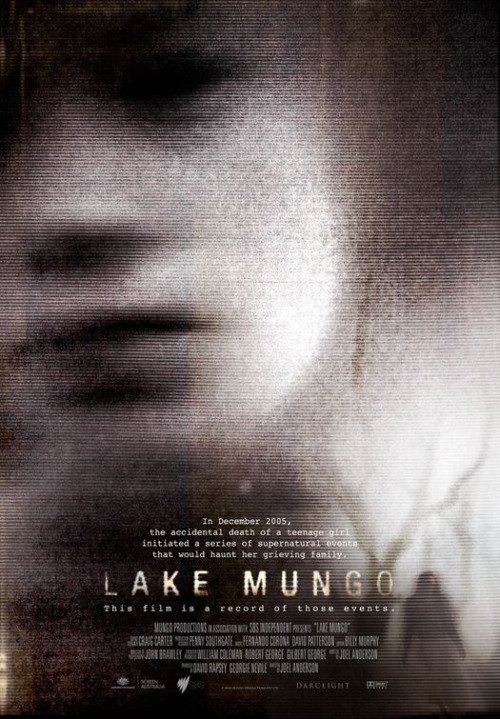
    Later, I watched a rather depressing ’apparent ‘ true story movie on SBS TV, called ‘Lake Mungo’, but in the main, set in the western Victorian town of Ararat, about 200 kms from here.

    Basically, the story  of  a teenager who drowns while swimming in the local dam. When her body is recovered and a verdict of accidental death is returned, her grieving family buries her.  The family then experiences a series of strange and inexplicable events centred in and around their home, and they seek the help of a psychic.  It is discovered that the daughter had led a secret double life, and a series of clues lead the family to Lake Mungo [in south west New South Wales] where her secret past emerges.  The ‘ghost’ aspect of the film, was determined to be the efforts of the teenager to reveal the truth about her life, to her family – until then, her ‘spirit’ or whatever could not rest.  I suggested at the beginning that this was a true story – but perhaps not. The ‘film’ [ a low budget variety] is presented in the form of a documentary with the family, various videos, and amateur films from hand held phones, etc, incorporated into the story – though in fact, all of the characters are actors!  Their performance certainly had this viewer thinking initially that all the material being used was original and authentic. In fact, as one online reviewer noted   ‘Anderson and company [the directors] have crafted an almost flawless impostor: a entirely fictional story brilliantly disguised as God’s honest truth. This feat has been attempted by many, though none have come close to executing their visions with the style and grace of Anderson’s eerie endeavor’  I have to agree. It had me fooled for a while.

    However, not really the kind of film I should have watched late into the night  – with thoughts going constantly back to how my daughter was coping, about 100 kms away, wondering whether she is wanting someone up there with her – is she working, studying, sleeping, crying?  Wish I was closer at hand!!


  • Tuesday, 5th April 2011 – Susie!

    During my ‘Showtime’ program tonight, I played a song for Susie – she couldn’t hear me of course, by then, she was safely back up in Bendigo –  but I simply felt the need to send some kind of message of  hope to counter her current feelings of despair. Maybe I will give her the words, after the passing of a few days.

    The singer was Anne Sofie Von Otter [whom I’m hoping to go and see in concert towards the end of the year] – and the song ‘April After All’, with the words and music written by Ron Sexsmith, and Anne’s vocals joined by Elvis Costello. Just a short song, of less than 3 minutes, I felt the lyrics expressed what I somehow wanted to say – ‘But there’ll be other days’ and ‘Life goes up and down’ –  it’s just raining because ‘It’s April after all’!!  Obviously, a northern hemisphere April, but no matter, I think we are going to get a fair share of showers, in this southern April, this year. Published in 1997 by Ronboy Rhymes, these are how the lyrics go.

    April After All

    It’s really coming down;

    It’s raining cats and hounds.

    It’s falling on parades

    And on the plans we’ve made.

    But there’ll be other days

    When things will turn our wsay,

    And rain will start to fall,

    It’s April after all.

    Even the longest night,

    Will lead you to daylight.

    It’s the way May leads to June

    And it’s how I’ve come to you.

    The world goes spinning round,

    Life goes up and down,

    And rain is bound to fall;

    It’s April after all.

    But there’ll be other days,

    Darling, come what may,

    The rain has got to fall,

    It’s April after all.

    And tears are bound to fall.

    It’s April after all.

    I was disappointed to get home late this afternoon, and find Susie had already left, for the return to Bendigo, but I was also glad in a couple of ways – leaving any later, and she would have been driving into the western sun for  most of the trip, and she would also, for the first half of the journey, have been amongst the late afternoon traffic coming out of the city. Perhaps she still caught a bit of that!  And just the fact that she had made the effort to return to the university and  her studies after what had happened. The temptation just to stay down here, and just put everything aside must have been strong, but I’m pleased my girl was stronger, and able to withstand those feelings. Unfortunately, tonight she is alone – away from all family and friends with no-one up there to turn to. Though she has been getting a steady stream  of text messages this evening, and while they may seem like a nuisance, I feel they will be welcomed.  I’m particularly pleased, that eldest son, James, has been in regular contact tonight with his sister. He really ‘comes through’ at times like that!

    But tonight, my own heart is aching for the loneliness and  pain of hurt that I know my daughter is feeling right now – and there is really little I can do about it. Sorry Susie. I guess most of us at some stage [I certainly have] have gone through the pain of a broken relationship, but until it actually happens, it’s difficult to really understand the depths of despair and personal loss that one feels.

    Over the years, I have retained a little self made poster, thast Susan, aged 9 nines, gave to me for Father’s Day, in 1995.  It was ‘The DAD Award’, Awarded to Bill Kirk because you are the GREATEST Father in the World for the following reasons……………….1.  You always love me and care for me.  2. When I am worried, you cheer me up.  3. I love it when you take me places.  4. I love you because you are my Dad.  Happy Fathers’ Day, Love Susan.

    Over the past couple of days, I haven’t really felt like the ‘Greatest Dad’ because I can’t stop my Susan from hurting………………………..

  • Monday, 4th April 2011 – unhappy Monday

    The day didn’t begin well, with a 90 minutes drive to the office in the morning – usually, just under an hour –  all good to put one in a fantastic mood for the rest of the day!

    But of course. all of that was overshadowed by concerns for Susan – thankfully, she had a couple of days this week before she was due to return to Bendigo, but I have to assume that for her, this was a very long, lonely and unhappy Monday.  Visited by her Mum during the day, and then younger sister Jodie came over and joined Susan and I for an evening meal. I think my girl made an effort to eat, but didn’t really achieve much, and soon after, apologised, and went back up to bed.  Neither Jodie nor her Mum [nor myself] had achieved a great deal of conversation from her, and I guess none of us wanted to push, she would talk when she was ready to. Jodie herself had a heavy cold, so was not feeling 100% herself.  The only positive aspect was that Susie went out for a while later, to visit a girlfriend who lives nearby – one of those loyal team of friends from schooldays who all seem to have stuck with each through good and bad. At least there was potentially someone to share her pain with, and for that I was grateful, having been feeling somewhat inadequate myself, and wishing the impossible, to rid a daughter of the pain she was going through – of the sort that many of us experience in the world of relationships, sometimes early in life, sometimes later. For Susie, this was a new, and painfully unexpected occurence.  I feel a little useless at present, but of course, won’t hesitate to assist when it is needed.

    Again, with not as much enthusiasm as usual, I watched the ABC’s QA & A program tonight, the pasnel for which included former Prime Minister and now Foreign Minister, Kevin Rudd, and Deputy Leader of the Liberal Party, Julie Bishop. Those two seem [not surprisingly] to bare the brunt of the questions, and responses – some of Julie’s comments, when they became negative, annoyed me, while I have to admit that I felt  Kevin Rudd handled himself quite well, particularly in responding to the kind of ‘grilling’ he got from host, Tony Jones, who seemed to be inputing more vigorous questions than time allowed from the audience, from where most of the questions should have been allowed to come.  In fact, the outcome was a series of ‘almost’ confessions from Mr Rudd, as indicated by this report, taken from a National Nine Newsonline item.

    “Former prime minister Kevin Rudd says he made the wrong call when he decided to shelve the federal government’s emissions trading scheme (ETS).  But, he said, he was trying to find the middle ground after some members of cabinet argued the scheme should be scrapped for good.  Asked on ABC television why he delayed the scheme until 2013 despite calling climate change the greatest moral challenge of our time, he said he made a mistake. “The judgment I made then was wrong,” he said.  He said the decision had been swayed by the roadblock faced in the Senate, which had already twice blocked legislation setting up the Carbon Pollution Reduction Scheme (CPRS).  But, Mr Rudd said, he’d also faced the difficulty of placating party colleagues who wanted to “kill the ETS” completely. “You had some folk who wanted to get rid of it altogether, that is kill the ETS as a future proposition for the country. I couldn’t abide that,” he said on Monday. “There were others that said we should stick to the existing timetable, apart from the fact that the Senate couldn’t deliver it.  “I tried to find a way up the middle of all that, preserve the unity of the government.  “On balance it was the wrong call. We should have simply tried to sail straight ahead.”

    Leaked cabinet documents have suggested it was his then deputy Julia Gillard, along with Treasurer Wayne Swan, who urged Mr Rudd to shelve emissions trading. Ms Gillard later toppled Mr Rudd as prime minister. Opposition deputy leader Julie Bishop said Mr Rudd’s mistake had been to trust his deputy. “She gave him the wrong advice, and he’s borne the consequences.”  [Later] asked later about what he’d learnt from his dramatic exit from the top job, Mr Rudd said: “I may in the future be a less trusting soul”.  The now-foreign minister was then asked why he had not explained Labor’s internal debate to Australians at the time, having chosen to instead blame opposition senators. “Guess what? Political leaders are not perfect,” Mr Rudd answered.  “I take responsibility for communicating the government’s message. “But no one gets it right every time, and I did not.”

    Perhaps I saw more into his performance tonight than was justified, but I warmed to Kevin Rudd a little more because of his sudden preparedness to be more openly ‘forthright’ about past mistakes, and judgement calls, and his strength in resisting the attempts by Tony Jones to get as ‘bigger story’ out of the program, then would eventuate anyway. An interesting session.  Incidentally, the other panelists on tonight’s show, who didn’t really get much of a go, were Jeff Bleich [the current US Ambassador to Australia], Louise Adler [political publisher], and Robert Manne [writer and academic].

    Another disappointment from this Monday was the news from the first day of horse racing’s ‘Jumps Season’, a subject uponwhich I have touched on previous occasions. Only Victoria and South Australia continue to allow the jumps to be part of the racing calender any more, it has been banned elsewhere in Australia. Today, on Day 1 of that season, at Warrnambool, three horses fell in the first jumps event, one of which had to be put down!! A terrible start for the industry, and plenty of ammunition for the anti-jumps protestors  –  of hich I am included, despite actually loving to watch the horses go over the jumps.

  • Sunday, 3rd April 2011 – weekend musings

    Woke up in the early hours of this morning, just as the World Cup Final was being played, in fact as it was finishing  –  India vs Sri Lanka. Great excitement amongst the large crowd, particularly as a supporter of India who won the championship. So finally, the 2011 World Cup Cricket competition was over, and India were the champions, after Australia had won the previous three world cups. A changing of the guard in more ways than one!  India won by 6 wickets, with the final scores –  India 4 for 277 defeated Sri Lanka 6 for 274.

    It was just after that, as I tried to get another three hours sleep, that Susie came home  – at 3.30 am in the morning – I’d not heard from her all weekend, and the arrival at that time was a bit of a surprise. Anyway, I went back to sleep, until my ‘Sunday morning ‘ alarm woke me again, two hours later. We had all supposedly gained an extra night’s sleep overnight –  daylight saving officially ended at 2am this morning, with our clocks being wound back an hour, now back with official Eastern Australian Standard Time.   One should have felt a little brighter, on departing for the studio this morning  – not sure if that was the case.  Nevertheless, I enjoyed this morning’s program, which I started just before 6.30 am, and this week, featured Beethoven’s 5th Symphony – over the past few months, I have been working through Beethoven’s nine symphonies, maybe playing one every 5/6 weeks, and today, I decided it was time for probably the most broadly popular of them. Even people who generally have no interest in classical music, etc, would have some time, if just by accident, heard some aspects of this particular composition, and could recognise it as belonging to Beethoven! Perhaps! Anyway, an inspiring piece of music, in my view.

    Jack came in this morning – he had only done a couple of previous shows –  came in to fill the spot usually occupied by our country music presenters who were absent because of illness – he was confident he could manage this morning without another sit-in presenter as guidance. Anyway, I got him  on the way, pointed him into the direction of a pile of appropriate ‘country cds’ and eventually left him to it! Like a learner driver minus  a co-driver!   However, there were two or three of us from the committee this morning, to help him out, at short notice, should he get into trouble.  He didn’t need us!

    ABC Radio’s Classic FM station’s monthly newsletter ‘Limelight’ had what I thought was an interesting little article in it this month, written by the Editor, and entitled ‘The elusive art of true listening’. I thought it worthwhile sharing with my readers on this occasion.

    “When people ask me why I prefer classical music, as they often do, I refrain from telling them the simple truth – I like it, because it’s better. That’s a sure-fire way to seem like a snob. Instead, I proffer an argument about what classical music is better for. It’s better for listening. I’ll happily concede that the works of Megadeth are great for doing squats at the gym and that the experience of flailing your body around in a nightclub is enhanced by the beats of DJ Tiesto. But try sitting alone in a darkened room for an hour and doing nothing but listening, to say, Lady Gaga [without having a psychotic episode]. When you turn off all the senses extrinsic to listening, classical music comes into its own. Just using your ears…..Not driving to work, reading the paper, cutting your toenails, chatting on Facebook or eating low-fat granola breakfast cereal.

    It’s a challenge, for me at least, to do nothing but listen. You need to set aside time for it. You need to concentrate on the music alone [and not on your next deadline]. But when it works, you open yourself up to the transcendent ecstasy good music can bring…………………….So perhaps it’s not so much a question of what music you listen to, but whether you really listen at all. I would argue that true listening brings people to fine music as inevitably as a perfect cadence brings resolution. For me, being a music lover is all about mastering this elusive, exquisite art – the art of listening”.  [Francis Merson].

    Keep that thought in mind, as we read, from the same publication, a brief item called ‘Music vs Sex’  –  A new study published in Nature Neuroscience links enjoyment of music to the same pleasure-promoting compound that stimulates feelings of love, sexual desire and food cravings in the brain. Researchers have conducted tests to monitor dopamine release at peak emotional arousal during music listening. The results indicate that intense pleasure in response to music is heightened by dopamine flooding the listener’s system.{And for those wondering, ‘dopamine’ is  – a chemical found in the brain that acts as a neurotransmitter, and affects various bodily functions including mood, sleep, learning,  and voluntary movements].

    On a personal front, I felt Susie was unhappy about something, but she was not communicating –  got home just before 7pm, found the meal I’d cooked for her untouched, and she was in bed. Part of a brief note about other matters, was mention of the fact that her boyfriend of 7 years had broken off the relationship. I could imagine [perhaps, though can we really, about another’s feelings] how she was feeling – that news while like a stab to the back, as it would be to the rest of the family when it became knowledge. I’ll leave it at that, but I would feel quite distressed for my girl over the next few days, and while it may not have outwardly been wanted, tried to make it clear in that time, that whatever support was needed, would be there.

    I finished the night, with little enthusiasm, watching the 2nd MotoGP of the year, from Spain. Australia’s Casey Stoner, who won the first race a couple of weeks ago, and started from the front of the grid tonight, was fancied for further success – it was not to be, he was ‘taken out’ by the mistake of the Italian rider, Valentino Rossi [who went on to finish 5th in the race] in the early stage of the race, and for a justafiably very angry and disappointed young man, his race was over.


  • Saturday, 2nd April 2011 – a finish to the John Howard biography

    Weather wise, a strange day, mixture of  sunshiny periods, interspersed with cloudy overcast conditions, as rain threatened, at times almost felt like it was raining.  Between those periods, we managed to get a bit of work achieved in the back garden [fighting those blackberry bushes again], as well as the front lawns mowed. In fact, I guess I took advantage of the isolated house, and caught up on a bit of ‘old fashioned’ housework, all those things which need to be done, but which one [me] tends to put off, and off, and off!!!  Until today! Even found time to have a look at the big Group 1 horse races up at the Rosehill course in Sydney –  what a great program, five Group 1 races featuring some of the best horses in Australia [and New Zealand] at present. What a pity Black Caviar wasn’t running today. A couple of my tips, from yesterday morning on the radio, came through – must admit, my average of successes are rather low, a good reason why I don’t usually spend much money on the horses!!

    Now after reading through it, chapter by chapter, since around November, I finally finished reading the biography published late last year, by former Prime Minister, John Howard –  ‘Lazarus Rising’. While it’s 710 pages had taken me quite a while to get through – occasional diversions to historical novels by Wilbur Smith, and Bryce Courtney, amongst other things –  I found it a relatively easy read, compared with some much ‘heavier’ biographies. In fact, Howard wrote his book in the style of biographical/cum history format that I believe I am trying to write my own family history. Quite often throughout the pages, he refers back to his own diary notes keep over many years, and  many personal recollections and circumstances that give the story a much more personal approach rather than a strictly political history. Whilst any non-Liberal supporter would probably accuse this comment of being somewhat biased, I genuinely felt that I was reading the story of a man who genuinely appears to believe deeply in the those things which his political life worked towards over almost 40 years of ups and downs, defeats and gains, successes and disappointments, etc.

    I enjoyed John Howard’s ‘personal’ references to many significant events outside of politics in particular, and the way such events affected him and/or his family. Some examples – Cyclone Tracey, which devastated Darwin on Christmas Day, 1974;  the September 2001 Twin Towers atrocity in New York; the Bali Bombing a couple of years later which cost 88 Australian lives as well as over 120 from other countries; the Port Arthur murders of April 2006 [and the subsequent Gun Laws legislation]; his personal relationship as a ‘friend’ with George Bush;’ and so it goes on. I have over recent months included various quotations from the book in these pages, and probably will again on future occasions, when the circumstances warrant doing so, as I found so many fascinating little antidotes, Howard viewpoints, opinions of other leaders, and personalities in all fields of Australian society, especially in the sporting area.  I read somewhere one that one criticism of Howard was his apparent lack of interest in academic circles and the arts – certainly the latter aspect of Australian cultural life does get little mention in the book, and the arts generally don’t seem to have figured greatly in his life and lifestyle. That may be a misreading, but that impression comes through to this reader anyway.

    I might finish this little reference to John Howard’s biography with a quotation from one of the closing chapters, entitled ‘The Tide Runs Out’, which is obviously referring to the election of November 2007, when he and the Coalition Government were thrown out of office. It reveals that he was a realist, who didn’t really hold out false hopes that things would always fall in his direction, as had been proved over many decades of political life, and the honesty of his strength of purpose in accepting defeat, together with his surprise at Costello’s response to the defeat,  He writes:-

    “Election day, 24 November 2007, was a lovely summer day in Sydney. I had my customary morning walk, followed by hordes of press people. I thought that it was probably my last day as PM, but still held out a small amount of hope, based once again on that poll shift earlier in the week. Having being a member of the House of Representatives for 33 years and 6 months, which made me the 12th longest-serving MP out of the more than 1100 who have been elected since Federation,  I had a good sense of the mood of the electorate, simply from moving around, talking to people on polling booths and observing their body language. By mid-afternoon I sensed that the Government was gone and that I would probably lose Bennelong [his seat]. Too many eyes were averted. There were two middle-aged women at Denistone East who simply said, ‘No thanks, Mr Howard’…….It was a different mood that of the two previous elections………………………..About 8.30 it was all over, even though the polling booths in WA had not closed. At about 9.30pm I rang Kevin Rudd, congratulated him and discussed transition arrangements. Peter Costello phoned. I told him that I would make my concession speech shortly and would say that I thought he should assume the leadership of the Liberal Party. He replied that he was not sure that he would take it on and intended to discuss it further with family and friends, Having other things on my mind, I did not think much more about Peter and the leadership. I was genuinely surprised when he walked away from the leadership the next day. As events were to prove, I had wrongly assumed that politics was so much part of his being that he could not walk away whilst the possibility of the ultimate prize was still there………………………………..The following morning I went on my normal walk, accompanied by an army of press people, which included a few strays who have come along for the ghoulish pleasure of watching me the day after my loss. I disappointed them and kept up my usual pace.  Later that morning, Janette and I attended Holy Communion at the local Anglican Church in Lavender Bay. If we had won the election we would have done the same thing. By these actions, I was saying in my own way that I fully accepted what had happened; it disappointed me, but that was the democratic process. For me and my family, life would go on, and it would continue to be a good life.” [pps 645-647 ‘Lazarus Rising’]

    Writing in my own ‘Blog’ that night [24 November 2007], I noted “It’s 11.30pm Saturday – I feel a little flat, a bit washed out, a little disappointed, but optimistically philosophical. I feel proud to be in a nation which allows it’s people the freedom to change it’s government without fear or threat”. And later, in responding to a response to my blog from a friend, I replied that ‘It seems  that the desire of the majority of the Australian electorate is fairly clear, as all governments in Australia [Federal and State] [at that time] are now Labor controlled. That for the time being, is the will of the people in our democratic society. Let’s hope that the trust that has been placed in those who govern us will not be betrayed. At least I won’t have to go to work tomorrow morning as I did 3 years ago,  and be told that half of Australia’s population are idiots and imbeciles because they didn’t vote for Labor. This time, only about 48% of us are idiots  in that person’s eyes, lol”.

    Blues update, Round 2, 2001 AFL Season:  by Saturday night [back to 2nd April, 2011] my attention went to more important matters  –  it was the Carlton Football team’s second match for the AFL’s 2011 season, on tonight up in Brisbane. My elder son, James, came over to watch the game on the TV – he  brought his young dog with him [which answers to the name of Murphy, by coincidence, one of Carlton’s best players!!]. A very friendly kelpie [of the sheep dog variety], but not quite properly house trained as yet in some respects, as I would discover on two occasions through the evening!

    This was a rather historic game tonight [quite apart from the fact that Carlton captain Chris Judd was playing his 200th game!] – we were playing against the Gold Coast Suns, a new team in the AFL Competition, and this was in fact their first game ever. Many of the pundits were predicting that as with one or two other first time interstate teams,  Carlton would be beaten tonight, but on form, and because of the relatively inexperience of the new team make-up, I couldn’t really see that. Just before the game started, I received a welcome little text message from my Collingwood supporting brother up in Brisbane, whom most of the family have not heard much from lately. I was pleased that football called briefly break that silence. Only brief, but a contact – “Good luck, first to play the Suns’.

    As the game eventuated, it was the Suns who needed a bit of luck, but unfortunately for them, it didn’t come their way tonight, and as the score sheet below indicates, it was a rather one-sided affair, and for the Suns, a ‘rather rude welcome’ to the ranks of the AFL. For us Blues’ supporters, a pleasing outcome, which saw the team dominate in each quarter for a change – usually a poor one or two quarters, often leads to a disappointing result.

    Carlton Blues:                   9.5.59                  15.7.97               21.10.136               FINAL:  26.15.171

    Gold Coast Suns:               1.1.7                     3.5.23                 6.8.44                    FINAL:    7.10.52

    [Carlton moves to 2nd of the AFL Ladder after 2 rounds, behind last year’s premiers, Collingwood – these two teams come up against each other next Friday night, a real good test for the Blues to establish how good their form really is at present].